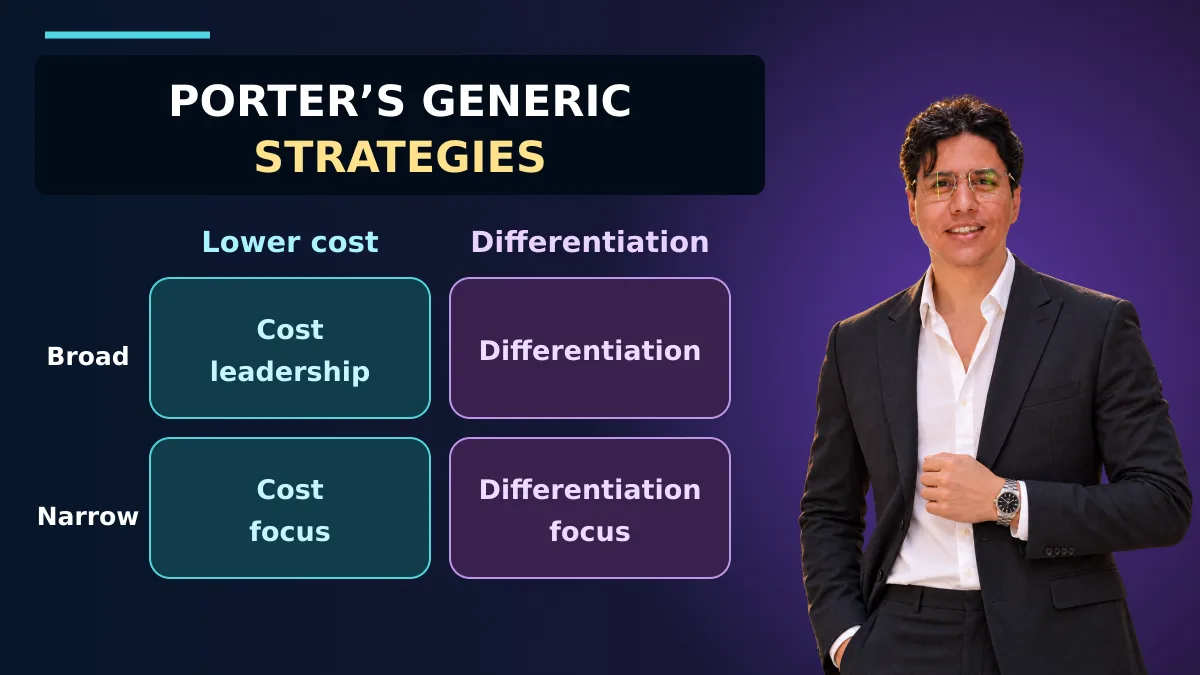
Two businesses can sell a similar service and still compete in very different ways. One builds a delivery system that serves many customers efficiently. Another solves a demanding problem for a narrower audience and charges enough to support that specialization. A third advertises a premium experience but organizes its operations around low-price volume. The first two approaches may be coherent; the third contains a tension that advertising cannot necessarily resolve.
Porter's generic strategies help explain these choices through two questions: where will the business compete, and what kind of advantage will it seek? This lesson translates those questions into practical decisions about an offer, its operating activities, its communication and its economics. Every organization, price, volume and result in the worked examples is hypothetical. The figures illustrate how to examine assumptions; they are not benchmarks, real client results or promises of business or clinical performance.
1. What this framework is designed to clarify
Generic strategies describe broad approaches to competitive advantage, as outlined in Porter’s own explanation of competitive advantage. They help a team distinguish a business that seeks a relatively lower cost position from one that offers meaningful differences customers value, and a broad market scope from a deliberately narrower scope. The framework is useful when a company must decide which customers to prioritize, how to allocate resources or why its offer is becoming inconsistent.
It is not a campaign calendar, a media selection tool or a prediction of market share. It cannot tell you whether customers value a proposed difference without research, nor prove that a lower-cost operating design will work. Its contribution is to make the strategic choice explicit so that the team can inspect the activities and assumptions required to support it.
Begin with a real decision. Perhaps the organization is considering a specialist service, expanding to more locations or responding to price pressure. Write what must change and why. “We want growth” is too broad to evaluate. “We need to decide whether to serve a narrow segment with more specialized support or simplify the offer for a wider audience” creates a concrete question the framework can organize.
2. Two axes and four practical positions
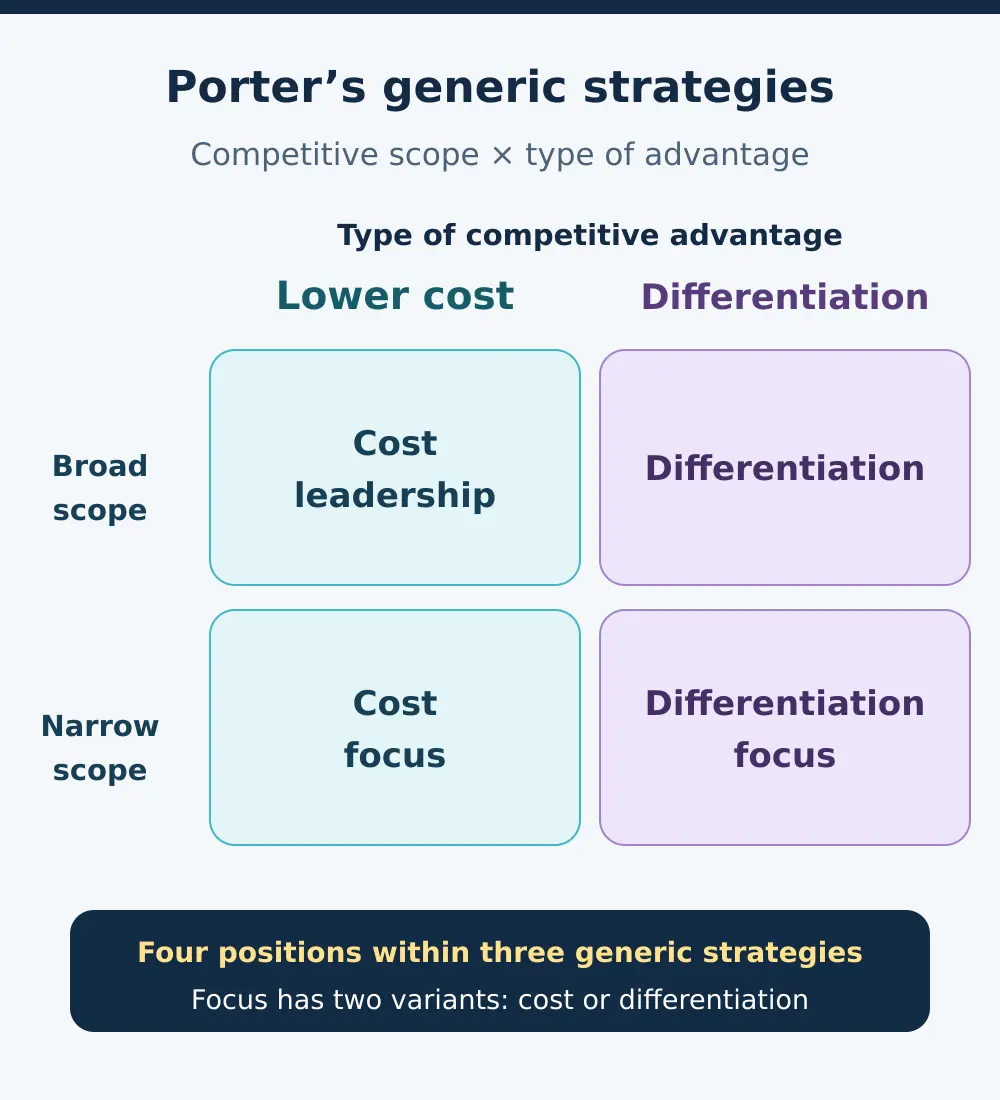
The first axis is competitive scope: broad or narrow. A broad scope seeks to serve a relatively wide market within the chosen industry or business. A narrow scope concentrates on a particular segment, need, geography, buyer type or application. Scope is relative to the market under analysis. A regional business can serve a broad range of local needs, while a geographically extensive company may focus on one specialized use case.
The second axis is the type of advantage: lower cost or differentiation. Combining the axes produces cost leadership and differentiation at broader scope, plus cost focus and differentiation focus at narrower scope. The focus variants matter because serving a niche does not specify how the business will win within that niche. Its advantage still needs an explanation.
The diagram is a classification aid, not a ladder. There is no instruction to begin in one corner and progress to another, and no quadrant is automatically superior. The appropriate choice depends on customer needs, competitive alternatives, resources and the economics of delivery. A business may have different strategic units, but each unit needs a coherent position rather than an unexplained mixture of promises.
3. Distinguish generic strategies from Five Forces
Porter's Five Forces examines the competitive pressures affecting an industry's attractiveness and profit potential: rivalry, new entrants, substitutes, supplier power and buyer power. Generic strategies instead help explain how a business intends to compete within its chosen setting. The tools can inform one another, but they answer different questions and should not be merged into one diagram.
An industry analysis might reveal that buyers have many alternatives and compare prices easily. That observation does not automatically prescribe the cheapest offer. A firm might seek a more efficient cost structure, develop a meaningful difference, narrow its scope or reconsider the market. Each response requires evidence about what is feasible and valued. Competitive pressure is the starting condition, not the complete strategy.
Use industry analysis to understand constraints and generic strategies to clarify the position under consideration. Then examine the activities needed to deliver it. A presentation that describes intense competition and immediately recommends more advertising skips the central decision: what value will the business provide, to whom, and through which sustainable operating arrangement?
4. Cost leadership means a cost position, not a discount
Cost leadership seeks an advantageous cost position across a relatively broad scope. It involves the design and coordination of activities: sourcing, capacity use, standardization, technology, distribution and other relevant cost drivers. Charging a low price without a supporting cost structure can reduce margin rather than create an advantage. Conversely, a lower-cost business does not have to pass every saving to customers.
Investigate the cost of serving customers, not merely the visible purchase price of inputs. An inexpensive component may generate more rework. A cheap acquisition channel may produce unsuitable enquiries that consume staff time. A standardized offer may reduce complexity, but only if it still meets the requirements that customers consider essential. Cost comparisons must use equivalent scope and quality requirements.
A practical review asks which activities generate avoidable work, where capacity remains unused and which variations add cost without meaningful value. It also asks whether proposed savings depend on unrealistic volume or create new risks. In healthcare and other high-responsibility services, efficiency must preserve required safety, professional standards and appropriate care. Cutting necessary checks is not a defensible competitive advantage.
5. Differentiation must matter to the buyer
Differentiation seeks a valued difference that can justify customer preference and, where supported, a price premium. The difference may involve performance, convenience, specialized knowledge, service reliability, integration or another attribute relevant to the decision. It is not established merely because the business describes itself as premium, innovative or customer-focused. Customers must recognize the difference and consider it important relative to alternatives.
Start with the buyer's problem and the evidence of willingness to choose or pay for its solution. A technically impressive feature may be irrelevant if it does not improve the customer's task. Likewise, a visible difference can be easy for competitors to copy. Evaluate both the value created and the capabilities needed to deliver it consistently.
Differentiation also has a cost. Additional support, specialized staff or a more flexible service may require resources that the price does not cover. Model the cost of delivering the promised difference before treating higher revenue per sale as proof of a better position. In sensitive services, describe the difference accurately and avoid implying guaranteed outcomes. Clear scope and reliable delivery are more credible than an unsupported claim of being the best.
6. Focus is a deliberate boundary
A focus strategy narrows the competitive scope to a segment whose needs or economics can be served in a distinctive way. The boundary should help explain why a specialized activity system makes sense. A niche might involve a particular buyer role, an operational problem, a geographic constraint or an application that broader providers serve less effectively. Being small is not itself a focus strategy.
Specify who is included and who is outside the intended scope. This can be uncomfortable because it makes some attractive-looking opportunities less relevant. Yet without a boundary, the business may keep adding exceptions until the specialized offer becomes another general service. Track whether new requests strengthen the position or create work that the organization cannot price and deliver coherently.
Focus also introduces exposure. Demand may be concentrated, a customer need may change or a larger competitor may develop a suitable offer. A niche is not automatically protected because it is narrow. Research its size, accessibility and alternatives, then consider whether the business can adapt without abandoning the capabilities that make it effective. Focus should be a reasoned choice, not a label applied after a broad campaign fails.
7. Cost focus and differentiation focus
Cost focus aims to serve a narrower segment with a cost advantage relevant to that segment. The advantage may come from simplifying the offer around a common need, reducing distribution complexity or avoiding activities that the segment does not value. It is different from offering every service at a lower price. The selected boundary is part of the economic logic.
Differentiation focus seeks a valued difference for a narrower audience. A provider might develop specialized expertise, tailored integration or a delivery format that fits a particular customer's operating context. The specialization must still be understandable to buyers and supported by capabilities. A narrow advertisement audience does not create differentiation focus if the underlying offer remains generic.
Compare the two variants explicitly when reviewing a niche. Does the opportunity come from serving its needs more efficiently, from meeting them in a meaningfully different way, or from an untested assumption that a small audience will pay more? A business can pursue efficiency while differentiating, but it should identify the main source of advantage and the trade-offs required to preserve it.
8. Trade-offs prevent incompatible promises
Strategy involves choices about what not to do as well as what to pursue; Harvard Business School’s strategy overview emphasizes distinctive choices and their supporting activities. A company that promises maximum customization, immediate delivery, the lowest price and unlimited support may be combining requirements that its operating system cannot sustain. The problem is not that these benefits are individually undesirable. The problem is that providing all of them may require contradictory activities or resources.
Write the trade-offs in operational language. Which requests will require a separate quote? Which customer groups will not be actively targeted? Which delivery options are unavailable because they undermine the model? Explain these boundaries clearly to sales and service teams so that commercial pressure does not turn every exception into an informal promise.
Trade-offs should not become an excuse to ignore customers or retain a poor process. Some improvements raise value and reduce waste at the same time. The important question is whether a proposed change strengthens the chosen position or changes its logic. Review that question deliberately rather than assuming every new feature or discount is a harmless addition.
9. Build advantage through connected activities
A competitive position becomes credible when the activities supporting it reinforce one another. Consider a service that promises predictable, standardized delivery. Its product design, scheduling, staff training, supplier arrangements and customer communication should all support that promise. If sales frequently sells bespoke exceptions, the rest of the system may become less reliable and more expensive.
Map the activities that make the offer possible. Identify dependencies, not just departmental responsibilities. A specialized promise may require a particular skill, an assessment step, a reporting format and an escalation route. An efficiency-led offer may require a limited range, repeatable processes and clear eligibility. The resulting map should show why the position is operationally plausible.
This is also where marketing connects with the rest of the business. The message must describe something that operations can consistently deliver. When customers ask for a benefit the system cannot provide, the response may involve redesigning the offer rather than rewriting the advertisement. Review the whole arrangement before assuming that an acquisition problem originates only in the media plan.
10. A practical sequence for choosing a position
First define the business or service being analyzed. Avoid mixing different units with different customers and economics. Next describe the relevant audience, alternatives and decision criteria. Use interviews, observed behavior and operational data where available, and distinguish evidence from hypotheses. Then identify the resources and activities the organization can realistically support.
Compare plausible positions using the same questions: what value would customers receive, why would they choose it, what activities are required, what would it cost and what must the business decline? Include the option of improving the current position rather than assuming that a dramatic change is necessary. Record uncertainty instead of converting every assumption into a confident forecast.
Choose a bounded test before a large commitment where possible. Define the offer, the intended audience, delivery capacity, measurement period and decision criteria. A pilot should test the strategic assumption, not merely whether an advertisement attracts clicks. At review, examine customer response, delivery quality and economics together. A favorable acquisition metric cannot compensate for a promise the team cannot fulfill.
11. Worked example: a hypothetical outpatient service
Imagine a fictional outpatient provider comparing a general offer with a more focused service proposition. This example concerns commercial planning only; it does not recommend treatment, select patients or promise clinical outcomes. Assume the current period has 100 completed visits at SAR 500 net revenue per visit. Variable cost is SAR 200 per visit. Revenue is SAR 50,000, variable cost is SAR 20,000 and contribution is SAR 30,000 before fixed, acquisition and other excluded costs.
A focused proposition is modeled at 70 completed visits and SAR 750 per visit, with variable cost increasing to SAR 300 per visit because the proposed delivery requirements are more resource-intensive. Revenue would be SAR 52,500, variable cost SAR 21,000 and contribution SAR 31,500 before the same excluded categories. The modeled contribution is SAR 1,500 higher despite fewer visits. That arithmetic does not establish demand, price acceptance or the suitability of the proposed service.
To assess differentiation focus, define the narrower need and the specific difference in the experience. Appropriate examples might concern coordination, clear service scope or convenience supported by actual capability. Do not use an unverified promise of superior medical results. Check whether staff, scheduling and documentation can deliver the proposition, and whether the added costs have been fully identified.
The assumed volumes are scenarios, not observations. If fewer people accept the price or the service requires more delivery time, the calculation changes. Compare net realized revenue rather than only list prices, and examine capacity and quality constraints. The example demonstrates why a higher price or fewer visits cannot be judged in isolation; it does not establish the right strategy for a real clinic.
12. Worked example: a hypothetical B2B service
A fictional B2B software provider has 40 active accounts paying SAR 1,000 per month. Variable delivery cost is SAR 400 per account per month. Monthly revenue is SAR 40,000, variable costs total SAR 16,000 and contribution is SAR 24,000 before fixed, acquisition and other excluded expenses. The team is considering a more standardized process and a revised price, but has not yet demonstrated that either will produce the expected result.
In the proposed scenario, 50 accounts pay SAR 900 per month and variable cost falls to SAR 300 per account. Revenue would be SAR 45,000, variable cost SAR 15,000 and contribution SAR 30,000 before the same excluded expenses. The SAR 6,000 contribution difference depends on both the assumed account volume and the assumed lower delivery cost. A lower price alone would not generate that result.
The strategic hypothesis concerns the activities enabling a lower cost position. Perhaps a repeatable onboarding process, a narrower standard scope and reduced rework could lower resource use while meeting customer requirements. These possibilities must be tested. Include implementation costs, support exceptions and any additional acquisition effort rather than presenting the variable-cost calculation as total profit.
The team should also clarify scope. If the standardized service addresses a narrow application, the relevant position may be cost focus rather than broad cost leadership. If many accounts demand bespoke work, the proposed system may not fit them. Track delivery hours, exceptions, retention and contribution by comparable account group. Test the process and demand assumptions separately enough to understand which one supports or undermines the proposal.
13. Translate the position into marketing decisions
Once the strategic position is credible, communication should make its relevance easy to understand. A differentiation-led message explains the valued difference and the evidence supporting it. An efficiency-led offer can communicate clear scope, access and value without claiming to be cheapest unless that claim is substantiated. A focused proposition should help the intended audience recognize its fit and understand its limits.
The channel choice follows the audience and buying process. A specialist B2B service may need detailed explanation and direct conversations; another offer may be understood through a straightforward search or booking journey. Neither channel automatically determines the strategy. Advertising to a small audience is a targeting choice, not proof that the business has a focus advantage.
Review the experience after the response. Does the landing page explain the same scope as the sales team? Does the quoted price match the delivery conditions? Do service exceptions contradict the advertised difference? These checks connect strategic positioning with the marketing mix. Consistency is not merely a visual brand standard; it is agreement between the promise, the offer and the operating activities.
14. Measure advantage without confusing the indicators
Use measures that test the proposed source of advantage. A cost hypothesis may require comparable delivery cost, rework, utilization and contribution measures. A differentiation hypothesis may require evidence of preference, retention, realized price and the cost of providing the difference. A focus hypothesis needs information about segment fit and the concentration risks associated with that boundary.
Keep definitions stable. Revenue, contribution and profit are different measures. A campaign conversion is not necessarily a completed customer transaction. Compare equivalent service scope and time periods, and separate one-time acquisition or implementation costs from recurring delivery costs. Report what the calculation excludes so that an attractive number is not mistaken for a complete business result.
Use quality and capacity guardrails alongside commercial measures. A process that lowers recorded cost by moving work elsewhere has not necessarily improved efficiency. A higher price that increases complaints or unfulfilled expectations may weaken the proposition. Where samples are small or conditions change, state the uncertainty. The framework helps structure a test; it does not remove the need for careful interpretation.
15. Common mistakes and the meaning of inconsistency
One common error is calling any discount cost leadership. Another is treating a new logo, a campaign slogan or a list of features as differentiation. A third is equating a small customer base with focus. In each case the label is being applied without explaining the underlying advantage or activity choices. Ask what actually changes in delivery and why the customer would value it.
The phrase “stuck in the middle” is often used to describe a business without a coherent advantage. It should not become a shortcut for declaring that a company must abandon either quality or efficiency. Lower cost and differentiation can coexist when supported by coherent choices; Harvard Business School’s strategic-positioning explanation does not impose a blanket ban on combining them. A business can improve both, and different strategic units may require different arrangements. The useful diagnostic question is whether its promises and activities fit together, rather than whether every initiative can be forced into a single slogan.
Other mistakes include treating the matrix as a permanent identity, ignoring competitors' responses and using historical examples as guarantees. Markets, technology and customer expectations change. Revisit the evidence and the chosen boundaries when conditions materially shift. Do not change direction after every disappointing week, but do not defend an unsupported position merely because it appeared in last year's strategy document.
16. Limits, worksheet and practical takeaway
Generic strategies simplify a complex competitive situation. They do not capture every regulatory, social or technological factor, and they cannot determine the right action without knowledge of the business. Network effects, multi-sided offerings and different customer groups can complicate the analysis. Use the framework as a disciplined starting point and combine it with other relevant research and operational judgment.
For a practical worksheet, write six statements: the business being analyzed, its intended scope, the proposed source of advantage, the activities supporting it, the choices it will decline and the evidence that would justify continuing. Add a short list of unresolved assumptions and a test owner. This worksheet is an original teaching aid, not a separately established Porter model or a claim of proprietary methodology.
The takeaway is to make a choice that can be explained, delivered and tested. A position is credible when customers understand its relevance, the operating activities support it and the economics remain transparent. Use the matrix to expose contradictions early, then use evidence to decide what to keep, improve or stop. Better communication matters, but it works best when there is a coherent business proposition to communicate.
17. Sources and further reading
The supplied Arabic explanatory PDF “شرح استراتيجية التسويق الرقمي,” associated with Jenna Tiffany's course material, is the approved course foundation for this lesson, with relevant physical pages 90, 146 and 147. These are references to the supplied document, not a public download. The worked examples, calculations, implementation sequence and worksheet are original educational adaptations, not reported outcomes from the course or the author's client work.
Public primary references are Michael Porter’s Competitive Advantage publisher excerpt, the Harvard Business School Institute for Strategy and Competitiveness pages on strategic positioning and creating a successful strategy. These references support the conceptual distinctions; they do not validate the hypothetical prices, volumes or results used here.
Comments
No published comments yet.