A large hospital activity figure can become a strong headline and a weak marketing argument at the same time. Before using it to describe reach, growth or service quality, ask what was counted. That distinction matters when a public announcement combines laboratory tests, appointments and procedures in one total.
The announcement and its reporting period
On October 26, 2026, SPA, citing Madinah Health Cluster, reported 1,626,734 services at King Fahd Hospital in Madinah during July–September 2026.
| Reported category | Count |
|---|---|
| Laboratory tests | 1,230,439 |
| Pharmacy services | 132,790 |
| Outpatient services | 110,390 |
| Radiology services | 61,491 |
| Emergency services | 56,308 |
| Rehabilitation services | 21,653 |
| Dialysis sessions | 10,436 |
| Surgical operations | 3,227 |
The categories sum to the reported total. The following interpretation is my independent business analysis, not an account of the hospital’s marketing practices.
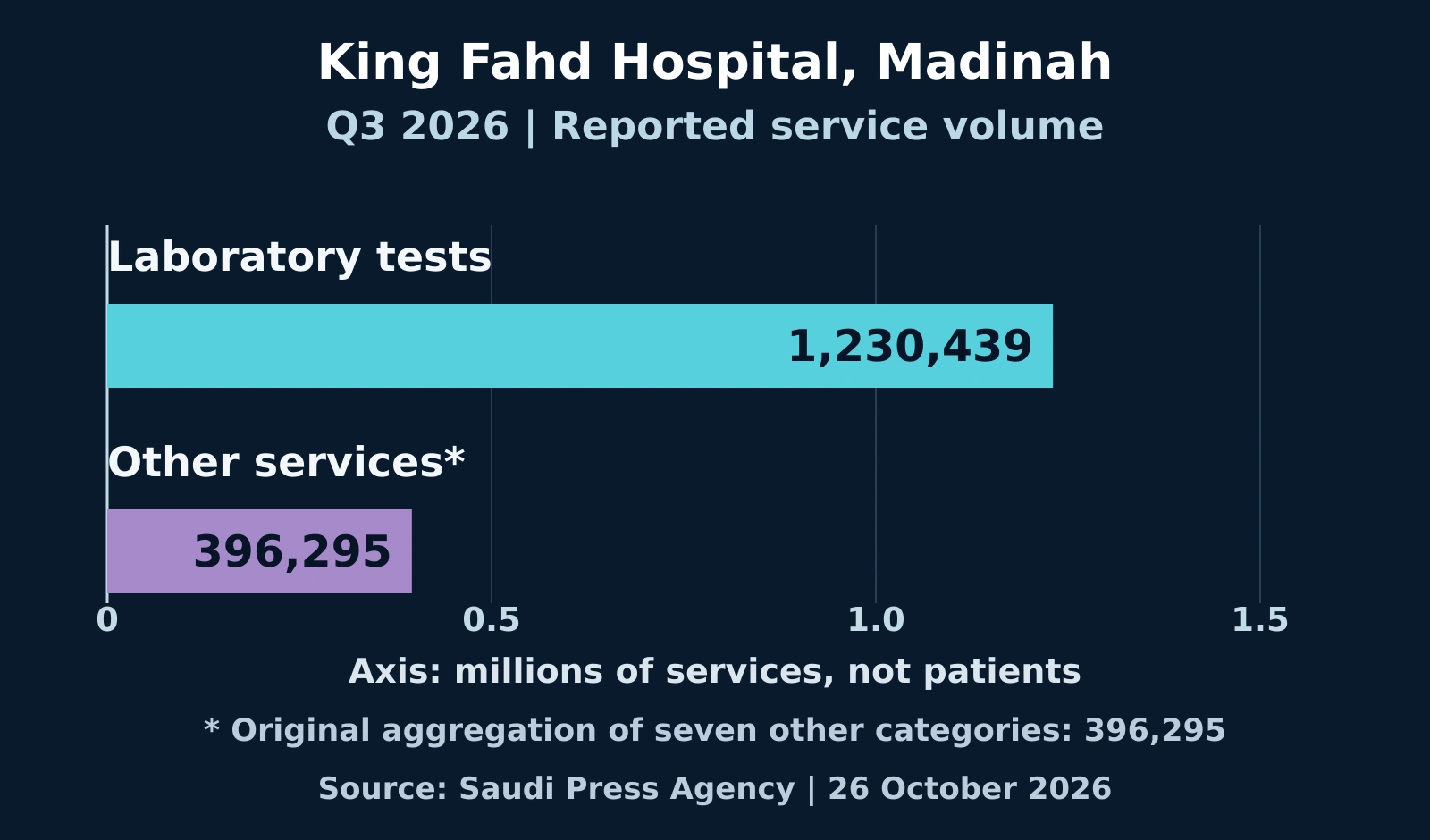
Original explanatory chart. Data: SPA, October 26. Other activity is my aggregation of the remaining categories; the chart does not count unique people.
Keep the unit attached to the number
A service is not automatically a person. One encounter can involve several tests and supporting services, while a person may return for multiple encounters. Replacing “services” with “patients served” would therefore change the meaning without supplying the evidence needed for that change.
My calculation places laboratory tests at approximately 75.6% of the reported activity count, with 396,295 remaining items. This is arithmetic on the published categories—not a patient, revenue or resource-consumption share. A laboratory test and a surgical operation do not represent interchangeable amounts of work. The chart explains the composition of the announced count; it should not rank departments by their importance.
Four conclusions the headline cannot carry
First, growth requires a comparable earlier period and stable counting rules. A large quarterly total alone cannot establish an increase. Second, market share requires a relevant market denominator. Third, activity volume cannot establish clinical quality or the experience of an individual patient. Fourth, completed activity does not reveal spare appointment capacity or profitability.
For a communications team, these are useful editorial boundaries rather than reasons to avoid numbers. A credible message names the institution, period and unit, links the source, and stops before the unsupported inference. The announcement supplies no comparison baseline, unique-patient total, income, waiting-time, occupancy or clinical-quality measures.
Translate the lesson into service-level planning
An independent hospital planning its own communication can build a small evidence sheet for each service line: the approved service description, administrative referral route, geographic availability, current scheduling information, and the person responsible for updating each item. Clinical eligibility remains with the appropriate clinical team.
That sheet should inform both the webpage and the contact-centre response. If they describe different next steps, buying more traffic may amplify confusion rather than improve access. This is a planning hypothesis for any provider to investigate—not an allegation about King Fahd Hospital. It connects with the Saudi healthcare marketing strategy: communication must match the service that can actually be delivered.
A bounded test of administrative clarity
Consider a hypothetical provider reviewing one existing referral pathway. Communications and operations jointly select a recurring administrative question, such as where an already-referred person should submit a scheduling request. They approve a clearer bilingual explanation without changing clinical eligibility or encouraging additional testing.
Before launch, define the baseline window, cohort and decision rule. Keep a human route for questions the page cannot answer. Review the wording with the teams that receive requests, then use a staged rollout or a suitable comparison group where feasible. Record simultaneous changes in staffing, appointment availability and referral processes so they are not mistaken for a communication effect.
Use measures that answer distinct questions:
- Routing accuracy: requests reaching the appropriate administrative team divided by reviewed requests, using a documented sampling method.
- Request completeness: administratively complete requests divided by all requests in the same cohort, under a fixed definition.
- Scheduling progression: confirmed appointments divided by eligible requests whose follow-up window has matured.
- Guardrails: repeated contacts, unresolved requests and complaints about unclear instructions, with an owner for review.
Use aggregate reporting and approved access; marketing does not need clinical records to understand whether instructions are clear. A before-and-after improvement is not automatically causal. If no reliable comparison is possible, describe the observed change and its limitations. Expand only if clarity improves without overwhelming the receiving service; otherwise revise the process before promotion.
My takeaway: measure the promise, not just the volume
The actionable lesson is to protect the meaning of the number and connect communication with a defined next step. As with the KFSH access announcement, a precise operational metric is more useful than a broader promise it cannot support. For healthcare growth, better reporting should help teams decide what to explain, what to verify and when not to increase demand.
Comments
No published comments yet.