
Reviewed November 2, 2026; announcement dated October 30.
A mixed outcome, not a blanket judgment
BBB National Programs’ National Advertising Division supported Carpe’s $19.95 reference price but recommended modifying or discontinuing other challenged savings, shipping and comparative claims. Carpe said it would comply. NAD is a US advertising self-regulatory body, not a court or the FTC. This article uses the organization’s public summary, not the full decision. Primary release.
The following is original editorial analysis, not a legal opinion or an assessment of Carpe’s current advertising. It proposes a way to review an offer as a complete explanation rather than a collection of individually approved phrases. The operational questions may be useful to Saudi teams, but the US proceeding does not establish Saudi requirements. Local legal decisions require separate qualified advice. No hypothetical example below describes Carpe’s prices, customers or actual checkout experience.
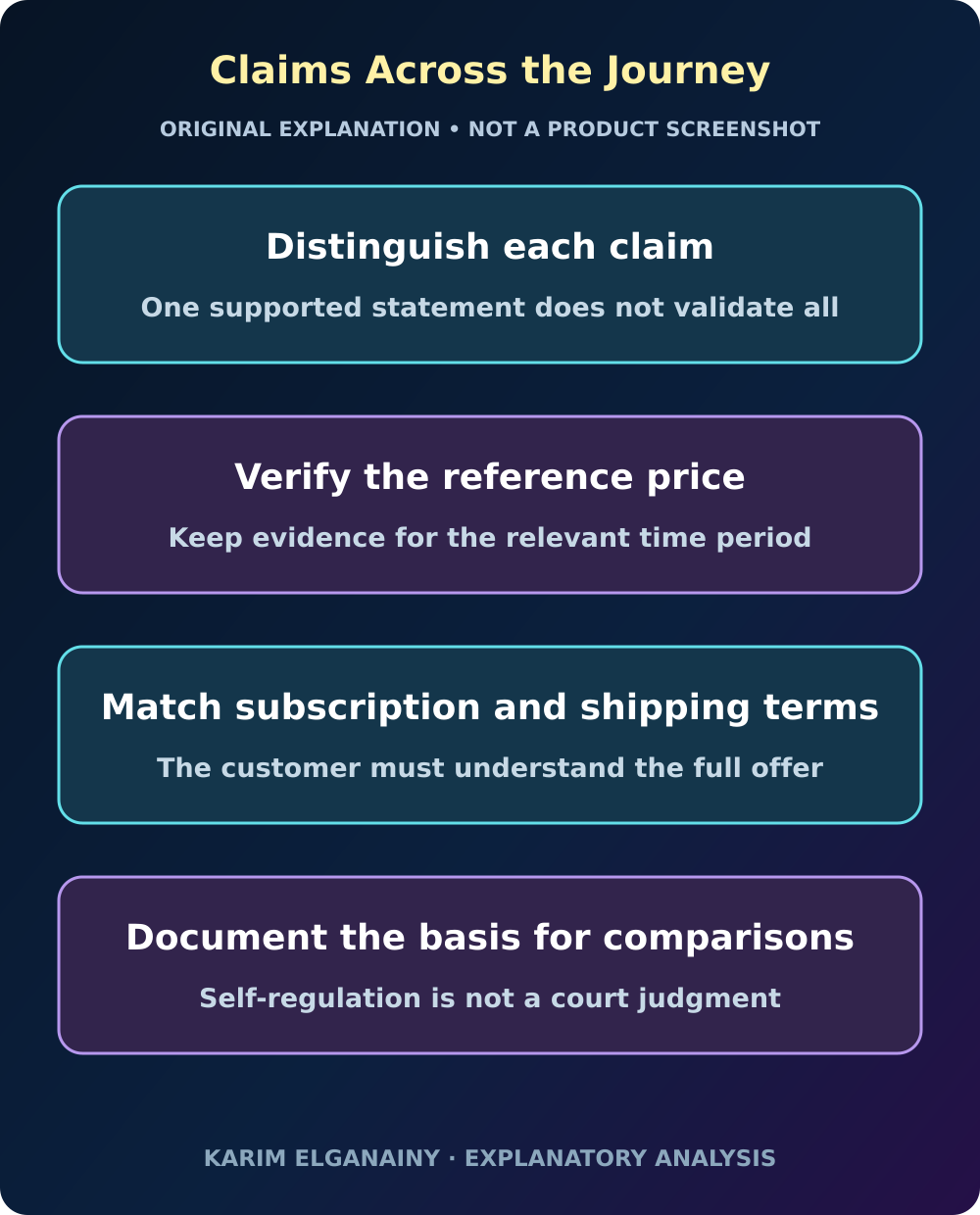
Original editorial framework; not a product screenshot or proof of campaign results.
A valid comparison point is only the beginning
An offer can contain several distinct propositions: the comparison price is meaningful, the arithmetic is correct, the shopper qualifies, the purchase commitment is understood and the stated duration is accurate. Evidence supporting one proposition does not automatically establish the others. A useful internal review breaks the offer into these components before discussing whether the overall creative is persuasive. This avoids an unproductive debate in which one team defends the price history while another is concerned about an unexpected condition of purchase.
Imagine a fictional product with a reference price of 100 units of currency and a displayed price of 80. The arithmetic difference is 20%, but that calculation alone does not explain whether the visitor must buy several items, enroll in a recurring arrangement or choose a particular variant. The point is not that conditional offers are inherently improper. It is that the condition belongs to the explanation of the offer. Review the proposition a shopper receives, not only the subtraction a spreadsheet can verify.
Build an offer equation before designing the badge
Write the transaction in plain language: what is purchased, how many units are involved, what is paid now, what other commitment is made and what changes later. Then construct the arithmetic from those terms. Define the comparison basket before calculating the percentage. A single-unit comparison and a multi-unit basket may answer different questions. Keep the calculation available to the person writing the headline so that the language and the arithmetic do not evolve independently through separate approval chains.
Use a worked example as an internal test, with hypothetical amounts clearly labeled. Suppose a basket contains two items with a comparison total of 200 and costs 160. The difference is 40, or 20% of the comparison total. If an additional item is included, explain whether it changes the basket being compared or is a separate extra. Do not silently add an assigned value to the denominator and keep the same headline description. The calculation should be reproducible by someone who did not design the promotion.
Separate lower expenditure from added value
A shopper spending less money and a shopper receiving more items are experiencing different forms of value. Combining them into one impressive figure can make the offer harder to understand, even when an internal workbook tracks every component. A clearer planning document keeps cash reduction, additional merchandise and delivery terms in separate rows. Decide which claim the team wants to make before choosing the most dramatic number. Precision may produce a smaller headline but a more intelligible proposition.
For an original hypothetical example, a customer pays 80 instead of a comparable 100 and receives an additional accessory. The cash difference remains 20. Any statement about the accessory’s value needs its own explanation and support; it should not be treated as money the customer would necessarily have spent. This is a communication framework, not a legal formula. Its practical benefit is that customer service, finance and marketing can discuss the same offer without using the word savings to mean three different things.
Map the first purchase and the next one separately
A recurring offer has a timeline, not just a checkout total. Create an internal table showing the first order, the next scheduled order and the conditions under which the arrangement changes. Include quantity, amount, frequency and any relevant delivery charge as separate fields. Do not fill missing information with an assumption because the launch deadline is close. A missing term is an unresolved product or operational question that should have an owner before a creative team is asked to describe it.
Then inspect the visitor journey in the order a person encounters it. When does the visitor first understand that the action creates an ongoing relationship? Does a later screen clarify the original proposition or substantially change it? The review is not merely a search for a sentence somewhere in the experience. It asks whether the relevant information is available when the associated decision is being made. These are proposed comprehension checks; this article does not prescribe a legally sufficient disclosure format for any jurisdiction.
Treat urgency as an operational claim
A countdown is not just a decorative conversion element. It can communicate something about what will stop being available and when. Before adding one, write down the actual event it represents: an inventory allocation, a campaign closing time or another defined condition. Ask the operations owner what will happen when the counter reaches zero. If nobody can answer, the design team is being asked to visualize a deadline that has not been established as an operational fact.
A hypothetical review could compare the displayed end time, the promotion configuration and the next planned offer. The aim is to understand what changes for the customer, not to invent a technical distinction that preserves the same impression under a different campaign name. If an offer continues in materially the same form, reconsider whether the creative is explaining the opportunity accurately. Keep the record specific to the actual promotion. Do not infer that every seasonal campaign or every repeated discount has the same meaning or merits the same conclusion.
Review comparative creative at the level of the takeaway
A comparison can be communicated by the whole scene rather than one explicit sentence. Images, demonstrations, gestures and editing can influence what the audience believes about another product. Start by asking an uninvolved reviewer to describe the takeaway without reading the creative brief. Compare that description with the evidence the advertiser actually holds. A technically narrow line of copy may not control a much broader visual impression, so a wording-only review can miss the claim that deserves the most attention.
Distinguish a preference statement from a testable performance assertion, and define the comparison population. A demonstration involving one selected item should not casually become a conclusion about an entire category. When evidence is limited, narrow the message or choose a different execution rather than stretching the interpretation. This is a proposed editorial discipline, not a finding about any unnamed competitor. An organization can communicate a distinctive benefit without relying on a broad portrayal that other options are useless or that every customer will obtain the same result.
Give a first-to-market claim its own research question
The word first asks a historical question in addition to any question about performance. An internal review should identify what exactly is claimed to be first, the relevant market, the time boundary and the basis for excluding earlier alternatives. This is different from showing that a product performs a task now. Treat novelty language as a separate proposition rather than a decorative intensifier attached to an otherwise supported sentence. If the research question cannot be stated precisely, the claim is probably not ready for confident use.
The same separation helps with words such as unique or only. A narrow feature configuration and a broad consumer benefit are not interchangeable categories. A team should not search until it finds one definition under which its preferred wording appears plausible while ignoring the interpretation a reader is likely to take away. Consider a less expansive description that says what the product does without making an unnecessary historical or category-wide assertion. Removing a superlative can improve clarity without removing the reason someone might choose the product.
Use bilingual review to test economic meaning
For Arabic and English campaigns, inspect whether both versions explain the same economic choice. A translator can reproduce individual words accurately while the prominence of a condition changes because of line length or layout. Review the price, quantity, recurrence and next step together at the intended display size. Ask a reader of each language what they would pay now and what they believe happens afterward. Differences in those answers are more useful evidence than a general verdict that the translation sounds fluent.
Keep numerals, units and qualifiers close enough in the visual composition to preserve their relationship. A condition that belongs to one price should not appear to describe a different price simply because the layout reverses direction. Test mobile crops and short social executions as well as the full page. These are design suggestions, not statements about mandated Saudi presentation. Where local requirements affect the offer, obtain the relevant review separately and make sure the approved wording survives the practical adaptation into every language and format.
Make corrections traceable without turning them into accusations
If a review identifies ambiguity, record the specific asset, the intended meaning, the observed misunderstanding and the approved correction. Avoid broad labels that imply every part of the offer is defective. A useful correction might affect the headline, the placement of a condition or a comparison scene while leaving other supported material intact. This discipline mirrors the analytical distinction between separate propositions without pretending that an internal review has the authority of an external adjudication.
Track the corrected version through the channels the team controls. A new landing page does not prove that an old social asset stopped circulating, and a revised template does not establish that every partner replaced its copy. Identify the owner of each placement and obtain appropriate confirmation. Preserve only the information necessary to understand the change and respect applicable data-handling rules. The goal is operational closure, not building a dossier on individual visitors or turning routine quality assurance into a public allegation against a colleague or partner.
A better approval question
Before the next promotion, ask the team to explain the complete offer without using its headline. Can another person reproduce the arithmetic, identify the commitment, understand the time condition and describe the comparison at the same level of specificity as the evidence? If not, improve the explanation before polishing the badge. This approach turns a news item into a bounded working exercise while avoiding the false conclusion that one favorable finding validates every message or one recommendation invalidates an entire business.
The useful output is a short, maintainable offer record shared by marketing, commerce, customer service and the relevant reviewers. It should state what is known, what remains unresolved and who can authorize a change. Keep the record connected to the actual customer experience rather than a presentation that becomes outdated after approval. The central lesson is to preserve the distinctions that matter: a price point is not the whole offer, arithmetic is not the whole explanation, and a self-regulatory announcement is not a substitute for jurisdiction-specific advice or direct evidence about current practice.
Comments
No published comments yet.