
What Multiply announced
Multiply announced on November 18 that its Slack agent can answer questions about Google Ads and LinkedIn Ads and edit live campaigns. The release does not establish a performance lift.
A reporting test should preserve the question
Start with a single account and a request the analyst can reproduce: rank eligible campaigns by cost per qualified enquiry for a fixed period. A useful answer first says what counts as eligible, what the account calls a lead, and whether qualification is even present in the underlying data. When the source only contains form submissions, the conversation should call them submissions and request the missing qualification data instead of silently renaming the metric.
Record the account, timezone, reporting dates, conversion window, currency and data refresh time beside the numbers. For a month-to-date comparison, compare the same number of completed days in both months unless the decision specifically needs a full-month baseline. Keep campaigns with zero conversions visible under a separate label, not at the bottom of a ranking where they can be mistaken for very expensive conversions. Have an analyst rebuild the check independently and explain any discrepancy before trusting a recurring answer.
Keep permission separate from conversation
Use a channel by deciding who should see the underlying figures, not simply by choosing where someone asked the question. A thread may include people who can see a proposal but should not have access to individual enquiries or an entire client account. Post only the minimum suitable aggregate, and keep supporting details where the same group is authorized to see them. Test this boundary with a harmless sample dataset before connecting an account.
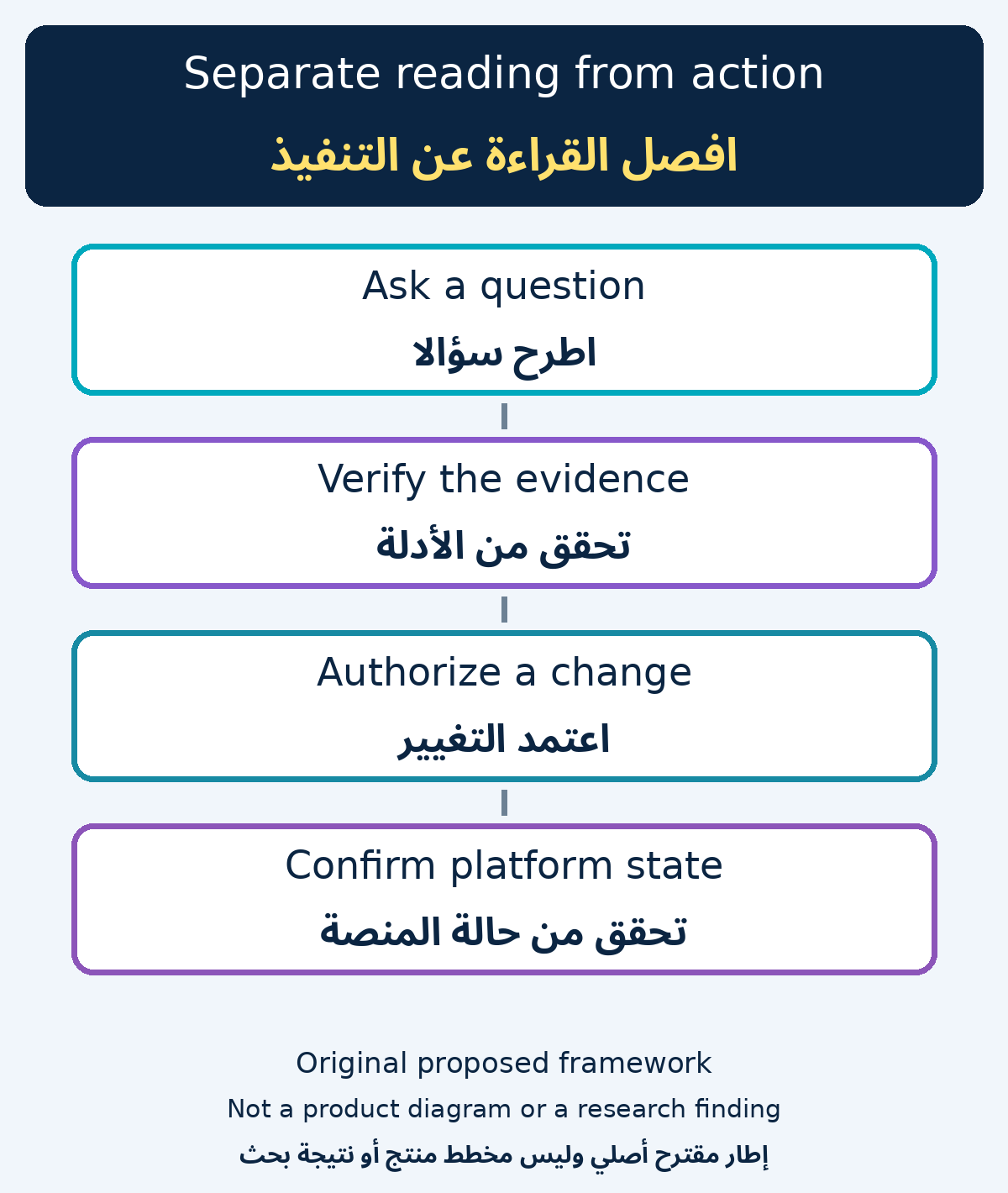
Treat a suggestion in chat, an authorized instruction and a successful platform edit as different things. Agree on who may propose, who approves and who executes. Ask for a preview specifying account, campaign, old and proposed values, currency, timing and stopping condition. Reject ambiguous short replies when several proposals share a thread. A bounded approval must apply to the exact edit under discussion, not to any later adjustment with a similar name.
A hypothetical decision with two denominators
Campaign A spends 900 SAR for 30 submissions and 3 qualified enquiries; B spends 1200 SAR for 24 submissions and 8 qualified enquiries. A appears cheaper at 30 SAR per submission versus 50 SAR for B. The ordering reverses at 300 and 150 SAR per qualified enquiry. The example assumes the same inclusion rules and a completed review window. If one campaign's recent enquiries are still awaiting review, even the second ranking is premature. Check source and follow-up delay before proposing a budget change.
Suppose the team proposes moving 100 SAR of daily budget from A to B. Define the expected account total, name the two campaign identifiers, and check whether another teammate has altered either budget since the plan was written. If the first platform change succeeds and the second fails, stop rather than reporting a completed transfer. Reconcile the actual values and decide with the account owner whether to restore or finish. This is a design for approval, not a claim about Multiply's controls.
Track the outcome, not merely the reply
Retain a small decision record: the question, evidence timestamp, agreed change, approver, execution status and final platform values. Attach a separate check for delivery after the change takes effect. For a pilot, track independently reproducible answers, edits that matched their approved values and manual time required to reconcile exceptions. If the team cannot review an answer quickly or reliably distinguish a proposed edit from an executed one, keep the pilot in reporting mode. Speed is only useful when the decision and its consequences remain clear.
A practical first milestone is one recurring decision that the team can run without searching its chat history for missing assumptions. Choose one person to inspect a sample of results weekly. Expand to another account only after that person can reproduce the answer and verify the action record without relying on the original conversation.
Define a useful request before inviting the team
In practice, the first rollout is easier to assess when every participant knows which decisions are in scope. Ask the channel owner to collect examples from the people who commission media, the analysts who check its performance and the operators who make changes. They may use the same vocabulary for different events. The media buyer might call a form fill a lead, while the sales manager reserves that name for a reachable person. Decide together which term is shown, with a definition in the account's reporting notes. An agent should not resolve a disagreement about the definition just because a confident label is available.
Create a small corpus of example questions that a reviewer can answer from an approved export. Include a request with a missing period, another with campaign names that are shared by different markets, and a comparison whose baseline has not finished collecting late conversions. For each one, say whether you expect an answer, clarification, or a warning alongside a provisional number. If a request sounds clear to someone who already knows the account but is underspecified for everyone else, the tool should expose that dependency. The test set should also contain requests where the correct answer is that the team cannot make the comparison.
The review is not a competition to match the length of an analyst's full report. A buyer needs a short answer and enough evidence to verify it. An analyst needs the assumptions, dates and filters. Show the concise answer in the approved channel and preserve the reproducible details separately, rather than making every participant scroll past a large export. Collect the cases where the shorter answer encouraged an incorrect interpretation; those cases tell you which caveat belongs in the first line, not at the end of a detailed explanation.
Design for evidence that arrives late
An account report, a CRM handoff and a sales review do not necessarily update on the same schedule. Match the cohorts with a consistent event definition: compare leads created in the chosen period and evaluate the same amount of follow-up time for each cohort. When current observations are incomplete, show which part is still missing. An answer can give a reliable count of submitted forms while marking the qualification result provisional. It should not put today's observed total next to last month's settled total without noting the difference.
Keep these checks attached to the specific question. If the team asks about campaigns intended to fill an appointment calendar, separate the number of prospective customers contacted from the number of appointment slots accepted. A filter that correctly identifies all leads may still capture products, locations or days for which appointments are unavailable. In a fictional appointment business, the reviewer would compare campaign targeting with the actual schedule before diagnosing a weak conversion rate. An apparently high cost per confirmed appointment can reflect a booking constraint rather than the quality of the audience.
Write down what would change the team's mind. For example, if the account export and sales report use different timestamps, make time alignment a condition of drawing a conclusion, not an explanation to add after a disagreement. If unresolved differences still matter, keep the proposed decision on hold. Have the person who maintains the data close the issue with evidence of the corrected result, so the team does not have to revisit the same disputed definition whenever a report is requested.
Practice exception handling before sending changes
A tabletop rehearsal is useful even without writing to any live account. Give the team a fictitious approval message, then present a new proposed amount from another teammate before the original is executed. Decide who would notice that the old approval no longer matches. Follow with a damaged test report that lists an account name but leaves out its identifier. The correct next step is to obtain enough information to resolve the ambiguity, not guess from the last account mentioned.
Review which actions are reversible and which may already have consequences even when the original setting can be restored. If an ad starts serving to the wrong audience, restoring the previous targeting does not erase exposure. If a budget is changed during a time-sensitive campaign, there may be delivery changes before a correction becomes effective. Assign someone to inspect the time between execution and detection, and keep the proposed pilot narrow enough that an exception can be reviewed promptly. This is better than relying on a broad promise to undo mistakes.
Finally, rehearse a decision to do nothing. An operator may have enough evidence to answer a question but not enough to justify a change. Record why that is a sensible outcome and what would make the issue worth revisiting. If people only count executed edits as evidence of value, the workflow will favor unnecessary interventions. In a useful pilot, people can show that a clearer answer prevented an ill-timed change, and the record makes that choice as understandable as any successful update.
Set up a handover so this design continues to work when the person who started the pilot is away. The replacement should be able to identify the report's owner, the person who can authorize a change and the team responsible for the landing page or sales process. These roles can sit with different teams. For example, a channel analyst can identify a sharp rise in failed form submissions but may not be responsible for fixing the form. Give each finding a destination and a person who can verify that it was addressed. If an issue has no assigned owner, mark it unresolved rather than calling it another successful insight.
A second reviewer can repeat the same workflow using only the written brief. Give them a small set of approved sample records, including an incomplete record and an apparent anomaly that is actually caused by a known change in business hours. Ask them to classify those examples without changing anything in the live account. Compare their conclusions to the original reviewer’s and explain the disagreements, rather than scoring them by speed alone. Document any new clarification in the account notes. This turns an interesting demonstration into a workable process that can survive staff changes, changes in naming conventions and an unfamiliar campaign.
Comments
No published comments yet.