The announcement and the access date are different
Motom announced Opportunities on November 12, 2026, describing a module for paid and gifting creator campaigns within brand- or retailer-owned creator programs. Its release schedules access for existing clients on November 17, with a January 2027 cohort for ten new brands and retailers. Campaigns can direct shoppers to creator storefronts or product links, with paid and organic sales reported separately. The product page describes outreach, briefs, gifting, approvals and payments, and notes a later onboarding wave in mid-February. These are supplier descriptions and planned access dates, not evidence that every prospective customer can use the product today. Sources: Motom announcement and Opportunities product page.
This November 15 analysis has not tested an account, inspected customer data or verified campaign results. Its focus is the practical decision behind an owned creator destination: what must a brand improve once it controls more of the shopping experience?
Original analysis: ownership creates work as well as options
An owned destination can make a commercial relationship easier to organize, but the word owned should not become a substitute for an operating plan. A retailer still depends on creators, ecommerce infrastructure, fulfillment, customer support and the channels that generate attention. The useful question is which decisions become clearer, not whether every dependency disappears. A storefront under the retailer's domain does not automatically make its message persuasive or its recommendation credible.
Before evaluating software, write down the current problem. Perhaps shoppers cannot find the products mentioned in a video, paid collaborations lose their context after a click, or reporting mixes different kinds of sales. Choose one problem that the team can observe. Otherwise a broad ambition to own the relationship can justify a complicated program without explaining what a shopper or creator should experience differently.
Begin with a shopping question, not a creator list
Consider a hypothetical homeware brand introducing a compact storage range. Its useful question might be whether customers understand which products fit a small room. A creator can demonstrate a real organizing problem and curate a relevant selection. That is more specific than commissioning attractive content and hoping the storefront creates demand. The example is a proposed test, not a Motom customer story or a claim about the platform's best-performing category.
The brief should identify the shopper, the decision they are making and the information they still need. Ask what belongs in the content and what belongs on the destination. A video may show use and scale; a product page may explain measurements and availability. When both parts perform distinct jobs, the journey has a reason to exist beyond collecting more clicks in one reporting system.
Select creators without confusing history with destiny
Historical sales can inform selection, but previous performance describes a particular combination of audience, offer, timing and distribution. A creator who succeeded with a familiar product may need a different explanation for a new category. Compare the conditions behind the figures before turning a ranking into an invitation list. Keep content suitability and the ability to explain the product visible beside sales history.
Make room for a limited discovery track for new creators, with a clear scope and review process. Otherwise a program can keep funding the same names because they already have the most recorded activity. This is an original selection recommendation, not a claim that Motom supplies a particular ranking formula. The team should be able to explain its decision in ordinary commercial terms rather than hide behind an unexplained score.
Treat gifting and paid work as different commitments
A gifted product, a paid deliverable and permission to reuse content are not interchangeable. Before any outreach, decide what the brand is offering, what it expects in return and what happens if the product is unsuitable. The agreement should make the intended work understandable without implying that accepting a parcel creates unlimited obligations. Ask the appropriate reviewer to resolve uncertain usage rights rather than inventing them in a campaign brief.
Keep operational details alongside the creative idea: contact owner, delivery information, timing, approval steps and payment responsibilities. A creator cannot reliably meet a launch date if the sample arrives after filming was supposed to finish. This analysis does not prescribe contract language or certify platform compliance. It recommends making commitments explicit enough that both sides know what they are agreeing to before production pressure begins.
Build a destination that preserves the recommendation
The storefront should answer the question that brought the shopper there. A creator's practical demonstration should not lead to an unrelated assortment simply because the retailer wants to feature a larger catalog. Check product identity, variants, stock, delivery promises and mobile presentation together. A smooth redirect is not a complete experience if the featured size is missing or the shopper cannot tell which item the creator used.
Review the route as a new visitor, without the internal knowledge of the campaign team. Can someone distinguish the creator's selections from general recommendations? Can they find important product limitations? Can they continue shopping without losing the original context? These are proposed usability checks, not confirmed Motom interface features. A destination earns its value by helping a person decide, not merely by appearing on a domain the brand controls.
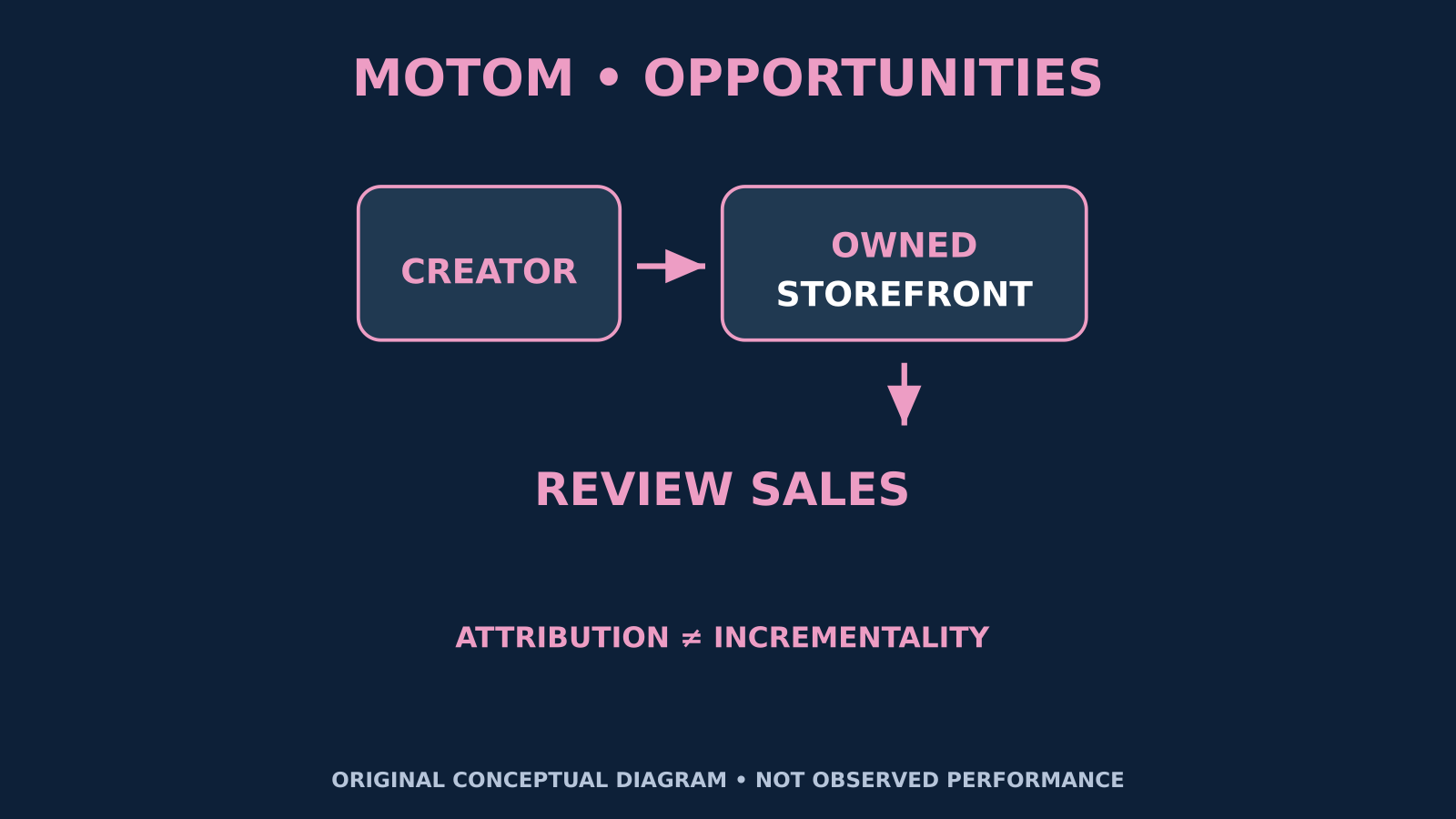
Original planning diagram, not a product interface or measured result. CREATOR means the creator's contribution; OWNED STOREFRONT means the brand's shopping destination; REVIEW SALES means examining observed purchases. ATTRIBUTION ≠ INCREMENTALITY separates assigning credit from proving additional sales caused by the campaign. The arrows describe a proposed review sequence, not guaranteed customer behavior. News context: Motom announcement.
Keep creative approval separate from distribution approval
A team may like a video while still needing to resolve where it can run, which version is approved and how long a claim remains accurate. Record those decisions separately. If a caption changes the offer, or a new edit removes a limitation, the earlier approval may no longer describe the asset being distributed. A familiar filename is not a reliable substitute for version control.
Give the final reviewer the content and destination together. The promise in the video should match the offer on the page, including availability and conditions. Specify who can pause a campaign when an important detail changes. These are internal safeguards proposed by this article, not a description of mandatory product settings. Their purpose is to preserve a decision as work passes between creator management, merchandising and media operations.
Separate paid, organic and genuinely additional sales
Separate reporting for paid and organic activity can improve visibility, but a reporting label does not establish causality. A shopper may have encountered a creator before the measured click, already intended to buy, or returned through another route. The team needs a clear attribution definition and an honest account of what remains unobserved. Do not turn the ability to assign revenue into a claim that all assigned revenue was created by the campaign.
Before launch, agree the outcome window, treatment of repeat purchases, cancellations and returns, and how overlapping activity will be discussed. Where a credible comparison is feasible, design it around the business question. Where it is not, describe the results as observed rather than incremental. The recommendation is methodological: a useful commercial report can be limited without being useless, provided its limits remain attached to the conclusion.
Compare contribution, not only gross orders
A program can record more orders while requiring more production, support, gifting and commission expense. List the relevant costs before looking at the results. Include the work required to coordinate creators and maintain destinations, even if another department pays for it. Otherwise the apparent efficiency of the campaign can depend on leaving necessary work outside the calculation.
Distinguish revenue, gross margin and the contribution remaining after the agreed campaign costs. Avoid a universal profitability target, because product economics and repeat-purchase patterns differ. For a small hypothetical pilot, the immediate aim may be to understand whether the process produces useful demand at an explainable cost. That is a narrower and more defensible goal than promising a scalable growth engine before the team has reconciled its first set of orders.
Give multi-brand campaigns a clear point of view
A retailer running several brands has an extra question: whose objective does the creator's selection serve? A supplier may want exposure for a specific range, while the retailer wants a useful assortment and the creator wants a coherent recommendation. Write these interests down instead of assuming they are naturally aligned. A storefront that tries to satisfy every stakeholder can become an unconvincing product list.
Separate any supplier funding, creator compensation and media expenditure in the planning record. Agree how results will be shared without revealing another participant's confidential information. These are proposed commercial controls, not accounting advice or a claim about a particular reporting permission. The shopper-facing proposition should remain understandable even when the funding arrangement behind it involves several parties with different measures of success.
Use a limited pilot to test the operating model
A sensible hypothetical pilot would use a manageable product range, a defined creator group and a review period chosen before launch. Keep the offer reasonably stable so the team can interpret what happened. Record changes in stock, content, destination and promotion rather than treating every adjustment as invisible background. A comparison loses meaning when the team forgets which version each shopper encountered.
The pilot should test collaboration as well as demand. How many briefs required clarification? Which approvals were delayed? Which product questions repeated? Did the creator receive useful feedback, and could customer support explain the offer? These observations can reveal work that revenue reporting misses. They do not replace commercial outcomes; they explain whether the process is sufficiently clear to repeat without relying on one person's memory or constant intervention.
Decide what would justify continuing
Before expanding, write the strongest conclusion the evidence supports. Perhaps the destination improved product understanding, the team learned which creators explain the range well, or the commercial result remains uncertain. Keep those findings separate. A useful learning outcome should not be inflated into a sales claim, and an attractive order total should not erase operational problems that would become larger at scale.
The next decision might be to continue, narrow the assortment, revise the brief or stop. Recheck actual access and onboarding arrangements before making a launch commitment, because the announcement distinguishes existing clients from a later new-client cohort. Opportunities is a relevant development in owned creator commerce. Its practical value will depend on the quality of the recommendation, the shopping experience and the evidence a particular team can responsibly establish.
Comments
No published comments yet.