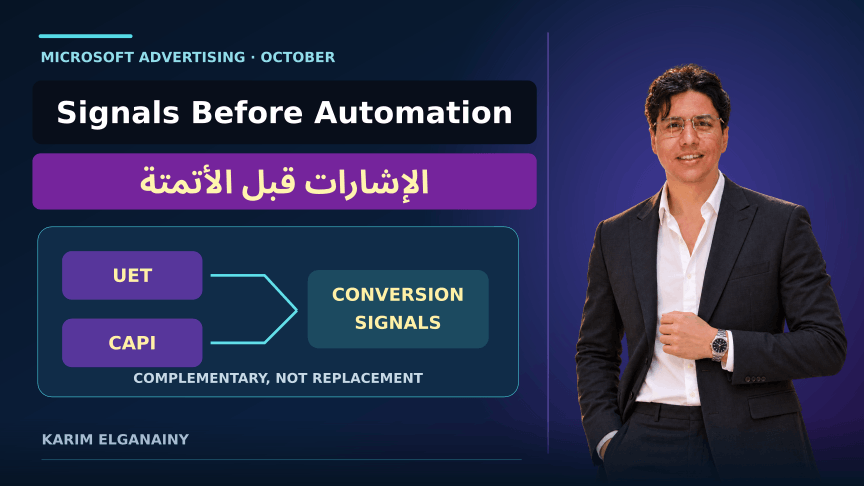
Microsoft Advertising published its October update on October 28, 2026. Conversions API is generally available alongside UET; messaging guidelines and audience exclusions are open pilots. Messaging guidelines apply to Performance Max and Search with AI Max enabled, while the audience-exclusion pilot concerns Performance Max. Guidelines allow up to 40 instructions. Search-term landing-page reporting is scheduled to begin rolling out in mid-November, not already universally available. Official update
For teams planning campaigns on October 29, the important distinction is between a feature announcement and a safe implementation plan. Measurement connections, copy controls and reporting changes solve different problems. Treating them as one automatic upgrade makes it harder to understand what changed and whether the business benefited.
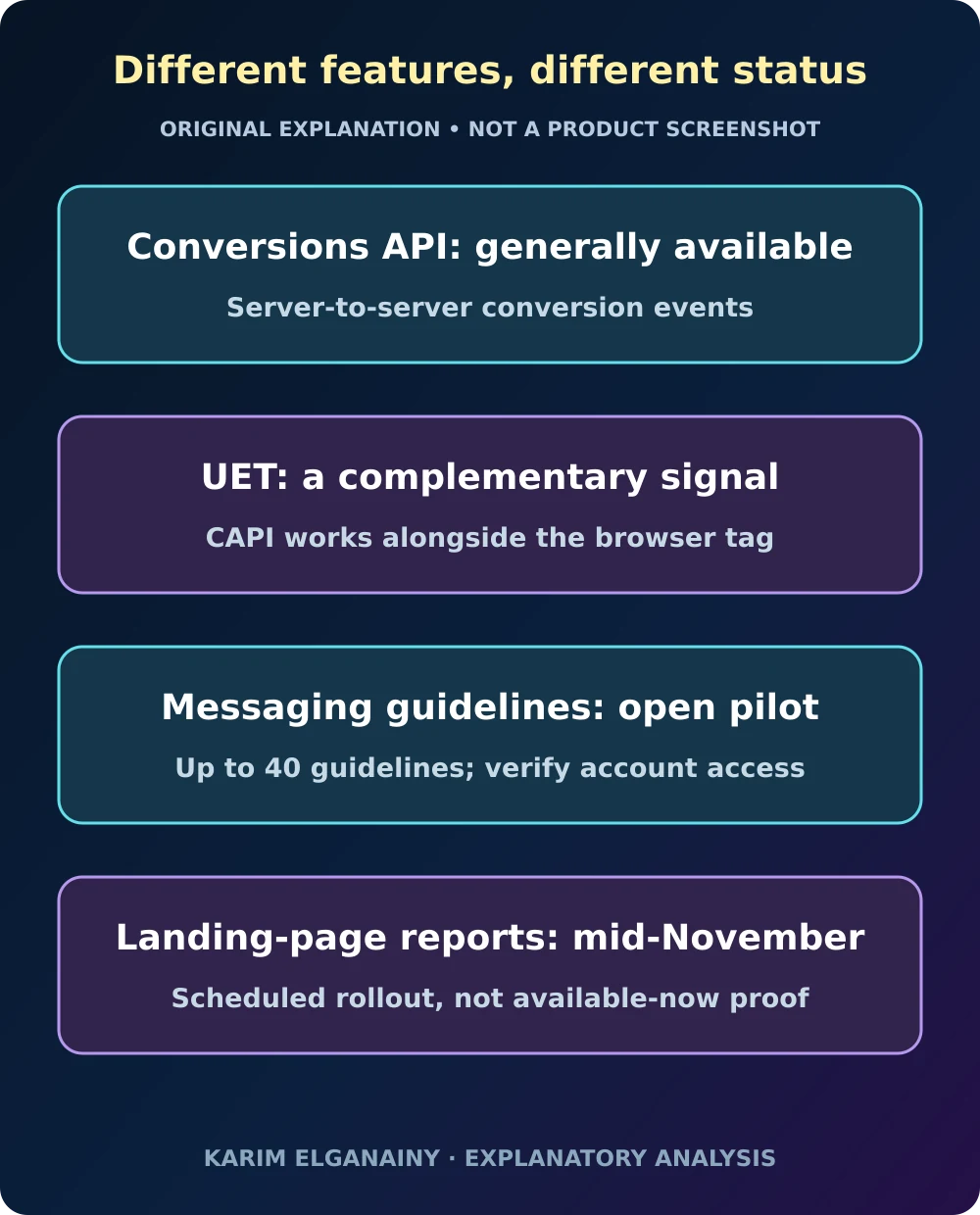
Original explanatory illustration by Karim Elganainy. An illustrated availability register, not a Microsoft interface screenshot or proof of access in a particular account. News context: Microsoft Advertising update.
Start with an availability register
Create a short register showing the capability, its announced status, whether the account can access it and the task it is intended to support. Keep future rollout dates separate from observed account access. This prevents a planning document from quietly promising something that the team cannot yet use.
A pilot is also a different operational commitment from a generally available feature. Ask what participation requires, who can provide support and how the team should respond if access or behaviour changes. Avoid making a time-sensitive launch depend on an unverified pilot capability without an alternative plan.
The remaining sections are original implementation recommendations, not additional product announcements. Specific settings, integration methods and contractual requirements should be checked against the relevant documentation and the account's actual configuration before changes are made.
Define the business event before adding a connection
Begin with the event the business wants to measure. A submitted form, qualified lead, paid order and fulfilled sale are not interchangeable. Decide which event should inform optimisation and which should remain a diagnostic signal. A more complete connection does not repair a weak definition of success.
Write the definition in language that both marketing and operations understand. Include the event's owner, timing, value and possible reversals. If a customer cancels or a lead fails qualification, establish how that change should be represented in the business analysis rather than assuming the original event remains equally valuable.
This work should precede implementation. Otherwise, the team may celebrate an increase in recorded conversions without knowing whether it reflects more customers, better data coverage or a new counting rule. Those explanations lead to very different budget decisions.
Keep browser and server measurement distinguishable
Do not treat a server-side connection as a reason to remove existing tracking without a reviewed migration plan. First map which events are collected through each route and where they may overlap. The goal is a coherent event system, not simply a larger number of signals arriving at the platform.
Ask the implementation owner to document identifiers, timestamps and the applicable deduplication approach using the current product documentation. Confirm the expected handling of repeated submissions and delayed events. These are engineering review questions, not instructions to assume a particular undocumented configuration.
Retain a record of the original setup and a rollback procedure. If the reported total changes after implementation, the team needs to reconstruct what changed. A reversible, documented rollout makes it easier to distinguish an integration problem from a real movement in customer activity.
Reconcile measurement before changing bidding
After a connection is tested, compare agreed event samples with the business system that records the underlying action. Check dates, values, currencies and status changes. A technically successful request does not by itself prove that the event represents the correct commercial outcome.
Separate transport success from reporting interpretation. The integration may deliver an event correctly while a reporting window or attribution rule causes the visible total to differ from operational records. Document those differences rather than forcing the numbers to match through unexplained adjustments.
Avoid changing several bidding assumptions immediately after a measurement change. If the signal definition and the optimisation strategy move together, interpreting the result becomes harder. A staged plan gives the team a clearer baseline and makes it easier to decide whether any later change deserves broader adoption.
Review data sharing as a specific operating decision
Map the fields that the proposed connection sends, the parties that receive them and the purpose of each field. Involve the appropriate privacy, security and legal reviewers for the actual implementation. This is a planning framework, not legal advice or a finding that a particular setup is compliant.
Do not assume that moving collection away from the browser removes the need to respect applicable permissions and data-use restrictions. Ask the responsible reviewers how the approved requirements should be reflected in technical configuration, access control and retention practices.
Assign an owner for unexpected data and a process for pausing transmission if a material issue appears. A good review produces practical answers to ordinary failure scenarios, not merely a statement that the project has been approved in principle. Those answers should remain accessible to the people operating the connection.
Turn brand policy into useful instructions
Before entering messaging guidance, identify the brand decisions that generated copy must respect. Separate product facts, prohibited claims, preferred language and stylistic preferences. A vague instruction to sound premium is less useful than a clear account of which messages would misrepresent the offer or confuse the customer.
Keep each instruction concise and avoid contradictions. If one rule demands urgency while another prohibits pressure language, explain the priority or revise the rules. A long list is not inherently a better list; it can make review harder if nobody knows which requirement matters most.
Preserve the rationale behind important rules outside the generation interface. The next reviewer should understand whether a restriction protects factual accuracy, customer clarity or brand positioning. This prevents a stylistic preference from being treated as an absolute requirement while a material product limitation is overlooked.
Test guidance with difficult examples
Evaluate generated copy against realistic edge cases before relying on it in a busy campaign period. Include products with conditions, offers with exclusions and descriptions that can easily be overstated. The purpose is to learn where review remains necessary, not to prove that a set of instructions eliminates every possible mistake.
Create an acceptance checklist that a human can apply consistently. Check factual claims, offer conditions, destination consistency and tone separately. An advertisement can sound appropriate while being commercially inaccurate, so a single overall impression is not enough.
Record failures and revise the underlying guidance when a pattern emerges. Do not add a new rule for every isolated wording preference without considering the whole set. A manageable collection of well-tested instructions is easier to maintain than an expanding archive of exceptions that few reviewers understand.
Use exclusions to express an actual business boundary
An exclusion should reflect a documented reason, not a reflexive attempt to make a campaign feel more controlled. Identify what the business intends to avoid and why. Then check whether the available capability can represent that boundary accurately in the specific account.
Review the effect on reach and the possibility of removing useful customers. If a proposed exclusion is based on a weak audience definition, it may create more uncertainty than it resolves. Test the assumptions where practical and preserve a record of what was excluded and when.
Keep policy-sensitive decisions with the appropriate reviewers. Technical access to a targeting control is not a complete business justification for using it. The campaign brief should explain the intended audience and the legitimate communication objective without relying on an unexplained list of restrictions.
Connect search intent with the destination
Prepare a review framework for search-term and destination evidence rather than waiting for every reporting feature to arrive. Identify the customer question behind a query and the information the intended page should provide. This is useful planning even when a particular account does not yet expose the desired report.
When suitable reporting is available, examine whether the page answers the query's likely need. Look for mismatches in product category, offer details, service coverage or expected next action. Treat these as hypotheses to investigate, not proof that every ambiguous query represents poor traffic.
Avoid rewriting a destination after a handful of observations. Check sample size, commercial context and the effect of other campaign changes. The aim is to improve the relationship between customer intent and available information, not to chase every minor movement in a report.
Sequence the rollout so the result can be interpreted
Choose an order of operations that preserves learning. For example, an organisation might first validate measurement, then review generated-copy guidance and later test a bounded targeting adjustment. This is a proposed sequence, not a mandatory product workflow, and the right order depends on the team's known problems.
Define the expected observation at each stage. Measurement validation should establish data quality, not claim media efficiency. A creative review should establish acceptable output, not claim incremental sales. A performance test should answer a specific commercial question under a suitable comparison.
Keep the changes reversible wherever possible. Record owners, approvals and rollback conditions in the same place as the campaign plan. This makes the process resilient when holiday pressure encourages quick changes and the person who implemented an earlier step is unavailable to explain it.
Report the cost of learning as well as the outcome
Include implementation time, development support, creative review and ongoing maintenance in the evaluation. A capability can be useful while requiring more operational effort than the initial pitch suggests. The budget owner should see that effort instead of encountering it later as unplanned work.
Distinguish one-time setup costs from recurring costs, and decide which outcome would justify each. If the main benefit is more dependable measurement, describe that honestly rather than forcing it into an immediate sales-return claim. Better information can improve future decisions without proving that the current campaign generated additional demand.
Use scenarios only when their assumptions are visible. Do not invent a conversion uplift to make the project appear financially complete. Identify the evidence still needed and the decision that can reasonably be made before that evidence exists.
Leave the review meeting with a bounded plan
The most useful response to the October update is a short, prioritised plan: which problem matters first, which capability is actually accessible, who owns the implementation and how success will be verified. Add a separate list of future or pilot capabilities that deserve monitoring rather than immediate dependence.
This approach preserves the value of the announcement without confusing availability, configuration and business impact. A feature can be generally available while a specific implementation still needs technical and organisational work. A pilot can be worth exploring without becoming a critical dependency.
Approve the next step at the smallest scope that can answer the relevant question. Then review the evidence before expanding. The point is not to adopt every new control; it is to build a campaign process in which the team understands what it changed, why it changed it and what the result can legitimately support.
Sources
Microsoft Advertising’s October 28, 2026 product update. Practical recommendations are original editorial analysis published October 29.
Comments
No published comments yet.