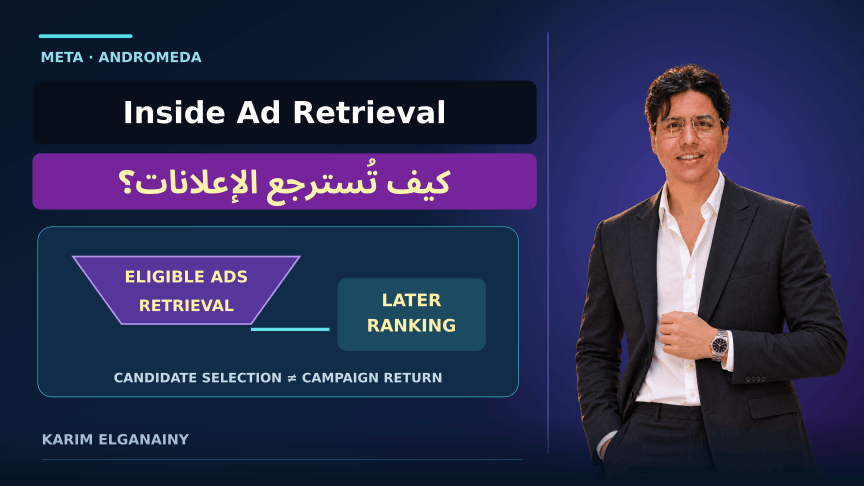
Meta published a new Andromeda engineering account on October 28, 2026. It reports a 2.4% increase in Facebook conversions since 2025 and production throughput exceeding one billion ads per second per GPU server. Those are company claims about infrastructure and aggregate outcomes, not a promise for an individual advertiser. Meta engineering disclosure
This October 29 analysis asks what a campaign team should do with that information. The answer is not to rebuild every campaign around a headline percentage. It is to distinguish the mechanism described by the platform from the business evidence needed to change a budget.
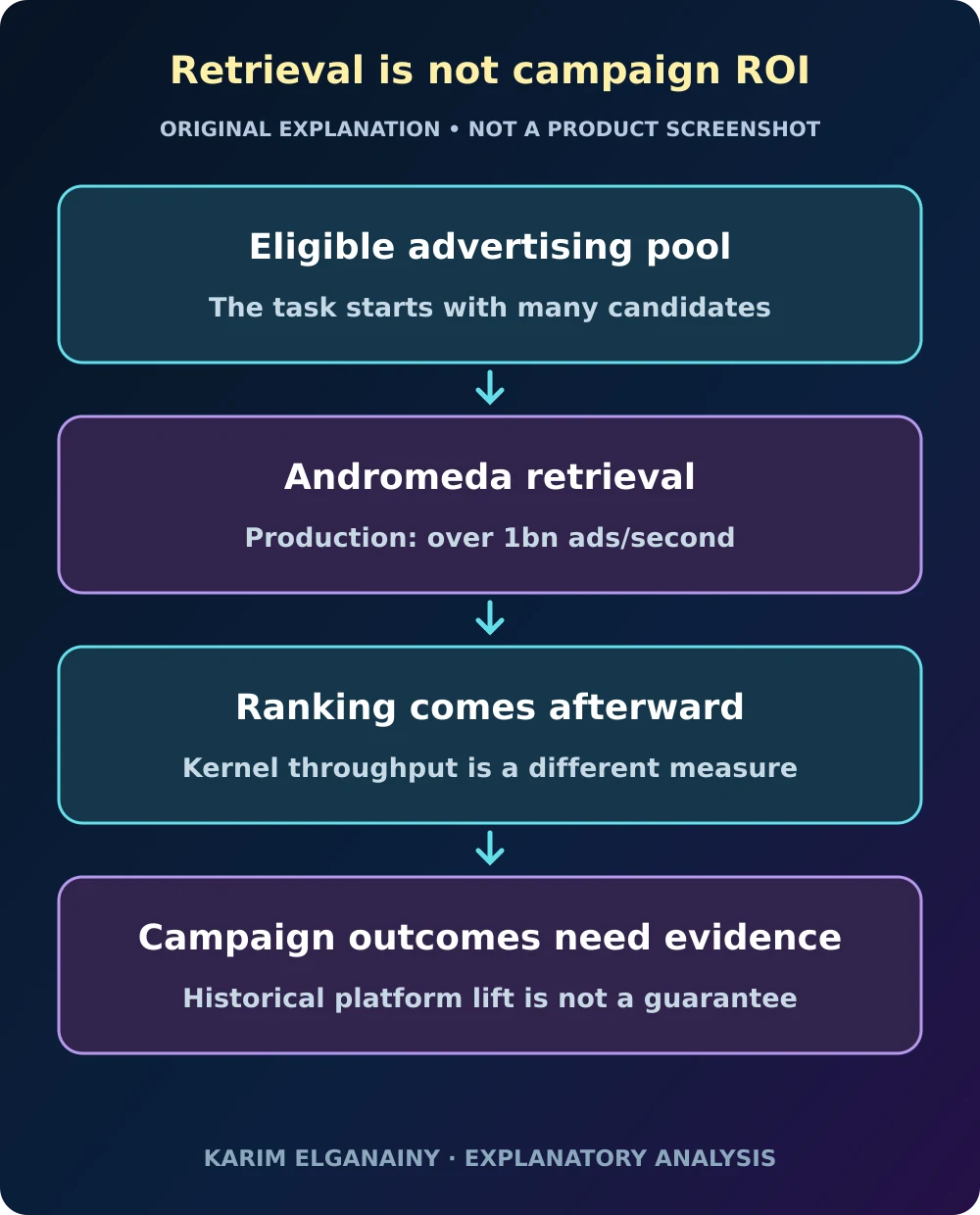
Original explanatory illustration by Karim Elganainy. A conceptual framework, not a reproduction of Meta’s technical diagrams. The production throughput label refers to one GPU server, not a campaign result. Source context: Meta engineering disclosure.
Understand the stage being discussed
Andromeda retrieves candidates before a later ranking stage. Meta's larger figure of over ten billion ads per second concerns model inference, not the complete production pipeline. Technical account
For a buyer, the useful distinction is between getting considered and producing a valuable result. A more capable selection process may change which creative receives an opportunity, but the advertiser still needs an appropriate offer, destination and measurement definition. Infrastructure capacity alone cannot tell a business whether its next additional unit of spending will be profitable.
The following sections are original planning recommendations, not additional findings from Meta's system or confirmed controls exposed to advertisers. They focus on decisions a team can inspect inside its own operating process, rather than trying to reverse-engineer an unseen auction from a few performance changes.
Treat the conversion percentage as a question
Before using a platform-wide result in a forecast, ask what population, comparison and outcome it represents. Then ask whether those conditions match the business decision in front of you. A general improvement claim does not establish the expected change for a particular product, geography, budget or account.
Do not add the headline percentage to last month's revenue plan. Instead, use it to motivate a review of whether existing tests and reporting can detect meaningful changes. If the platform supplies further methodology, preserve it alongside the claim so that future readers understand its boundaries.
A campaign review should allow three conclusions: evidence of improvement, evidence of deterioration or insufficient evidence. Removing the third possibility encourages teams to manufacture certainty from normal variation and makes their recommendations harder to trust.
Audit inputs before changing the campaign structure
Start with an inventory of active products, destinations and creative. Check that the offer in each advertisement matches the information a customer receives after clicking. Record unavailable products, expired promotions and inconsistent prices. These are concrete problems a team can address without making speculative claims about how a retrieval model works.
Next, inspect the conversion events used for optimisation. Confirm that the business understands what each event represents and whether it still reflects the desired outcome. An event can be technically recorded while being commercially weak, such as a low-quality inquiry that rarely becomes a customer.
Prioritise issues by their likely effect on customer understanding and decision quality. Fixing a broken destination may provide clearer value than making a large structural campaign change whose mechanism and consequences cannot be isolated.
Give creative variety a business rationale
Creative variation should represent meaningful differences in customer need, message or use occasion. Producing many almost identical files can increase operational work without creating a useful learning agenda. The planning question is which distinct proposition deserves a fair test, not how many assets can be exported in an afternoon.
Create a simple matrix linking each concept to its intended audience question. One concept might explain a practical benefit, another might demonstrate use, and another might answer a common objection. These are hypothetical options, not a claim that any particular mix is favoured by Andromeda.
Keep version names and approval records consistent. If a concept performs differently, the analyst should be able to identify what changed. A library of well-described variations is easier to evaluate than a folder of anonymous files with unclear relationships.
Avoid diagnosing every fluctuation as an algorithm change
When results move, first inspect changes the team can document: spending, offers, stock, tracking, landing pages and audience conditions. Check whether the comparison covers equivalent weekdays and commercial moments. An unexpected movement deserves investigation, but its timing alone does not identify its cause.
Write competing explanations before selecting one. A fall in conversion rate might reflect different traffic, a technical problem or a weaker offer. These possibilities are analytical hypotheses, not observations about Meta's advertisers. State what evidence would support or weaken each explanation.
This approach prevents a platform announcement from becoming a universal explanation for every account problem. It also makes conversations with agencies and stakeholders more productive because they focus on evidence that can be checked rather than an invisible mechanism that can explain anything.
Design a bounded experiment
Choose one decision that an experiment can inform, such as whether to adopt a different creative concept or change the offer presentation. Agree on the outcome, comparison, duration rationale and stopping conditions before reviewing results. Use a suitable controlled design when feasible, and disclose the limitations when it is not.
Avoid changing the creative, budget, destination and measurement event simultaneously unless the actual question concerns the whole package. A combined change can still be informative, but it does not identify the contribution of each component.
Preserve an inconclusive outcome as a legitimate possibility. A small or noisy test may not resolve the decision. The next action could be improving the design, correcting a data problem or declining to expand, rather than choosing whichever interpretation sounds most optimistic.
Separate attribution from additional value
Platform attribution and causal impact answer different questions. Attribution assigns conversions according to a rule; additional value asks what would have happened without the activity. Both can support a useful review, provided the report does not pretend they are interchangeable.
Show attributed results alongside business outcomes and, where available, experimental evidence. Explain the timing, exclusions and definitions of each layer. If they disagree, investigate the reason before choosing the number that best supports a preferred recommendation.
For a commercial decision, consider cancellations, returns, lead quality and contribution after relevant costs. The right measure depends on the business. A retailer and a service provider may need different definitions, but both benefit from knowing exactly where the evidence ends and an assumption begins.
Make automation accountable without inventing control
Document which decisions belong to the advertiser, agency and platform. Do not confuse a recommendation about good governance with a claim that the advertiser can inspect or configure every internal model. A sensible operating policy begins with the controls that actually exist in the account.
Assign an owner for budget approval, creative claims, destination accuracy and measurement changes. Keep a change log that can be reviewed when results shift. Decide who may pause activity if a material problem appears and how the rest of the team will be informed.
These responsibilities do not require pretending that automation is fully transparent. They create accountability around the parts the business can influence, while making uncertainty about the remaining system explicit rather than hiding it behind technical language.
Localise the interpretation before the execution
A platform-level disclosure is not a local market study. Teams operating in Arabic and English should examine customer questions, product descriptions and service expectations in each market rather than importing an aggregate performance claim into a regional target.
Review translations for meaning and commercial accuracy, not merely grammatical correctness. Check that an offer's conditions remain understandable in each version and that the destination supports the promise. Where reliable market-level evidence is limited, describe that limitation rather than inferring a result from global infrastructure scale.
The practical aim is a locally testable proposition. A clear message, an available product and an appropriate comparison provide a stronger basis for learning than a broad declaration that a new system must improve every campaign in the same way.
Check the denominator behind a performance movement
A conversion rate is meaningful only when the team understands what sits below the line. Compare eligible visitors, sessions, clicks or people consistently rather than switching denominators between reports. If a tracking change alters how visits are counted, the apparent rate can move even when customer behaviour is unchanged. Record that possibility before attributing the movement to better delivery.
Also inspect the mix behind the average. A campaign may sell more lower-priced products or generate more inquiries from locations that are harder to serve. These are hypothetical diagnostic examples, not findings from Meta's disclosure. Segment only where the data can support a useful comparison, and avoid treating tiny groups as reliable evidence. The purpose is to identify a commercially meaningful explanation, not to search through enough slices until one looks impressive.
Keep the analysis brief enough to audit. A manager should be able to identify the comparison, the definition and the main uncertainty without reconstructing a complicated spreadsheet. That clarity makes a cautious recommendation more actionable, especially when several teams need to agree on the next step.
Evaluate the cost of the operating response
A new technical disclosure can trigger expensive organisational reactions: rebuilding dashboards, producing additional creative, restructuring agency workflows or replacing familiar reporting. Before commissioning that work, identify the specific uncertainty it will resolve. A task that makes the team feel modern is not necessarily a task that improves a decision.
Estimate the staff time and recurring maintenance involved. If the proposed response requires a large stream of new assets, ask who will review their accuracy and whether the learning design needs all of them. If it requires new data, define the question and approved use before collecting it.
Prefer reversible steps where evidence is limited. A targeted audit or bounded creative test can reveal useful information without forcing the organisation into a broad transformation. Record what would justify the next investment so that a modest first step becomes a deliberate learning sequence rather than an indefinite collection of disconnected experiments.
Turn the disclosure into a decision checklist
The next review meeting should answer four questions: what changed in the business, what changed in campaign execution, what evidence can be trusted and what decision is justified now? Attach owners and dates to unresolved issues so the discussion leads to action rather than another slide about artificial intelligence.
Meta's disclosure is significant as an explanation of evolving advertising infrastructure. Its usefulness to an individual advertiser depends on a disciplined translation from platform claims to account-level questions. Faster processing and more sophisticated selection are not substitutes for a credible offer or a defensible evaluation.
Keep the recommendation proportional to the evidence. Improve known weaknesses, run a bounded test where necessary and expand only when the business case supports it. That is a more durable response than treating a technical milestone as a universal spending instruction.
Sources
Meta’s October 28, 2026 Andromeda engineering disclosure. The operating recommendations are original editorial analysis published October 29.
Comments
No published comments yet.