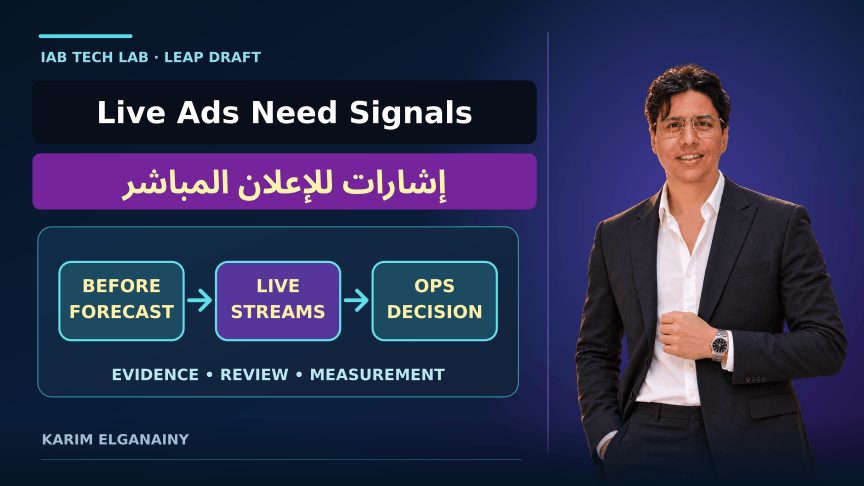
IAB Tech Lab opened its LEAP Implementation Guide for public comment on October 28, 2026. This October 29 analysis examines what advertising teams should review before treating implementation guidance as an operational plan. The immediate opportunity is to identify integration ambiguities while feedback can still influence the document, rather than interpreting consultation as a compulsory deployment deadline.
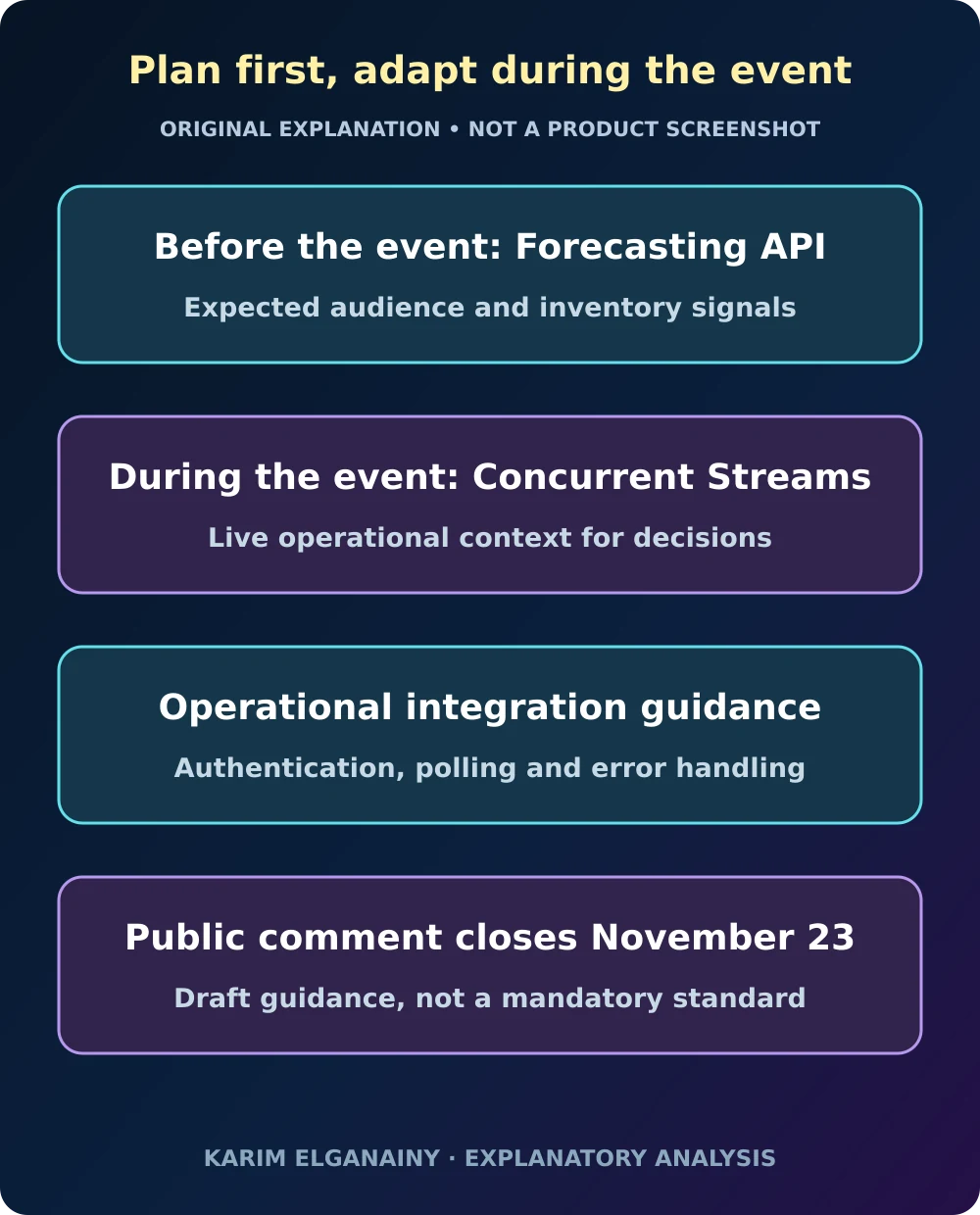
Original explanatory illustration by Karim Elganainy. An original summary of the announced guidance and consultation date, informed by the IAB Tech Lab announcement, not a reproduction of a source asset.
What is open for comment
The issuer’s announcement describes guidance for implementing the existing LEAP Forecasting and Concurrent Streams APIs. Forecasting supports pre-event information exchange; Concurrent Streams supplies near-real-time viewership signals. The public-comment deadline is November 23, 2026. This is draft implementation guidance, not a newly launched API, a final specification or a mandatory adoption requirement.
The recommendations below are independent editorial analysis, not additional requirements from the draft. They offer questions for publishers, buyers and technology partners to investigate together. They do not establish that an integration will reduce costs, improve delivery or generate incremental revenue. Those outcomes would require evidence from an actual implementation and an evaluation appropriate to the business question.
Begin with one operational decision
A useful review starts with a decision, not a list of available fields. Identify who needs information, when they need it and what they may change in response. A planner assessing an event opportunity and an operator responding during transmission can require different levels of freshness and certainty.
Write a short scenario that follows one decision across organisations. Name the sender, recipient, responsible operator and system of record. Explain what happens when the information is missing or contested. That exercise can reveal ambiguity more quickly than a general discussion about interoperability because it connects the proposed exchange to a concrete action and a person who must defend it.
Keep forecasts distinct from commitments
For an internal review, treat a forecast as an estimate whose assumptions need to remain visible. A commercial commitment should have its own explicit basis and approval. Confusing the two can cause a planning number to acquire contractual significance simply because it appears in a shared workflow.
Ask partners how they distinguish an initial estimate, an updated estimate and a confirmed commercial arrangement in their operational processes. Record the relevant time and context when a team relies on a forecast. If the estimate later changes, reviewers should be able to reconstruct what was known when the decision was made, rather than evaluating that decision using information that arrived afterward.
Agree what the signal can justify
A current operational signal should not automatically trigger every available campaign action. Define which decisions may use it and which need corroboration. Teams should distinguish monitoring, an alert to a person and an automated change with financial consequences. Each deserves a different approval and escalation rule.
Avoid describing a viewership-related signal as proof that an advertisement was seen or that a customer acted. For an evaluation, map each input to the question it actually helps answer. If a team wants to claim advertising effectiveness, it needs a suitable measurement design beyond operational telemetry. Clear language in dashboards and handoff notes prevents useful infrastructure information from becoming an unsupported performance claim.
Review identifiers with real examples
An identifier can be syntactically valid while still being interpreted differently by two organisations. During a review, ask partners to walk through an ordinary event, a schedule change and two similarly named events. Examine where their existing systems assign identities and where a mapping is necessary.
Document ambiguous cases rather than quietly resolving them in one integration. A local workaround can hide a problem that will reappear with another partner. Keep a record of the assumptions used in tests and explain which organisation maintains each mapping. The useful output is a shared understanding of what the exchange refers to, not merely a successful response from a test endpoint.
Make freshness understandable to operators
Operators need to know whether information is timely enough for the action they are considering. A dashboard that updates visually can still display information generated earlier. In a proposed operating model, distinguish observation time, transmission time and the point at which a downstream system made a decision.
Agree how stale information will be labelled and which actions should stop when freshness becomes uncertain. These are review questions, not claims about prescribed thresholds in the draft. The right tolerances depend on the decision and the systems involved. Include clock alignment and delayed processing in the discussion so that partners do not interpret the same timestamp as evidence of different stages of an exchange.
Test failure before a high-stakes event
A demonstration that succeeds under ideal conditions leaves important questions unanswered. A bounded test should include unavailable services, incomplete responses and temporary disagreement between systems. Explain what an operator will see and what the receiving system should do while the condition persists.
Choose recovery expectations with the partner rather than inventing them after an incident. Decide who investigates, which evidence is retained and how normal operation is confirmed. Avoid making an automatic retry strategy more aggressive merely to hide a transient failure from a dashboard. The objective is a controlled response that protects the wider workflow, not the appearance that every individual request succeeded immediately.
Separate technical access from commercial authority
Access to an interface does not by itself confer permission to change budgets or commercial terms. An integration review should identify the systems that can read information, the people who approve downstream actions and the controls that prevent a test from affecting live spending.
Begin with a limited environment and the minimum access needed for the agreed scenario. Review credential ownership, rotation responsibilities and what happens when a partner relationship changes. These are general governance recommendations rather than a description of particular authentication requirements. Keep sensitive operational data out of public examples and feedback submissions unless the organisation has explicitly authorised its disclosure. A useful technical comment can usually explain the problem without exposing confidential commercial detail.
Give the business team a readable runbook
A runbook should explain the action to take, the owner and the evidence required, in language that the relevant operator can use during a busy event. Keep engineering detail available, but do not require a campaign manager to infer operational meaning from an unfamiliar response payload.
Use a small set of clearly named states for the local workflow, with an explanation of what each permits. Identify the escalation contact and the decision that remains with a human. Rehearse a handover between teams so responsibility does not disappear across a shift change. The test is whether a colleague can follow the procedure without depending on undocumented knowledge held by the person who built the integration.
Evaluate coordination without promising ROI
An early evaluation can measure whether partners interpret the same information consistently, whether alerts reach the correct owner and whether incidents can be reconstructed from records. These are useful operational outcomes even when their commercial effect has not yet been isolated.
Record a baseline before changing the process. Otherwise, a team may mistake a quieter event or a different partner mix for an integration improvement. If the pilot produces fewer manual interventions, examine why and whether important checks were removed. Report what was observed and what remains uncertain. A credible operational assessment can support a later investment decision without turning every improvement into a precise revenue claim.
Submit comments that another implementer can use
Good consultation feedback identifies the passage under discussion, explains the ambiguous interpretation and provides a concise example. Suggest a clarification where possible, while distinguishing a necessary interoperability issue from a preference about one company’s internal architecture.
Before submission, have engineering and operations review the comment together. Confirm that it describes an actual scenario and does not reveal private account information. Keep an internal record of the question and the proposed wording so the team can check how later revisions address it. The November 23 deadline is an opportunity to contribute evidence, not a reason to rush an unreviewed integration into production.
Separate technical success from business readiness
A successful exchange can demonstrate connectivity without proving that a partner is ready to use the information responsibly. Before moving beyond a test, check whether support coverage, escalation routes and campaign controls exist for the proposed operating period. A system can be available while the person authorised to respond is not.
Create a readiness review that includes engineering, operations and the commercial owner. Ask each team to identify its unresolved dependency and the condition under which it would pause the rollout. This should be a decision meeting rather than a ceremonial sign-off. If a critical assumption remains untested, narrow the initial use case instead of disguising the uncertainty with a general assurance that the integration is complete.
Preserve a reversible path through the pilot
A pilot is more informative when the team can stop or change it without losing the ability to operate. Agree on a fallback before introducing new signals into an established workflow. Explain which decisions return to the previous process, who authorises the switch and how partners are informed.
Keep the pilot scope narrow enough that an unexpected result can be investigated. Changing several systems and decision rules at once may make it impossible to identify the cause of an improvement or failure. Version the local configuration and retain a record of material changes, while applying appropriate limits to sensitive data retention. At the end of the pilot, review exceptions as carefully as successful exchanges. A recommendation to expand should explain which uncertainties were resolved, which remain and whether the evidence applies to the next proposed event or partner. Reversibility is a practical way to keep learning separate from an irreversible operational commitment.
The next step is a focused review
Choose one event workflow and one partner for a structured discussion. Map the decision, the information required, the failure response and the approval boundary. Use that exercise to produce a short list of specific questions for the draft rather than a broad declaration that the organisation supports standardisation.
The implementation guide matters because coordination depends on shared interpretation as much as on connectivity. Our assessment is that a careful review should produce clearer responsibilities before it produces a deployment promise. Preserve the distinction between draft guidance, local operating choices and demonstrated results. That discipline gives both technical teams and marketers a more reliable basis for deciding what to build next.
Source
IAB Tech Lab announcement, October 28, 2026. This article is dated October 29. Operational checklists and evaluation suggestions above are original editorial analysis, not additional provisions of the consultation draft.
Comments
No published comments yet.