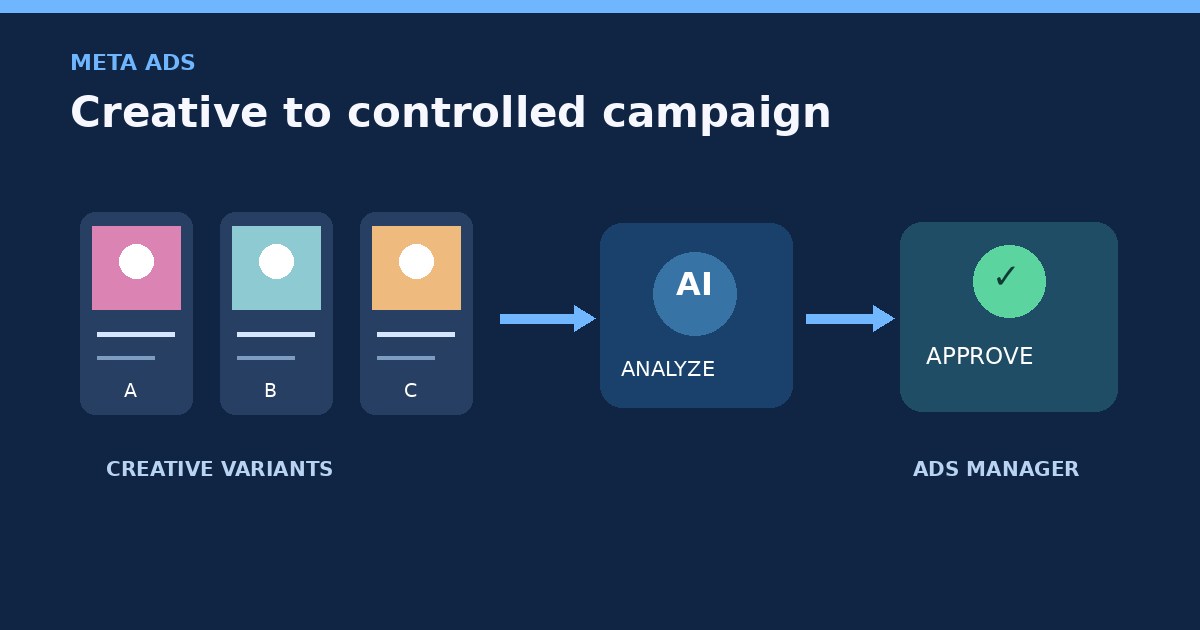
Meta's 6 October 2026 Advertising Week announcement is a useful signal about where campaign operations are moving. The company says Ads Creative Studio is expanding to more advertisers, its AI business assistant is gaining memory and creative insights, and agentic actions are entering tests. The same announcement describes AI-assisted audience discovery, a broadly available Customer Lifecycle Strategy, and wider video-generation tools. These are product announcements at different stages of availability, not a promise that every advertiser can use every feature today. The operational question for a marketer is which decisions can be delegated to software, which require approval, and how to tell whether faster production generates better customers. Meta's 6 October announcement.
What actually changed
Ads Creative Studio is intended to connect creative output with performance insight. Its expansion matters because a team can examine which messages and formats worked before commissioning the next variation. The AI business assistant already operates inside Ads Manager and can advise on planning, configuration, optimization, and measurement. Meta now says it can carry more business context between conversations, including past experiments, seasonality, and stated objectives. The company is testing import of strategy, brand voice, and guidelines from other AI tools. That distinction matters: a remembered instruction may save setup work, but it is only valuable if the underlying instructions are correct and current.
Meta also describes tests in which a marketer can request a campaign, change targeting or budget, and create images or copy conversationally. Preview and approval controls are part of that workflow. Separately, its Ads MCP server is expanding the campaign tasks available from external AI tools: creative upload, ad preview, and performance review. Agent-prepared work can arrive as a draft in Ads Manager. Meta says advertiser permissions and explicit approval apply before publication. This is a more concrete governance model than a chatbot that can silently make live changes, but each organization still needs to test the permission boundary in its own account. Meta, 6 October 2026.
Why creative becomes a data operation
When an advertiser can turn a static asset into video, alter its opening hook, change its audio, adjust length, add subtitles, and vary the ending, production volume can increase rapidly. Meta says static-to-video creation in Advantage+ creative is generally available, while catalog-based product video is in eligible beta. More variations create a measurement challenge: if a team changes audience, budget, offer, and asset together, it cannot know which change contributed to a result. Creative Studio should therefore be used to organize hypotheses rather than create countless undifferentiated variants.
A useful hypothesis identifies one audience question, one message angle, and one expected customer action. For example, a clinic could compare a physician explaining a procedure's preparation with a receptionist explaining how to book a consultation. Both should use approved claims, the same conversion event, and comparable budget and delivery conditions. The comparison is about patient understanding and qualified bookings, not which synthetic video earns more impressions. If the service is high consideration, a cheaper lead may cost more after no-shows and unsuitable inquiries are counted.
Meta states that more than 60% of time spent on Facebook and Instagram is with video. This is a platform-wide company figure in its 6 October product announcement, not a measure of every Saudi audience or of video ad effectiveness for a specific business. It justifies testing video as a format; it does not justify abandoning still images, carousels, or clear landing pages. A business should use its own account's creative and conversion data to decide the mix. Meta, 6 October 2026.
The assistant changes workflow before it changes strategy
An assistant that remembers prior tests can make weekly analysis faster. It might retrieve a campaign's creative history, flag deteriorating response, or prepare a draft for an operator. Yet it cannot decide which service has enough clinical capacity, whether a product margin supports acquisition, or whether a claim is permissible. Those facts live outside an advertising dashboard. Before using agentic campaign changes, a team should create a small source of truth: campaign objective, allowed audiences, prohibited claims, conversion definitions, budget ceiling, escalation contact, and the date each rule was reviewed.
Meta says advertisers using its assistant's recommendations often obtain 5% more conversions at the same cost per conversion than advertisers who do not. This is a company-reported association in the 6 October 2026 announcement; Meta does not establish that adopting recommendations alone caused the difference or that the sample represents Saudi healthcare. Treat the figure as a reason to run a controlled local test, not as a projected return. Keep a log of the assistant's recommendation, the person's decision, the campaign change, and subsequent qualified outcomes. Meta, 6 October 2026.
Audience discovery and the new-customer problem
Meta plans to bring natural-language audience discovery into Detailed Targeting later in 2026. A marketer would describe an ideal customer and review suggested audiences instead of navigating many menu options. Suggestions should be treated as candidates, not verified descriptions of who will buy. The same announcement says Customer Lifecycle Strategy is available to all advertisers, making it easier to mark acquisition campaigns and receive recommendations for excluding existing customers. In healthcare, the practical value is avoiding an acquisition report that counts returning patients as new demand.
A credible acquisition measure needs a matching rule. Decide how the CRM identifies a previous patient or customer, what consent allows matching, and how duplicates across phone numbers, email addresses, and household accounts are resolved. Then compare platform-reported new customers with a first completed appointment or transaction in the business system. Excluding existing customers may improve the purity of an acquisition audience but can also suppress useful reactivation if the underlying lists are inaccurate. Keep reactivation and acquisition as separate, explicit objectives.
A thirty-day implementation plan
In week one, audit current permissions and measurement. Record who may create drafts, change budgets, approve clinical copy, and publish. Export a baseline of spend, accepted leads, scheduled appointments, attendance, sales, and customer status. Confirm the Meta pixel or Conversions API events map to real commercial milestones. If a team cannot distinguish form submissions from attended appointments, it should fix that mapping before optimizing an agent for more forms.
In week two, define three creative hypotheses linked to distinct objections. One may answer safety and eligibility questions, another explain the booking process, and a third show an approved service outcome without exaggerated promises. Give each hypothesis an owner and a source for every factual claim. Test localized Arabic rather than translating English copy mechanically. Preview placements to check text legibility, captions, brand presentation, and whether the landing page fulfills the promise made in the ad.
In week three, use the assistant to prepare analysis or drafts if account access exists. Require a human to approve every budget, audience, and copy change. Compare the new creative with a stable control under an agreed attribution window and sufficient delivery time. Avoid repeatedly restarting ads in response to one bad day. In week four, reconcile ad results with the CRM: cost per accepted inquiry, scheduled booking, attended appointment, and contribution margin where available. Stop a creative if it attracts the wrong cases even when its click-through rate looks strong.
A useful decision rule should be written before seeing results. For example, promote a creative only if qualified booking rate improves without a material rise in no-shows, policy violations, or cost per attended appointment. The thresholds should come from the business's own baseline and unit economics. They are not numbers supplied by Meta. Small samples can make a short test inconclusive; in that case keep learning rather than declaring a winner.
What the Gulf and healthcare teams should watch
Saudi and Gulf operators have additional questions: Does the assistant correctly understand Arabic variants? Can it distinguish a general inquiry from sensitive patient information? Are clinic locations, operating hours, and appointment capacity current? Does a generated image imply an actual patient result or a procedure that the clinic does not perform? Local advertising and privacy rules require careful review, especially when targeting relates to health. The safest first use is drafting and insight retrieval with human publication approval, not autonomous campaign launch.
For agencies, the opportunity is an auditable creative production service: connect approved brand knowledge, create controlled variations, log why each variant was made, and report downstream outcomes. This offers clients a practical reason to trust automation. The risk is selling “more AI content” without a quality control process, which can multiply errors and make attribution harder.
Karim's strategic decision
Karim can test a narrow Meta workflow for one service line: approved Arabic and English creative briefs, assistant-generated draft options, clinician or compliance review, then measurement through attended appointments. Build a reusable approval record and a weekly outcome table before expanding to more accounts. The central advantage is faster learning with visible accountability. An AI agent should shorten the distance from evidence to a test, while people retain responsibility for the offer, claims, budget, and final publication.
The review questions that protect a rollout
Before widening an agent's authority, ask whether its proposed change can be reversed, who sees the draft, and what evidence the recommendation cites. Run a simulated campaign edit with a low budget ceiling and confirm that the same person who requested it cannot bypass approval. Review generated captions on small screens and compare the final ad with the approved clinical source. Keep an export of prior settings so the operator can restore them after an error. Assign an owner to investigate a rise in rejected leads, not only a fall in platform conversions. These procedures make the difference between useful automation and a faster way to amplify a mistake. A quarterly access review matters because agency staff, service lines, and campaign responsibilities change. The system should make the safe choice easy without forcing every routine analysis through a long committee.
Comments
No published comments yet.