
What happened, and what this analysis asks
Sinch announced on November 16, 2026 that Bland selected its voice infrastructure for AI-agent calls. That is the reported development; the operating test below is our original proposal, not a vendor capability assessment or a compliance guarantee.
For a marketing team, the useful question is not simply whether an automated voice can answer a call. It is whether a customer can move from a campaign promise to a clearly owned next step without losing context. A pleasant conversation can still end in an abandoned request. Conversely, a well-managed transfer to a person may be the right result, even when it reduces the apparent automation rate. The distinction matters before anyone chooses a pilot target or writes a success headline.
An operating review should also distinguish the channel from the relationship. Someone may enter through an advertisement, return through search and finally call after comparing alternatives. The voice interaction is one part of that sequence, not necessarily the source of demand. Keep attribution claims separate from service observations. A completed next step can show that the workflow functioned for the caller without establishing which earlier exposure persuaded that person to act. That distinction prevents a service improvement from being presented as a causal advertising result.
Choose a narrow customer task
Start with one low-sensitivity task, such as asking a business-service provider about a published package and requesting a conversation with its sales team. Define the information the caller needs, the action the system may propose, and the conditions that require a person. Keep account changes, payment decisions and consequential advice outside this illustrative pilot. These boundaries describe a test design, not permissions granted to any product.
Marketing should supply the current offer and its limitations. Operations should identify who can accept the next step and during which hours. A named owner should resolve disagreements between the campaign page and the service team's working instructions. Otherwise, the voice channel becomes another place where an outdated promise can circulate, rather than a reliable continuation of the customer journey.
Build a task card that a reviewer can understand without knowing the technology. It should describe the customer's starting information, the expected answer, the relevant exception and the acceptable ending state. Include examples of requests that sound similar but require different treatment. Asking what a package includes is different from asking for an exception to its published terms. Rehearse both situations with fictional details. If reviewers disagree about the right ending, resolve the business rule before using the disagreement to judge the assistant.
Separate conversation from commitment
Write three distinct outcomes into the test record: information supplied, action requested, and action accepted by the responsible team. A caller hearing “someone will contact you” has not necessarily received a confirmed appointment. The interface and the follow-up message should describe the state that actually exists, including any unresolved availability. Avoid promising a response window until the receiving team has accepted that obligation.
Use a short handoff packet: the customer's stated goal, the question still open, the next action requested and the permission needed to share it. Do not collect extra personal details merely to make the summary feel complete. The receiving person should be able to correct the summary, and the caller should have a clear way to explain that the automated interpretation was wrong.
The wording of confirmation deserves its own review. Compare the message heard by the caller, the note seen by the receiving team and the state recorded in reporting. They should describe the same commitment. If a request is only queued, say that it is queued; if a person has accepted a callback, identify the accepted next step without inventing a guarantee. A useful audit asks a colleague to explain what the customer could reasonably believe after hearing the message. That interpretation can reveal a promise that the internal labels conceal.
Design the human route before the launch
A transfer button is not an operating model. Decide what happens when staff are unavailable, the connection fails, the caller declines a callback, or the request exceeds the pilot's scope. Each state needs an honest message and an owner. A request can remain unresolved without disappearing; the dangerous state is an unresolved request displayed internally as completed.
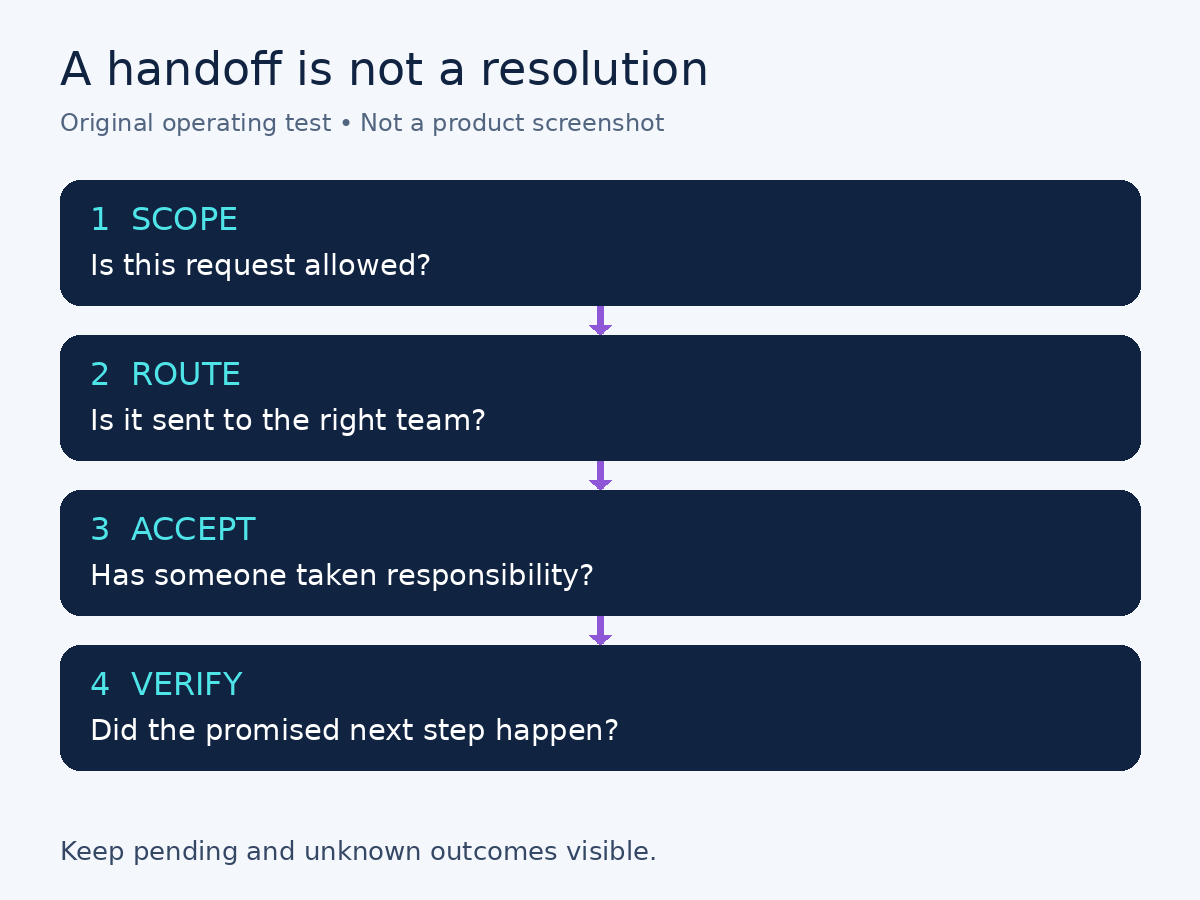
Original operating illustration: Scope → Route → Accept → Verify. These are proposed review checkpoints, not a product screenshot or measured result. Context: the original announcement.
The diagram separates routing from acceptance deliberately. A system may attempt a handoff successfully while the receiving team never accepts responsibility. Verification then checks whether the promised next step occurred, rather than merely counting the initiation of a transfer. Treat the four labels as a practical review aid, not an inevitable sequence for every conversation.
Make exception ownership explicit across shifts. An unresolved request should not depend on the person who happened to be available when the test began. Specify where pending work is visible, who reviews it and how a replacement owner is assigned. Practice a change of shift with synthetic requests and inspect whether any context becomes inaccessible. The objective is continuity of responsibility, not a longer summary. If the receiving team cannot find the pending item, the handoff design is incomplete even when the call itself sounded fluent.
A hypothetical scorecard with clear denominators
Imagine 100 test calls, all using synthetic customer details and the same eligible task. Suppose 80 reach a useful answer or a relevant routing decision. Of those, 50 require a human next step, and staff accept 40. By the review deadline, 32 of the accepted requests have the agreed next step completed; eight remain pending. The other ten requests awaiting acceptance are a separate backlog, not part of those eight.
The useful-answer-or-routing rate is 80/100 = 80%. Acceptance among requests requiring a person is 40/50 = 80%. Completion among accepted requests is 32/40 = 80%, but completion among all requests requiring a person is 32/50 = 64%. Identical percentages can therefore hide different denominators. None of these figures demonstrates revenue uplift, legal compliance or customer satisfaction; they describe this invented operational exercise only.
Keep the scorecard attached to a written definition sheet. A request that appears twice should not become two successful outcomes simply because it crossed channels. Decide how duplicates and reopened requests are represented before comparing teams. Also distinguish test eligibility from successful completion: excluding difficult cases after observing their outcomes can make the rate look better without improving the process. Retain an explanation of exclusions and review unknown states separately. These are proposed measurement controls, not claims about how either named provider calculates its own performance.
Inspect failures without rewarding silence
Review the 20 calls that did not reach a useful answer or routing decision. Separate unclear offers, misunderstood requests and technical interruptions instead of assigning one generic failure label. Then examine the ten handoffs not accepted and the eight accepted requests still pending. Different owners may need to act, so a single overall score cannot tell the team what to fix first.
Do not improve the reported automation rate by discouraging legitimate requests for a person. Track repeat contact and corrections alongside speed, with a defined observation window. If reviewers cannot determine whether a request was resolved, mark the outcome unknown rather than silently treating the absence of another call as success. Keep any use of recordings or personal data subject to the organization's applicable permissions and review process; this article does not establish those permissions.
Use the failure review to change one identifiable part of the workflow at a time where practical. An unclear offer may need a revised explanation; an unavailable receiving team may need a different routing window. If both change together, record that the next comparison tests a combined intervention. Avoid blaming every exception on the model or every delay on staff. A shared review should identify the point where the customer's intended next step stopped being actionable, then assign a repair that can be observed in another rehearsal.
Give marketing a bounded decision
Run the pilot before increasing campaign demand. Compare the advertised task with what the receiving team actually accepts, and review whether the workload can be supported during the proposed launch window. If the routing is accurate but acceptance capacity is insufficient, adding traffic may increase the backlog rather than improve the experience. Correct the constraint that the evidence identifies.
The go-forward decision should name what is ready, what remains excluded and who can stop the rollout. Preserve the test definitions so later results remain comparable. A change in audience, task complexity or staffing can alter the meaning of a headline metric even if its label stays the same. Expansion should follow demonstrated capacity for the selected task, not enthusiasm about voice technology in general.
Prepare the campaign team for an honest launch message. Describe the supported task in plain language and provide a visible alternative when a caller needs a person. Do not advertise unrestricted assistance when the pilot deliberately excludes complex requests. The same scope should appear in the campaign brief, the landing page and the operating instructions. If a commercial owner wants a broader promise, ask what additional capability and staffing would make that promise true. Changing the wording alone does not expand the service that customers can actually receive.
The practical takeaway
Treat the announcement as a prompt to inspect responsibility across a customer journey, not as proof that your own workflow is ready. Before launch, ask four questions: is the request within scope, is it routed correctly, has someone accepted it, and has the promised next step been verified? The most useful answer may be a specific process repair rather than a larger automation target.
This approach keeps the customer promise concrete. It allows automated assistance and human judgment to occupy different roles without declaring either universally better. Most importantly, it gives marketing a way to discuss experience quality using observable states, explicit exceptions and honest uncertainty instead of a reassuring voice alone.
Finally, retain a short decision record after the review. State the selected task, the observed limitations, the accepted next action and the evidence still needed. A future team should be able to understand why the pilot stayed narrow or why expansion was approved without reconstructing every conversation. Revisit the record when the offer or receiving team changes. This preserves learning while allowing a different decision under different conditions. The durable benefit is a clearer customer promise and a traceable chain of responsibility, not a permanent claim that one channel has solved the entire journey.
Comments
No published comments yet.