An AI-assisted research output is ready to inform a marketing decision when the team can trace its important claims to evidence, explain the limits of the interpretation and identify who accepts the next action. A polished presentation alone does not answer those questions. The useful starting point is a specific decision that research can improve, followed by a practical way to review the work before the organization relies on it.
For a marketing director, this changes the conversation about speed. Ask which part of the work becomes quicker, what still needs human judgment and whether the finished recommendation can survive a challenge from sales, operations or finance. The following analysis uses a recent study as a prompt, then develops an independent workflow. Its examples are hypothetical and its suggested measures are proposals, not reported results from a company or a product test.
What the November 10 study actually reports
Listen Labs published its study of 76 US market researchers on November 10, 2026. Fieldwork took place in April and May 2026 through AI-moderated video interviews. Participants came from a professional panel and were screened for relevant employment, research activity and recent use of a research platform. The report says 91% were open to AI in their workflow, while 29% trusted AI-generated insights as much as traditional research.
The bases matter. Rating-scale and multiple-choice findings use 76 respondents; a technology-attitude scale uses 52. Open-ended themes use respondents who supplied codable answers, allow multiple themes per response and can therefore sum above 100%. Those percentages should not automatically be described as shares of all 76 participants. Read the primary study and its methodology.
This is vendor research about reported attitudes. The small US panel does not establish the views of every researcher, GCC-specific preferences, objective AI accuracy or improved business performance. The supplier used its own interview and analysis system. The practical recommendations below are this article’s independent analysis.
Start with the decision that research must support
Write the pending decision in one sentence before choosing a tool. Consider a fictional medical-equipment maintenance supplier deciding whether its service proposal needs clearer scope information. The useful question is why otherwise suitable facility buyers postpone a technical assessment. A broad request to understand customer trust would leave the team with too many possible explanations and no clear next step. Define the audience, the stage in the buying process and the decision that the findings could change.
Next, identify what would count as a meaningful answer. A buyer might need a clearer description of response coverage, an explanation of exclusions or confirmation that the service team can support a particular location. These are different problems with different owners. Research should preserve those distinctions rather than compress every hesitation into a single theme called confidence. The project brief should say which commercial choices are open and which contractual or operational decisions require separate review.
Specify what the study cannot decide. Interviews can help explain participants’ accounts, but a small qualitative project should not become a market-size estimate or a forecast of revenue. If management needs to compare conversion rates, a separate measurement design may be necessary. Agreeing on that boundary early prevents an attractive summary from quietly acquiring a stronger purpose than the evidence can support. It also makes the eventual readout shorter because the team already knows the decision under discussion.
Agree on permitted inputs and the comparison task
Choose material the organization is authorized to use for this evaluation. Check the purpose, access conditions and handling requirements before sending recordings, transcripts or customer details into a tool. Remove unnecessary identifiers and restrict access to the people doing the work. In a healthcare-related business, keep patient information out of a marketing-research test unless a properly authorized process requires it. Technical convenience is not a reason to widen the data being shared.
A useful pilot can begin with a completed study for which the team has a reliable reference. Give the AI-assisted workflow and the comparison workflow the same research question and the same permitted evidence. Record the instructions, versions and review conditions. Avoid giving one route a cleaned dataset and the other an unfinished export, then attributing the difference to the technology. If the inputs need preparation, include that effort in the comparison rather than treating it as invisible background work.
Decide in advance what the reviewer will inspect. The evaluation might cover whether important themes are supported, whether contrary evidence survives, whether counts use the correct base and whether the recommendation answers the agreed question. A reviewer should be able to request a correction without rebuilding the entire analysis. Keep the task bounded enough that someone can inspect the evidence carefully, rather than approving a large collection of outputs from their general appearance.
Review the path from a claim to its source
For each important conclusion, ask for the underlying material and the reasoning connecting it to the conclusion. A theme label is useful only when the relevant responses can be inspected in context. One respondent saying that a proposal was confusing does not establish which passage caused the problem, whether the issue occurred repeatedly or whether it changed the buying decision. The reviewer should preserve uncertainty where a follow-up question would be needed to separate those possibilities.
Look deliberately for exceptions. In the fictional supplier project, several buyers might mention scope clarity while another describes a scheduling conflict. Removing the exception could produce a cleaner story and a worse decision. Keep a short record of evidence that challenges the leading explanation, including cases where the available material is insufficient. This creates a practical way to decide whether the team should revise the proposal, investigate capacity or ask a more focused research question.
Keep counting rules attached to every number. Distinguish people interviewed, people asked a question, people who answered and people whose answer was usable for a particular theme. If one response can receive several codes, explain that the categories overlap. Do not convert qualitative coding into a precision claim simply because a chart can display a percentage. Where a base is too small for a stable comparison, show the underlying counts and describe the finding cautiously.
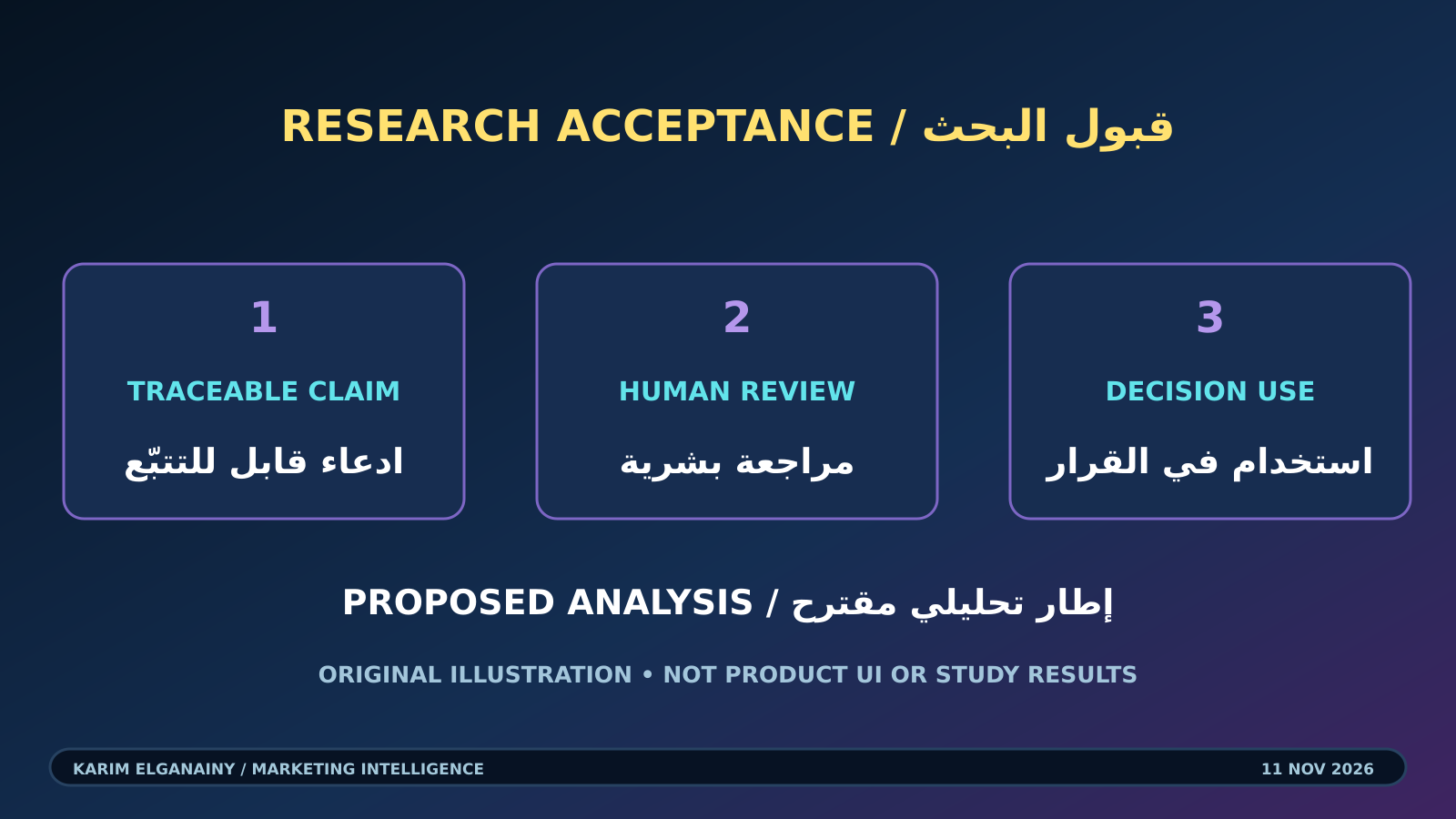
Original conceptual illustration by Karim Elganainy for this article: a proposed review process, not a Listen Labs screenshot, study result or validated causal model. The Arabic and English labels identify a traceable claim, human review and decision use. Transitions represent questions for the reviewer, rather than automatic guarantees of quality. Research context: Listen Labs’ primary study.
Compare useful work without rewarding agreement
The reference analysis also deserves scrutiny. A human-produced summary can contain missing context, inconsistent coding or assumptions that nobody revisited. Use the comparison to examine disagreements rather than declaring the older answer correct by default. When the two routes identify different themes, ask reviewers to inspect the underlying material and explain the difference. The goal is a defensible interpretation, not a high similarity score achieved by reproducing an existing mistake.
Separate errors by their consequences. A spelling error, an unsupported frequency claim and an invented customer statement should not carry the same weight. Define which problems require revision and which make an output unsuitable for the intended decision. For instance, a recommendation based on a nonexistent quotation should be withheld until the evidence is corrected and the affected conclusions are reassessed. A tidy slide cannot compensate for an absent source.
Where practical, let reviewers examine outputs before learning which workflow produced them. Record unresolved disagreements and ask a second reviewer to consider material cases. This is a proposed way to reduce preference-driven evaluation, not a promise that bias disappears. Apply the same acceptance rules to both routes, and avoid changing the scoring after seeing which tool appears to win. If the comparison reveals a weak brief, repair the brief before interpreting the result.
Calculate time per accepted output, including rework
Define an accepted output before measuring productivity. In this hypothetical pilot, an output is a short research brief that meets the agreed evidence and decision requirements. Suppose a comparison workflow produces ten briefs using 300 minutes of preparation and 100 minutes of review. Eight pass. Its time per accepted brief is 400 divided by eight, or 50 minutes. These figures are invented to explain the calculation, not drawn from the study.
Suppose the AI-assisted route takes 120 minutes of preparation, 180 minutes of review and correction, and 60 minutes of setup. Seven of ten briefs pass. The corresponding figure is 360 divided by seven, approximately 51.4 minutes per accepted brief. First-draft production is quicker in this example, yet accepted work takes slightly longer. Rejected work remains in the time total because the organization incurred that effort even though the brief was not usable.
Interpret this small example carefully. Review time, task difficulty, acceptance criteria and repeated setup can all change the result. Record those components separately and repeat the evaluation across comparable work before generalizing. If money rather than time is the decision variable, use the organization’s actual approved cost assumptions. Do not invent a universal hourly rate or convert a reduction in drafting time into a claimed return on investment without accounting for the rest of the process.
Plan the handoff before expanding access
Decide who may prepare material, review interpretation and authorize its use. These responsibilities can sit with different people without creating an elaborate approval committee. A researcher might approve the evidence summary, while an operational owner checks whether a proposed promise can be delivered. The marketing lead then decides whether to test revised messaging. Make those responsibilities visible so a completed research report does not silently become permission to publish claims or change commercial terms.
Prepare a short correction path. Identify how someone flags a disputed statement, which version is current and who checks whether a correction affects downstream work. If a mistaken interpretation has already entered a sales deck, correcting the research file alone may leave the practical problem unresolved. Track the affected materials and ask their owners to review them. The depth of the response should match the importance of the mistake and the audience that received it.
Keep access proportional to the task. Someone testing an analysis workflow may need selected transcripts without needing a whole customer database or publication rights. Review permissions when the pilot ends, especially where a temporary experiment could otherwise become permanent access. The related guide to separating creation from publishing authority develops that organizational question. Research acceptance and publication authorization should remain explicit decisions even when one platform supports both activities.
Make the stakeholder readout a decision record
Open the readout with the question, the evidence boundary and the decision being requested. In the supplier example, the team might propose testing a clearer scope page for one service. Show which interview material supports that proposal, which alternative explanations remain and what must be checked with operations. This is more useful than presenting a long list of themes and expecting a busy stakeholder to infer which action follows from each one.
Include disagreement without making the presentation unreadable. A concise note can explain that some buyers described scheduling rather than proposal clarity, and that the test will track both issues. Preserve the fuller evidence for people who need to inspect it. State what would change the recommendation, such as finding that the relevant information was already understood but the service was unavailable. A decision record should make it possible to reverse course when better evidence arrives.
Choose downstream measures that fit the test. For a revised service proposal, these could include the reasons for postponed assessments, the questions buyers ask and the share of suitable inquiries that proceed. Establish the definitions before comparing periods. Changes in lead mix, service availability or sales handling may affect outcomes, so an improvement after a rewrite does not by itself prove that the research workflow caused it. Keep business evaluation separate from the quality review of the research output.
Translate the research question, not only the report
A multilingual team should review the meaning of the task before translating its conclusions. An Arabic expression of hesitation may not map neatly to an English category chosen during coding. Commercial terms can also carry different implications across markets. Use a reviewer familiar with the relevant language and business context to inspect material differences. Preserve uncertainty where a phrase admits more than one reasonable reading, rather than forcing every response into a convenient shared label.
Maintain the same substantive evidence boundary in every edition. If an English statement says that several interviewed buyers raised an issue, the Arabic, Chinese or Italian version should not turn it into a claim about most customers. Preserve counts, qualifying words, examples and the distinction between an observation and a recommendation. Check the final presentation as well as the text, because a shortened chart title or caption can remove an important qualification even when the translated paragraph is accurate.
For GCC application, choose participants and business contexts relevant to the actual decision instead of importing a foreign benchmark as a target. This is a recommendation for local evaluation, not a claim about a uniform regional preference. Consider differences in service delivery, purchasing authority and language when planning the work. Keep any privacy, contractual or sector-specific questions with the responsible specialists rather than assuming that a translated consent statement resolves them.
Decide what to keep, revise or stop
End the pilot with a written decision on the workflow itself. Keep the parts that produce inspectable, useful work under the agreed conditions. Revise stages where the instructions, inputs or review criteria are unclear. Stop uses that repeatedly produce unsupported conclusions or require more correction than the team can responsibly provide. Record the task boundaries alongside the decision so success on one narrow exercise does not become a blanket approval for every research activity.
The practical opportunity is to make research easier to use without weakening the connection between evidence and action. A team earns confidence by showing how an important claim was checked, why the recommendation fits the decision and what remains unknown. That record is more durable than enthusiasm for a particular interface. It gives the next person enough context to question the work, improve it and decide whether the organization should rely on it again.
Comments
No published comments yet.