
Customer context is useful only when it helps the next interaction become more accurate, safer and less repetitive. A longer history is not automatically a better understanding. For customer-experience leaders, the important question is whether a service can carry forward the right information, recognize what has changed and avoid turning an earlier mistake into a persistent assumption.
The announcement and the evidence boundary
Cresta announced Journey Intelligence on November 12, 2026, connecting interaction history with journey insights and context for human and AI agents. This article is published November 16. Read Cresta’s company-issued announcement.
Everything below is original operational analysis: a proposed evaluation framework, not verified Cresta performance, a product demonstration or a description of its internal implementation. The release establishes the announcement; it does not independently prove improved resolution or savings. The right response is a bounded test with clear information rules, not a promise that more connected conversations will necessarily produce better relationships.
Define the journey around an unresolved need
A journey should have a meaningful boundary. Grouping every interaction associated with an account can create a large record without clarifying what the customer is trying to finish. One person may have several unrelated needs, and a single need may involve several contacts. A proposed operating definition should distinguish those cases before a dashboard starts counting journeys.
For a hypothetical service team, define an issue, its opening condition, what would constitute resolution and when a later contact counts as continuation or a new matter. Preserve uncertainty when the classification is ambiguous. This is not merely an analytics choice: the boundary determines what context reaches the next agent. A billing question should not acquire an unrelated complaint as its explanation just because both occurred recently under the same account.
Separate remembered statements from verified facts
A customer’s statement, an agent’s interpretation and a confirmed action are different types of information. If a summary collapses them into a single confident narrative, the next agent may treat an unverified assumption as an established fact. Repetition can then make the mistake appear more credible without adding evidence.
A proposed context record should preserve source, time and status for consequential details. “Customer requested a refund” is not equivalent to “refund approved,” and neither means “refund received.” Use language that keeps those differences visible. Review whether the summary retains qualifiers and unresolved questions, not only whether it is fluent. The practical standard is whether another authorized person can understand what is known, what is claimed and what still needs checking without replaying every interaction.
Make identity confidence a gate, not a decoration
Helpful continuity becomes harmful if information is attached to the wrong person. Shared contact details, account changes and ambiguous matches should be treated as conditions requiring care, not as rare inconveniences that an attractive customer timeline can conceal. The amount of available history should not itself justify showing that history.
In a hypothetical design review, define the minimum context required for each task and the identification confidence needed to reveal it. When confidence is insufficient, use a restricted path and appropriate verification rather than silently joining records. Separate the ability to recognize an account from permission to disclose every detail associated with it. These are operational recommendations, not statements about particular product controls or legal advice. Confirm relevant obligations through the organization’s established privacy and security process before implementation.
Plan for corrections and contradictions
Memory needs a correction mechanism. A later conversation may clarify that an earlier summary was wrong, that a preference was temporary or that the customer’s circumstances have changed. A system that only accumulates information can preserve obsolete assumptions indefinitely, even while its record grows more detailed.
Ask how conflicting details will be presented to an authorized agent. Prefer an explicit unresolved discrepancy over a falsely tidy story. Specify who may correct the record, what evidence supports the change and how downstream summaries are refreshed. Keep the distinction between updating a current working fact and erasing an audit trail where retention is required. The appropriate design depends on the information and context; the evaluation should surface that dependency rather than assume that the newest statement always wins.
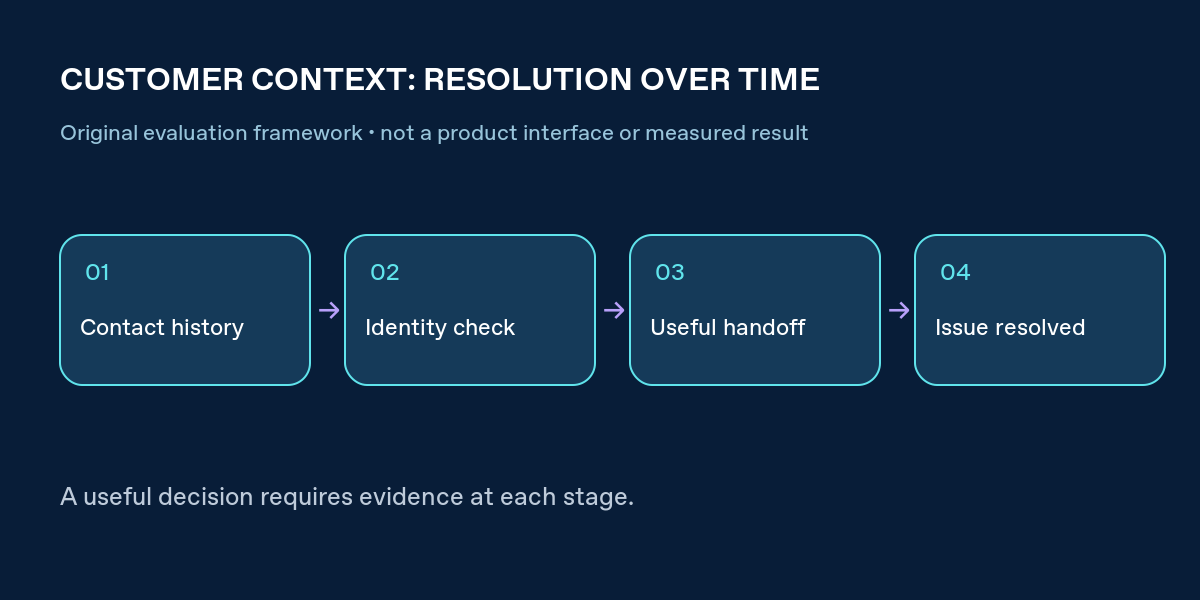
Original explanatory diagram, not a Cresta interface or measured result. Contact history means the relevant earlier interactions; Identity check establishes the appropriate access boundary; Useful handoff preserves the responsible next step; Issue resolved means checking evidence that the need was addressed, not assuming success. The arrows show a proposed evaluation sequence. News context: Cresta’s announcement.
Preserve the next action, not just the story
A beautifully written history can still leave the next agent unsure what to do. Useful continuity requires a clear current state, an unresolved need and an accountable next step. A promise made in one interaction should not disappear merely because the next summary prioritizes background detail.
For a proposed handoff review, ask whether the receiving agent can identify what was promised, who owns the action, what remains conditional and when a customer should expect a response. Do not invent a deadline where none exists. If a step depends on another team, preserve that dependency instead of presenting the issue as complete. Evaluate the handoff with realistic exceptions, including a failed action or a customer returning before the promised follow-up, rather than testing only a clean successful path.
Measure resolution separately from contact speed
A shorter interaction can be useful, but it is not equivalent to resolving the underlying need. A fast handoff may simply move work elsewhere. Conversely, a longer conversation may prevent another contact by explaining the issue clearly and completing the necessary action. The unit of analysis matters.
Define resolution evidence for the chosen issue type before evaluating efficiency. Distinguish an agent marking a case closed from a completed action and from the customer confirming that the need is addressed. None should automatically substitute for the others. Where customer confirmation is unavailable, describe the operational proxy honestly. Pair time measures with appropriate outcome and quality checks so that an apparent productivity improvement cannot be achieved merely by shortening the conversation or moving unfinished work beyond the measurement window.
Treat repeat contact as a question, not a verdict
Repeated contact can indicate unresolved work, but not every subsequent interaction is a failure. A customer might provide requested information, start a different task or check a legitimate ongoing process. A single repeat-contact rate can mix these situations and mislead both managers and frontline teams.
Use a consistent observation period and a defined reason taxonomy. Review a sample of linked interactions to test whether the grouping makes sense. Keep channel transitions visible: a customer who moves from chat to a call may be continuing a task rather than starting over. Explain what cannot be linked reliably. A proposed evaluation should seek avoidable repetition and its causes, not reward a team for making contact harder or interpreting every later conversation as evidence that the previous agent failed.
Test with a bounded, representative case set
Begin with an issue type whose resolution can be checked and whose information requirements are understood. Include ordinary cases and meaningful exceptions: a corrected detail, an incomplete handoff, conflicting information and an uncertain match. This is a proposed testing design, not a report of a completed deployment.
Use authorized, appropriately protected material and avoid expanding data access merely to make the test easier. Review context accuracy before interpreting business outcomes. If comparing assisted and existing workflows, document assignment, case mix, staffing and policy changes that could explain differences. A before-and-after improvement alone does not establish causality. The purpose of the first test is to learn whether the mechanism works safely for a defined task, not to manufacture a universal efficiency benchmark from a convenient set of examples.
Count the cost of maintaining trustworthy context
Connecting history can create work as well as remove it. Teams may need to review summaries, resolve identity exceptions, correct records and investigate unusual handoffs. Those activities belong in the operating assessment, even when another department pays for them. Otherwise apparent savings may simply be displaced costs.
Agree on the relevant cost categories before reading the results. Include training, review and exception handling alongside the time spent on direct contacts. Separate a one-time setup effort from recurring maintenance without pretending that either is free. If the service reduces repetition but requires substantial oversight, that may still be worthwhile; it is a different proposition from automatic savings. The decision should reflect the quality and cost of the complete operating process rather than the speed of one visible interaction.
Adapt carefully for multilingual and sensitive services
A multilingual journey can lose meaning when a summary translates a tentative statement into a firm conclusion or misses the difference between a request and a commitment. Review important qualifiers across languages, including Arabic, with people who understand the service context. Do not assume that fluent wording proves faithful continuity.
Healthcare settings require particular caution. Administrative navigation should remain distinct from clinical advice, and historical health information should not be carried into a marketing or service conversation simply because it exists. Use the organization’s authorized privacy, clinical and security review to define appropriate access and escalation. This is a boundary for responsible evaluation, not a claim that a general customer-experience feature is suitable for clinical decisions. Start with the legitimate task and minimum necessary context, not with the largest possible customer profile.
Decide what evidence permits expansion
A pilot should end with a decision, not just a dashboard. Set advance criteria for acceptable context quality, useful continuity and manageable exception work. Identify the failures that require a pause, especially wrong-person context or consequential false statements. Give someone responsibility for stopping the affected path and verifying the correction.
Karim’s strategic takeaway: the valuable asset is not accumulated conversation history; it is trustworthy continuity of service. Expand only when the team can explain which need is being carried forward, what information is reliable, who owns the next action and how resolution is checked. If the evidence shows faster summaries but uncertain outcomes, improve the operating model before promising better relationships. Context becomes an advantage when it reduces the customer’s burden without weakening accuracy, boundaries or accountability.
Comments
No published comments yet.