Why is it not enough for people to know your name?
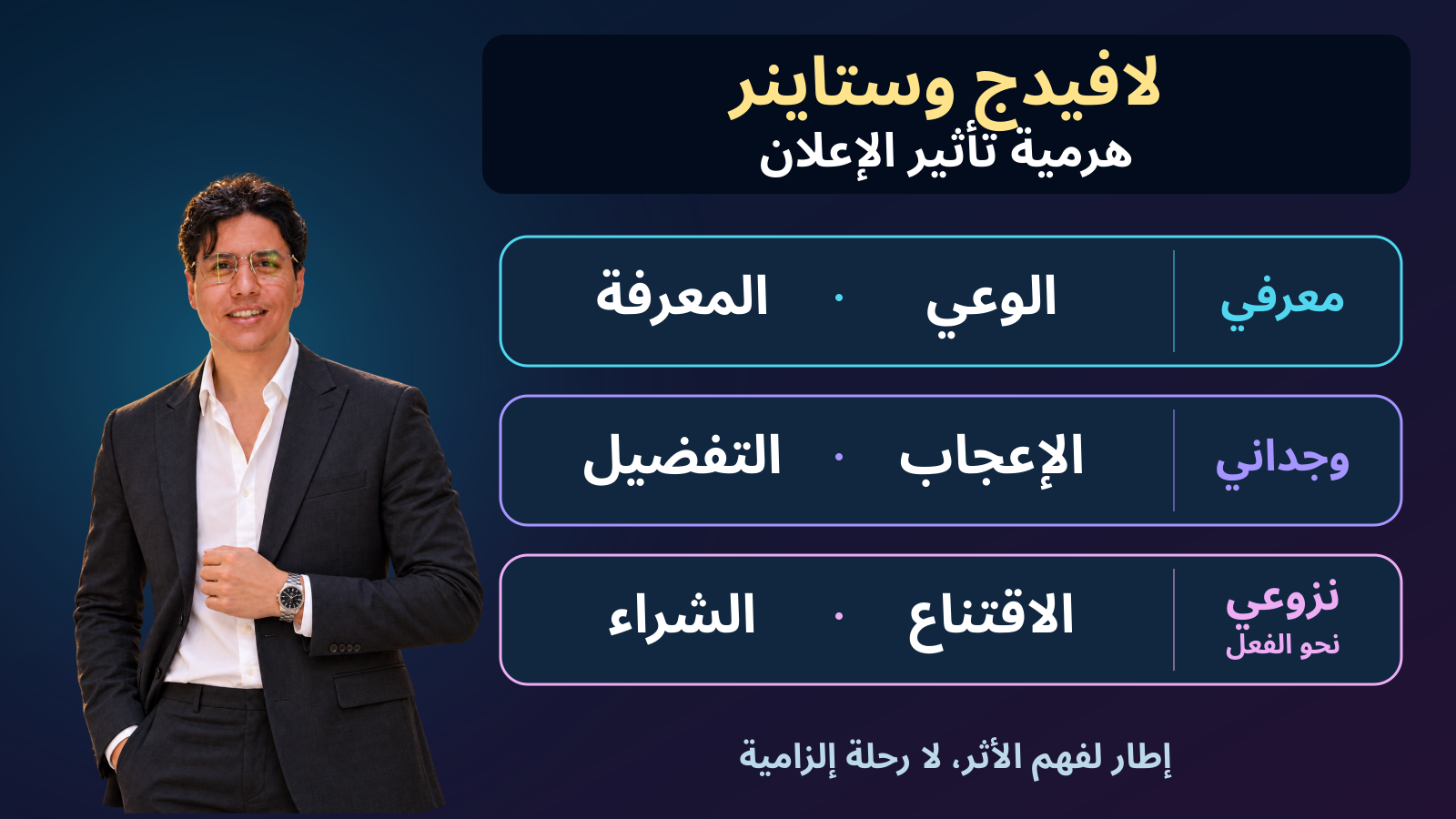
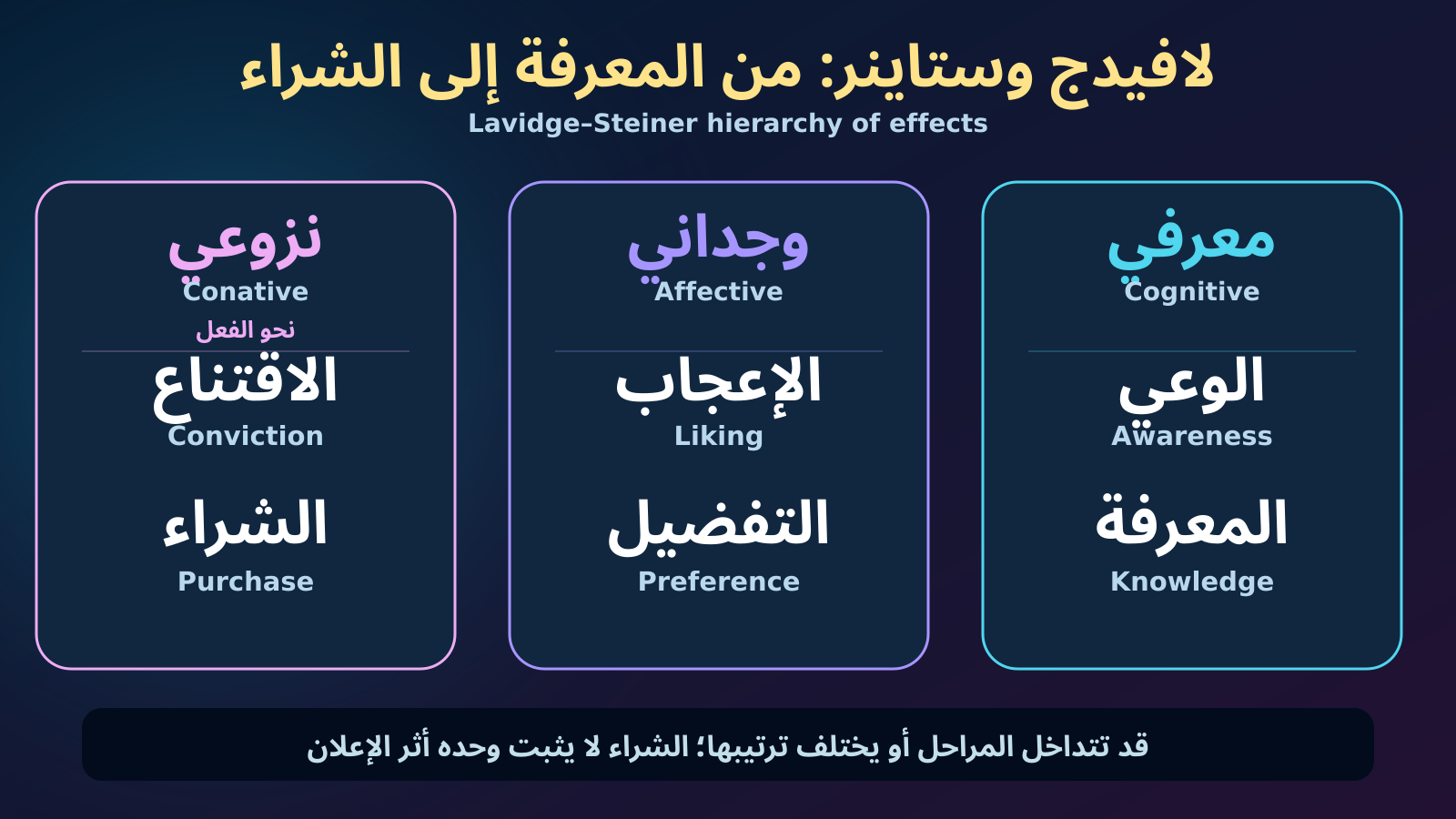
The Lavidge and Steiner hierarchy-of-effects model helps marketers distinguish six different outcomes: awareness, knowledge, liking, preference, conviction, and purchase. Someone may know an organization's name without understanding its offering, like an advertisement without preferring the product, or prefer the product and still not buy because of price, timing, or difficulty completing the process. The model's value lies in making communication objectives more specific and preventing exposure from being equated with trust, or intention with action. It is not, however, a mandatory description of every customer's path, nor a machine that can read someone's mind from a click.
Imagine a manager seeing campaign reach increase and asking why sales have not increased at the same rate. Before requesting more budget, we need to understand which question the campaign actually answered. Did the audience merely learn the offering's name? Did they understand what it provides and whom it suits? Was there enough information to compare options? Can the team deliver the step promised in the advertisement? The problem could lie in the message, the offering, distribution, or operations. A marketing diagram should not become a ready-made explanation for every weak result.
This lesson explains the definition and then presents original analytical applications. All cases and figures used below are hypothetical training examples, not client results or industry benchmarks. In the healthcare example, we distinguish requesting an appropriate assessment from deciding on treatment: marketing does not determine clinical suitability and should not manufacture medical need or encourage an unnecessary procedure. You can compare this framework with the AIDA model, but the aim here is to understand the differences between knowing an offering, preferring it, and carrying out a decision, rather than simply renaming the same stages.
The model's origins and what it adds
Robert Lavidge and Gary Steiner published their paper, “A Model for Predictive Measurements of Advertising Effectiveness,” in the Journal of Marketing in 1961. The publisher's page confirms October 1961, volume twenty-five, issue six, pages fifty-nine to sixty-two. The abstract begins with advertising's function and what it should accomplish, then connects that with choosing how to measure its effectiveness. This is historical background to the model, not new news as of this lesson's publication date. Original publisher source.
The six stages can be organized into three groups: cognitive, comprising awareness and knowledge; affective, comprising liking and preference; and conative, comprising conviction and purchase. “Conative” here refers to an inclination and readiness to act; it does not mean that internal conviction is a completed purchase. The academic reference hosted by Columbia Business School presents this grouping and cites Lavidge and Steiner's paper. Reference for the three-part grouping.
This is where the practical application developed in this article begins. Instead of asking, “Is the advertisement good?” we ask, “Which gap do we want to address, and what evidence would show that we have addressed it?” A new brand may need a clear introduction, a familiar offering may need an important difference explained, and a convinced customer may need a payment or booking obstacle removed. These are different decisions, so selecting one metric and calling it success in every situation is not enough.
Awareness: knowing the name is not understanding the offering
Awareness is a starting point concerned with knowing that a brand or offering exists. But advertising impressions alone do not prove that someone noticed or remembered it. The message may pass in front of a distracted person; they may remember the idea but not the organization, or remember the name and associate it with a different service. We therefore need to distinguish advertising distribution data from measurement of what the audience learned. The former matters for monitoring delivery; the latter requires a question or test suited to the objective. They should not be confused simply because both appear in a marketing report.
Start by defining what should remain in someone's mind after the first encounter. Do you want them to know that a service exists in a particular city, or that your company provides a solution for a specific type of business? Bring the name, category, and core benefit together clearly, and do not leave the identity until the end of a long piece that most of the audience will not watch. The more general the promise, the more likely people are to remember attractive words without understanding what distinguishes your offering or when they might need it.
Review the quality of awareness, not just its scale. If the audience comes to see the organization as always the cheapest, while its offering depends on specialist service and higher cost, you may be creating expectations that harm later stages. If a healthcare advertisement associates the name with a guaranteed outcome, the problem is not poor recall but the content of what people remember. Choosing an honest, specific message from the outset saves the service team the effort of correcting a promise it cannot fulfill.
Knowledge: what does the person actually understand?
Knowledge goes beyond recognizing the name. People need to understand what the offering includes, whom it suits, its conditions and limitations, and how to use it. That does not mean putting every piece of information on one page. It means making the essential answers available to those who need them, without exhausting searches or internal jargon. A technical offering may need a use case, a professional service may need a description of deliverables, and a healthcare appointment may need an explanation of what happens during the assessment and what it does not include.
You can test understanding with an open question rather than settling for a participant saying that the page is clear. Show them the message, then ask them to describe the service in their own words: who benefits, what do they receive, and what happens next? If they repeat the slogan but misunderstand the scope, that indicates a knowledge gap. Do not treat answers from a small number of participants as statistics representing the whole market. Use them to identify potential confusion, then test the scale of the problem in a way suited to your decision.
The customer service team can help identify frequently asked questions, but it is not the only source of truth. People who call may differ from those who leave the page silently, and some confusion may originate in a particular channel. Classify questions by source and context without collecting unnecessary personal data. Then correct the information in the reference version used across all channels, instead of adding another manual response for each employee while leaving the old page unchanged.
Liking: a positive feeling is not a choice
Someone may see a brand as pleasant, professional, or aligned with their style, yet still find its offering unsuitable for their needs. This is the distinction we must preserve when interpreting liking. Similarly, a social platform's like button is an interface action, not a complete measure of someone's feelings about a product. They may be responding to the image, joke, or information, rather than intending to use the service. Do not turn a simple interaction into a conclusion broader than the data permits.
In practice, review what makes learning about the offering comfortable and respectful. Clear language, readable design, professional responses, and honest imagery can contribute to a positive impression. But do not add decoration that hides essential information or makes conditions hard to read. Presentation should support understanding, rather than buy a moment of liking followed by a sense of deception when the real price or restrictions omitted from the first message emerge.
To understand impressions, ask about specific elements rather than a general question that invites politeness. What seemed trustworthy or unclear? Which phrase made the participant hesitate? What did they expect but not find? Keep an impression of the advertisement separate from an impression of the organization and actual experience with the service. People may like the campaign's style while complaining about delivery, and an engagement report alone cannot reveal that distinction.
Preference: why choose you over the alternatives?
Preference involves comparison, even when someone does not name competitors. They may compare your offering with another solution, doing the work internally, or postponing it altogether. A long feature list therefore does not establish that you are the best fit. Start with the segment's decision criteria: ease of use, service scope, delivery time, support, or total cost. Then provide information that enables comparison without misrepresenting alternatives or inventing superiority you cannot document.
The reason for preference can differ between user and buyer. An employee may want a simple interface, the manager clear oversight, and finance predictable terms. If the campaign focuses only on user convenience, it may build liking that never turns into purchase approval. Collect objections from people in different roles and identify what needs explanation and what needs changing in the offering itself. Do not address a genuine product shortcoming by rewriting the promise more attractively.
In healthcare, comparison should not become a promise that one provider guarantees the best outcome for everyone. You can explain available specialties, verified qualifications, location, appointment procedures, and service scope. Suitability for a particular case, however, requires clinical assessment. Making comparison clearer does not require pushing someone into a choice they do not understand, or exploiting fear to bypass their questions or rush their consent.
Conviction: readiness to decide is not the decision itself
Someone may prefer your offering but still not be ready to commit. They may need internal approval, clarification of the cancellation policy, information about data migration, or confirmation that a suitable appointment is available. The question now concerns the uncertainty that remains. Do not assume the answer is more pressure or a countdown timer. Sometimes a clear scope document, a limited trial, or a candid answer about a service limitation is more useful than repeated reminder campaigns.
Distinguish a statement of intent from a completed outcome. A survey participant saying they “might buy” is not a contract; a quotation request does not prove a budget exists; adding a product to a cart does not mean payment. Use intention to understand a possible direction, then track action under a separate definition. If the decision cycle is long, do not penalize every campaign for failing to produce immediate sales, but do not award it untestable success under the banner of long-term trust building either.
Responsible conviction means the person understands the commitment and can decline it. For renewable products, explain renewal and cancellation; for services, explain scope, duration, known costs, and what needs an additional estimate. In healthcare, do not confuse someone's willingness to book with informed consent to treatment. The marketing invitation should end at the appropriate step, after which the relevant professional process handles whatever requires assessment, explanation, and separate consent.
Purchase: verify completion, not the button
Purchase is an action with a clear operational definition, such as a paid order or an effective contract under the organization's operating system. It is not synonymous with every digital conversion. You can track an appointment request or demonstration session as an intermediate step, provided you label it accordingly. Do not rename a form submission an acquired customer to improve the report, or combine payments and canceled orders in one figure without explanation. Precision in definition matters more than choosing a number that looks large in a monthly presentation.
Inspect the entire path from advertisement to completed action. Does the form work on a phone? Are conditions visible before confirmation? Does the request reach the responsible person exactly once? Is a payment method available to the audience? Is there enough stock or operational capacity? Someone may know, prefer, and feel convinced, yet stop because the system does not work. In that case, fixing the process takes priority over buying additional reach or interpreting the problem as weak desire.
Nor does the work end with the sale. An advertisement may generate sales and then increase cancellations or complaints because it created an inaccurate expectation. Review delivery quality, collections, refunds, and actual usage to the appropriate extent. If your aim is to build the relationship after action, the EAIDAL model adds room for education and loyalty, while retaining the need to protect customer freedom and privacy and avoid equating repetition with satisfaction.
First hypothetical example: software for managing business requests
Suppose a company provides software for small service teams and wants to improve the quality of inquiries, not just their volume. Hypothetical training interviews reveal that the audience knows the software's name but thinks it is a simple task list. The first problem concerns knowledge: content needs to explain the difference between an individual task and a request with an owner, status, and history. The company therefore produces a short example showing one request's workflow, followed by a page explaining integration, training, and permission scope, without claiming time savings it has not actually measured.
Next, it examines preference among real alternatives. One prospective customer cares about easy data migration, another wants responsibility tracking, and a third prefers staying with spreadsheets because they do not see the cost of disorganization. The message does not try to persuade everyone. It offers clear fit criteria, provides an explanatory session for those suited to the offering, and explains the system's limitations to those needing an unavailable function. Total inquiries may decrease, but that is not failure if the team now spends its time on needs it can serve.
Assume fifteen thousand riyals are spent on a time-limited test, generating one hundred and fifty unique inquiries. Ninety turn out to be suitable, sixty demonstration sessions are completed, and thirty customers begin a paid subscription. The cost per inquiry is one hundred riyals; per suitable inquiry, approximately one hundred and sixty-seven; per session, two hundred and fifty; and per new subscription, five hundred riyals, counting campaign spending alone. These hypothetical calculations exclude the full cost of sales and support, and do not establish profitability without contribution, collection, and cancellation data.
The subscription rate from completed sessions is fifty percent, but that alone does not measure psychological conviction. Attendees may have been more ready to begin with, or the team may have filtered out unsuitable inquiries before the session. If conversion falters, review the reason for each category of cases: a missing function, timing, budget, or ambiguity in the agreement. Do not infer from the number that you need more persuasion. The right recommendation may be to change the segment, product, or trial terms.
Second hypothetical example: a healthcare assessment service
Imagine a center offering an assessment appointment with a specialist and wanting the public to understand what the appointment includes before requesting it. The awareness message introduces the location and specialty, while knowledge content explains the visit's steps and what needs confirmation from the team. A professional impression can be built through calm language and documented information, rather than fear or treatment promises. Preference rests on details people can compare, such as service scope, accessibility, and appointment availability, not a guaranteed health outcome.
At the conviction stage, someone may need to know the cost, how the time is confirmed, and the rescheduling policy. Say “Request an appointment and we will contact you to confirm it” if booking is not immediate. Do not request sensitive health details in a marketing form merely to improve qualification, and do not send those fields' contents to advertising tools. When clinical information is necessary, the process should move to the appropriate professional channel with its safeguards, rather than turning the marketing report into a repository of patient data.
Assume a test spends nine thousand riyals and produces ninety valid, unique requests, followed by fifty-four confirmed appointments and forty-five attendees. The cost per request is one hundred riyals; per confirmed appointment, approximately one hundred and sixty-seven; and per attendee, two hundred. The confirmation rate from requests is sixty percent, and attendance from confirmed appointments is approximately eighty-three percent. These are hypothetical operational metrics: attendance is not a successful treatment and does not prove that the campaign created clinical value.
If many people who contact the center expect treatment within the assessment appointment, begin by correcting knowledge and the scope description. If expectations are accurate but times are unsuitable, discuss operations. If the location is unclear, fix the directions. Do not use the model as an excuse to explain every problem as insufficient conviction, or measure marketing success by increasing procedures the person does not need. The goal is an appropriate decision and a clear experience the organization can deliver.
How do you measure without constructing an imaginary funnel?
Choose a measurement method suited to each question. You may need recall research for awareness, a comprehension test for knowledge, questions about impressions and comparisons for preference, and operational definitions for inquiries and sales. Not all these measures automatically exist in an advertising platform. You cannot call video views knowledge, likes preference, or a pricing-page visit conviction without additional evidence. An indicator may help form a hypothesis, but it does not reveal an internal state with certainty.
Keep the denominator, period, and group consistent. Do not divide a month's purchases by a week's visits, compare unique people with impressions, or treat a small survey's respondents as if they were the same people who purchased. If you cannot link the measures reliably and permissibly, present them separately and explain their limitations. Drawing six boxes with numbers does not make the data comparable, and may give readers false confidence in transitions you never measured.
You must also distinguish correlation from causal impact. Brand knowledge and sales may rise together because of seasonality, a price change, or distribution activity. To estimate the effect of a message change, design an appropriate comparison, hold constant what you can, and record the factors that changed. Do not describe simultaneous improvement as proof that a particular stage succeeded. When evidence is limited, state what it actually supports and identify what would strengthen the decision, instead of manufacturing certainty you do not possess.
The model's limitations and common misuses
The sequence is useful for thinking, but it is not a law that everyone follows in one direction. A consumer may try a product before knowing much about it, a previous buyer may return directly to purchase, or decision stages may be distributed among committee members. Circumstances may change and a previously convinced person may reconsider. Use the framework to identify possible questions and messages, then test them in your audience's context instead of imposing a fixed journey on people with different knowledge, needs, and experience.
One mistake is dividing the budget equally across six stages simply because the diagram contains them. The main gap may concern knowledge, offering availability, or an operational step advertising cannot fix. Start with the most important obstacle supported by evidence, and identify what you can change and who controls it. Do not ask the content team to remedy unsuitable pricing or a product missing an essential feature, or make sales responsible for correcting every ambiguity that could have been clarified on the page.
Another mistake is turning distinctions in terminology into artificial precision. Liking, preference, and conviction are not boxes into which people can be confidently sorted with one quick question. Measurement requires clear wording, an appropriate sample, and cautious interpretation. Results may also differ between a low-risk product and a high-commitment service. Do not transfer transition rates from a training example into a real budget, or use the model's fame as a substitute for evidence specific to your decision.
Turn research into a decision, not a survey that invites compliments
Before writing questions, define the decision that will change based on the answers. If choosing between two explanations of the offering, ask what the participant understood and expected after reading. If investigating a lack of preference, explore comparison criteria and alternatives they are considering, not just how much they like the colors. A broad question such as “Did you like the advertisement?” may produce a positive answer that does not help identify what needs fixing in the campaign, page, or offering itself.
Avoid questions that teach people the answer. “Do you find our outstanding service easy to use?” combines a predetermined judgment with a question and may encourage agreement rather than observation. Begin with a neutral description and let people explain their experience without quickly correcting them. Then ask for an example of what they found clear or difficult. Do not turn a learning session into a sales presentation. Defending every choice reduces the chance of discovering the gap the team overlooked because it knows the product so well.
Also distinguish people who had not previously known the offering from those who have actually used it. An existing buyer may understand a message because experience fills in the gaps, while a new visitor cannot. A longtime user's view may also be influenced by a support problem a newcomer has not encountered. Comparing the two groups is useful when made explicit, but becomes misleading if you combine them into a single average and describe it as the opinion of the entire target audience.
Record in the report how participants were selected, the sample size, and what cannot be inferred from it. Observations from ten interviews may reveal important types of confusion, but do not establish their prevalence among thousands of customers. A large survey can repeat a poor question and produce a precise-looking number with little meaning. Research quality requires the tool, question, and sample to fit the decision, rather than choosing the largest number or neatest chart.
After gathering observations, organize them into problems of understanding, fit, evidence, or execution. Assign each problem an owner and a follow-up step, then retain the version of the message you tested and the test date. When you change the page, review whether the same confusion decreased and whether a new problem appeared. This small loop connects the model to actual learning and protects the team from repeating surveys that change nothing, or revisiting the same discussion every month without a record of what was tried.
A practical exercise before the next campaign
Choose one offering and one segment, and write down what people should know, what they need to compare, and what might prevent them from acting. Gather observations from marketing and sales or service, then separate facts from assumptions. For each assumption, identify evidence that can be collected appropriately and with less intrusion on privacy. Do not begin with six campaigns. Begin with one gap you can test without changing every part of the experience simultaneously.
Define a specific experiment, such as clarifying service scope before the form, or adding a usage demonstration that answers a recurring objection. Specify a primary outcome and a safeguard outcome: inquiry quality while monitoring completion, understanding of the offering while monitoring confusion, or sales while monitoring cancellations. Agree on a duration suited to the decision cycle and stopping conditions such as a measurement error or an inaccurate promise. Then review the result with the team delivering the service, not with the advertising dashboard alone.
The model's central lesson is that knowing the name is not knowing the offering, liking is not preference, preference is not sufficient conviction, and intention is not purchase. These distinctions help you choose a more appropriate message, metric, and action. Use Lavidge and Steiner as a map of questions, not a substitute for research, operations, or ethical judgment. When the message is honest, measurement is specific, and execution is consistent, campaign improvement becomes a decision you can learn from and review, rather than a pursuit of numbers that merely look attractive.
Sources
- Lavidge and Steiner, original paper at Sage, October 1961: publication details and abstract; access to the full text is restricted on the publisher's site.
- Academic reference hosted by Columbia Business School: the file's second page explains the cognitive, affective, and conative groups, citing the original model.
Comments
No published comments yet.