
A larger billboard network can simplify buying, but it does not automatically deliver more people who are useful to an advertiser. Lamar’s acquisition of Newman Outdoor inventory is a timely reason to separate the size of a media owner’s portfolio from the incremental audience and business outcomes a particular campaign can achieve. The practical question is not simply how many faces are available. It is which locations add relevant exposure, at what frequency, on what terms, and with what evidence of value.
This article distinguishes the verified transaction from an original planning framework. The recommendations below are proposed advertiser practices, not disclosures about Lamar’s pricing, measurement systems or integration plans. The hypothetical example is not a client case study and does not imply that the acquisition has already improved campaign performance.
What the announcement actually establishes
On November 11, 2026, Lamar announced the acquisition of Newman Outdoor Advertising assets. Its investor-relations release says the transaction closed that week and adds more than 2,250 billboard faces, including 73 digital displays, in North Dakota, Minnesota, Montana and South Dakota. Payment was in cash, but the purchase price was not disclosed. Newman’s non-billboard operations and Southwest billboards had previously been divested and are outside the inventory described in this transaction.
Those facts describe an ownership change and a geographic footprint. They do not provide campaign-level reach, negotiated rates, advertiser returns or an independent assessment of competitive effects. “More than 2,250” is not an exact denominator from which to report a precise digital percentage. A face is an advertising surface, not a unique person; digital screens also require an understanding of the purchased schedule rather than an assumption of continuous exclusive exposure.
Start with the business geography, not the inventory catalogue
Before requesting a package, define the area in which the business can serve a customer well. A retail catchment, a delivery boundary and a specialist service’s drawing area can be different. Mark current locations, planned openings, access routes and places where additional demand would be difficult to fulfil. A campaign should not create a persuasive invitation to a service that is unavailable or operationally constrained in the advertised area.
Then distinguish awareness from immediate response. A regional launch may need recognition among people who will purchase later; a local promotion may need qualified visits during a defined period. Neither objective is inherently better, but each changes which locations and measures are relevant. Write one primary objective and a small number of supporting measures before comparing proposals. Otherwise an impressive inventory total can quietly replace the commercial problem the campaign was meant to solve.
Audit the location-level offer
Request a location list that identifies each face, its direction, format, proposed dates and practical buying conditions. Examine placement relative to the intended audience’s journeys, not merely the distance from a branch on a map. Two sites close to each other may address different travel directions; two distant sites may repeatedly reach the same commuters. These are questions for a location review, not conclusions that can be inferred from ownership or state boundaries.
For digital inventory, clarify the purchased dayparts, duration, rotation and evidence of delivery. For static inventory, clarify production, installation and removal responsibilities. Ask how unavailable placements or interrupted delivery are handled and whether substitutions require approval. Compare offers on the same documented basis. A lower headline media price can lose its apparent advantage when a package has different production requirements, shorter delivery windows or less useful geographic coverage.
Separate additional reach from additional repetition
Repetition can help an audience remember a message, but additional repetition and additional people are not interchangeable benefits. Ask the seller or measurement provider how reach and frequency estimates are produced, which period they cover and what assumptions are used to account for duplicated exposure. Keep estimated audience measures clearly labelled as estimates. A portfolio expansion alone does not supply that evidence for a particular schedule.
Build an overlap review around actual travel corridors and the existing media plan. Flag placements that appear likely to reinforce exposure already purchased, and placements that might add a genuinely different route or catchment. Treat those flags as planning hypotheses until supported by appropriate measurement. It can be rational to buy reinforcement, especially for a difficult message, but the budget justification should say that explicitly rather than claiming every added face represents newly reached customers.
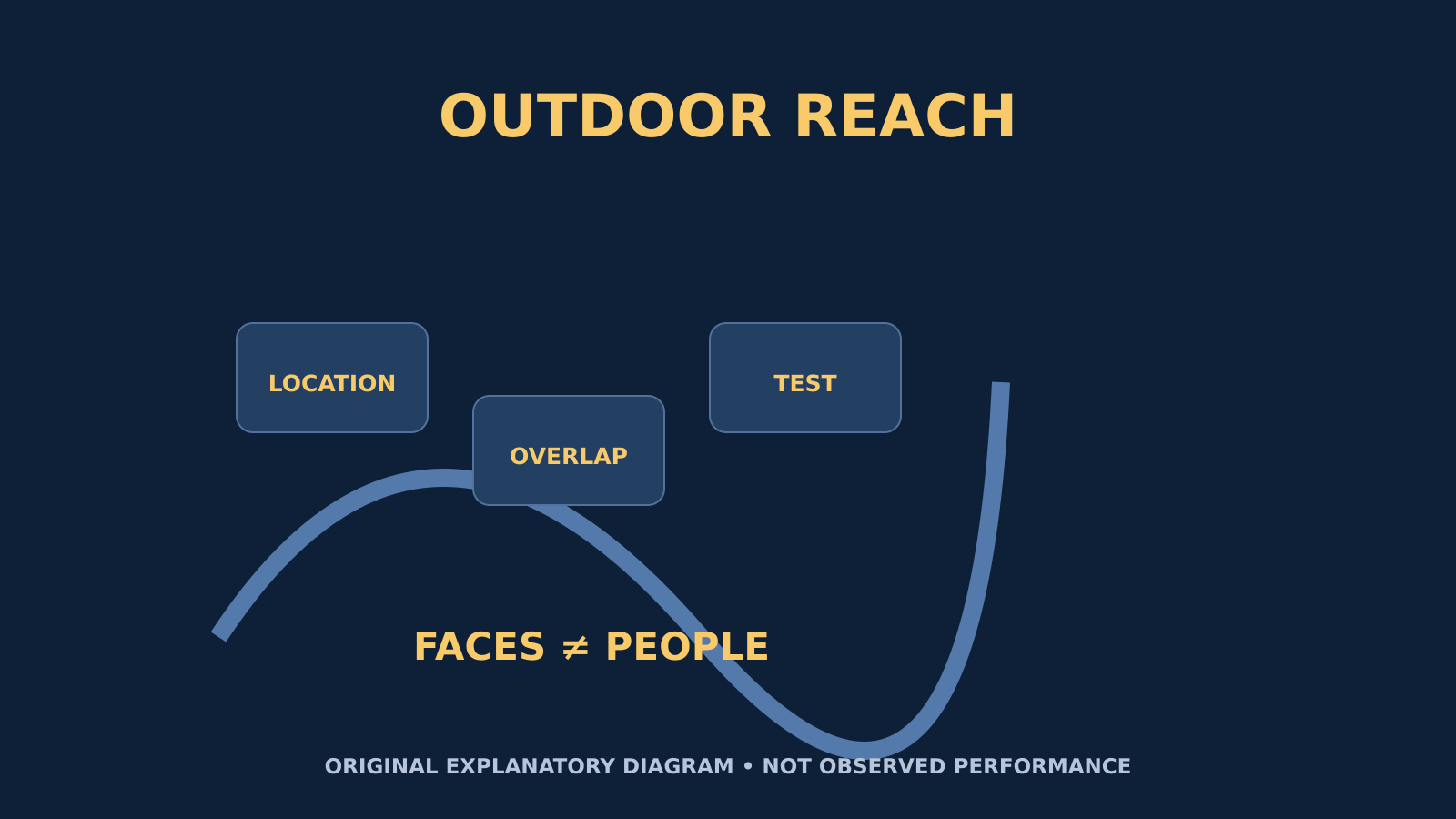
Original explanatory illustration: a curved route links LOCATION, OVERLAP and TEST, with FACES ≠ PEOPLE below. It illustrates planning questions, not observed audience reach or delivery data. Transaction facts: Lamar announcement.
A hypothetical local-network decision
Imagine a regional retailer considering two proposed outdoor packages for an upcoming opening. Package A concentrates on familiar commuter routes around established branches. Package B shifts part of the schedule toward the new branch’s practical catchment. This is a hypothetical example with no actual prices, audience counts or results. The comparison is useful because it forces a choice between reinforcing an existing audience and exploring a different geographic opportunity.
The team first checks whether the new branch can handle the demand being invited. It then reviews routes, creative legibility, delivery conditions and the basis of the audience estimates. If Package B appears more relevant, that is a reason to test it, not proof of superior returns. Record what would change the decision: inadequate delivery, weak relevant awareness, poor qualified traffic, or a business outcome that does not justify the full campaign cost.
Use a creative brief that fits a passing audience
The media choice and the creative should be reviewed together. A location may be appropriate while the message is too complicated to understand in its real viewing context. Define a single communication task, a recognizable brand cue and a truthful next step. Test the actual layout at realistic scale rather than approving a large presentation slide whose details will not survive the eventual viewing conditions.
Do not make a driver responsible for capturing complicated information while moving. Evaluate whether the message can be understood without a long address, dense terms or a phone interaction. Where the offer requires qualifications, avoid turning an essential caveat into unreadable text. A concise, accurate promise is more useful than an attractive claim that becomes misleading when its conditions cannot be communicated properly in the chosen format.
Design the evaluation before the booking
A before-and-after sales change is not automatically the effect of outdoor advertising. Seasonality, promotions, other channels, competitor activity and changes in availability can move outcomes at the same time. Where feasible, compare suitable geographic areas with similar prior patterns while varying the outdoor intervention. Define the comparison, timing and primary outcome before seeing the results, and seek appropriate analytical support for sample size and uncertainty.
Geographic comparisons also have limitations. People cross boundaries, media spill into neighbouring areas and locations rarely match perfectly. Record these risks rather than presenting the design as a clean laboratory experiment. If the available data cannot credibly isolate an incremental effect, report descriptive performance and uncertainty instead. An honest limited conclusion is more useful for the next allocation than an impressive return figure produced by attributing all growth to the campaign.
Keep delivery, response and profit in different columns
Use a reporting structure that separates what was bought, what was delivered, how audiences responded and what happened commercially. Delivery evidence can establish that the contracted schedule ran; it cannot, by itself, establish attention or a sale. Branded search, direct website visits and customer enquiries may provide useful context, but each can be affected by other activity. Do not add them together as if they were independent new customers.
For a commercial outcome, agree how qualified visits, completed transactions, cancellations and repeat customers will be treated. Evaluate incremental contribution only when the design and data support an incremental estimate. Include media, creative, production and measurement costs on a consistent basis. Keep revenue separate from contribution or profit, and state the attribution window. A transparent decision record lets another colleague understand both the calculation and the limits of what it can demonstrate.
Procurement after consolidation
An enlarged supplier relationship may reduce administrative work, but convenience should be measured rather than assumed. Ask whether a proposed consolidated package preserves location choice, provides clear itemization and allows unsuitable placements to be declined. Compare alternatives for the same business objective, not just the number of faces. The reviewed announcement does not establish future prices or contract terms, so claims about automatic discounts or price increases would be speculative.
Keep a record of who owns approvals, creative changes, delivery disputes and reporting. Review any proposed substitution against the original objective rather than accepting it solely because the replacement belongs to the same network. If a new arrangement simplifies invoicing but weakens useful coverage, the operational saving may not justify the trade-off. Conversely, a documented reduction in administrative effort can be a genuine benefit when audience suitability and service remain adequate.
A practical decision sheet
Prepare a one-page summary before commitment: business objective, service geography, selected locations, expected role of repetition, delivery conditions, full cost basis, measurement design and decision thresholds. Attach the underlying location-level proposal rather than relying on the summary alone. Have operations check fulfilment, creative review the message, procurement examine terms and analytics review the proposed evidence. This does not require a large bureaucracy; it makes a small team’s assumptions visible.
After delivery, compare the evidence with the pre-agreed questions and document what should be retained, changed or stopped. Avoid changing the success criterion simply because one secondary metric improved. The value of Lamar’s expanded footprint for an individual advertiser will depend on those specific choices, not on the acquisition headline. More available inventory creates options; disciplined selection and credible evaluation determine whether an option deserves the budget.
Source and editorial boundary
The transaction details come from Lamar’s November 11, 2026 announcement, also available as an official PDF. The source does not disclose the purchase price or provide advertiser performance results. The planning framework, diagram and retailer example above are original analysis and hypothetical guidance. They are not investment recommendations, statements of personal campaign experience or claims about results produced by Lamar or Newman.
Comments
No published comments yet.