Imagine that an advertisement for a new service does its job perfectly. People find a clear explanation, visit the page and submit a request. Then nobody on the team knows who should follow up. The marketing manager reads the low booking count as a problem with the audience, while the receptionist sees a campaign that brought in requests the system was not designed to handle. Both are seeing a real part of the picture, but buying more visits will not close the gap in responsibility between them. The team needs a different way of working, not a louder campaign.
John Kotter's model offers eight steps for leading this kind of organizational change. It starts by identifying why change matters now, then by building a coalition and a practical vision. It moves on to communicating that vision, removing barriers to execution and demonstrating an early win. Finally, the team builds on what it learns and makes the new behavior part of everyday operations. We will apply the steps to appointment requests and in-store pickup, and distinguish an improvement in an internal process from an improvement in a business outcome. Both examples are entirely hypothetical and designed for teaching.
When does Kotter help, and when is it unnecessary?
The dividing question is whether one person can fix the problem with their existing authority, or whether improvement depends on repeated behavior across multiple teams. If a button on a page is broken, fix the link and verify the result immediately. But if the offer promises prompt contact and that promise depends on coordination among marketing, sales, reception and IT, the model clarifies what has to change and whether the organization is ready. Here the program does more than fix one fault. It helps prevent the bottleneck from returning when the campaign or shift changes.
Start by defining what this framework cannot fix. It will not tell you which audience is most willing to buy, which version of an ad answers a customer's objection, or whether the market needs the offer in the first place. Test those questions with suitable research and experiments. If you do not know whether the issue lies in the ad or in follow-up, map the journey and inspect each handoff before adopting an organization-wide solution. You can use the McKinsey 7S model to diagnose misalignment, then use Kotter to plan how to put a change into practice. The two models do not compete to answer the same question: the first helps diagnose the conditions for execution, while the second organizes what leaders do to change behavior.
This lesson follows the structure of lecture six in the Digital Marketing Strategy course, which groups the steps into three phases: setting the stage, engaging and enabling the organization, and implementing and sustaining the change. In step four, we use the course's formulation: communicate the vision to everyone whose work it affects. Kotter's current presentation emphasizes mobilizing a wider network of participants. The practical issue is not which phrase you choose, but whether the people responsible for making the change understand it and can take part. The grouping directs a leader's attention; it is not an instruction to prevent overlap or to postpone all work on a step until the one before it ends.
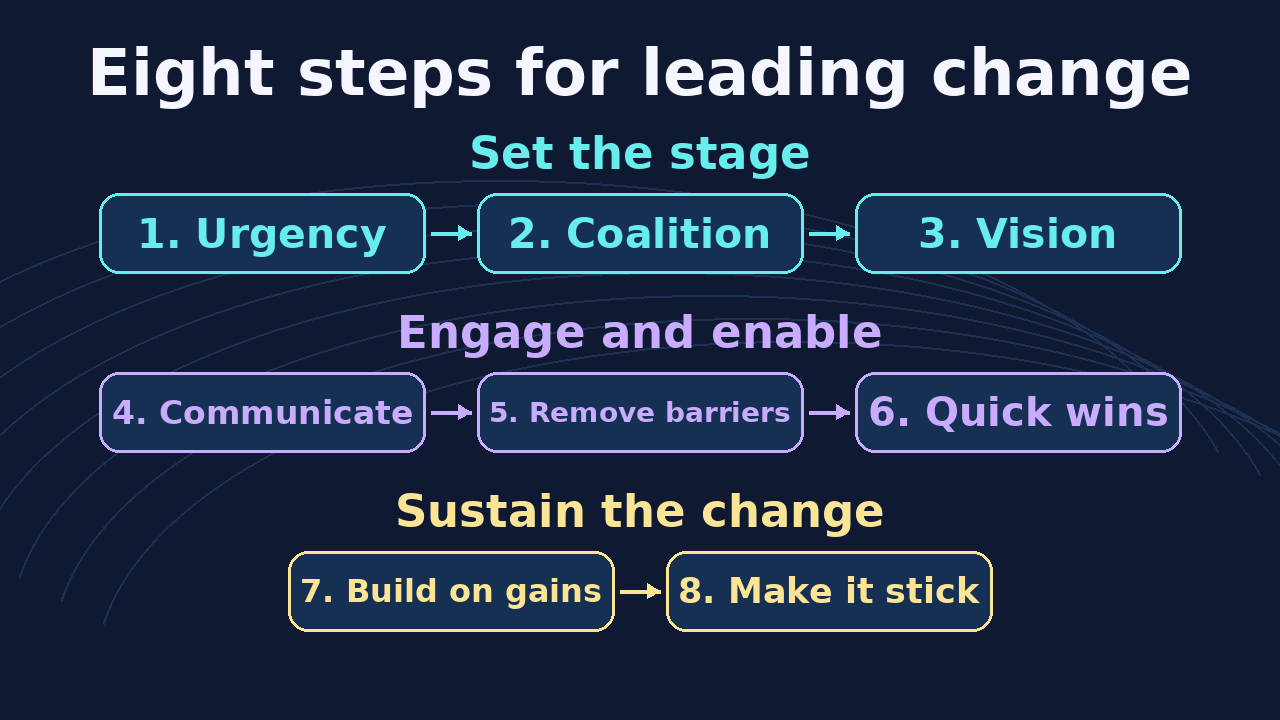
Figure: Eight steps in the course’s three groups, with concise explanatory labels.
1. Create urgency with evidence, not anxiety
Make the problem visible and verifiable. Pick a cohort of requests from a completed period and measure the time from receipt to assignment to a named staff member. Show how peak and quiet hours differ rather than settling for a daily average. Speak to the employees who actually hand requests over: perhaps two teams receive identical copies and neither knows who should act, or perhaps the appropriate team only sees a request when someone opens a shared file. Do not substitute anecdotes for counts, or a spreadsheet for understanding what is happening on the screen.
Good urgency does two things: it describes the harm of leaving things as they are and identifies a realistic opportunity to act now. Customer complaints or competitive conditions may justify starting, but a change at a competitor does not explain why your own requests are late. Use a statement you can revisit, such as: “During the pilot, we need to reduce the number of requests still without an owner at the end of the first working hour.” Do not say: “Everything will fall apart if we do not change now.” Share what you do not know as well: how many requests went unassigned because of routing rules, how many were duplicates, and which categories need a different team. That openness makes urgency an invitation to solve a problem, not a vehicle for blame.
2. Build a coalition that can remove barriers
The name of a sponsor is not enough. The coalition needs people who understand the customer journey, have operational decision authority, manage the system and experience the problem during a shift. In the appointment example, marketing can identify request sources, the reception supervisor can set shift coverage, the system owner can configure the assignment log, and a frontline employee can explain why the rule is hard to apply at peak times. Bring in the owner of a material risk such as data quality or privacy if the proposed solution touches it. Do not add names without a decision to make. Involve the smallest group that has the necessary knowledge, trust and authority.
Give each decision one accountable owner, along with a deadline and a way to escalate conflicts between team priorities. Who settles the official definition of an eligible request? Who approves a backup queue? Who pauses the pilot if requests accumulate faster than staff can handle them? Ask anyone who objects to turn that objection into a test or a stop condition. If the supervisor says the last hour before closing is not comparable, agree to count an actual working hour rather than removing those requests after seeing the results. The coalition then turns disagreement into an explicit rule, instead of postponing it until the end-of-month meeting.
3. Set a vision an employee can test during a shift
The vision is not a project name or just a financial target. A useful formulation is: “Reception will see every valid request in one place, and a named employee will take ownership within one working hour, with a backup when the main owner is unavailable.” Then specify what you are not promising. Assignment does not mean the customer answered a call, an appointment was confirmed or every case can access the service. When staff understand the limits of the promise, they can protect the customer's trust rather than recording a misleading internal success to hit a target.
Turn the vision into practical choices: one source of time, one state that proves ownership was transferred, and one backup for the queue at the end of the shift. Before adopting any metric, ask a new employee how they know the task has been completed. If they need a manager to explain the difference between opening a request and accepting responsibility for it, the vision has not yet become an understandable rule. If the workflow needs to differ by type of service, write down two explicit paths rather than announcing a universal rule that each person interprets as they wish.
4. Communicate the vision and ask teams to explain it back
An email is not enough. Show one short case at a shift meeting, then ask people in each role to explain what they do first and what happens if the usual owner is absent. Repeat the explanation with late shifts and teams that did not attend. State what will stop as well: no more forwarding the same request to multiple groups and waiting for the first person to reply. At the end of training, ask a new employee and a different supervisor to solve the same scenario independently. If their answers conflict, fix the instructions before interpreting the inconsistency as resistance to change.
Do not make communication a one-way speech. Give people a route to report a real barrier, with a deadline for a decision and feedback to whoever raised it. Ask for examples without personal names. An employee may point out that requests from a certain link lack the information needed to route them. Respond with a decision they can understand, such as updating routing rules before expanding the pilot, rather than thanking them and ignoring what the report means. Make sure management and frontline staff hear the same message so one department is not held accountable for speed another cannot support.
5. Remove barriers that penalize the behavior you want
The vision can hand staff a new responsibility without giving them the time, permissions or skills to meet it. Look for those gaps in a real scenario. Can the backup employee actually accept a request, or is the queue hidden from them? Does an alert trigger as the deadline approaches? Does the request disappear from view when their shift ends? Classify barriers as problems of procedure, permission, capacity or data, then address the first cause that blocks the behavior at its root. Do not grant wider access than people need or exchange personal data in public channels simply because replies are faster there.
Address conflicting incentives as well. If supervisors score employees on how many requests they close, some may close a request before confirming that someone has taken ownership. Monitor reopened requests, define a handoff clearly and make recording quality a condition of counting a result. Give staff an explicit way to place a request in the exception queue when assignment is impossible. The ability to surface a problem is better than pushing someone to pick the wrong status to stay out of a performance report. If the root cause lies outside the team's authority, escalate quickly to the person the coalition agreed could decide.
6. Design an early win you can demonstrate
An early win is a limited experiment with a baseline, an explicit cohort and a metric that cannot easily be gamed. Agree on the rules before the pilot: what makes a request eligible, when the working-hour clock starts, when a request is mature enough to enter the denominator, and how to handle out-of-coverage requests or missing time records. A mature denominator prevents recent requests with an incomplete opportunity window from distorting the result. Document duplicates against an agreed priority rule and show the volume excluded rather than hiding it. If data gaps make the comparison unreliable, say so and repair the recording before declaring a result.
When improvement appears, describe only what the evidence supports. “More eligible requests were assigned during the first working hour” is useful, but says nothing by itself about an increase in completed visits or revenue. Thank the team for removing a concrete barrier and show what changed in the procedure so others can repeat it. Test a guardrail beside the main metric: track reopened requests, misrouting or backlog in the backup queue. If the main measure improves at their expense, the win is not ready to scale until the team understands the trade-off and decides what to address.
7. Build on early gains instead of declaring the work finished
Check which part of the pilot can travel. If a morning shift succeeded because a supervisor intervened manually every half hour, the result can be real even though the second branch cannot reproduce the cause. Test the backup rule on another shift and keep other factors stable where possible. Watch differences in staffing, request sources and case mix. Use the results to improve operations or adjust the scope of the service rather than generalizing from a small cohort in unusually favorable conditions.
Agree on expansion criteria before expanding: an appropriate volume of mature requests, no unacceptable decline in routing quality or workload, and the new team's ability to repeat the workflow without close supervision. Set a rollback condition in case the backup queue stops working or overdue requests increase. Incremental rollout protects what you can learn. If you change the routing rule, the system, staffing coverage and the budget on the same day, you lose the chance to understand which decision helped and which made things worse. That does not rule out parallel work; it means each experiment needs a clear question and explicit limits.
8. Make the behavior part of everyday work
A change that depends on one person being there is not embedded. Update the operating procedure, onboarding instructions, queue permissions and holiday coverage. Have the supervisor review why requests are delayed, not just tally them. Retire the old steps that created duplicate ownership once you know there is a safe alternative. Do not run two default methods indefinitely. If the team documents every case differently, it will stop being clear who owns any given request.
Test durability in an uncomfortable situation: the supervisor is away, an alert fails or a campaign suddenly brings in more demand. Can the next shift take over using the normal instructions and records? Does the manager know how to review rising demand against actual capacity? Give the procedure a place in a routine meeting, a named owner and a review cadence, and decide when the rule should be updated again. Embedding a practice does not freeze it. It means the people working today know where to find the current decision and how to correct it tomorrow with a record of what changed.
Example one: appointment requests between advertising and reception
In this hypothetical scenario, a clinic sponsors a campaign that lets people leave a contact number, and requests go to a shared channel. In the baseline period, the team counted one request per case under a deduplication rule and required valid contact details and a covered service workflow. Requests with incomplete consent or outside the service scope are recorded in separate categories with a reason. The one-hour window counts actual working time: a request arriving ten minutes before closing should not be compared unfairly with one received at opening. Assignment means that a named owner accepts responsibility in the system, not simply that someone sees a notification.
The sponsor chooses a reception supervisor, a system owner, a marketing representative and an evening-shift employee. They review ten anonymized cases to understand the bottlenecks, then agree on a short vision: one clear queue for each category, plus a backup if a request is still ownerless as its deadline approaches. They train the team on regular and exception cases before the test, and give the backup user limited queue access instead of an open file. At the end, they do not compare yesterday, which still contains very recent requests, with a completed week. They count only cases whose full one-working-hour window has elapsed.
| Period | Assigned within one working hour | Eligible requests with a complete window | Rate |
|---|---|---|---|
| Baseline | 36 | 60 | 60% |
| Pilot | 45 | 60 | 75% |
That is an increase of 15 percentage points, or a relative uplift of 25% compared with the baseline. It does not tell us that 45 people answered or booked. Check the same windows by source and shift, and report counts alongside rates. If the pilot had quieter hours or more staff, the change may not be due entirely to the assignment rule. Retest with more comparable conditions or cohorts before generalizing, and keep a record of excluded requests to see whether the change attracted a different mix rather than actually speeding up service.
Next, set up a separate funnel to follow the first contact attempt, successful contact, confirmed appointments and attendance. Each stage has its own time, definition and denominator. Connect outcomes with operational identifiers inside authorized systems, report aggregates to the team and leave service decisions with the responsible person. Marketing succeeds here by seeing where requests drop out, not by increasing spend in the hope of fixing an unmeasured internal cause. The review may show faster assignment with no change in successful contact. That is a reason to test call timing or data quality, not to dismiss the first result or turn it into a claim about bookings.
Example two: delivering on a same-day in-store pickup promise
Imagine a retailer advertising same-day pickup for selected products. Checkout displays a generic pickup message, but the local stockroom may not see the order in time. The customer has to call or may turn up before the order is ready. The problem is not a shortage of ad impressions. Management brings together e-commerce, inventory, store operations and support. They set a clear vision: an eligible order appears in the store's picking queue, and the customer receives a ready message only after readiness has been recorded. For a late order or an unavailable product, the customer receives an explicit alternative time rather than an implied promise.
In a meeting that includes shop-floor staff, the coalition presents three cases: an early order for an in-stock product, an order near closing and a product that went out of stock between browsing and payment. The team names who can pause the marketing message if actual inventory and the system disagree. It solves the missing picking device at the workstation before blaming staff for not tapping the confirmation button. It starts with one location and comparable products, and sets deadlines and eligibility before the test. The message becomes an operational promise the store can substantiate, not just words that make people click.
| Period | Orders ready by the promised time | Eligible orders with a complete window | Rate |
|---|---|---|---|
| Baseline | 64 | 100 | 64% |
| Pilot | 78 | 100 | 78% |
The difference is 14 percentage points. Before expanding, monitor cancellations, support requests and premature ready messages, and review how many orders lost pickup eligibility because stock or order timing changed. A better rate could hide a service limited to a narrower group. Do not infer sales growth from readiness. Measure checkout completion and completed pickup in their own windows. Repeat the test at a store with different capacity. If the improvement depends on an extra employee, put that cost into the expansion decision. Then update offer terms, inventory rules and store training, and test peak-time cases before adding more branches.
A measurement dashboard and an exercise before committing
Make the early measure a question about new behavior, the outcome measure a question about an effect the customer values, and the guardrail a question about unintended costs. The clinic has three separate questions: was the request assigned within one working hour, did staff actually reach the requester, and did misrouting increase? For the store, ask whether orders are ready on time, whether pickup takes place, and whether cancellations or calls increased. Check a sample of timestamps and record what the system does when a time is missing or an integration fails. Record the decision prompted by each metric instead of accumulating dashboards that produce no actionable correction.
For an exercise, choose a handoff that happens each day. On one page, write the reason to act now, one decision for each coalition member, one sentence describing the intended behavior and a scenario in which a new employee explains what to do. Then write down the first barrier, the evidence that it was removed, the criteria for an early win, the decision to expand or stop, and how the rule fits into training and operations. Record who reviews the first cycle and when. Write an alternative hypothesis, too. If assignment becomes faster but the final outcome does not improve, what will you check first? If the guardrail worsens, will you redesign the intervention or temporarily halt expansion? Do not let one improving number make the decision for you.
Separate whether a test is valid from whether it can be rolled out. Before day one, ask whether people can access the data they need, whether the team covers the hours it is measuring and whether the outcome is defined consistently with its label. On the final day, ask the team to explain what it cannot infer: two small groups cannot establish the cause, and an internal result cannot substantiate a new advertising promise untested in every setting. Tie expansion to staffing coverage, service type and the existence of an exception queue. Keep dated versions of changes to the rules so comparisons remain understandable.
Before declaring a successful pilot, give a team that did not design it the same eligibility definition and two boundary cases. Ask them to calculate the rate again from the same records. If their denominator differs, fix the rule before debating performance. If the numbers agree but the decision differs, write down the cost of waiting, the cost of expanding and what can be reversed. The report then becomes a way to test whether the decision is understandable and defensible, rather than a set of scores for employees. The team may choose to extend the test rather than expand or cancel it, if the sample is too small to make a convincing case either way.
Limitations and common mistakes
Kotter is useful because it makes visible the work leaders forget to organize, not because it guarantees success. Common mistakes include creating permanent urgency that encourages staff to hide bad news, building a coalition detached from frontline work, and declaring victory after the first notification goes out. Another mistake is treating the phases as if each step requires executive sign-off before the next can begin. A small experiment during coalition-building may expose a barrier that changes the vision itself. Document what you learned and how you changed course rather than defending an orderly plan that no longer serves the work.
An urgent problem harming customers or data may require you to stop the harm first and work out how to sustain the solution afterward. Do not use the framework to delay an obvious intervention. Do not use it to justify expanding permissions or sharing information the team does not need. If the underlying issue lies in offer terms or capacity, cross-team agreement cannot conjure appointments or inventory that do not exist. Go back to the service design when that happens, and make the ad reflect only what the organization can deliver.
Next week, start with one handoff and test one change. State the problem in a way someone else can verify, and define the first success as a change in team behavior rather than a promise of revenue. Then check whether the result holds when you are not there to make it happen. When staff know when to act, what proves they acted and who takes over in their absence, you have moved the strategy from a presentation into the way the team works. Declare lasting success only when the regular system can sustain, review and revise the new behavior.
Sources and attribution
Course source: Digital Marketing Strategy Explained, lecture six, slide 22 of 25, PDF page 174. The original illustration reinterprets the course's grouping without reproducing the slide.
John Kotter: Why Transformation Efforts Fail, Harvard Business Review
Comments
No published comments yet.