
A healthcare access story deserves more than an impressive headline. For a marketing team, the useful question is how to communicate an operational improvement without promising an experience that the booking pathway cannot consistently support.
What the announcement establishes
In an October 23, 2026 company announcement, King Faisal Specialist Hospital and Research Centre reported that the wait for its Heart Center’s first available echocardiography appointment moved from 126 days in June 2023 to one day in 2026. The release does not specify the 2026 measurement cutoff, sample size, independent audit, or financial impact. Primary announcement.
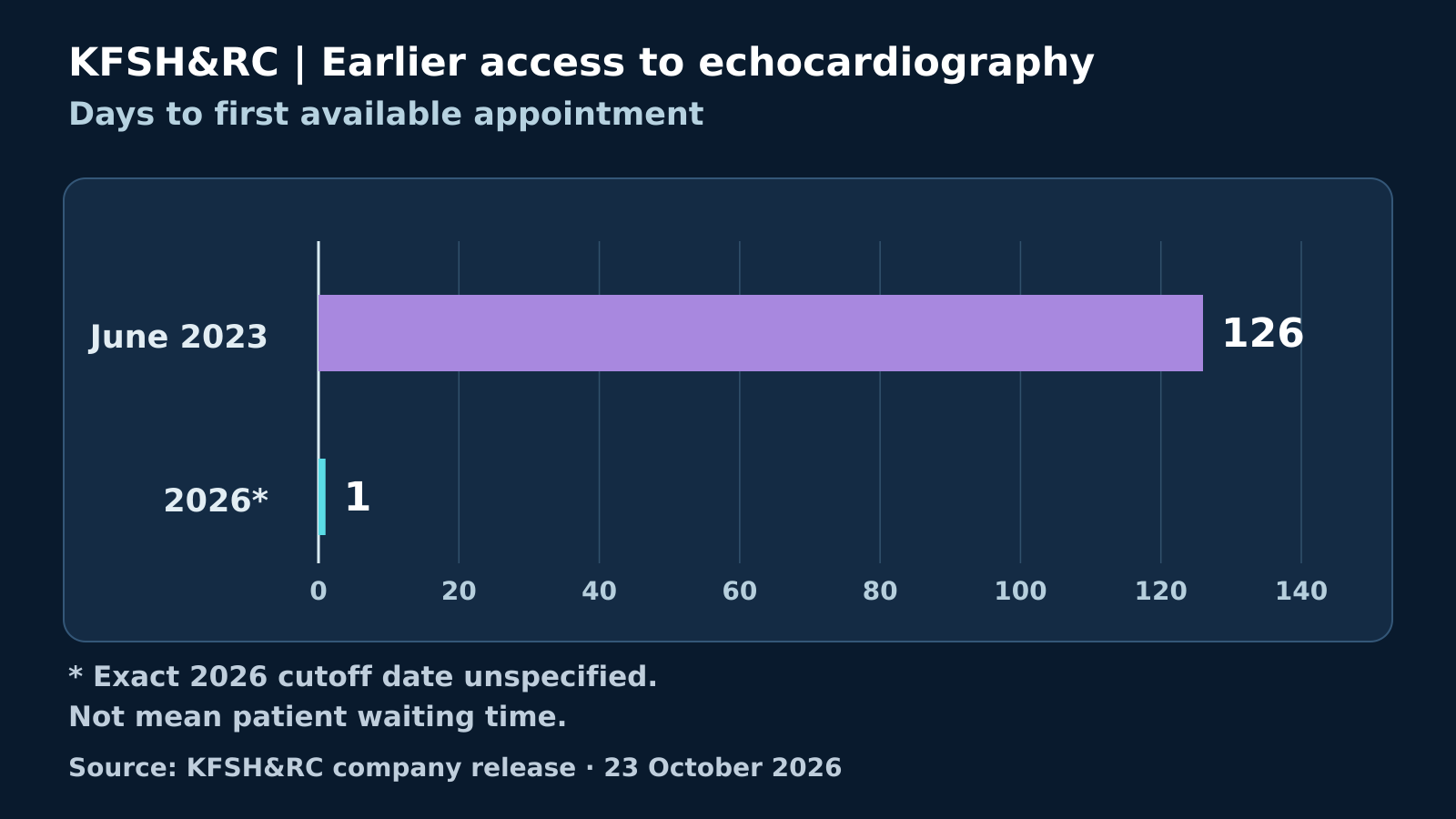
Chart: two reported time points, not a continuous trend. Source.
Independent analysis: make the claim operational
The recommendations below are an independent healthcare marketing framework. They are not a description of the hospital’s internal marketing practices, an audit of its performance, or clinical advice.
Start with the boundary of the claim. An available appointment indicates something about the booking calendar. A patient’s actual journey can also depend on referral review, the service requested, administrative requirements, personal availability, and the appointment ultimately accepted. Marketing should preserve those distinctions instead of converting a narrow access measure into an unconditional promise.
A useful internal claim sheet would identify the metric, its starting and ending events, the service covered, the measurement period, and the person responsible for verification. It should also say where the claim may appear and when it must be reviewed. This makes a headline reproducible across paid search, service pages, referral materials, and contact-center scripts without stripping away its meaning.
Build the pathway before increasing demand
Before using improved access as a campaign theme, walk through the complete response journey. Can someone understand which service the page describes? Is the next action clear? Does an inquiry reach a team that can help with eligibility and scheduling? Can that team see the information already submitted, where authorized, rather than making the person start again?
Separate requests by operational purpose. A general information inquiry, an existing referral, a rescheduling request, and a question from a referring organization may need different destinations. Sending every contact into one sales-style queue makes attribution simpler on paper while making the actual service harder to manage.
Keep marketing forms limited to information needed for the next administrative step. If clinical details are required, direct people to the organization’s approved secure intake route. Marketing staff should not interpret symptoms, recommend a diagnostic test, or assign clinical urgency. Escalation language and clinical triage belong with the appropriate care team.
Treat capacity as a campaign constraint
A launch plan should define what happens when demand changes. Agree with operations on the capacity signal that controls campaign volume, the person who can pause promotion, and the message shown when the advertised pathway is temporarily constrained. Specify an update interval rather than assuming a historical improvement will remain a current booking promise.
This need not become a complex forecasting exercise. A shared review can compare available appointments, incoming eligible requests, unresolved scheduling contacts, and the time needed to respond. If one part of the pathway becomes congested, the response might be to change the call to action, narrow the campaign’s scope, or reduce promotion while operations investigate.
Measure completed access, not just interest
A click or submitted form can be useful for evaluating a message, but neither establishes that access improved for the person who responded. Build a measurement chain that distinguishes inquiry, eligibility review, appointment offered, appointment accepted, and attendance. Record why a case stopped progressing when that can be done appropriately and without unnecessary personal detail.
Report both a typical journey and the slower end of the distribution. A median can summarize the center, while a higher percentile can reveal experiences that a single average obscures. Define the clock consistently, and separate service or referral categories only when the resulting groups remain meaningful and privacy is protected.
Keep attribution claims modest. A campaign may coincide with more bookings while referral patterns, capacity, seasonality, or other communications also change. Without a suitable comparison, describe observed movement rather than claiming marketing caused it. Financial conclusions require financial evidence, including the relevant costs and accounting definitions.
Test clarity without weakening safeguards
A practical first experiment is to compare two accurate ways of explaining the same service pathway. Keep eligibility criteria, clinical review, and access rules identical. Change only the wording or arrangement of the information, then examine whether people better understand the next step and whether misrouted contacts decline.
Set the evaluation criteria before launch. Otherwise, a team can declare success based on whichever metric happens to rise. Useful checks include inquiry quality, scheduling completion, unresolved contacts, and complaints about mismatched expectations. Test design should never prioritize conversion at the expense of appropriate care routing or transparent information.
Put ownership behind the message
The strongest final deliverable is a maintained service promise. Give one operational owner responsibility for the access data and one communications owner responsibility for updating public wording. Keep a record of approvals, review dates, and material changes so that an old statistic does not quietly become a permanent advertisement.
For healthcare marketers, the strategic opportunity is straightforward: use a credible improvement to explain a usable pathway. Publish what the evidence supports, make the next step understandable, and ensure the organization can respond when people take it.
Comments
No published comments yet.