JioHotstar announced StreamToCart Ads on October 27, 2026. JioStar describes an Instamart-powered overlay that lets viewers browse products and add them to a cart inside the player without pausing playback. The announcement concerns India's commerce ecosystem; it does not establish Saudi availability or demonstrate additional completed purchases. JioStar announcement
For a marketing team reading the news on October 28, the distinction between a shopping interaction and a commercial outcome matters more than the novelty of the interface. A shorter route to a cart is a proposition worth examining, not a result that can be entered into a revenue forecast. The practical analysis below explains how to evaluate that proposition without confusing launch language with evidence.
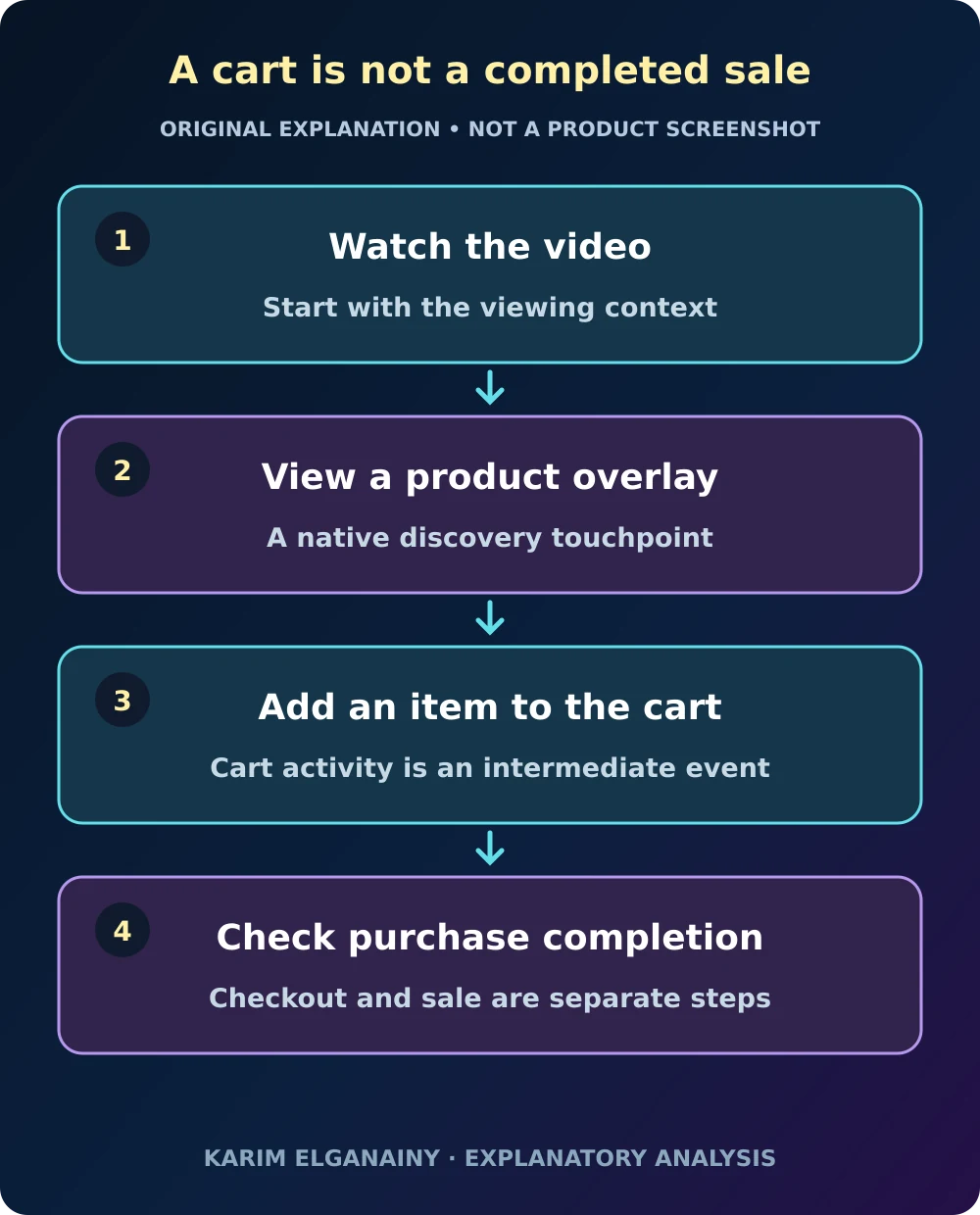
Original explanatory illustration by Karim Elganainy. Conceptual journey, not a JioHotstar screenshot or a confirmed checkout flow. News context: JioStar announcement.
What is confirmed and what still needs checking
The source describes a launched advertising format and its intended interaction. It does not provide a controlled campaign study establishing sales lift. That boundary is important: an announcement can establish what a company says it is offering without independently validating its commercial impact.
Before requesting a proposal, write two lists. The first should contain the product description supported by the announcement. The second should contain questions about eligible devices, locations, buying terms, reporting and the journey after cart addition. Do not fill the second list with assumptions drawn from other products offered by the same companies.
This article's remaining sections are original editorial recommendations, not a description of guaranteed platform functionality. Suggested controls, experiments and reporting fields should be discussed with the seller. If a recommended capability is unavailable, adjust the test or narrow its objective rather than quietly treating the capability as present.
Practical analysis: choose the decision before the metric
Start with a business decision that the pilot can realistically influence. A brand might want to know whether an interactive video treatment generates more useful shopping activity than a conventional treatment. Another might be testing whether a particular product is suitable for an entertainment-led purchase occasion. Those questions call for different creative and measurement choices.
Specify one primary outcome, the comparison required and the action that follows each plausible result. If the only reliable outcome available is cart addition, define the pilot as a test of cart-building behaviour. Do not present it internally as a sales-incrementality study.
Keep awareness indicators as supporting evidence rather than discarding them. A campaign can be valuable for communication while producing limited immediate commerce. Conversely, a high interaction rate can coexist with weak brand understanding. Decide which problem the budget is meant to solve before choosing the most flattering metric in the report.
Map the whole journey beyond the overlay
Draw a journey that begins with an eligible ad opportunity and ends with a fulfilled order, then mark which steps are actually observable. Product opening, cart addition, checkout initiation, payment, cancellation and fulfilment should remain distinct. Some of these events may not be available to the advertiser, and the map should show that honestly.
Ask what happens when a viewer is not signed in, changes devices or returns later. Ask whether the cart persists and how existing items are distinguished from new additions. These are diligence questions, not claims about the implementation announced by JioStar.
The resulting map should identify both user friction and measurement blind spots. A missing event is not automatically a failed experience; it may simply be outside the reporting agreement. But a business case should never quietly convert an unobserved step into an assumed success. Keep the boundary between known and unknown visible throughout the evaluation.
Treat cart additions as intent, not booked revenue
An add-to-cart event can be a useful signal, but it is not the same as an order. A shopper may compare alternatives, remove an item or abandon the basket. A single person may also add the same item more than once. Those possibilities should shape reporting definitions before they shape a celebratory headline.
Agree whether the metric counts events, unique people, unique baskets or product quantities. Ask how duplicate actions, removals and previously existing cart contents are handled. If downstream information is unavailable, report the limitation explicitly and avoid estimating revenue with an unexplained conversion assumption.
Where completed-order data can be obtained under suitable terms, analyse the relationship between cart activity and final outcomes. Keep discounts, cancellations and returns visible. The objective is to learn whether the interaction produces valuable demand, not simply to create a larger number by counting every tap as a separate commercial achievement.
Make serviceability part of the media plan
A commerce-linked creative concept should be checked against where the advertised item can actually be supplied. Ask how eligible geography, catalogue availability and delivery coverage interact with media targeting. A broad entertainment audience is not necessarily the same audience that can purchase a particular product at the advertised moment.
Create a simple exception plan for unavailable products, changed prices and unsupported locations. Depending on the negotiated capabilities, a campaign might need alternative creative, narrower targeting or a pause. Do not assume automatic inventory-aware substitution unless the seller confirms it and the team has tested the behaviour.
Include the retail operations owner in the launch review. That person should know which products are promoted, which variations are acceptable and who can approve a change. This operational connection matters even in a small pilot: a compelling shopping message is difficult to evaluate fairly when the intended product cannot be bought.
Build a useful creative hypothesis
Design the video and the shopping invitation as one argument. The video should establish why the product matters, while the interactive element should make the next action understandable. Avoid turning the screen into a catalogue of unrelated choices that competes with both the brand message and the entertainment experience.
Choose a narrow creative test. For example, compare a use-occasion message with a product-benefit message while holding other practical conditions as steady as possible. Label this as a proposed experiment, not an observed best practice for this specific format. The aim is a lesson that can inform the next campaign.
Review product names, pack sizes, prices and offer conditions against the destination experience. If the ad promises one thing and the cart presents another, interaction numbers may obscure disappointment. A preflight review should therefore include the marketing team and someone who understands catalogue and merchandising details, not only the person exporting video files.
Protect the viewing experience while measuring action
An interactive treatment should make shopping optional and its controls understandable. During usability review, inspect whether viewers can distinguish the video, product information and available actions. Consider readability, contrast, touch targets and the ease of returning attention to the content. These are review criteria, not claims that the announced product fails any of them.
Test on the devices actually included in the proposal. A design that works in one screen orientation or input method may need different handling elsewhere. Do not infer support for television remotes or every mobile environment from a general platform description.
Track a small set of experience guardrails alongside commerce indicators. Depending on available reporting, these might include dismissals, playback problems or support complaints. Interpret them carefully and agree on action thresholds in advance. A campaign that produces shopping interactions while creating avoidable frustration may not deserve expansion, even if one headline performance metric looks attractive.
Design the comparison before launching
To assess additional impact, a pilot needs a credible estimate of what would have happened without the treatment. Discuss whether a randomised comparison is feasible and what the unit of assignment would be. If it is not feasible, document the alternative and the weaknesses that remain instead of presenting an observational comparison as causal proof.
Keep the comparison relevant to the budget decision. A conventional video treatment may be a more useful alternative than no advertising if the choice is between formats. Hold the offer and product selection steady where possible, and record any differences that cannot be controlled.
Decide how the team will handle repeated exposures, overlapping campaigns and incomplete data before seeing outcomes. An inconclusive result is a legitimate outcome. It may mean the design needs improvement, the available sample is insufficient or the effect is too uncertain to justify a confident commercial conclusion.
Demand a reporting dictionary, not just a dashboard
Ask for definitions of eligible impression, delivered impression, interaction and cart addition. Establish whether denominators represent all impressions or only opportunities where the shopping feature was available. Without that distinction, two apparently identical interaction rates can answer different questions and mislead the person comparing them.
Request reporting latency, deduplication rules and a clear explanation of which events are directly recorded versus modelled. Agree on how discrepancies between media and commerce systems will be investigated. A dashboard can display a neat total while concealing a mismatch in timing or event definitions.
Preserve the specification used for the pilot so later campaigns can be compared on the same basis. If a definition changes, mark the break rather than drawing a continuous trend across incompatible numbers. Good measurement discipline is not about accumulating more columns; it is about making the most important columns intelligible, stable and relevant to the decision.
Review information sharing before activation
Map what information moves between the media platform, commerce partner, advertiser and agency. Ask which party can access account-level details, which reports are aggregated and what retention arrangements apply. This is an operational review framework, not legal advice or a conclusion about the product's compliance.
Have the appropriate privacy, security and legal reviewers examine the proposed arrangement for the actual market and campaign. Translate their requirements into a usable launch checklist. A commercial team needs to know who approves access, how unexpected fields are handled and when an integration should be paused.
Avoid collecting information merely because it might be interesting later. Start from the business question and request only what the approved analysis needs. This also reduces analytical confusion: a smaller, clearly defined dataset can be more useful than a large collection of fields whose meaning, permitted use or reliability is uncertain.
Build the economic case without a fictional conversion rate
Include media, production, adaptation, setup, reporting and agency effort in the pilot cost. Separate one-time learning expenses from costs likely to recur. If the decision concerns profitable growth, identify the product economics and promotional support required rather than treating gross sales as an adequate measure of value.
Do not multiply cart additions by an invented order-conversion rate and call the result revenue. If a scenario calculation is useful, label it hypothetical, disclose every assumption and explain that it is not measured performance. The budget owner should be able to see exactly which evidence would replace the assumptions.
Compare the proposed test with realistic alternatives for the same objective. A familiar format might offer better measurement, while the interactive format might offer a more relevant shopping moment. Neither wins automatically. The choice should reflect the quality of the expected learning as well as the immediate commercial opportunity.
Apply the lesson without exporting the availability claim
For Saudi and other regional marketers, the useful lesson is a design question: can a brand connect entertainment, product information and a feasible next step without confusing the customer? That question can inform local planning, but it does not establish that this particular offering is sold or supported in those markets.
Before proposing any local execution, confirm the actual media partner, commerce infrastructure, service coverage, language requirements and commercial permissions. A locally available solution may need a very different journey. Copying the shape of an interface is not the same as reproducing the operational conditions behind it.
End the first evaluation with a decision memo: what was confirmed, what was purchased, what was observed and what remains unresolved. Expand only when the evidence supports the intended objective and the operational weaknesses are understood. StreamToCart is a reason to ask sharper questions about shoppable video, not a shortcut around the work of proving business value.
Comments
No published comments yet.