A team does not become more coordinated simply because its members can ask an AI assistant to do more things. Coordination requires agreement about the customer facts that matter, the changes people may authorize, and the evidence needed before a message reaches an audience. Iterable’s Winter announcement offers a useful occasion to examine those decisions. This article, prepared on November 15, 2026, analyzes an announcement published on November 12, not a new launch occurring today.
What was announced, and what remains unverified
Iterable describes a hosted MCP connection that brings Nova Agent into supported AI tools while retaining each user’s existing Iterable permissions. The announcement also covers version-specific mobile SDK guidance, additional integrations and an email AI-summary preview. These are vendor descriptions, not independently measured results. Availability and supported actions need checking separately for each feature and account. Official November 12 announcement.
The public What’s New page describes the Winter capabilities, while the linked release notes provide another place to check implementation details. This review did not access a customer account, install an integration or verify account entitlements. The analysis below is an original, hypothetical evaluation framework, not a report of hands-on performance or a claim that every proposed safeguard exists in the product.
At the review date, the linked release notes showed October 20 as their latest entry, without a Winter entry, and the public launch pages did not provide a feature-by-feature availability matrix. Confirm enabled capabilities with your account contact before planning implementation; this is an evidence gap, not proof that a feature is unavailable.
Begin with a decision, not a connector
Consider a hypothetical subscription service whose customers receive onboarding messages. The useful question is not whether another system can be connected. It is which customer decision should change when new information arrives. A completed setup might make an introductory reminder unnecessary; an unresolved support request might call for a pause. Each change should have a clear purpose that a reviewer can explain without referring to the technology used to implement it.
Write a short decision specification before building anything: the relevant event, the message it should affect, the expected customer benefit and the person who owns exceptions. Include cases where nothing should happen. This prevents the integration from becoming an excuse to send more communication simply because more information is available. A successful connection may improve the customer experience by removing an unnecessary message rather than adding a new one.
Define what a customer fact means
A field called customer status can hide several incompatible meanings. It might describe billing, product access, a support classification or a marketing segment. Treating them as interchangeable can create a journey that is technically valid but commercially confusing. The hypothetical team should identify the authoritative source for each decision and document what happens when two systems disagree.
For every field used in a journey, record its meaning, permitted values, update timing and missing-data behavior. Separate an observed event from an inference about intent. A person viewing a help page has performed an action; they have not necessarily expressed dissatisfaction. When uncertainty matters, choose a neutral message or pause rather than inventing a precise interpretation. The objective is reliable relevance, not the largest possible collection of customer attributes.
Test time, not just field mapping
A successful import proves that information can move, not that it arrives soon enough to guide a decision. In the hypothetical onboarding workflow, a completed task may be recorded after a reminder has already entered a sending queue. A dashboard showing the correct final profile can conceal an inappropriate message that was sent earlier.
Build test cases around sequences: an event arrives late, a duplicate arrives, an update reverses an earlier value, or the source stops responding. Observe the resulting journey rather than checking only the profile screen. Establish which conditions should stop execution and who investigates failures. These are proposed test requirements, not claims about a specific integration’s delivery guarantees. Their purpose is to reveal the gap between correct data eventually and appropriate action at the necessary moment.
Separate capability from authorization
Existing access permissions can define what an employee is technically able to do. They do not automatically explain what that employee intends an assistant to do in a particular conversation. A request to inspect a journey differs from a request to edit it, and both differ from permission to send messages. A conversational interface should make those transitions visible rather than relying on the reader to infer them.
For a hypothetical pilot, distinguish read-only inspection, draft preparation, approved edits and external delivery. Ask reviewers to identify the audience, content, timing and consequences before a consequential step. Preserve a clear record of the approved version. If the proposed scope changes, review the changed portion instead of treating an earlier broad request as unlimited authority. This is an operating recommendation, not an assertion that the announced interface implements these exact approval stages.
Make review portable across the team
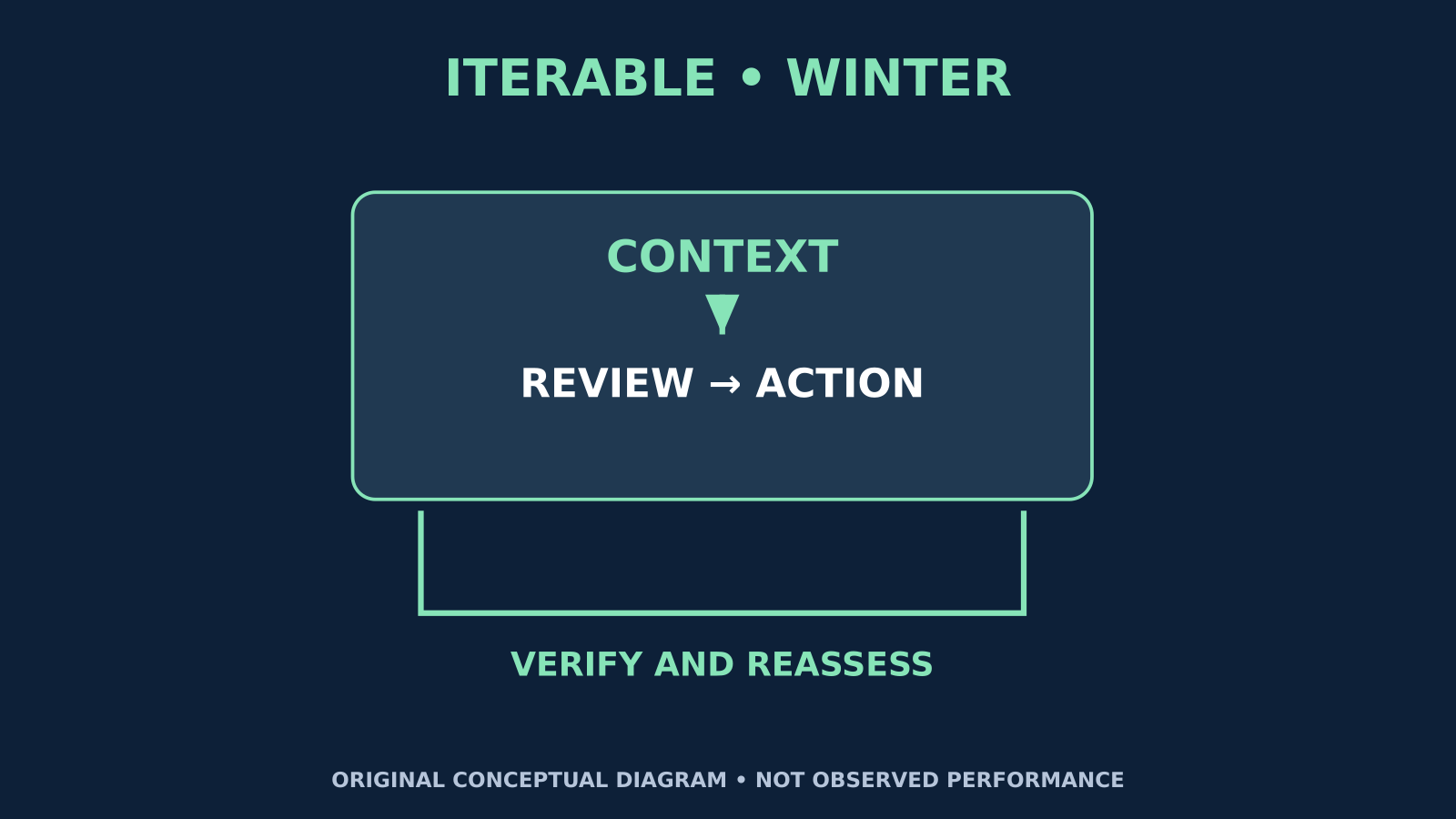
Original conceptual workflow: CONTEXT → REVIEW → ACTION, with VERIFY AND REASSESS below. It separates customer context, review and action, followed by verification and reassessment. This is not an Iterable interface or measured outcome. Product background: [Iterable announcement](https://iterable.com/blog/winter-2026-product-launch/).
An effective review record should travel with the work. If a journey is discussed in a chat and later edited in another interface, a teammate should still understand why the change was proposed and which assumptions were checked. The record does not need to reproduce every conversation. It needs the decision, evidence, scope and remaining uncertainties.
A reusable review template might ask whether the audience is appropriate, the trigger is current, the content is accurate and the stopping condition is visible. Assign ownership for updating that template as the team learns. Shared guidance is valuable when it improves judgment, not when it turns an old decision into an unquestioned rule. Make exceptions explicit and inspect their reasons before incorporating them into the standard process.
Treat SDK completion as a chain of evidence
A mobile integration should be evaluated through the customer interaction it is intended to support. In a hypothetical test environment, a clean build is only one checkpoint. The team still needs to establish that the correct test profile receives the intended message and that the resulting event can be interpreted accurately. The point is not to distrust coding assistance, but to define completion beyond code generation.
Use authorized test accounts and keep production recipients outside the initial exercise. Record the relevant application and SDK versions, the change reviewed by a developer and the observed test result. Include a way to disable the changed behavior if it causes unexpected effects. Do not translate a vendor’s speed claim into a delivery promise for your own project. Local complexity and the quality of existing instrumentation still need evaluation.
Handle preferences as operational constraints
A preference is not merely another field to personalize a sentence. It can determine whether communication should occur at all. In the hypothetical service, a changed preference should affect the relevant journey even when another system still holds an older value. The team needs to decide which record takes precedence and how an unresolved conflict is handled.
Test the direction of each relevant update rather than assuming every connection is bidirectional. Verify what happens when an update fails, and make reconciliation someone’s responsibility. Do not infer permission for another channel from activity in the first one. The commercial aim is simple: the customer should not need to understand the company’s system architecture to have a clearly expressed choice respected.
Review advertising destinations separately
Moving an audience into an advertising destination is a different operation from receiving an event into a customer profile. The useful review asks which audience operation is supported, what matching identifiers are needed, how updates occur and how removal is handled. A destination appearing in a launch announcement does not establish that every audience strategy or account configuration is supported.
For a hypothetical suppression use case, test a small authorized audience and inspect whether additions and removals behave as expected. Keep the business rule separate from the transport mechanism so that a failed sync does not silently redefine who should receive a promotion. Consider the information shared with the destination and limit it to the approved purpose. This framework recommends verification; it does not report having uploaded any customer audience.
Write emails that remain clear when shortened
An email can lose its meaning when a reader encounters only a subject line, preview or summary. The original writing should therefore make the main action and its qualifications easy to find. A hypothetical offer that states a benefit prominently but hides a condition far below it may be misunderstood even without any automated summary.
Review whether a shortened account preserves who the message is for, what is being offered and what the reader must know before acting. Avoid trying to manipulate an imagined summarizer through hidden instructions. A preview is a diagnostic aid, not a guarantee of every inbox’s output. Test clarity with human readers too, and fix the source message when an important qualification repeatedly disappears. Better structure should help both the full reader and the person seeing only an excerpt.
Measure work quality before celebrating speed
Time saved preparing a draft is useful, but it is not the same as time saved completing an approved campaign. Review effort, corrections, failed tests and handoffs can move rather than disappear. A hypothetical evaluation should record the whole path from a defined request to a verified result, using comparable tasks and a consistent definition of completion.
Track material errors and unnecessary communications alongside preparation time. Keep customer outcomes separate from operational convenience. If a faster workflow coincides with improved conversions, examine other changes before attributing the result to the tool. The evaluation can support a practical decision without claiming a causal effect it cannot establish. A slower preparation step may still be worthwhile if it prevents a larger correction after delivery.
Expand only what the pilot has demonstrated
Choose a bounded workflow with a clear owner, reversible changes and observable results. Before starting, state the conditions that would pause the pilot: incorrect recipients, unexplained profile changes, missing approvals or inconsistent preference handling. Also state what would justify expansion, such as clearer review records or fewer repeated manual corrections within the authorized scope.
The central buying question is whether the team can carry customer context into action without losing accountability between systems. Iterable’s announcement is a timely reason to investigate that question, not proof that every organization will answer it successfully. Verify feature access, test the relevant path and preserve the distinction between what the vendor describes, what the team proposes and what the team has actually observed.
Comments
No published comments yet.