Announcement: November 2, 2026. Editorial analysis: November 3, 2026.
The announcement is about an activation offer
Inuvo says IntentKey managed-service audiences can go live on Safari and iPhone within 24 hours after campaign-plan approval. It describes content-based intent modeling without cookies or person-linked profiles and reports unchanged iPhone impression share and client performance, without publishing an evaluation method. The release acknowledges earlier Safari capability. Inuvo announcement.
The practical analysis below is original. It separates activation speed, delivery, relevance and incremental impact rather than treating them as one claim. Proposed workflows and examples are hypothetical, not reported customer results, contractual terms or independently verified product capabilities.
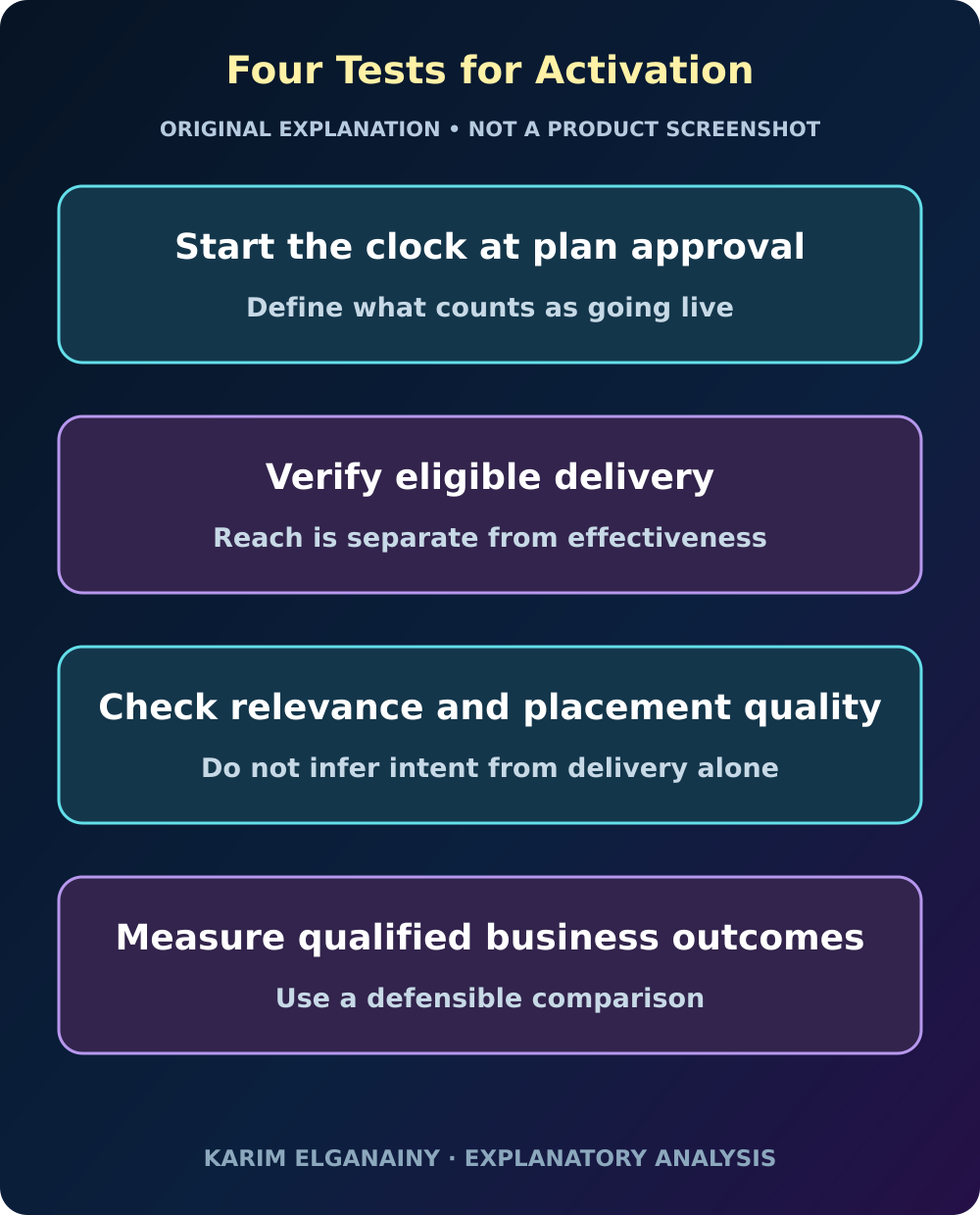
Original editorial framework; not a product screenshot or proof of campaign results.
Start the clock at an agreed event
A rapid activation promise matters only when the buyer and provider agree on the starting point. Sending a creative brief, approving a media plan and accepting final creative can be different events. If the marketing team counts from its first email while the provider counts from a later approval, both can describe the same experience accurately and still disagree about whether it was fast.
Before a campaign begins, record the approval event and the person authorized to give it. Identify which inputs must already be complete, such as creative files, the destination, budget, geographic scope and exclusion rules. Clarify how a material revision affects timing. A new offer or destination should not be smuggled into an already approved plan without an explicit discussion of what changes.
Then define “live” for the intended purchase. It might mean an eligible campaign has begun serving, but that is different from reaching a meaningful delivery volume or learning anything about demand. A small first delivery can be an operational milestone without being a performance result. Keep those milestones separate in the acceptance sheet so that speed remains useful rather than becoming a substitute for an outcome.
Delivery continuity needs a denominator
A statement about stable impression share requires a clear denominator. The proportion of impressions on one device category can remain unchanged while total impressions, spending, prices or audience composition change. That does not make share useless; it means share answers a narrower question than a complete commercial evaluation.
A buyer should ask which campaign population, period and delivery definition a continuity assessment covers. Are the same accounts included throughout? Did the mix of destinations, placements or objectives change? Is the comparison based on purchased impressions, served impressions or another measure? These questions are part of measurement diligence and should not be interpreted as evidence that a supplier's claim is false.
Separate what the available information establishes from what it leaves open. A campaign that continues to serve has passed an operational test. Whether it reaches suitable contexts, brings qualified customers or adds profitable demand requires further evidence. For an internal report, preserve this distinction in the headline as well as the footnotes. A cautious footnote cannot fully correct a confident headline that says the campaign's effectiveness has been proved.
Audience relevance starts with a useful brief
An audience brief should describe the commercial need the offer can meet. Broad labels such as “premium buyers” or “people interested in wellbeing” leave too much room for interpretation. A stronger brief explains the situation, the intended decision, relevant contexts and reasons the offer may be unsuitable.
Consider a hypothetical retailer selling equipment for small home offices. The useful distinction may be between someone researching how to set up a compact workspace and someone casually reading about workplace trends. The brief can describe the intended use, practical constraints and questions a suitable buyer is trying to answer. It should also specify exclusions, such as situations where the product cannot be delivered or the offer does not apply.
Ask the provider to explain how it interprets that brief in language the marketing team can review. The purpose is not to demand a list of identified people. It is to understand the relationship between the business need and the proposed media context. Where visibility is limited, record that limitation and decide whether the proposed spend and risk remain proportionate. An appealing audience name should never replace a reviewable definition.
Build a campaign acceptance sheet
A practical acceptance sheet fits on a page or a short shared document. It begins with the approved brief, the final offer, the destination and the approval timestamp. It names the campaign owner and the person who can authorize changes. This prevents a fast launch from becoming a collection of undocumented assumptions.
The second part records where delivery is permitted: markets, languages, eligible inventory, relevant device or browser requirements, brand-safety exclusions and any placement visibility the buyer expects. The third part defines the outcome. A form completion, a qualified enquiry, a fulfilled order and a repeat purchase describe different stages of a customer relationship. Choose the one that matches the business question and specify how it will be observed.
The final part records measurement boundaries and a review date. Explain which comparisons are planned, what data may be used and what would justify a pause. Include a route for reporting an unsuitable placement or a broken destination. None of these fields needs to slow an uncomplicated campaign. They reduce the risk that a team discovers after launch that it approved a different purchase from the one it thought it was making.
Evaluate privacy as a workflow, not a slogan
A description of one audience method does not, by itself, settle every data question in an advertising workflow. The destination page, reporting process, customer database and other vendors may introduce separate data flows. Review the campaign as it will actually operate instead of extending a statement about the audience method to all of those systems.
A useful inventory asks what information is supplied, who receives it, what it is used for and how the results return to the advertiser. Keep the inquiry proportionate to the intended activity. The buyer should not send extra customer information merely because it might make a briefing feel more specific. Start with the business problem and establish the minimum information needed for the agreed purpose.
This article does not offer a legal assessment of the product or of any market. Appropriate privacy and procurement reviewers should evaluate the proposed implementation. The practical marketing principle is straightforward: a campaign should be designed around a legitimate customer need and an approved data process. Avoid describing an approach as a way around user choices or platform protections. The objective is useful advertising within the relevant boundaries, not evasion.
Test relevance before making a causal claim
A campaign can deliver successfully and still attract the wrong kind of enquiry. Before debating incremental impact, inspect whether the observed actions resemble the intended customer journey. Review the destination, response quality and the reasons customers drop out. Those checks help identify practical mismatches that an aggregate conversion total may conceal.
Use an agreed definition of qualification. For a retailer, it may depend on delivery eligibility and a completed purchase. For a service business, it may involve whether the requested service is actually offered in that location. The definition should be consistent across the comparison, and it should not be rewritten after results arrive merely to make a favored channel appear stronger.
Then ask the causal question: what would have happened without the tested activity? Where appropriate, a suitable comparison can help distinguish new demand from activity that would have occurred anyway. The design needs to fit the business, available data and feasible allocation. If the experiment is too small or the outcome arrives too slowly to support a confident conclusion, report that uncertainty instead of treating a positive-looking trend as proof.
A hypothetical launch with four separate reviews
Imagine a homeware advertiser preparing a seasonal offer. This example illustrates a buying process and does not describe an Inuvo customer. The team approves the final plan only after confirming stock, destination accuracy and delivery geography. It records the approval time and agrees on what first delivery will establish.
The first review checks activation: did the agreed campaign begin serving under the accepted conditions? The second checks delivery: were the purchased impressions consistent with the approved scope and exclusions? The third checks relevance: did the visits and customer actions align with the defined need? The fourth examines business impact using the comparison chosen before launch.
These reviews can finish at different times. A launch can pass its timing check while the commercial result remains pending. It can also fail a relevance check even if delivery was smooth. The purpose of the sequence is to locate the problem precisely. A timing failure may require an operational fix; a weak offer may require commercial revision; an inconclusive impact result may require a better test rather than an immediate supplier change.
Make speed economically meaningful
Fast activation can have value when a business has a genuine, time-sensitive opportunity. It can reduce the period during which an approved offer waits for distribution. But speed also makes it easier to spend before the destination, service team or measurement plan is ready. The economic review should consider both sides.
Estimate the full cost of the proposed campaign using the actual commercial terms, including service and media charges where applicable, creative work, internal setup and the effort needed to handle responses. Compare that cost with the business outcome the campaign is intended to create. Do not count unqualified enquiries as equivalent to customers or gross sales as equivalent to contribution.
The team should also ask what faster delivery replaces. If it replaces avoidable coordination delays, the benefit may be operational. If it makes a previously impossible opportunity feasible, the business case may be different. Neither benefit can be assumed from an activation headline alone. State the hypothesis in the approval memo and use the campaign review to decide whether the expected value actually appeared.
Regional and healthcare teams need a narrower brief
For a hypothetical GCC service advertiser, the brief should make market and language requirements explicit. An offer that is valid in one city may not be available in another. A well-written Arabic advertisement can still create a poor experience if the customer reaches an English-only form or a team unable to answer the original question. These are execution issues the advertiser can inspect before spending.
For healthcare, avoid confusing a topic someone reads with a verified diagnosis or clinical need. A proposed campaign should go through the organization's appropriate privacy and clinical review, and its wording should reflect services that can actually be delivered. Do not introduce sensitive patient details simply to make an audience description more precise. This is a process recommendation, not a claim that a particular targeting use is permitted.
The announcement does not establish that every geography, inventory requirement, budget or service arrangement is eligible. A regional buyer should confirm the exact proposed scope, commercial terms and reporting options with the provider. Until those points are resolved, a general launch offer should remain a possibility under evaluation rather than a committed local implementation plan.
Decide what would justify stopping
A fast campaign needs a clear pause rule because problems can become expensive before the next scheduled meeting. Before launch, specify who can stop delivery if the destination breaks, the offer becomes unavailable or a placement conflicts with the agreed scope. The rule should be operationally usable, not a vague request to “monitor performance.”
Distinguish a genuine failure from an unresolved measurement question. A broken booking form calls for immediate repair. A slowly accumulating outcome may call for patience within the agreed observation window. Repeatedly changing the creative, audience and spending in response to each short-term fluctuation can destroy the comparison the team hoped to learn from.
At the review, record one of several honest outcomes: expand within the approved conditions, repair and retest, retain a limited use, stop the activity or acknowledge that the evidence remains insufficient. Keeping an inconclusive result visible is more valuable than forcing every campaign into a success narrative. It preserves learning for the next brief and prevents unsupported claims from becoming internal precedent.
Karim's strategic takeaway
Treat launch speed as the first acceptance test, then keep following the customer journey. A useful buying decision needs an agreed starting point, a reviewable audience rationale, clear delivery boundaries and an outcome that matters to the business. Those conditions make a rapid service easier to evaluate without dismissing its potential value.
The most important question after the campaign goes live is what has actually been established. Delivery, relevance and incremental impact each need their own evidence. A team that can answer that question precisely is better equipped to scale, repair or stop than a team that lets one attractive timing claim stand in for the entire business case.
Comments
No published comments yet.