
What the survey measured
ICSC’s November 18 release reports an online survey of 1007 U.S. adults conducted November 9–11. It separately describes intentions to use AI for shopping help or to complete purchases. These are intentions, not transactions.
Start with what people need to verify
When a shopper asks whether a product fits, the first job is to make the answer checkable. For an appliance, provide verified dimensions and the clearance needed to install it, not merely a marketing label like compact. Display the unit next to each number. For delivery and returns, show which facts depend on location or item condition. If a fact is missing, make it easy to ask for help rather than suggesting that the product is suitable.
Build a reference sheet for a limited set of products. An owner should sign off on the stable fields, then separately verify price and availability because they expire faster than specifications. Carry dates and sources when information travels from a listing to a comparison interface. Spot-check discrepancies against the merchant’s actual offer and correct the source, not just the displayed answer. The goal is that the same product and price have the same meaning in both places.
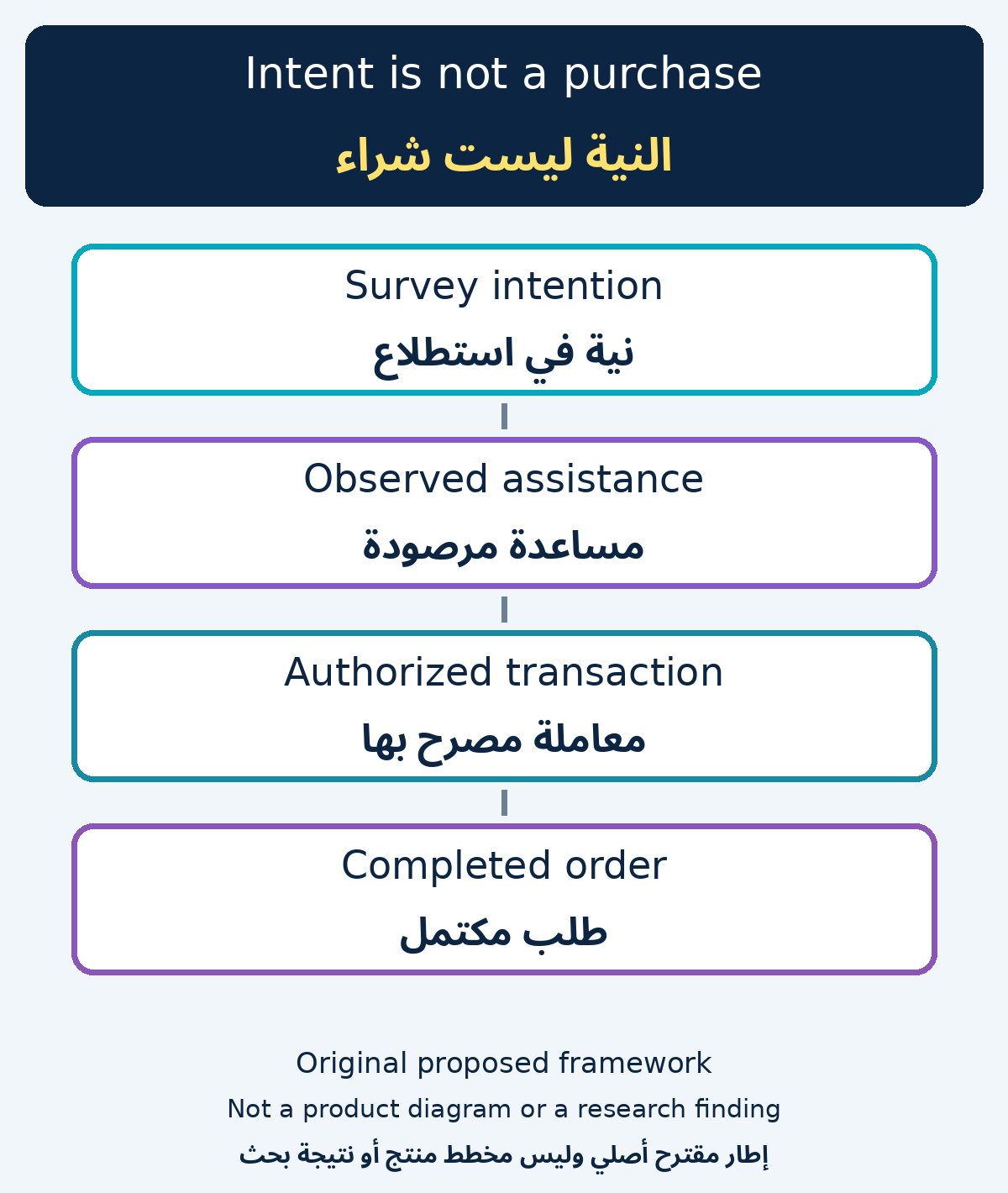
Separate three customer decisions
A comparison can help the customer check fit or total cost without touching a cart. Preparation can assemble an editable basket without placing an order. Delegation lets a system proceed within an explicitly agreed scope. Do not infer willingness for the last step from use of either of the first two. In each version of the experience, make the committed state clear through plain wording, the exact item and final total, and what can yet be changed.
A proposed test can therefore compare a standard product page with one that adds a verified comparison, while keeping checkout the same. After that, a separate test can compare standard checkout with an editable, prefilled basket. Hold the discount and inventory rules constant between groups, assign eligible visits consistently and decide what to exclude before launch. A test of transaction delegation is a different decision; it needs its own confirmation flow and safeguards rather than being enabled merely because the comparison was popular.
A hypothetical example shows the denominator problem
Suppose 1000 eligible visits see a comparison feature. Of those, 250 complete a comparison, and 100 reach checkout. The comparison completion rate is 25% of eligible visits. The number at checkout is 10% on that same base. Unless the events are joined, it would be wrong to say 40% of comparison completers reached checkout: some checkout visitors may never have finished a comparison. It would also be wrong to call any of these counts incremental sales. That claim needs completed purchases and a valid comparison, with uncertainty accounted for.
Check safety and quality alongside conversion. Count wrong variants, changes to the basket after a proposed recommendation, and discrepancies between the quoted and final total. Track corrections or returns separately from order starts. Set a stopping rule if the feature repeatedly presents incorrect product facts or if people mistake a basket preview for a confirmed order. Do not hide these failures in a single average satisfaction score.
Take the next step supported by evidence
A US holiday survey can suggest a useful question for another market, not answer it. Before using the idea in Saudi Arabia, verify the catalog data, local delivery and pickup rules, Arabic wording and price presentation. Use local outcomes to decide whether the feature helps shoppers, and report which products and channels were actually tested. A result should not be generalized to unrelated categories or shopping periods without checking the conditions.
If customers verify more offers without more mistakes, make the assistance easier to reach. If they still need to ask about total price, fix the information rather than pushing them faster towards checkout. If the handoff between comparison and a finished basket is accurate, the next decision is whether to test helping people prepare orders. None of those findings alone warrants authorizing automatic purchase.
Build a product evidence sheet the shopper can actually use
Give the merchandising and support teams a shared worksheet rather than asking each team to produce its own version of the offer. Assign a named owner for each field, but have a different person review facts that determine whether the customer can use the product. For example, a replacement filter can have the same nominal size as another version while still fitting a different model. Keep compatibility separate from dimensions. In the primary listing and the comparison, explain how the customer can verify the model number. That simple task is more informative than asking whether the new feature feels helpful in general.
Put volatile facts on a separate review schedule. A pickup promise based on a stale stock count is not fixed by improving the product description. Show the store and time to which the stock estimate applies, and distinguish stock shown as available from stock held for a particular order. If a person needs to travel to collect the item, do not present an estimate as a reservation. Have support record what the shopper saw and where the promise broke, then send the issue to the catalog, inventory or ordering team according to its source.
Make the sheet useful for missing facts as well as known ones. Give the interface an acceptable way to say that it cannot verify a field, ask for the necessary detail, or offer a human handoff. Check the outcome with a scenario where a compatible item is out of stock and the product data matches several nearby versions. Do not rank an available but incompatible version above the correct one solely to preserve a sale. Record when the team chose to withhold an answer, what information it was missing and whether the next step eventually resolved the question. A retailer can learn as much from a trustworthy refusal to compare as from a completed comparison.
Treat it as a decision test, not an interface popularity contest
Before launching, specify the consequence you want to change. A team adding a comparison to a page could predict fewer questions about whether a replacement part fits. Another team could aim to reduce wrong-item orders when versions are easily confused. These are different outcomes and can move in different directions. Keep a small set of outcome measures and identify which ones are only diagnostic. More clicks on the comparison, for example, tell you that customers interacted with it; they do not tell you that customers understood a critical requirement.
Observe how participants complete the task, not only whether they arrive at the expected screen. Let shoppers choose between similar hypothetical items with deliberately different delivery conditions. Ask them to explain what arrives, when, at what cost and what would happen if they return it. Mark answers against the actual condition. If shoppers choose correctly but still think returns are free when they are not, do not count the task as fully understood. Test on phone screens as well as larger devices, with the same factual details available in both conditions. Place a common question early enough that the user can make a meaningful decision before reaching payment.
Interpret signals with care. Fewer support contacts could mean information improved, but could also mean support was hard to reach. Compare task accuracy and access to help together. The same reasoning applies to time: a faster decision can be useful if the person remains correct, but it is not inherently better if the customer skips an important condition. Ask a reviewer who was not involved in designing the interface to inspect examples of both success and failure. Their notes should identify the facts that drove errors and actions to correct them, instead of attributing every result to the presence of artificial intelligence.
Check the handoff among storefront, cart and fulfilment
Once the product comparison is reliable, inspect the information passed across steps. A cart can preserve the exact item and variation, but promotions, delivery charges or pickup locations may need fresh confirmation. Set an explicit rule for recalculations. If the quoted total changes, show the corrected amount and a brief reason before the person commits. If an item loses availability, keep the change visible and offer options instead of silently substituting another item. In a hypothetical trial, the review should catch both a changed pickup store and a lower-priced item that no longer matches the selected version.
In addition, rehearse what happens when an order appears uncertain. An interruption after the customer confirms could be a delay, a declined action or a successful purchase whose receipt did not load. Before asking someone to repeat the action, verify whether an order actually exists. Give support enough information to find it without unnecessary personal details. Track duplicate orders, unresolved receipts and time to clarify the outcome separately. This is how a team can tell whether smoother preparation reduces work overall or simply transfers it from the storefront to fulfilment and support.
Finally, choose an owner for the customer’s next step after purchase. Do not count an order as frictionless while someone has to reconstruct which variant was promised or where it can be collected. Define the information the receipt should contain and check it against the order record. Introduce one change at a time so that a better result has a plausible explanation. Clear facts, a truthful cart and a reliable confirmation can be tested independently before the retailer ever considers whether the purchaser wants to delegate the decision itself.
End the pilot with a decision note that another team can use. Name the tested product group and the reason a particular variant passed or failed. Distinguish confusing copy from missing information, because they require different fixes. If a shopper could not find a product dimension already available in the catalog, improve how it is displayed. If the dimension was never verified in the first place, assign someone to obtain it. Record which problems were uncovered only after the order was prepared, and decide whether showing them sooner would help people avoid the wrong choice. The next test should follow from that record rather than the amount of attention the feature attracted.
Comments
No published comments yet.