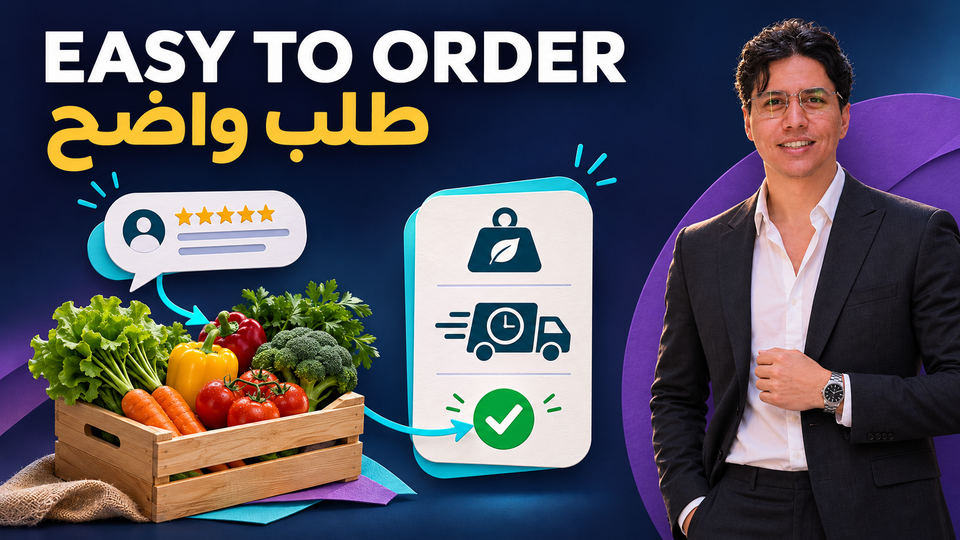
A customer can believe that your tomatoes are fresh and still hesitate at the order button. How much is in the box? Does delivery cover their neighbourhood? What happens after payment? For a fresh-produce business, those questions deserve attention alongside the reviews that build confidence in its products.
What the new research measured
A 9 November 2026 paper in *Frontiers in Sustainable Food Systems* surveyed 150 adults involved in fresh-produce purchasing in Bandung, Indonesia. Data were collected online from 15 August to 30 September 2025 through self-reports and homogeneous convenience sampling, then analysed with partial least squares structural equation modelling (PLS-SEM). Participants generally used conventional purchasing channels and had been informed about digital alternative food networks.
Perceived ease of use, usefulness and adoption of electronic word-of-mouth were associated with purchase intention; ease of use had the strongest direct model association. Review exposure concerned produce generally, not a standardized review. This single-city, non-probability study measured intentions, not transactions, and cannot establish causality, Saudi representativeness or sustainability benefits.
Read the primary study and its methods.
Reviews and ordering information do different jobs
A review can describe the firmness of an avocado or whether a delivery arrived as expected. The merchant must still explain what today's customer is buying and how the order works. Praise for quality leaves practical gaps when the unit, availability or delivery conditions are unclear.
Treat this as a design question worth testing: can customers understand the offer and complete an order without guessing? Review volume alone cannot answer it. Neither can a polished checkout screenshot without evidence that people understand it.
A fictional produce merchant
Imagine a hypothetical shop selling “small” and “large” vegetable boxes. Its genuine reviews praise freshness, but the product page does not explain approximate weight or the delivery window. A shopper cannot work out whether one box will cover the meals they have planned.
This is an illustrative scenario, not a research finding or a client case. The merchant could add an approximate weight range, examples of seasonal contents, substitution rules and delivery availability. Where weight or contents vary, the explanation should make that variation visible before payment. Any visual example must be clearly labelled rather than presented as a guaranteed assortment.
Fix essential information for everyone first
Missing charges, misleading descriptions and ambiguous order confirmation should be corrected for every customer. Keeping a confusing or deceptive version live merely to manufacture a test result is a poor starting point.
Once both versions are accurate, compare two ways of presenting the same information. One could group the box size, delivery details and confirmation steps beside the order button. Another could use a short sequence. Keep products, prices, availability, delivery promises and review content the same.
Make the test answer a business question
Before launch, ask a few people unfamiliar with the page to explain what they would receive, the total cost and when an order becomes confirmed. Use the misunderstandings to improve both versions. This is a comprehension check, not proof of a conversion effect.
Then write down the experiment's rules:
- Randomly assign eligible visitors before they see either layout, and keep each visitor in the same version. Define eligibility in advance.
- Use completed paid orders per eligible randomized visitor as the primary measure. Verify that analytics records orders accurately and avoids duplicate visitors and payments.
- Track cancellations, refunds and support contacts as guardrails, with consistent denominators and observation windows. More orders accompanied by more avoidable problems may be a poor trade.
- Estimate the required sample from the existing purchase rate and the smallest improvement worth acting on. Set the duration and decision rule before examining results.
- Allow enough time for delivery, cancellations and refunds to appear. Report the difference and its uncertainty, including when the result remains inconclusive.
A few extra orders do not settle the question. A small merchant without enough traffic can still find comprehension problems through observation and customer questions, while being honest that these observations do not establish a sales effect.
Ask for honest, useful reviews
Invite customers to describe the produce they actually received and the ordering experience they actually had. Ask neutral questions about clarity, delivery and quality. Do not request feedback only from happy customers or suppress criticism to make the page look stronger. Never fabricate testimonials, and clearly disclose any incentive attached to a review.
Keep the conclusion within the evidence
Use the research to frame a question, then evaluate your own customers' understanding and actual outcomes. A promising explanation is a starting point for an experiment. Decide what to change only after checking the quality, uncertainty and practical importance of your own evidence.
Comments
No published comments yet.