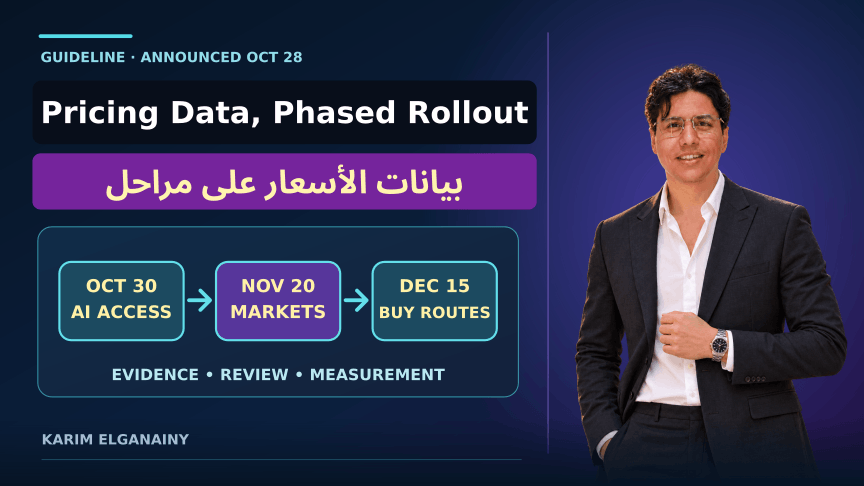
Published October 29, 2026. Guideline announced expanded advertising intelligence on October 28, with phased availability rather than one immediate release. The practical question is not simply whether an AI assistant can retrieve a media price. It is whether the price describes a genuinely comparable purchase, and whether the team can explain that comparison before changing a budget.
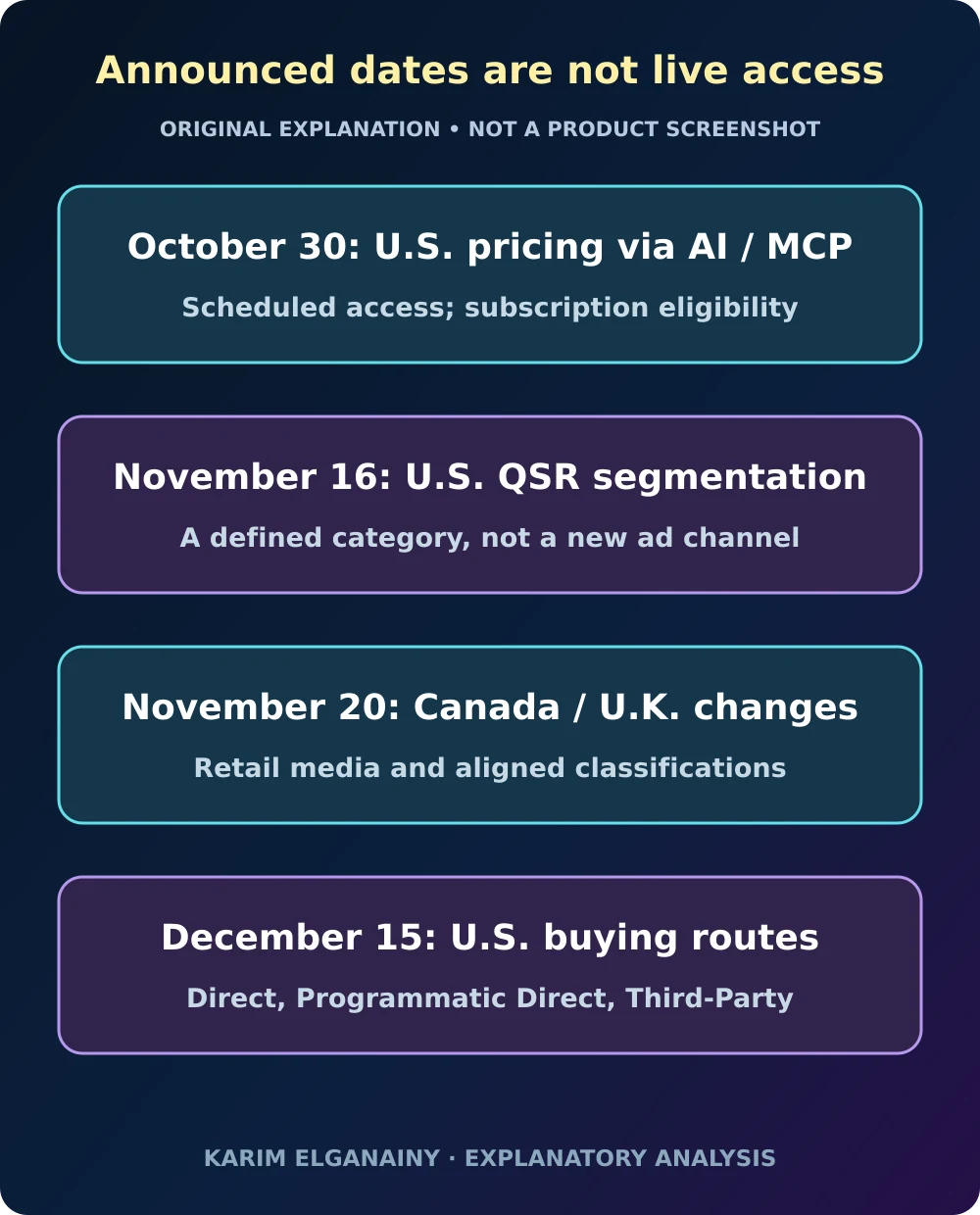
Original explanatory illustration by Karim Elganainy. Announced availability schedule, not a product screenshot or confirmation of live access. Announcement context: Guideline release.
What the announcement actually establishes
The company's schedule places U.S. digital pricing in its AI Agent and MCP Server on October 30, U.S. quick-service restaurant segmentation on November 16, Canadian retail media and aligned U.K./Canadian digital classifications on November 20, and a U.S. Programmatic Direct view on December 15. Subscription eligibility applies. The latter separates buying channels into Direct, Programmatic Direct and Third-Party. These are announced dates, not independently verified deployments. Primary announcement.
That distinction matters because the release also uses present-tense language. This article follows its dated availability table. The analysis below is an editorial framework for evaluating the capabilities, not additional product claims, a demonstration of the software or a prediction of savings.
A pricing answer needs a comparison contract
Before asking an assistant whether a publisher is expensive, write down what would count as an equivalent buy. Include market, reporting period, format, placement, buying route and the commercial unit being compared. A price without those boundaries may be accurate in its original context and misleading in a negotiation.
Treat this short definition as a comparison contract shared by planning, buying and finance. If one team means delivered media cost and another means the total invoice including services, apparent disagreement is inevitable. The useful output is therefore not a solitary benchmark. It is a benchmark accompanied by the definition that makes it interpretable.
Classify the transaction before judging the rate
A practical concern with programmatic reporting is that the transaction mechanism and the commercial relationship answer different questions. A buyer may have negotiated directly while technology executes delivery. Collapsing both ideas into a single label can make analysis harder, especially when different teams maintain different buying taxonomies.
The editorial opportunity here is to create a two-part review: how was the inventory purchased, and what was actually included? Neither an automated route nor a direct relationship alone establishes quality. A classification should improve the precision of questions, not become a shortcut for declaring one channel inherently efficient and another wasteful.
Ask what changed in the mix
Suppose an internal dashboard shows a higher average cost this month. A team might immediately infer weaker negotiating power. An alternative explanation is a change in the mix of formats, placements or commitments. These possibilities need to be separated before an account manager receives a performance verdict.
A useful analytical sequence is to compare the total, then compare stable subsets, then inspect the movement between them. This is a proposed workflow, not a finding from Guideline's data. It protects teams from confusing a different purchase with a worse purchase. Where comparable subsets are unavailable, the correct answer may be that the benchmark cannot settle the question.
Keep AI queries narrow enough to audit
Natural language can lower the effort required to explore data, but vague prompts transfer ambiguity into the answer. Instead of asking for the best publisher, ask for a defined comparison across a specified period and buying route, then request the dimensions and exclusions used to construct it.
Save both the question and the returned interpretation. A colleague should be able to see whether the assistant compared the intended market, included an unexpected format or silently broadened a filter. This does not require treating every output as suspicious. It means matching the documentation burden to the importance of the decision that follows.
MCP access is not permission to transact
Connecting intelligence to an assistant should not blur the difference between reading information and authorizing action. A planning tool can help investigate a rate without receiving the authority to change a campaign, approve a purchase or transmit confidential negotiations elsewhere.
Teams evaluating any connected workflow should define who can retrieve which datasets, where responses may be retained and how outputs can be shared. An approved source does not automatically make every destination appropriate. This is general operational guidance, not a description of additional Guideline controls. Keep the first evaluation read-only until the data interpretation and internal permissions are understood.
Do not confuse price with business value
A lower cost per thousand impressions does not, by itself, establish a better commercial outcome. Inventory can differ in audience suitability, context, delivery reliability and the role it plays in the wider campaign. Equally, a premium price should not escape scrutiny simply because it comes with an appealing narrative.
Use pricing intelligence as one input alongside delivery evidence and the campaign's actual objective. A negotiation question and an effectiveness question may require different datasets. The disciplined response to a surprising benchmark is to investigate, not automatically move spend. This preserves room for both efficiency and strategic choices that cannot be summarized by a single rate.
Protect historical comparisons when labels change
A cleaner taxonomy can still disrupt established reports. Before replacing a classification, preserve the prior version and document the mapping. Otherwise, a board presentation may display a sudden category shift that reflects relabeling rather than any change in buying behavior.
Ask whether historical series have been restated, whether every old category maps cleanly and whether exceptions remain. If two reporting periods use different definitions, annotate the break rather than presenting them as seamless. This is especially important when a team has tied targets or incentives to category-level spend. Analytical consistency is a governance issue as well as a dashboard issue.
Regional consistency is not regional equivalence
Shared labels make cross-market reporting easier to read, but they do not erase differences in currency, media availability, campaign objectives or commercial conditions. A comparison across countries needs an explicit explanation of which differences have been normalized and which remain.
For a regional marketing team, the first benefit may be a common vocabulary rather than a universal target price. Local buyers should be able to challenge a comparison without being seen as resisting transparency. A good review asks what additional context would make the numbers useful. A weak review uses a global average to overrule the people responsible for local execution.
Build a controlled evaluation, not a transformation claim
Start with a small set of real questions from an upcoming planning cycle. Include one straightforward comparison, one case with ambiguous classification and one request that should be declined because the available data cannot support it. The third case is important: a useful system should reveal uncertainty rather than fill every gap.
Record whether each answer is reproducible, properly scoped and understandable to someone outside the original query. Compare preparation effort only after defining the task consistently. Do not claim faster planning merely because an answer appears quickly; verification and correction time belong in the assessment too. A convincing pilot measures the whole decision workflow.
Build an evidence packet for a disputed benchmark
A disputed comparison should produce a compact evidence packet rather than a long exchange of screenshots. Include the original question, the selected cohort, the reporting dates, the unit of cost, the classification version and any relevant exclusions. Add the decision the benchmark is supposed to inform. A perfectly documented number can still be irrelevant to the choice on the table.
Separate disagreements about data from disagreements about priorities. One person may believe the cohort is inappropriate; another may accept the cohort but place more value on a particular context. Those are different problems and should not be resolved with the same argument. The first calls for a revised comparison. The second calls for a clear commercial judgment, with its trade-offs recorded instead of hidden behind a supposedly objective score.
Make missing information visible
A blank field, an unavailable segment and a genuine zero should never be treated as interchangeable. In an AI-assisted workflow, the final response should preserve these distinctions rather than smoothing them into a fluent summary. Teams should ask what coverage is present, what is absent and whether the answer depends on a proxy rather than the requested measure.
This matters particularly when a manager wants a simple ranking. An apparently complete list can disguise unequal evidence across publishers or categories. A more useful output may show which comparisons are supported, which need clarification and which should not be made. That is not a failure of the analysis. It is a way to prevent uncertainty from becoming invisible as information moves from a specialist to an executive audience.
Give negotiators questions rather than automatic demands
A benchmark can improve a commercial conversation without dictating a target price. If an offer appears materially different from a relevant reference, ask the seller to explain the included inventory, commitments, services and delivery conditions. The purpose is to uncover the source of the difference, not to assume that every deviation represents an avoidable premium.
Likewise, an unusually low rate deserves questions. What is excluded? What happens if delivery changes? Which commitments are fixed, and which are estimates? These are proposed diligence questions, not allegations about any supplier. Procurement and media specialists can use the same comparison while reaching a nuanced conclusion. Better intelligence should make a negotiation more specific, not merely make the opening demand more aggressive.
Preserve a way to correct the decision record
Even a careful comparison may need revision when a definition changes or an omitted condition becomes visible. Establish a straightforward correction process: identify the earlier output, explain what changed, name the affected decisions and issue a replacement with a clear date. Quietly editing an old slide leaves colleagues using different versions of the same argument.
For important decisions, retain the initial rationale alongside the correction. That makes it possible to distinguish a reasonable choice made with limited information from a preventable process failure. It also creates a useful learning record for the next planning cycle. The aim is not to build a bureaucracy around every query, but to ensure that evidence remains traceable when it influences real commitments, supplier relationships and performance assessments.
Assign ownership before the first budget review
Planning should own the question, analytics the comparison logic, buying the commercial interpretation and finance the reconciliation to actual commitments. One person may cover several roles, but the responsibilities should still be explicit. Otherwise a polished output can circulate without anyone accepting responsibility for its assumptions.
The immediate next step is modest: confirm subscription eligibility and scheduled access, agree a comparison template, and choose a decision where better context could genuinely help. Guideline's announcement is relevant because pricing and classification may become easier to query together. Whether that produces better decisions depends on disciplined interpretation, not the presence of an AI interface alone.
Sources
Guideline's issuer-provided announcement, October 28, 2026. Publication date of this analysis: October 29, 2026. Product statements are attributed to the announcement; recommendations and hypothetical examples are original editorial analysis.
Comments
No published comments yet.