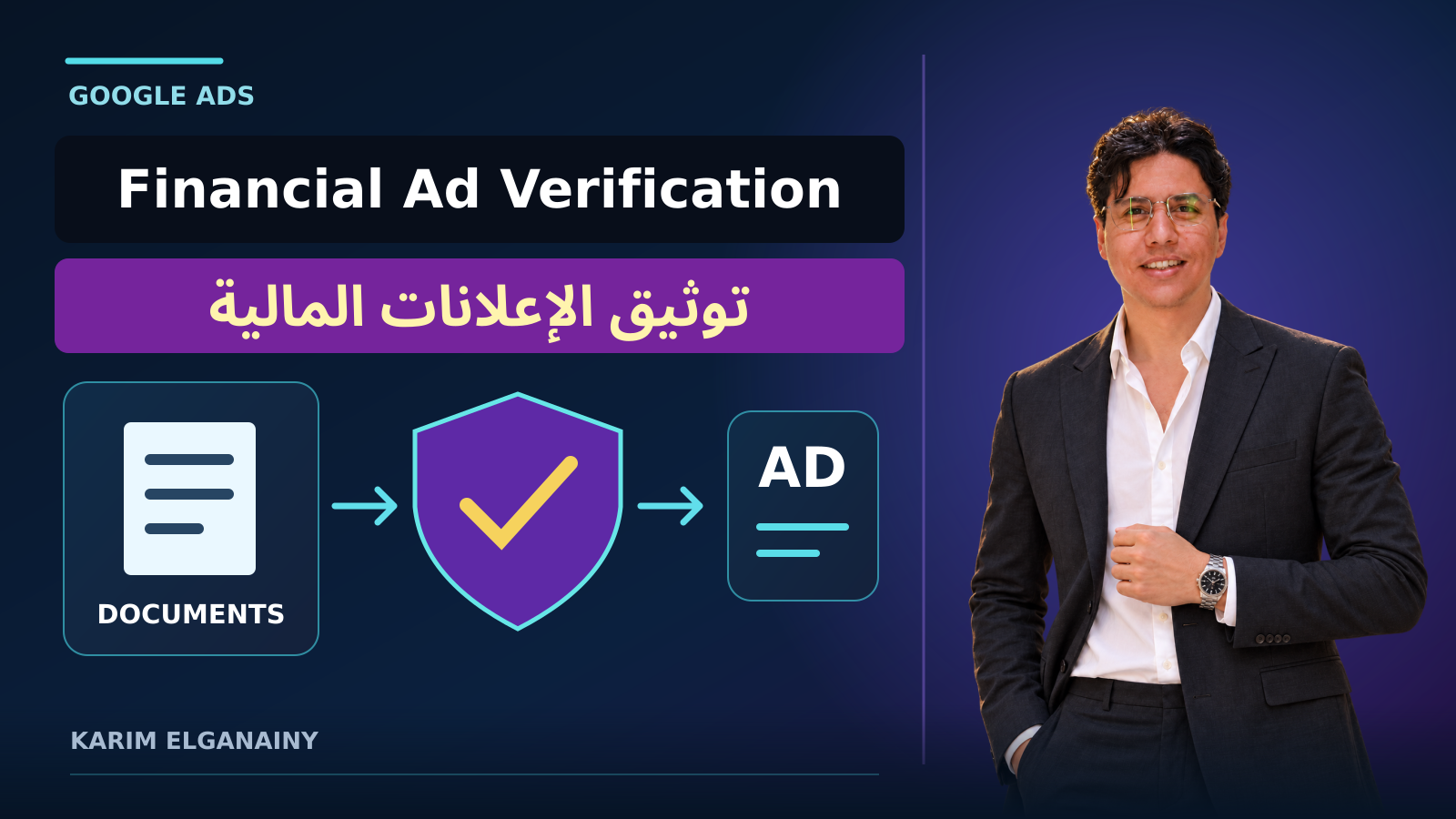
The announcement and its real geographic scope
On 20 October 2026, Google announced that it would extend financial-services advertiser verification to the United States and Canada in early 2027. The additional checks concern financial-service credentials, rather than simply confirming who operates an advertising account. Google says the existing programme covers 42 countries and approximately two billion internet users. Separately, it reports that identity-verified advertisers generated more than 97% of US and Canadian ad views during 1 September 2025–31 August 2026. These are different measures and should not be combined. Google’s announcement.
The important operational distinction is between identity and eligibility. A business can establish its identity without thereby proving that a particular financial product, representative or destination meets a specialised verification requirement. The announcement is about the United States and Canada; it does not establish a new Saudi requirement, a universal launch date for every account, or automatic approval for previously verified advertisers.
This article’s planning recommendations are analysis, not legal advice or a substitute for the account-specific instructions Google eventually provides. For a marketing leader, the immediate opportunity is to organise evidence and responsibilities before verification becomes an urgent dependency in a live campaign.
Treat verification as part of campaign readiness
Marketing teams often describe readiness through creative approval, tracking checks and available budget. That definition is incomplete when delivery also depends on the advertiser’s category and qualifications. A beautiful landing page cannot compensate for an unresolved eligibility question. Equally, a compliance document cannot rescue an offer whose wording creates a misleading expectation.
Add a verification workstream to the launch plan alongside media, creative, measurement and operations. Its output should be a documented conclusion about the intended account, entity, product and destination, with an owner for outstanding questions. Avoid treating a green status elsewhere in the interface as evidence that every requirement has been met.
Use a simple launch dependency map. Identify which campaigns cannot run without the new verification, which are outside the announced scope, and which need clarification. A dependency map is more useful than a generic warning because it shows where uncertainty can affect revenue, customer acquisition or a committed launch date.
Build an evidence inventory without collecting everything
Begin with the legal entity that advertises, the brand shown in the advertisement, the website destination and the relevant product or service. Record whether these names match and, if they differ, why. Corporate structures, agency relationships and trading names can be legitimate, but an unexplained inconsistency is a predictable source of operational friction.
Next, have the authorised internal team identify the evidence relevant to the actual requirement. Do not ask every employee to upload personal documents or assemble an indiscriminate collection of sensitive information. The appropriate principle is to collect the minimum evidence needed through the official process, with controlled access and a clear retention policy.
Create a checklist that distinguishes information already verified, information awaiting confirmation and information that has expired or changed. Keep a record of where the authoritative copy lives rather than circulating attachments across multiple chat groups. This proposed workflow reduces duplication while preserving accountability; it does not claim that Google will request every item in the checklist.
Separate three questions that are often confused
The first question is whether the advertiser is who it claims to be. The second is whether it is qualified for the service being promoted. The third is whether the advertisement and destination comply with the applicable advertising rules. These questions overlap, but they are not interchangeable.
An internal review can use three corresponding sign-offs. The account administrator confirms the entity and access structure. The appropriate compliance owner assesses the relevant qualifications. The marketing reviewer checks that the message, landing page and intended audience accurately reflect the approved offer. No single person should be expected to infer the answers from a screenshot of a rejection notice.
This separation is particularly useful when a campaign is incorrectly classified. The right response is to establish the actual business activity and seek a correction through the supported appeal process. It is not to upload irrelevant financial documents, disguise the service or rewrite the page merely to evade the classification system.
Design a realistic timeline before setting a launch promise
The announcement uses an early-2027 rollout horizon. That is enough to justify preparation, but not enough to invent an exact deadline for every advertiser. Build the timeline around confirmed account notices and official guidance as those become available. Record the date and scope of each update so an old screenshot does not become the team’s permanent policy reference.
Work backwards from the intended launch. Allow time for internal ownership checks, document retrieval, review, submission and possible clarification. These are planning stages, not promised platform processing times. A team should not tell a client that approval will arrive within a particular number of days unless an applicable source actually supports that commitment.
Prepare a contingency that does not depend on bypassing the verification. Options might include adjusting a campaign launch, strengthening owned communications or reallocating resources to already eligible activity after appropriate approval. Contingency planning is about preserving business continuity within the rules, not finding a different account to conceal the same unresolved problem.
Keep agencies and clients aligned on responsibility
An agency may operate campaigns while the client controls the underlying corporate evidence. That arrangement creates a handoff risk: each side can assume the other has completed a task that nobody owns. Resolve the ambiguity with a responsibility table before the verification window becomes urgent.
For each required action, specify who prepares the information, who confirms its accuracy, who is authorised to submit it and who monitors the response. Include a backup contact for absence or staff changes. The table should be brief enough to use in practice, not a policy document that remains unread until something fails.
Agree what the agency can see and retain. Operational access to an advertising account does not automatically justify unrestricted access to all corporate or personal records. Where a secure owner-led submission is appropriate, the agency can still coordinate timing and campaign consequences without holding unnecessary copies of the underlying documents.
Measure the cost of friction rather than blaming compliance
A verification requirement can expose weaknesses in campaign operations. Measure those weaknesses directly. Useful internal indicators include time from notice to ownership assignment, time spent retrieving correct evidence, number of clarification cycles and the duration of avoidable delivery interruption. These are suggested management measures, not Google product metrics.
Separate platform review time from time lost inside the organisation. If a request waited a week for an internal sign-off, attributing the entire delay to the platform hides a repairable problem. Conversely, do not penalise a team for an external review period it could not control. An accurate timeline supports a better process conversation than a single total-duration figure.
Estimate commercial exposure cautiously. Planned media spending that did not run is not automatically lost revenue. A useful analysis considers whether demand moved to another channel, whether the campaign was seasonal and whether customers could still access the service. State assumptions explicitly rather than multiplying a historic return ratio by every delayed advertising dollar.
Use a small readiness exercise now
Choose one representative account or product line and run a tabletop exercise. Ask the team to identify the advertiser, locate the authoritative evidence, explain any naming differences and map the submission responsibility. Do not submit hypothetical or unnecessary documents simply to complete the exercise.
Record the questions that cannot be answered quickly. A missing owner, an outdated company description or an unclear relationship between the brand and the licensed provider may deserve attention even before the new programme reaches the account. Prioritise issues by their potential to interrupt real campaigns, not by how easy they are to close in a spreadsheet.
Repeat the exercise after correcting the largest gaps. Success means the team can explain the process and retrieve appropriate evidence consistently. It does not mean every future campaign is guaranteed approval. The distinction protects the business from treating an operational rehearsal as a regulatory certificate.
What GCC and healthcare marketers should take from this
For a GCC organisation advertising into the United States or Canada, the announced geography may be directly relevant. For an organisation advertising only locally, the immediate lesson is operational rather than a newly announced local rule. Check the actual destination market, account notices and service category before deciding what action is required.
Healthcare businesses should be especially careful when an automated system classifies a medical service as insurance or another financial activity. The appropriate escalation describes the real service, the advertiser and the landing page accurately, and requests review of the classification. It should not claim that all healthcare advertising is exempt from every specialised requirement.
Keep patient information out of routine advertising-verification correspondence unless a specific lawful and necessary process genuinely requires it. A service-category explanation can usually focus on the organisation and advertised offering. This is a privacy-conscious operating recommendation, not a claim about a universal document rule across platforms or jurisdictions.
The strategic takeaway: make eligibility visible
The most useful response to this announcement is not to panic or postpone everything until 2027. It is to make eligibility an explicit part of marketing operations. A shared readiness view can show what is verified, what is uncertain, which campaigns depend on a decision and who is responsible for the next step.
That visibility improves planning even when no immediate action is required. Finance can distinguish a planned campaign from an eligible campaign. Creative teams can avoid producing assets for an offer whose description is still disputed. Account managers can give stakeholders a precise status rather than an optimistic launch promise unsupported by evidence.
The durable advantage is a marketing system that can explain its claims, entities and dependencies. Verification becomes easier to manage when the business has already organised those foundations. Treat the new programme as a reason to strengthen that discipline, while keeping its announced geography, timing and unresolved implementation details clear.
Source and evidence boundary
The factual announcement above comes from Google, 20 October 2026. The operational frameworks, readiness exercise and suggested metrics are original analysis. No account-specific approval, precise rollout deadline or Saudi policy change is inferred from the announcement.
Comments
No published comments yet.