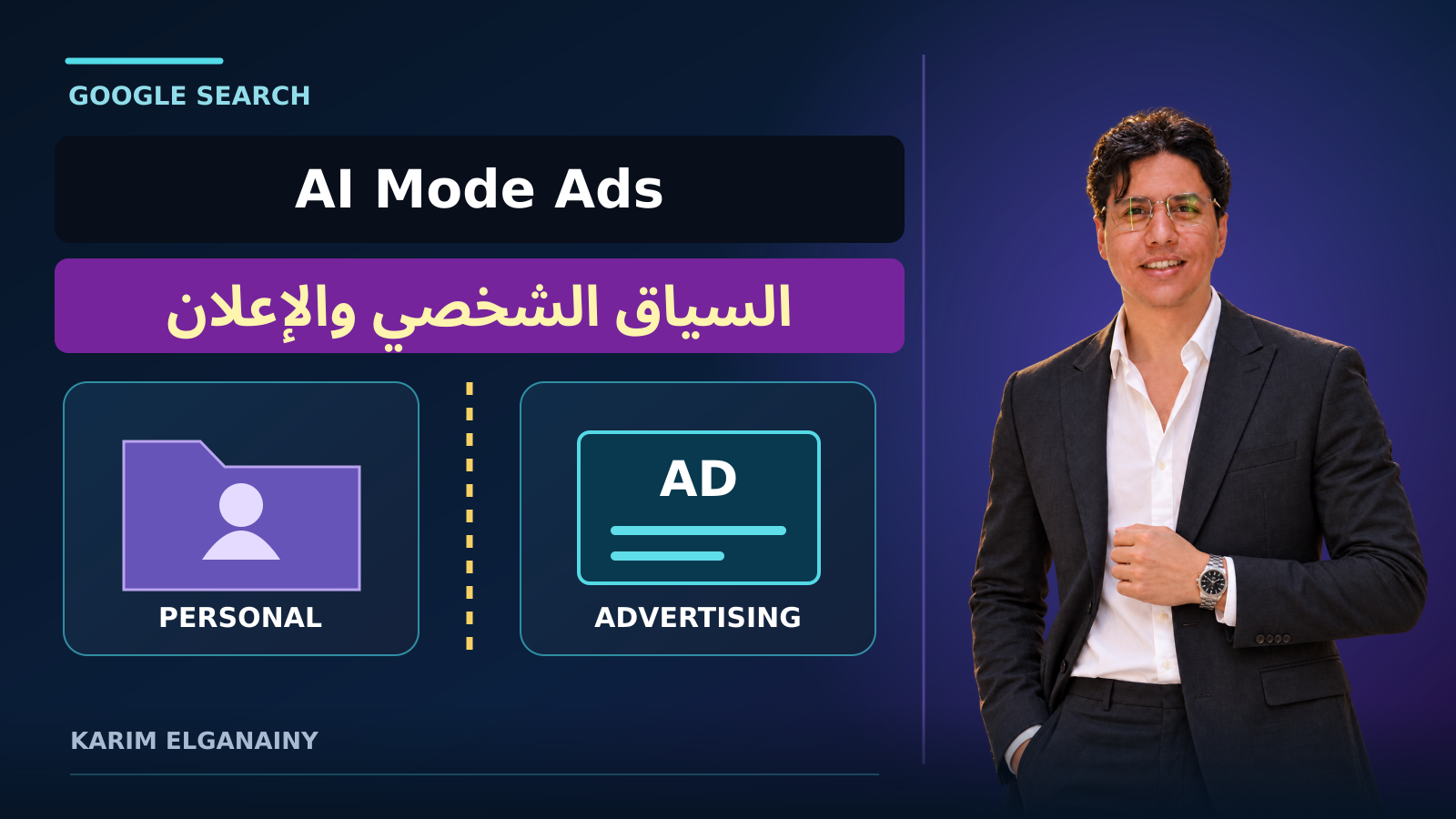
A reported test, not a universal advertising rollout
On 16 October 2026, Search Engine Land reported that Google had begun testing advertisements in AI Mode for users with Personal Intelligence enabled. The report should be read as evidence of a test, not as a promise that every advertiser, market or account can buy the same experience. This article was published on 20 October and does not present the earlier announcement as a new event today. Dated reporting.
Google’s help documentation, checked on 20 October, explains a crucial boundary: summaries, excerpts or inferences associated with Personal Intelligence may contribute to ad personalisation, but this does not mean advertisers receive access to a person’s inbox or photo library. The documentation also excludes sensitive categories such as health, race and religion from personalised advertising. The page is undated, so it is used to explain the mechanism rather than establish the test’s launch date. Google’s explanation.
The commercial question is therefore not whether brands can suddenly inspect private customer lives. They cannot infer that permission from this development. The more useful question is how to communicate a relevant, understandable offer when a search experience can incorporate context that the advertiser does not directly see or control.
Relevance and access are different concepts
A system can use information to shape an experience without exposing that underlying information to every participant. Marketing teams should keep that distinction visible in their internal discussions. Otherwise, a technically nuanced change can become an exaggerated sales presentation about access to private intent that the product does not provide.
Write a plain-language description of what is known, what remains unavailable and what must be checked in the actual account. Include the distinction between a platform-generated contextual signal and advertiser-held first-party data. They have different origins, different controls and different implications for how a campaign can be measured or explained.
This clarity also protects creative strategy. A brand does not need to imply that it knows a person’s private situation to make an advertisement useful. Clear service descriptions, transparent prices where appropriate, relevant availability information and credible evidence can reduce uncertainty without pretending to possess intimate knowledge about the viewer.
Build around the task the customer is trying to complete
Conversational search can encourage marketers to focus on longer prompts and richer context. A more durable starting point is the underlying customer task. Is the person comparing options, resolving a practical constraint, learning unfamiliar terminology or deciding whether a service meets a need? Each task creates different information requirements.
Map a small number of tasks to the questions your business can answer reliably. A travel provider might explain cancellation conditions and accessibility information. A software business might clarify compatibility and implementation effort. These are illustrative examples, not claims about categories currently included in the test or instructions to target sensitive personal characteristics.
Then decide what should happen after the advertisement. If the promise is help with comparison, the destination should support comparison. If it offers a specific product, the page should establish availability and material conditions. A contextual placement cannot compensate for a destination that ignores the task and immediately demands a lengthy form.
Make the offer understandable without hidden context
The advertiser may not know every contextual ingredient behind an impression. That makes self-contained communication especially important. The advertisement should explain the offer accurately on its own, without relying on an assumption that the user has already seen a particular question, answer or personal reference elsewhere in the conversation.
Review the creative with someone who has not attended the campaign briefing. Ask what the company offers, which claims are supported and what action the person expects after clicking. If the interpretation depends on information the advertisement does not contain, simplify the message or move the missing explanation into the destination.
Avoid language that sounds as though the brand has read a private message. Even where a platform permits contextual relevance, a presumptuous tone can damage trust. This is a creative-risk observation rather than a claim that every such phrase is formally prohibited. The safer strategic principle is to demonstrate usefulness through the offer, not through suggestions of surveillance.
Audit the destination before exploring the placement
A useful landing-page audit begins with consistency. Compare the advertisement’s promise with the page title, offer description, pricing or eligibility information and primary action. Record every mismatch. A contextual system can bring a motivated visitor to the page, but motivation can disappear quickly when the destination changes the subject.
Next, assess the evidence supporting important claims. Distinguish a measurable product feature from a broad promotional statement. Make limitations easy to find. If an offer depends on location, time, availability or an existing customer relationship, explain those conditions before the person invests effort in completing a form or contacting the business.
Finally, check the operational handoff. A lead form is not the end of the customer experience. The receiving team should know which offer generated the inquiry and what response was promised. That alignment is particularly important when a contextual advertisement raises expectations of relevance that a generic call-centre script cannot fulfil.
Start with an account-eligibility check, not a spending forecast
Because this is a reported test, the first practical step is to establish what the actual advertising account can do. Review official account guidance and available settings. Do not build a client forecast around a placement that cannot be selected, observed or measured in the account being discussed.
Separate three states in the plan: available now, announced but unavailable, and uncertain. Attach a source and review date to each. This prevents a presentation created during an early test from being reused months later as though it described a mature, universally accessible product with stable reporting and predictable delivery.
If access is unavailable, there is still useful preparatory work. Improve offer clarity, destination quality and measurement definitions. Those improvements serve existing campaigns as well. Avoid creating a fictional test plan with invented targeting controls simply because the new experience sounds strategically important or competitors are discussing it enthusiastically.
Define an experiment that can answer a business question
If an eligible test opportunity becomes available, begin with a bounded question. For example, does the available contextual experience improve the proportion of inquiries that meet a predefined qualification standard compared with an appropriate existing approach? This is a proposed research question, not a statement that the platform supplies every control needed to answer it.
Choose a comparison design that the available tools can genuinely support. Keep the offer, destination and qualification definition as stable as possible. Record differences in audience composition, spending and delivery. If those factors change together, acknowledge that the experiment cannot isolate the placement’s effect with the same confidence as a controlled test.
Set the observation period and decision rule before launch. Do not stop the experiment at the first favourable result or extend it indefinitely because the answer is disappointing. A useful outcome may be that the placement is promising, inconclusive or unsuitable for the current offer. All three conclusions can improve future allocation when the evidence is honestly described.
Measure quality and trust alongside response
Clicks and form completions are not enough to judge a more contextual advertising experience. Define what a qualified response means for the business. A service organisation might distinguish a relevant inquiry from a wrong-category request. A retailer might examine completed purchases and subsequent returns. The definition should reflect the offer rather than whichever metric is easiest to obtain.
Track the reasons for disqualification in a restrained, privacy-conscious way. The objective is to understand mismatches between the promise and the response, not to build a speculative profile of sensitive characteristics. Use aggregate categories that help improve the campaign and avoid collecting personal details that are unnecessary for the stated purpose.
Include trust signals in the review. Complaints about relevance, confusion about why an advertisement appeared or questions about data access may reveal a communication problem even when click-through rate rises. A strong report can show a positive response metric and a negative trust signal together instead of selecting whichever one makes the campaign look better.
Give privacy explanations an operational owner
Marketing, customer service and privacy teams may answer the same customer question in different ways unless they coordinate. Prepare a short, accurate explanation of what the business itself knows and controls. Do not attribute private platform processing to the advertiser or promise that a third-party system never uses a category of information unless the relevant documentation supports that statement.
Route difficult questions to the appropriate internal owner. A frontline employee should not have to improvise a technical account of an AI advertising system during a customer conversation. Equally, a standard answer should not conceal uncertainty. It can explain the business’s own data practices and direct the person to the platform’s controls and official documentation for the platform’s behaviour.
Review this explanation when the product changes. Early test documentation can evolve, and a static slide may outlive the conditions under which it was written. Keeping an accountable owner and a review date is a practical safeguard against turning a cautious description into an unsupported permanent assurance.
Apply the lesson carefully in GCC healthcare marketing
A healthcare organisation should not interpret this development as an opportunity to infer medical conditions from private context. Google’s documented exclusion of sensitive health categories matters. Any proposal involving healthcare advertising should be reviewed against the applicable account policies, local requirements and the organisation’s own privacy and clinical-communications standards.
A lower-risk planning exercise can focus on public institution-level information: locations, opening hours, service descriptions and how to request general information. Even there, claims need to be accurate and the next step needs to be clear. Do not describe such an exercise as automatically compliant merely because it avoids an explicit diagnosis or a named condition.
For GCC audiences, verify actual market availability and prepare natural Arabic and English communication where relevant. Localisation should cover the destination, contact process and service terminology, not only the advertisement. The usefulness of contextual advertising ultimately depends on whether the organisation can deliver the experience its message leads a person to expect.
Strategic takeaway: contextual relevance must earn trust
The test is worth watching because it brings advertising into an experience that can be more personally contextual. Its value, however, cannot be established by the novelty of the technology alone. A marketer still needs a credible offer, a suitable destination, a measurable outcome and an explanation that does not overstate access to personal information.
The recommended preparation is practical: confirm eligibility, map customer tasks, review the promise, audit the handoff and define a bounded experiment. Keep sensitive assumptions outside the strategy. Report what the evidence supports and what remains unknown. That discipline is more durable than an early claim that a new placement will automatically improve conversion rates or reduce acquisition cost.
Sources and interpretation
The test timing comes from Search Engine Land, 16 October 2026. The privacy and personalisation boundaries come from Google’s help page, checked 20 October. The planning framework and experiments are original analysis, not features or results promised by either source.
Comments
No published comments yet.