What the new benchmark actually measures
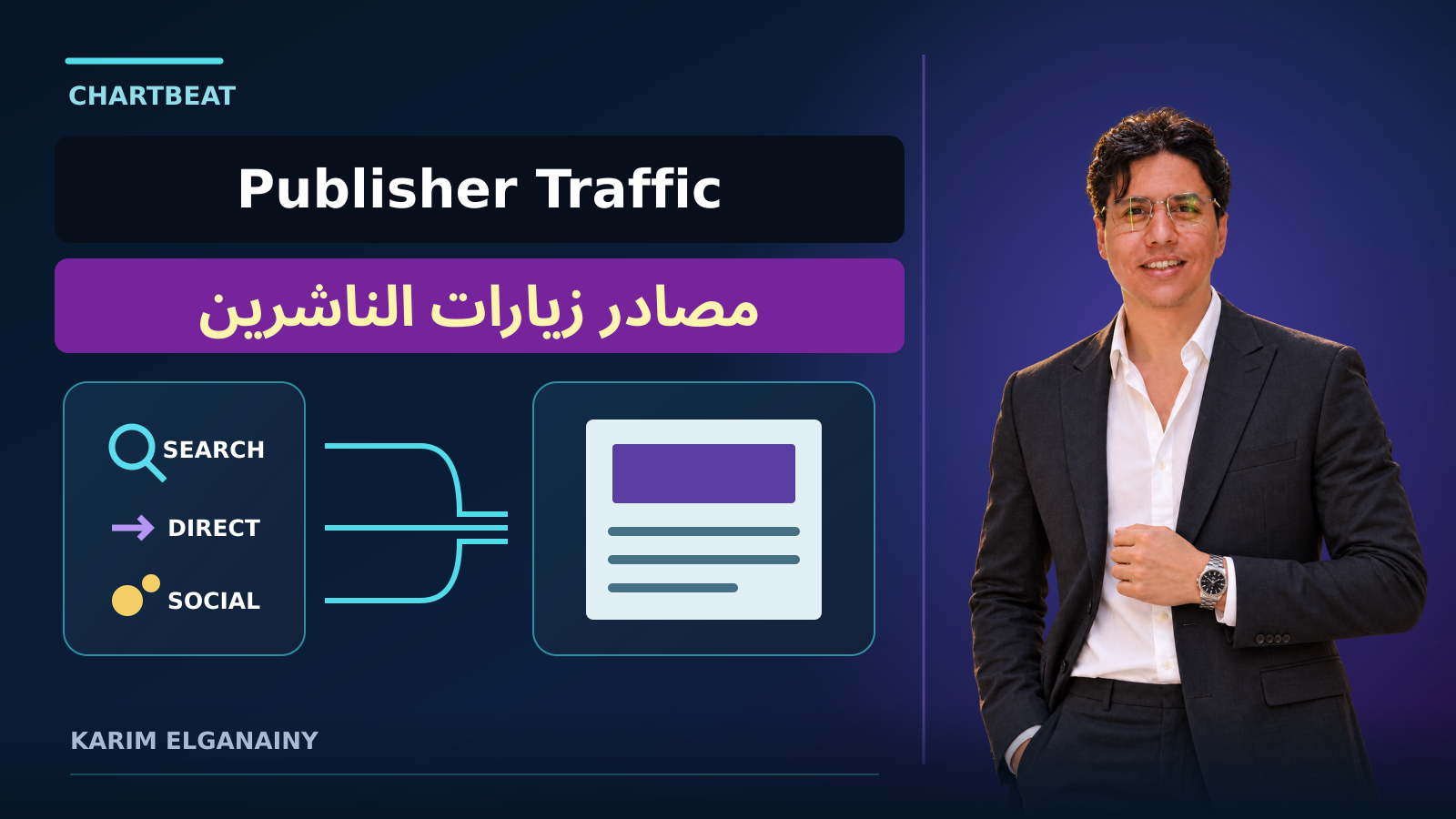
Chartbeat's report, published on 15 October 2026, shows search engines accounting for 12% of North American publisher pageviews in Q3 2026. Its corresponding Q3 2025 chart shows 21%. The difference is nine percentage points in share, not proof that search pageview volume fell by the same amount. Compare the 2026 report with the 2025 report.
The published charts concern publishers in Chartbeat's network. They do not establish a representative benchmark for every website, identify a particular search engine as the cause or provide a matched-panel explanation of the annual movement. This article, published on 20 October, uses the finding to examine acquisition risk. It does not claim that a Saudi clinic, retailer or professional-services website experienced the same change.
Start with the denominator, not the alarming headline
A traffic share has two moving parts: the visits or pageviews attributed to a source and the total against which that source is divided. Search can occupy a smaller share because search volume declines, because other sources grow or because both change. Differences in the websites measured can also affect the aggregate. Without examining those components, an apparently simple percentage becomes a story with more certainty than the evidence supports.
For your own business, put the absolute count beside the share. Then identify whether the reporting unit is users, sessions or pageviews and keep that unit consistent. A visitor reading several articles can generate multiple pageviews, so a pageview benchmark should not be compared directly with a customer count. The first useful response to the report is therefore an analytics question: can the team reproduce its own trend using stable definitions and an explainable reporting period?
Audit measurement before changing the strategy
Create an inventory of changes that could affect the trend. Consider consent implementation, analytics configuration, domain migrations, redirects, campaign tagging and the introduction of new content templates. These changes do not necessarily explain a decline, but excluding them from the investigation risks treating a measurement discontinuity as an audience decision. Document when each change occurred and whether the observed movement begins at the same time.
Next, compare independent sources of evidence where available. Search performance tools, server information and the site's analytics may measure different stages rather than identical quantities. Use their differences to ask better questions, not to force a false reconciliation. If search clicks remain stable while measured sessions fall, investigate the landing experience and measurement boundary before concluding that the search channel has stopped working. Record uncertainty as an operational task with an owner.
Identify which pages create real business exposure
An aggregate decline can hide very different situations. Losing incidental visits to a broad informational article is not equivalent to losing qualified visits to a service comparison page. Conversely, an informational page may play an important role in trust or subsequent discovery even when it rarely produces an immediate inquiry. Evaluate pages by their intended function rather than assuming that every visit has the same commercial value.
Group content into a manageable set of roles: discovery, explanation, comparison, action and ongoing support. For each group, review search dependence, engagement and the next useful step. Include a qualitative check of whether the page answers the reader's question clearly. This exercise turns a general traffic concern into a prioritized work list and reduces the temptation to rewrite every page in response to a single industry statistic.
Distinguish an acquisition problem from a journey problem
A website may attract fewer people while serving those who arrive more effectively. It may also receive stable traffic but fail to help visitors progress because the next step is unclear. These are different management problems. The first calls for an investigation into discoverability and demand. The second may require changes to information architecture, service explanation, availability or the conversion process.
Draw a simple journey from entry page to the action the business can genuinely fulfill. Identify where a visitor must change language, repeat information, wait for an answer or leave the site to complete the task. Some friction is necessary, particularly where eligibility or safety matters, but unexplained friction should be addressed. A channel diversification plan will not repair a broken journey; it will simply send a broader mix of people into the same difficulty.
Build direct relationships without manufacturing a captive audience
Reducing dependence on search does not mean forcing every visitor into a registration wall. The goal is to create a reason for people to return voluntarily. A useful newsletter, a clearly organized resource hub or a dependable update service can support that relationship when the audience understands the value and chooses to participate. Collecting contact details without a credible ongoing benefit creates a database, not loyalty.
Begin with a narrow recurring need. Decide who the information serves, what makes it worth returning for and how often the team can maintain quality. Explain subscription expectations before sign-up and make withdrawal straightforward. Evaluate the relationship through meaningful repeat use and relevant actions, rather than celebrating the gross number of addresses collected. Privacy and consent requirements should be reviewed for the specific market and implementation instead of assumed from a generic growth playbook.
Diversify by testing a mechanism, not collecting channels
Opening more social accounts is not the same as reducing acquisition risk. Several channels may depend on the same platform, audience behavior or content format. A genuinely useful diversification effort identifies a different mechanism through which customers can discover, remember or return to the business. Partnerships, professional communities, referrals and owned communication may each offer possibilities, but none is automatically effective.
Choose one test with a clear audience and an explicit route back to the business. Define the work required to sustain it and the evidence that would justify continuation. Compare the quality and cost of the resulting relationships, not only the number of clicks. A small channel that reliably brings suitable inquiries may contribute more resilience than a large channel that produces brief, unqualified attention. The appropriate comparison depends on the actual commercial objective.
Give content maintenance a decision framework
When search conditions change, teams often respond by increasing publication volume. That can make the archive larger without making it more useful. Review existing material for accuracy, relevance, duplication and the clarity of its intended audience. A neglected page with genuine demand may deserve attention before another article on an adjacent topic is commissioned.
Create separate decisions for updating, consolidating, retaining and removing content. Do not remove a page merely because it has low recent traffic; it may serve a specialized support or trust function. Likewise, do not retain a page only because it once ranked well if the information is outdated or misleading. For every material change, preserve a record of the reason and intended outcome so that later performance can be interpreted in context. Editorial judgment and measurement should inform one another.
Design an acquisition dashboard that supports decisions
A practical dashboard should make dependency visible without creating a false promise of attribution precision. Show source share alongside absolute volume, then add the business outcomes that can be measured responsibly. Separate acquisition indicators from engagement and commercial outcomes. Include definitions directly in the reporting documentation so that a new team member can understand what is counted and what is excluded.
Add a small set of exception notes: campaign launches, outages, major content changes and known measurement limitations. These notes often explain more than another chart. Review the dashboard with the people responsible for fulfillment and customer response, not just media delivery. Their observations can reveal whether a change in inquiry volume reflects improved demand, confusion about an offer or a service that is temporarily unavailable. The dashboard should support investigation rather than replace it.
Apply the insight to GCC markets without importing the benchmark
Regional businesses should use the report as a reason to inspect their own dependency, not as a target share to achieve. Search behavior, language use, audience expectations and channel access can differ between markets and service categories. A bilingual site may also contain different journeys rather than two interchangeable versions of the same experience.
Review Arabic and English entry pages separately where both are material to the business. Check that information, navigation and the next action remain coherent in each language. Look at whether local customers can find practical details, such as location, service scope and contact options, without relying on an external platform. These are proposed management checks, not findings from Chartbeat's publisher sample and not evidence that one language necessarily converts better than another.
Healthcare communication requires clear boundaries
For healthcare organizations, a resilient acquisition strategy should improve access to reliable information without turning patient details into a marketing asset by default. Keep educational content, service navigation and clinical advice clearly distinguished. Have qualified reviewers assess relevant claims and ensure that the website does not promise outcomes that the evidence or the service cannot support.
Measure inquiries, bookings, attendance and recognized revenue separately where those indicators are appropriate and lawfully available. Do not interpret an increase in content visits as better clinical outcomes. Avoid collecting sensitive details simply to make a channel report more complete. Any use of health-related information requires the organization's privacy and legal review. The application here is about responsible communication and operational clarity, not a recommendation for individual medical decisions or an account of the author's clinical experience.
A staged response for the next review cycle
First, establish a trustworthy baseline with stable definitions and a list of measurement changes. Second, identify the small number of page groups where dependence creates meaningful business exposure. Third, repair obvious journey problems before purchasing additional traffic. Fourth, run one complementary acquisition test with an agreed review point and a documented stopping condition.
At that review, ask what the organization learned that it did not know before. Did the test attract the intended audience? Could the business respond effectively? Did the evidence support the proposed mechanism, or only show a temporary increase in activity? Keep the answers separate from the pressure to label every experiment a success. A disciplined negative result can prevent a larger, less informative expenditure and improve the next decision.
Strategic takeaway and sources
The central lesson is to manage concentration risk without abandoning a useful channel because of a dramatic headline. Search remains a source to evaluate through the organization's own evidence. Resilience comes from better information, stronger customer journeys and carefully tested alternatives, not from replacing one unexamined dependency with several new ones.
- Chartbeat Q3 2026 audience insights, published 15 October 2026.
- Chartbeat Q3 2025 audience insights, the annual comparison.
The workflows and sector applications are original analysis. The published source charts support the percentage-point comparison, not a causal claim about AI or a forecast for any individual website.
Comments
No published comments yet.