The development: more companies are raising budgets
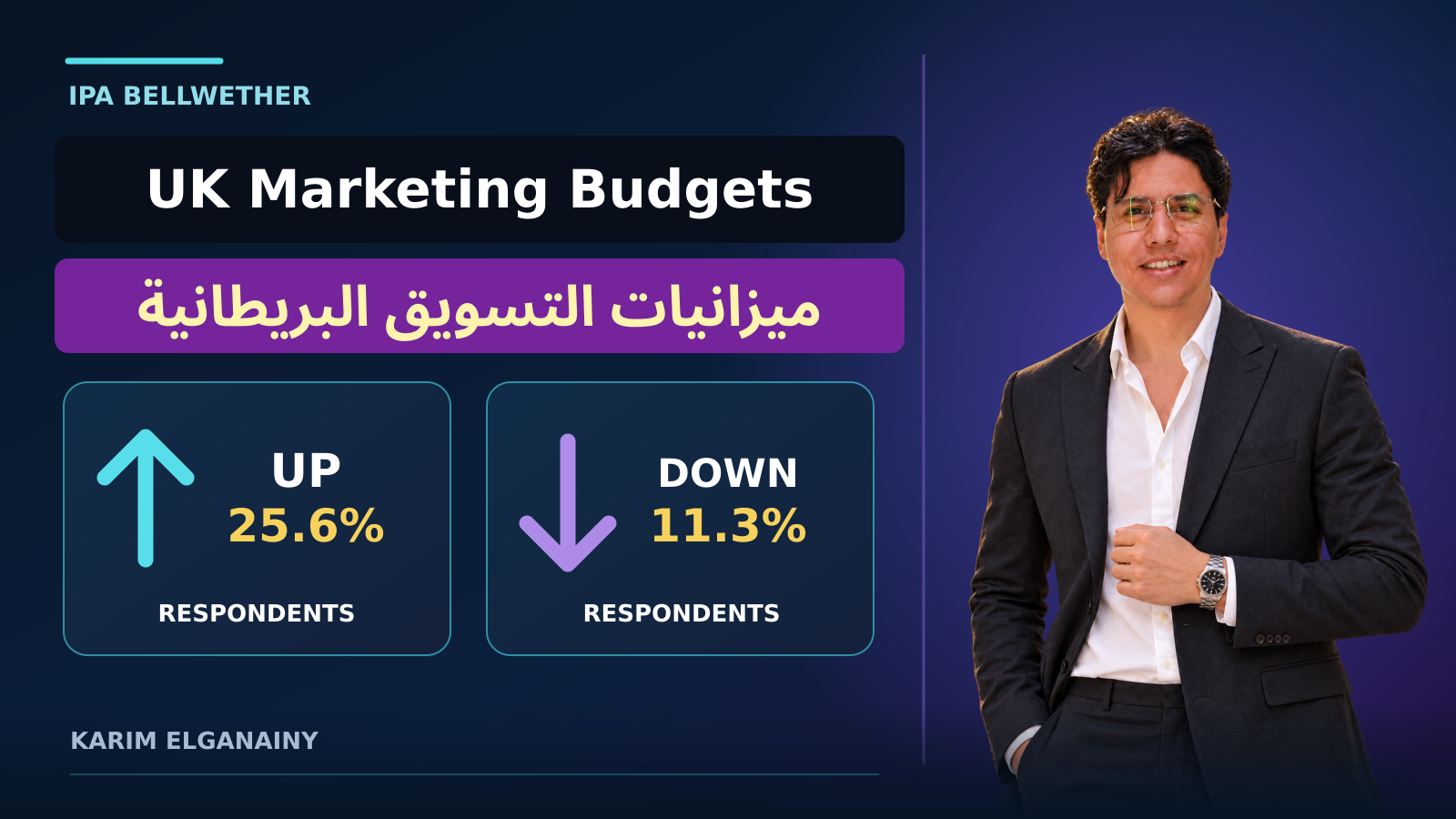
The IPA published its Q3 2026 Bellwether findings on 15 October 2026. Among respondents, 25.6% raised marketing budgets and 11.3% reduced them, producing a net balance of +14.3%, compared with +6.9% in the previous quarter. These are respondent shares and a survey balance, not percentage growth in money spent. See the IPA announcement.
The survey covers a panel of around 300 UK marketing professionals, drawn primarily from the largest companies. Its purpose is to track intentions and confidence, not provide a census of worldwide spending. The report description explains that scope. This article, published on 20 October, examines the management implications; it does not present the announcement as today's news or claim equivalent growth in Saudi Arabia.
A positive balance is not a budget instruction
A finance director cannot turn this headline into an instruction to raise every department's budget by 14.3%. The calculation subtracts the proportion reporting reductions from the proportion reporting increases. It does not weight companies by their spending, describe the size of individual revisions or disclose what any particular firm should invest. A small adjustment at a large business and a larger adjustment at a smaller business can both count as one respondent revising upward.
That distinction matters because an attractive industry number can become a negotiating shortcut. A team seeking additional funding may invoke the survey as evidence that standing still means falling behind. The stronger argument would connect its request to a specific opportunity, show what current capacity cannot achieve, explain the expected cost of learning and define a condition under which the allocation would be reduced. Market confidence is context; the investment case remains the organization's responsibility.
Separate three different decisions
The first decision is the total amount of capital available for marketing. This depends on cash requirements, margins, operational capacity and the time needed to recover acquisition expenditure. The second is the allocation between objectives, such as building awareness, helping people compare alternatives and capturing existing demand. The third concerns execution: which audience, message, channel and landing experience offer a credible route to those objectives.
Do not collapse these decisions into one spreadsheet. A larger total budget does not automatically justify additional search advertising if current demand is already well served. Equally, a weak short-term conversion rate does not by itself prove that an awareness investment is unnecessary. Establish what problem each allocation is meant to solve, then choose evidence that can reasonably evaluate it. This makes disagreements more useful because managers can identify whether they dispute the objective, the mechanism or the amount at risk.
Build a budget request around a constraint
Start with an observable constraint rather than a channel wish list. Perhaps prospects understand the service but do not trust an unfamiliar provider. Perhaps awareness is high while product availability or appointment capacity limits sales. Perhaps the sales team receives many inquiries but cannot distinguish genuine demand from curiosity. Each situation calls for a different response, and some require operational changes before media investment.
Write a one-page statement containing the business problem, the audience affected, the evidence supporting the diagnosis, the proposed intervention and the decision it should enable. Add an explicit alternative: what would happen if the team improved the website, staffing or follow-up process instead of buying more exposure? Comparing alternatives prevents marketing from becoming the default answer to every growth problem. It also creates a more credible conversation with finance because the proposal acknowledges opportunity cost.
Use scenarios without presenting forecasts as facts
A useful planning model can contain a conservative case, a central case and an upside case. The inputs should reflect the organization's own information wherever possible. If a conversion assumption comes from a small pilot, label it as provisional. If the sales cycle is long, show the cash timing rather than treating inquiries received this month as revenue immediately collected.
For each scenario, explain which assumption has the greatest effect on the outcome. A modest improvement in response time might matter more than a substantial reduction in media cost. Avoid giving every uncertain input an optimistic value at once. That creates a persuasive spreadsheet but a fragile operating plan. The purpose of scenarios is not to announce a precise future; it is to identify what must be learned before a larger commitment becomes sensible.
Protect learning from constant reallocation
When confidence improves, stakeholders often want faster results from every new investment. This can produce repeated changes before a campaign has had enough time to answer its original question. A team changes the audience, message and budget, then attributes the next fluctuation to whichever change is easiest to explain. The organization spends more but learns less.
Before launch, agree on a review window suited to the sales cycle and expected volume. Define which conditions justify an immediate stop, such as an inaccurate claim, an unavailable product or a broken conversion path. Distinguish those conditions from ordinary variation. At the scheduled review, examine results against the original hypothesis, record what changed during delivery and decide whether the evidence supports continuation, modification or withdrawal. A decision log is more useful than retrospective certainty.
Keep demand creation and demand capture connected
Demand capture responds to people already considering an action. Demand creation helps an audience understand why a category or brand may matter before that moment. The balance between them cannot be derived from a survey headline. It depends on the maturity of the business, the purchase cycle, competitive awareness and the problem the organization is trying to solve.
A practical connection is to map the questions customers ask at successive stages. Early communication may explain the problem or available approaches. Comparison content can clarify suitability, process and limitations. A conversion page should make the next step understandable without adding pressure. Shared language across these stages helps avoid the common situation where a broad campaign promises one thing and the landing page delivers an unrelated sales pitch. Consistency should be reviewed as a journey, not merely as a brand guideline.
Make promotions accountable beyond the initial sale
Promotional activity can remove a genuine barrier, but its evaluation should include what happens after the response. Does it attract customers the business can serve profitably? Does it change purchase timing rather than generate additional demand? Does the customer understand the ordinary price and conditions? These are questions for local testing, not conclusions that the Bellwether survey can resolve.
Assess the offer together with contribution margin, fulfillment costs, cancellations and repeat behavior over an appropriate period. Where a controlled comparison is feasible, use it to distinguish incremental demand from purchases that would have happened anyway. When it is not feasible, describe the limitation instead of turning attributed conversions into a causal claim. A promotion that looks successful in the advertising dashboard may still create operational strain or encourage customers to wait for the next discount.
Translate the lesson to GCC organizations carefully
The UK findings can inform a discussion about planning discipline, but they do not establish the spending environment in Saudi Arabia, the UAE or another GCC market. Local demand, competition, language, channel access, seasonality and operating constraints need their own evidence. Treat international research as a prompt for questions rather than an imported allocation rule.
For a regional service business, begin with separate views of audience need and delivery capability. Review Arabic and English journeys where both are relevant; do not assume translation alone makes the experience equivalent. Check whether inquiries can be answered in the language used by the campaign and whether the advertised next step is available. These operational checks may produce more immediate value than following an international budget trend.
Healthcare applications need an additional review layer
A healthcare provider should not interpret stronger marketing confidence as permission to expand claims or use sensitive patient information for targeting. The strategic application here is narrower: connect communication investment to the ability to explain services responsibly and handle demand appropriately. Clinical, legal and privacy reviewers should assess proposed claims, data flows and measurement designs under the rules applicable to the organization.
Use aggregate operational indicators where appropriate, and separate an inquiry, a booked appointment, an attended appointment and revenue actually recognized. They represent different stages and must not be reported interchangeably. A campaign that produces inquiries the facility cannot accommodate may worsen the experience rather than improve growth. Any illustrative workflow in this article is a planning proposal, not medical advice, a legal determination or evidence of the author's personal client results.
A practical review agenda for the next planning meeting
Begin by asking each team to name one growth constraint supported by evidence. Then identify the smallest useful intervention, the operational owner and the cost of obtaining a decision. Require a primary outcome and a short list of diagnostic measures. The primary outcome should reflect the business question; diagnostic measures should explain delivery without replacing the outcome when results are uncomfortable.
Next, agree on the evidence threshold for increasing the allocation. This need not be a universal numeric target: it can be a defined confidence requirement, acceptable cost range and minimum operational readiness. Finally, record what would invalidate the plan. A transparent stopping condition makes investment easier to defend because it shows that the organization is purchasing a structured opportunity to learn, not making an indefinite commitment to a channel.
Strategic takeaway
The useful response to a stronger budget survey is not to imitate the average respondent. It is to improve the quality of the decisions behind the organization's own spending. Separate confidence from cash, survey balances from growth rates and attributed activity from incremental outcomes. Give promising ideas room to produce evidence, while preserving the ability to stop when the assumptions no longer hold.
The strategic position of this article is straightforward: a larger budget is valuable only when the business can explain what additional capability, learning or demand it is buying. That explanation should survive scrutiny from finance, operations and the customer-facing team, not just the marketing department.
Sources and interpretation
- IPA announcement, 15 October 2026: reported Q3 survey results.
- IPA Q3 2026 report description: panel and research scope.
The planning methods and GCC applications above are original analysis, not findings attributed to the survey. No personal investment recommendation is offered.
Comments
No published comments yet.