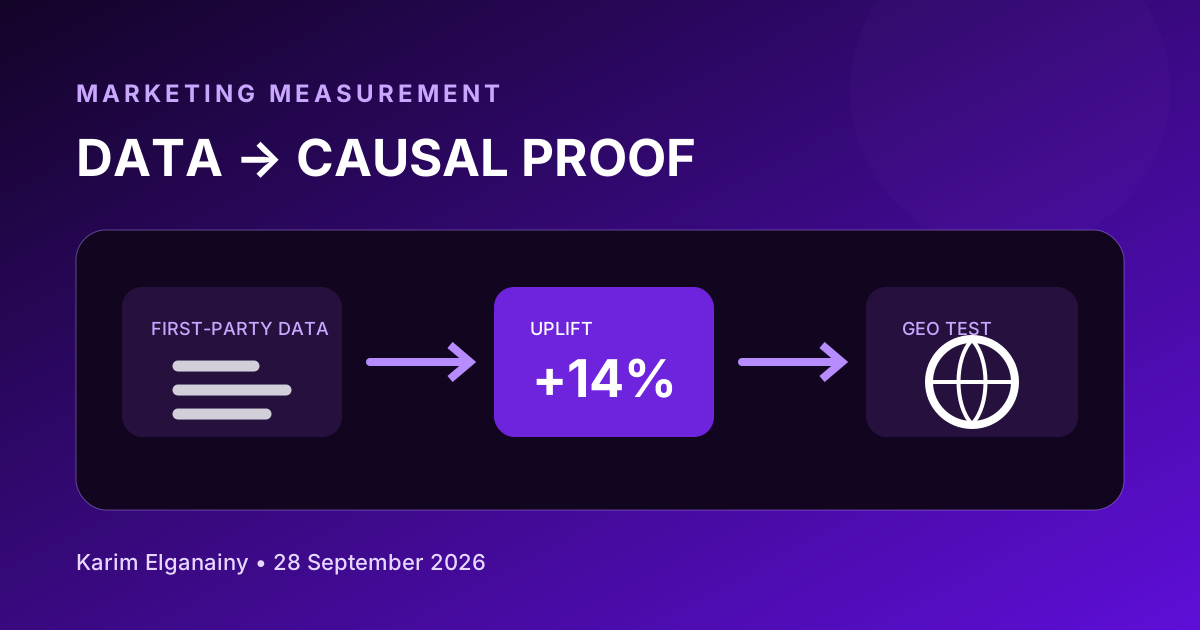
Google is expanding its advertising measurement stack around three connected questions: how strong is the advertiser's data foundation, how many conversions does that foundation recover, and which investments create genuinely incremental demand.
The company is bringing Data Manager into Google Analytics and Display & Video 360, making the Data Manager API broadly available and adding diagnostics that can identify data problems before they weaken campaign performance. Enhanced conversions are also expanding across those products to improve privacy-conscious matching of customer and conversion signals.
Google's official announcement, published 10 September 2026, also introduces a Data Strength Uplift metric. It is intended to estimate additional conversions recovered through an advertiser's first-party data setup. Google reports performance lifts from its own internal datasets, so the figures should be treated as directional evidence rather than a guaranteed result for every account.
From attribution to causal proof
Google also updated Meridian, its open-source marketing-mix model. Brand indicators such as branded search volume can now be included to estimate how upper-funnel investment contributes to later sales. Meridian GeoX is generally available for geographic experiments across advertising platforms, allowing teams to compare test and control markets and calibrate their models with causal evidence.
This matters because platform attribution can tell a marketer which touchpoint received credit, but not necessarily whether the sale would have happened without the campaign. A well-designed holdout or geo experiment is a stronger way to test incrementality.
GCC relevance
Businesses in Saudi Arabia and the Gulf often combine online acquisition with phone calls, WhatsApp conversations, branch visits and offline payments. Measurement improves only when these events are consistently connected to the same commercial outcome while respecting consent and local data requirements.
Karim strategic takeaway
Start with one high-value journey. Connect qualified leads, attended appointments and realized revenue—not every raw inquiry—to the advertising stack. Then run a controlled regional or audience holdout before increasing budget. The decision metric should be incremental profit, while Google's uplift score remains a diagnostic signal rather than the final commercial answer.
Comments
No published comments yet.