
A new study, not a universal customer rule
Ye, Godbole and Gaumer's November 17, 2026 study combines 12 entrepreneur interviews and self-reports from 314 US respondents aged 18–24. Hopping associates with perceived information usefulness; the overall digital-savviness path is nonsignificant. This is not causal sales evidence or a universal Gen Z/Saudi finding. Original study.
This article proposes an independent practical exercise: choose a customer question and examine whether the information available to answer it agrees. It is not a replication, a report of work conducted for a client or a claim that the exercise will increase revenue. A research finding can suggest a question worth testing without supplying the answer for a particular business. Keep the distinction visible when presenting the idea internally. The audience, product and decision context of a local evaluation need their own definition rather than an assumed demographic label.
The practical goal is not to keep a person inside one channel at all costs. It is to make the business's own statements understandable and checkable wherever they are encountered. A person who leaves a page may be comparing, pausing, asking somebody else or doing something unrelated. Without evidence, none of those explanations should become a confident journey story. Start with what can be inspected: the question, the published statement, its supporting information and the next step offered. This makes the work useful even before the team has sophisticated tracking or a complete view of a customer's browsing history.
Define the decision task before counting channels
Choose one decision task narrow enough to observe. For a hypothetical retailer selling work bags, it might be determining whether a particular bag fits the buyer's laptop and what the relevant return conditions are. That is more actionable than a vague objective such as improve the experience. It gives the reviewer a clear question to answer and a way to identify information that is missing, contradictory or difficult to interpret. Do not start by deciding that the company needs more posts or another app. First establish which uncertainty the communication is supposed to reduce.
Write the expected answer and the conditions that could change it. A size claim might depend on the product variant; a return statement might depend on the market or purchase route. Those dependencies should remain visible rather than being stripped away for a shorter headline. Identify who inside the business can confirm the statement and which source is authoritative for the specific condition. This is an original audit design, not a description of the research participants. Keep the exercise limited to information you are authorized to review. Do not assume that finding a public comment gives permission to contact its author or that observing a question requires identifying the person who asked it.
Build a claim inventory instead of a content calendar
List the statements needed for the decision task and record where each appears. Useful fields include the exact claim, product variant, audience or market scope, supporting evidence, responsible owner and last review date. The aim is not to make every channel use identical wording. A brief social caption and a detailed product page serve different reading conditions. The test is whether their meanings remain compatible and whether the shorter version leads to enough detail for the decision. A consistent phrase is not sufficient if it consistently omits a necessary condition.
Classify each issue before correcting it. A contradiction requires establishing which statement is wrong. A missing explanation may need an addition. An outdated offer needs a clear update process. A genuine difference between products should be labeled rather than flattened into one convenient claim. Keep these categories distinct so the team does not solve every problem by copying the longest paragraph everywhere. The inventory should also identify information beyond the business's direct control without pretending it can rewrite independent reviews. For those surfaces, the relevant action may be a correction through an available legitimate process or a clearer statement on an owned page, not pressure to make every outside opinion agree.
Use a bounded example to distinguish coverage from clarity
Suppose the hypothetical bag retailer audits 40 claim-and-location pairs relating to the chosen task. It identifies 12 pairs with a contradiction or an unresolved condition, giving 12 / 40 = 30%. After correcting 8 pairs, 4 remain unresolved, so the corresponding rate is 4 / 40 = 10%. The change is 20 percentage points, or a 66.67% relative reduction in the flagged-pair rate. These are invented figures for an audit example, not study findings, customer results or a forecast of commercial performance.
The denominator matters. The audit counts statements in locations, not people, visits or orders. Fixing the same statement in several locations can improve consistency without demonstrating that anyone understood it. Keep the original list stable when comparing the two passes. If the team adds new channels, report the expanded inventory separately rather than quietly changing the denominator and claiming improvement. Also distinguish corrected from verified: an editor may have changed text, but a second check should confirm that the live version now communicates the intended condition. A completed editing task is not yet evidence of an easier customer decision, and neither measure should be presented as a sales conversion rate.
Test whether the question can be answered
After the content audit, design a small task-based review using the same bag decision. Ask participants to explain which variant is suitable and what information supports their conclusion. Give them a realistic starting point without telling them which page contains the answer. Observe whether they can find and interpret the necessary condition, not simply whether they click a preferred button. Where participation or recording is involved, use an appropriate agreed process and avoid collecting unnecessary personal information. This is a suggested evaluation method, not a claim that such testing was performed here.
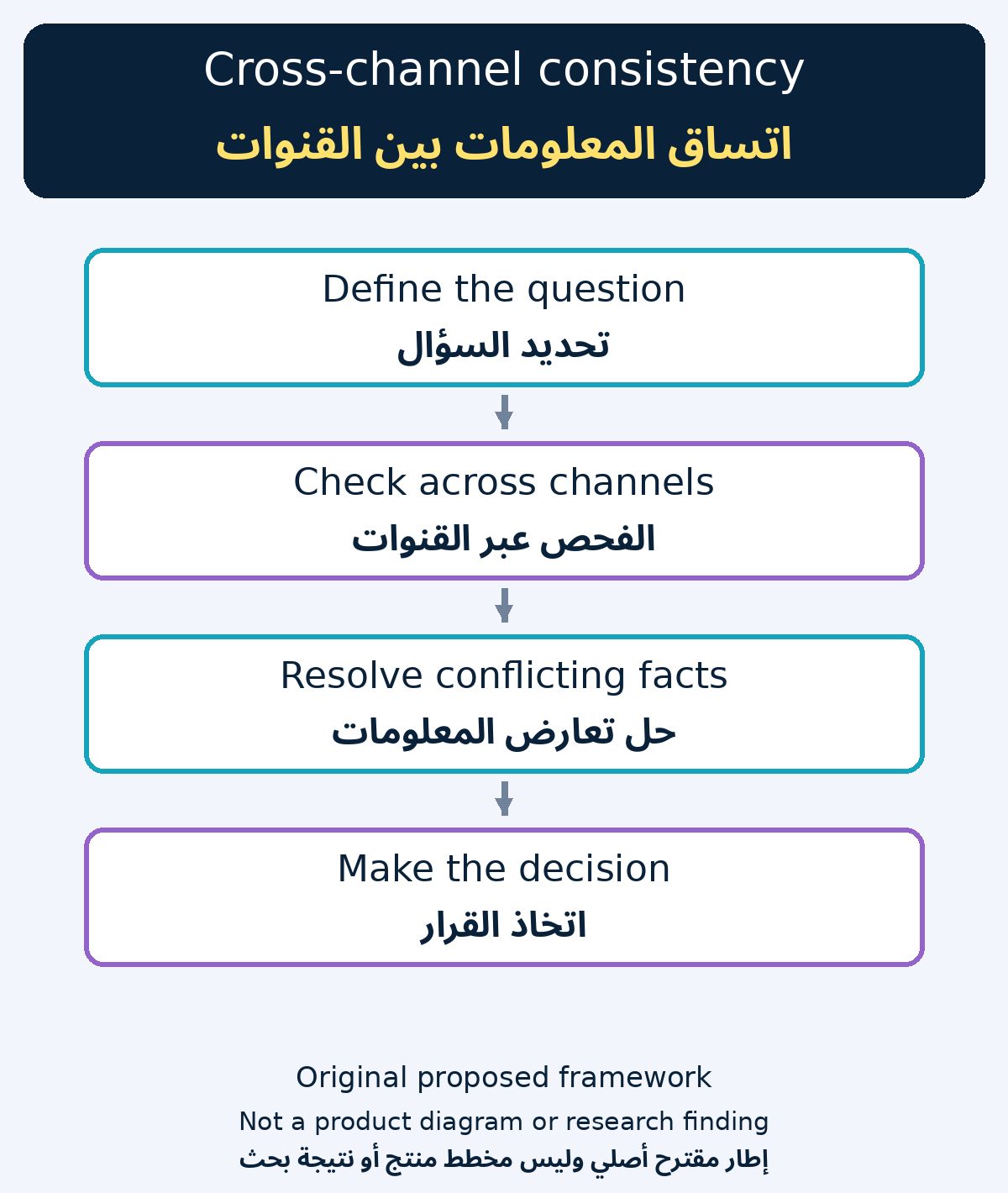
Original explanatory diagram by Karim Elganainy. It shows this article's proposed audit, not the paper's statistical model or a guaranteed customer journey. Research context: original study.
Separate a correct answer from a confident answer. Ask the participant to identify the evidence and any remaining uncertainty. Someone may reach the right conclusion by guessing, while another may accurately recognize that the published information is insufficient. Record both cases honestly. Use the observation to improve a specific claim or handoff rather than treating a small session as representative of every customer. Preserve examples of confusion with enough context to diagnose the issue, but do not turn an isolated comment into a demographic stereotype. The outcome should be a clearer decision task, not a dramatic narrative about an entire generation.
Decide what the measures can and cannot establish
Use separate measures for content quality, task performance and business outcomes. The content audit describes the information inspected. The task review describes what the recruited participants could do under those conditions. Revenue requires its own definition, observation and comparison. Keep these layers separate in the report even if a stakeholder wants a single success number. A useful improvement in one layer does not automatically establish an effect in another. Record the period, scope and exclusions beside each measure so the reader can see exactly what was evaluated.
If a team later compares versions in live use, define the allocation and measurement plan before interpreting the difference. Explain what else changed during the period and what the design cannot isolate. Do not turn an ordinary before-and-after observation into a causal claim merely because the percentages look persuasive. When the evidence is limited, report a limited conclusion and specify the next question. This preserves the value of the work without overstating it. It also helps avoid a common reporting mistake: mixing observed behavior with remembered behavior, or treating an answer about perceived usefulness as if it were a completed transaction. Each is a different object of measurement, and the business should know which one informs the next decision.
Adapt the audit locally without inventing a local finding
For a Saudi or wider GCC team, the practical next step is to define the local decision task, not to relabel an external audience as local evidence. Review the actual language, units, product variants and service conditions used in the market. A translated headline can preserve the words while losing an important condition. Ask a qualified local reviewer to check the complete path from the initial claim to the detailed explanation. Keep the standard of evidence the same across languages rather than accepting a vague translation because it sounds fluent.
In a healthcare-marketing setting, apply this exercise to ordinary service information such as how to find an approved description or understand an administrative next step, not to making clinical recommendations. Keep individual health details outside the routine content inventory and use the appropriate professional review for medical claims. These are conservative editorial safeguards, not a legal or clinical assessment. The same principle applies to other specialized categories: choose a task the team is qualified to evaluate and identify where specialist judgment is required. Local adaptation should make the boundaries clearer, not provide a reason to extrapolate beyond the available evidence or to promise an outcome the audit never measured.
Karim's recommendation: repair one uncertainty, then learn
Start with the recurring customer question that creates the most avoidable clarification work. Assign an owner, record the relevant claims and fix the most consequential contradiction first. Then check the published result and test whether the intended question is easier to resolve. This is a manageable operating choice for a small team because it connects content work to a defined decision instead of demanding a complete redesign of every digital channel. Keep a clear stopping point so the pilot does not become an endless inventory exercise.
Finish with a short learning memo: what was inspected, what changed, what was verified and what remains unknown. Preserve the option to find that the problem was not cross-channel information at all. The question may have been poorly chosen, the product may not fit the need or a service condition may require an operational change rather than better copy. A useful audit must allow those conclusions. Do not force every observation into a success story about content. The strategic benefit is a more precise understanding of what the business can truthfully communicate and how it can test whether that information helps. That benefit is meaningful without claiming that every departure is lost trust, every return is a purchase signal or every clearer page creates measurable revenue.
Comments
No published comments yet.