Announcement: November 3, 2026. Editorial analysis: November 4, 2026.
The verified development
Gap announced a new seasonal execution of its existing Give Your Gift platform, featuring three choirs. Digital, social, video and brand channels carry the campaign. Planned shopping experiences include a Williamsburg pop-up and selected-store gift areas, with customization and wrapping. The announcement supplies no measured sales lift. Gap announcement.
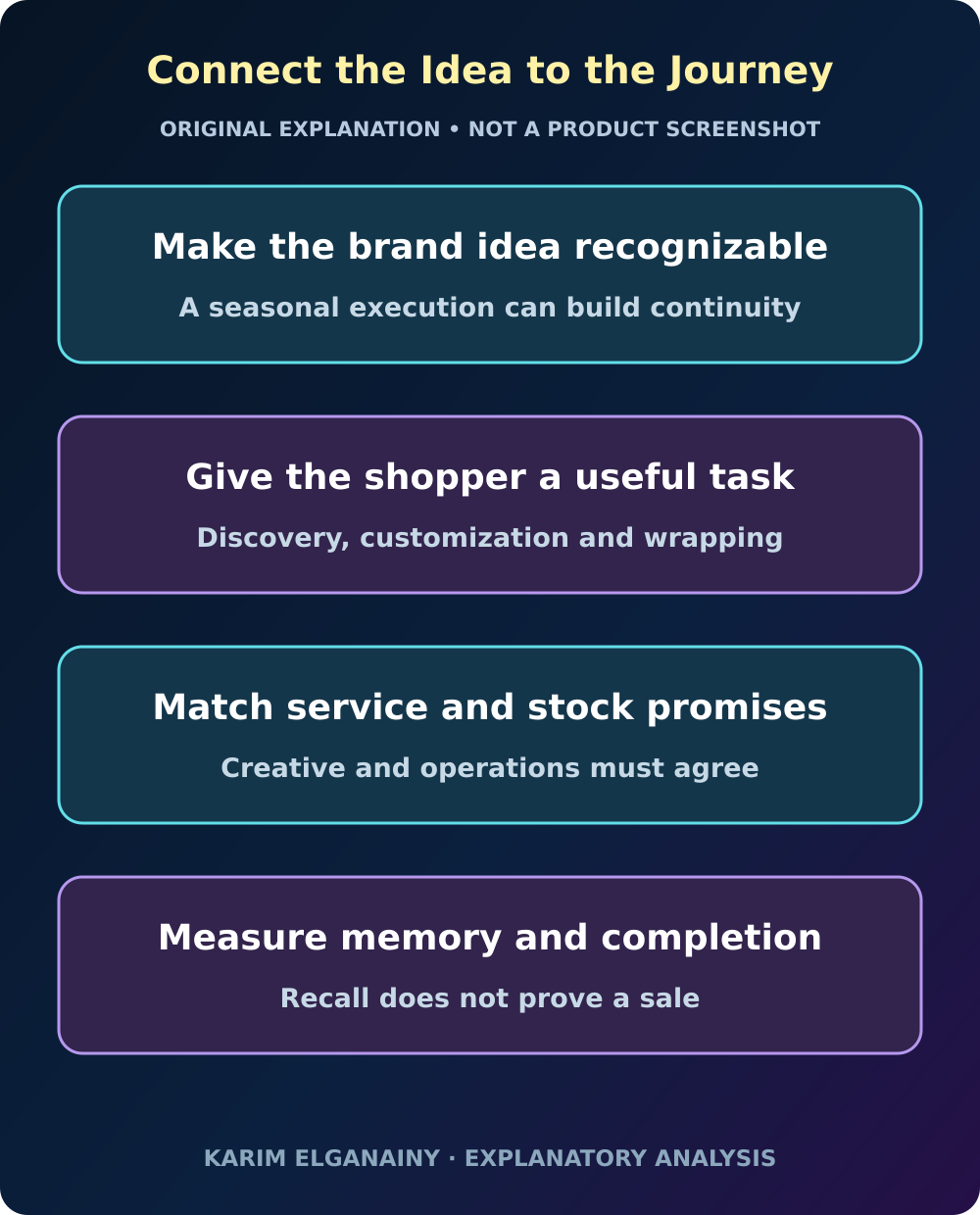
Original editorial framework; not a product screenshot or proof of campaign results.
Original analysis: give the brand idea a useful destination
The following is independent editorial analysis, not a report of campaign results or undisclosed Gap plans. It proposes a way for retail marketers to connect a recognizable creative idea with an easier customer task. Every example below is hypothetical. The useful planning question is what a person can actually do after a seasonal advertisement makes them interested in giving a gift.
A campaign can be memorable while leaving that question unanswered. The viewer may remember a feeling, a color or a performance without knowing which product suits the recipient, how to choose a size or whether the package can arrive in time. A strong creative brief should therefore have a companion service brief. The first explains what the brand wants to mean; the second explains how the customer can act on that meaning.
Neither brief should dominate the other. Reducing an emotional idea to a list of checkout instructions can weaken the work, while treating practical details as someone else's problem can create a disappointing journey. The task is to connect them deliberately. A clear visual or verbal cue can lead from the story to a relevant assortment, then to the information and services needed to finish the purchase.
Decide what stays familiar and what earns attention
For a retailer developing a repeatable campaign platform, begin by separating the enduring idea from the seasonal execution. The enduring idea should be specific enough to guide choices but broad enough to support more than one film or promotion. The execution can then change the people, setting, format or customer task without forcing the audience to learn an entirely new identity each time.
This is a design recommendation, not a claim that repetition automatically creates effectiveness. Ask which elements a viewer should recognize and which elements should feel fresh. Write those choices down so that local teams and channel partners do not have to guess. Familiarity becomes useful when it helps someone identify the brand and understand the offer, not simply when the same asset appears again.
Review the platform from the customer's perspective. If the campaign disappeared from view and only the product page remained, would the page still express the intended promise? If the customer entered a store first, could staff connect the message with a useful shopping choice? These questions reveal whether consistency exists across the journey or only inside the advertising files.
Map the gifting task before mapping channels
A useful planning map starts with what the giver is trying to solve. They may know the recipient well but be unsure about size, want something personal without a long production wait, or need a gift that is easy to exchange. These are hypothetical customer needs to investigate, not findings from the announced campaign.
For each need, identify the minimum help the business can reliably provide. A product comparison, plain-language sizing explanation, visible exchange policy or clearly bounded personalization service may answer a real question. Avoid adding a feature merely because it looks attractive in a campaign presentation. Every promised service should have an operational owner and a clear condition for availability.
Then map the channels to the task. A short video can introduce the idea, a product page can explain suitability, and a store interaction can resolve uncertainty. They do not need identical content because they perform different jobs. What they need is continuity: the customer should not have to reinterpret the promise or start the search again whenever the channel changes.
Build the service brief with operations
Before a creative promise is approved, ask the people delivering it to describe the process. What products qualify? Who performs the work? How is capacity managed? What happens when supplies run out, a requested option is unavailable or a customer arrives near closing time? These questions belong in planning, not only in a crisis meeting after the advertisement is live.
Create a small promise register. For each service, record the wording customers will see, the conditions that make it true, the responsible team and the fallback if the condition changes. The register should be understandable to store staff, customer service and the people editing digital content. Its value comes from making the same promise visible to everyone who must keep it.
Where an offer has limits, make those limits easy to find before the customer invests effort. A well-explained constraint can preserve trust better than an attractive claim that becomes narrower at the final step. The campaign team should also know who can change a message quickly when stock or service capacity changes. A seasonal plan needs a practical update path, not just a launch checklist.
A hypothetical local adaptation
Imagine a hypothetical Gulf retailer planning a gifting campaign around a locally relevant occasion. The creative idea celebrates the thought behind choosing for someone else. Rather than copy another market's imagery or calendar, the team interviews appropriate customers and staff about the actual shopping decisions they need help making. This is a suggested research method, not evidence about any region's preferences.
The retailer might discover that its most useful contribution is a clearer way to compare gift options and understand delivery conditions. It could build an Arabic-first selection guide with natural language, readable product details and a direct route to available stock. The hypothesis would be that clearer choices help qualified shoppers complete an appropriate purchase, not that a translated slogan alone improves sales.
The team should review cultural details with people who understand the audience and the occasion. Avoid presenting the region as one uniform market, and distinguish local relevance from decoration. Language, product suitability, store operations and service timing need to work together. The resulting campaign may look quite different from the inspiration while preserving the discipline of linking a human idea with useful assistance.
Design the handoff between attention and action
Give each major creative asset a clear next step. That does not mean every asset needs an aggressive purchase instruction. A brand-led film might lead to a curated destination, while a practical product message might lead directly to the relevant item. The important point is that the destination should satisfy the expectation created by the asset.
Inspect the handoff on a mobile device under ordinary conditions. Check whether the first visible content matches the message, whether the page is usable without unnecessary interactions, and whether the next choice is understandable. If the campaign promotes a service, show where it is available and how to use it. Do not bury the practical answer behind several unrelated promotional panels.
For a physical experience, write the same journey from arrival to departure. How will the visitor recognize the offer, find help, understand the queue and complete the task? Include people who choose not to purchase. They should still leave with an accurate understanding of the brand rather than a confusing impression created by unclear signs or unavailable services.
Measure memory and shopping separately
A proposed evaluation should distinguish whether people recognized the brand idea from whether they completed a shopping task. These outcomes can inform one another, but neither should stand in for the other. A memorable advertisement may need a better destination, and a useful service may need clearer communication so that suitable customers discover it.
Choose measures that fit each question. A brand study can investigate recognition and message association if its design supports those conclusions. Journey data can describe product discovery, service use and order completion. Operational records can reveal unavailable options, waiting problems and avoidable support contacts. Keep the population, period and method visible rather than combining every signal into a single unexplained effectiveness score.
For a causal business claim, plan an appropriate comparison before launch and document its limits. If the team can only observe campaign activity alongside seasonal sales, say so. Seasonality, price changes, stock and other promotions can complicate interpretation. A useful report explains the evidence available and the decisions it supports without announcing a sales effect that the design cannot establish.
Test the weakest link first
A hypothetical retailer might find that viewers recognize the campaign but customers repeatedly ask where the advertised service is available. The first test could simplify the service information and its placement, rather than replace the entire creative platform. The team would define a relevant outcome, preserve other conditions where feasible and monitor whether the revised explanation resolves the identified problem.
Another hypothetical retailer might have a clear destination but little evidence that people connect the creative with the brand. That suggests a different test involving recognizable brand cues, not necessarily more promotional detail. The two situations can produce similar headline sales results while requiring different actions. Diagnosis should therefore precede a broad conclusion that the campaign needs more spending or a complete redesign.
Record what changed and what remained stable. If several elements must change together, describe the test as a package and avoid claiming that one isolated component caused the result. Keep a decision log that connects each change with its hypothesis and the evidence that followed. This makes the learning useful to the next seasonal team rather than leaving only a folder of final assets.
Protect the customer experience after purchase
The gifting journey does not end at payment. A buyer may need an accurate dispatch update, a recipient may need an exchange, and customer service may need to explain what happens when a personalized item cannot be changed. Plan those interactions with the same clarity used in the campaign, while checking actual policies and local requirements with the responsible specialists.
Be careful when collecting messages, recipient details or personalization preferences. Ask for only what the service requires, explain the intended use and involve privacy reviewers before introducing a new data flow. A creative opportunity does not justify unnecessary collection or reuse of personal information. Staff should know how to handle the information and where to direct questions they cannot answer.
The strategic takeaway is a connected promise. A recurring brand idea can give a seasonal campaign coherence, but its practical value depends on whether the customer can move from interest to a suitable, deliverable gift. The marketing leader's job is to make that path visible, test the parts that are uncertain and keep creative ambition aligned with what the business can reliably provide.
Comments
No published comments yet.