When does an employee-led campaign become useful brand evidence?
It becomes useful when the employee’s knowledge helps customers make a better choice and the business can deliver the experience the campaign suggests. A familiar face or a long career can make a story engaging, but neither substitutes for a clear recommendation, available stock and dependable service. For retailers, the practical opportunity is to connect human expertise with merchandising and customer support rather than treating the employee as a decorative spokesperson. This article is published on November 8, 2026, and examines a campaign announcement from November 6. The analysis below proposes a retail workflow; it does not claim to measure the campaign’s results.
Verified news: Foot Locker’s holiday campaign
Foot Locker announced “Joy to the Sole,” featuring Head of Stores George Jenkins, a 33-year company veteran. The campaign includes the George’s Picks gift guide and a film, with paid, social, digital and in-store activity. The release establishes the campaign and its elements, not sales effectiveness. Read Foot Locker’s original announcement.
Independent analysis: turn experience into a customer answer
Start with the customer’s uncertainty, not the employee’s biography. A gift buyer may know the recipient’s general taste but not the right size, use case or return requirements. Another shopper may need to distinguish a fashionable choice from something suitable for a particular activity. These are illustrative situations, not campaign findings. Ask staff which questions recur and which explanations genuinely help people decide. Then build the creative around a useful answer that can be shown clearly. The employee’s experience matters because it supports the quality of that answer, not because years of service automatically validate every product claim or preference presented in the advertisement.
Translate the expertise into specific editorial criteria. A recommendation should explain who the product might suit, what tradeoff matters and what the buyer should check before choosing. Avoid presenting a personal favorite as the best option for everyone. A useful guide can offer a small number of distinct paths rather than a long assortment with a friendly name attached. Keep the language accessible to shoppers who do not know the category vocabulary. If a technical claim is necessary, have the appropriate product specialist verify it. The goal is to reduce uncertainty without creating a new burden of jargon or implying expertise beyond the evidence available.
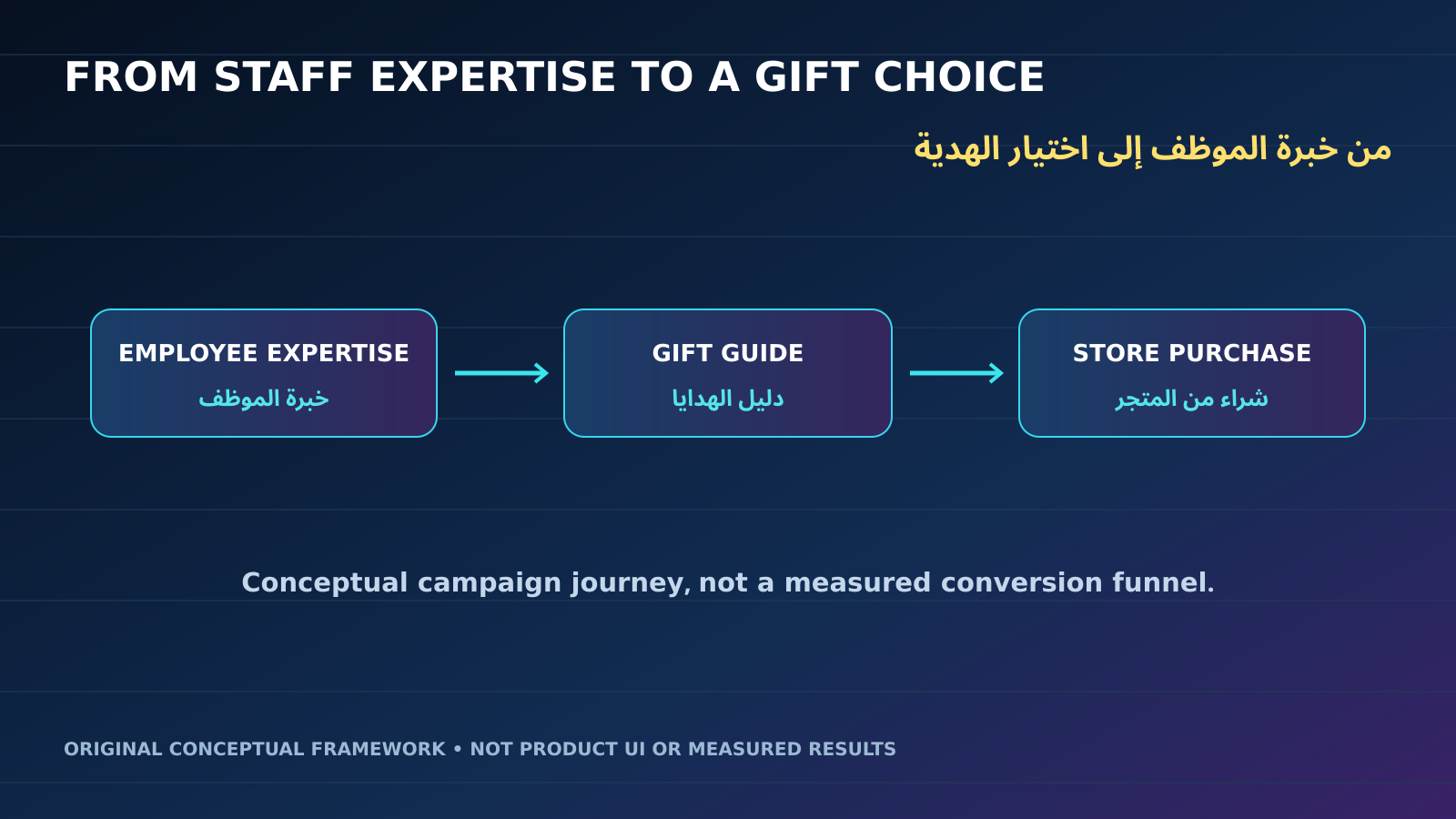
Original conceptual diagram of the proposed retail workflow, not a campaign image, store photograph or evidence of performance.
Make the recommendation executable
A recommendation is only useful if the customer can act on it. Before promoting a guide, check the product links, available options, stock information and the path from the content to a purchase or store visit. A beautiful film that leads to a confusing assortment creates friction precisely when interest is highest. Give each recommendation a clear next step and an alternative when the preferred option is unavailable. Do not imply that every branch carries every featured item. The campaign team and merchandising team should agree on which claims depend on local inventory and how those claims will be updated when conditions change during the season.
Design the guide around the decisions people actually make. Depending on the category, those decisions might involve use, fit, recipient preference, price range or delivery timing. These are planning examples, not a description of Foot Locker’s guide structure. Keep filters and labels consistent with the product pages so customers do not have to translate one classification into another. If the guide uses a budget range, verify the current price and explain any relevant qualification. Avoid an attractive recommendation that only works after an unexpected add-on or unavailable promotion. Commercial clarity is part of the experience, not a compliance detail to be added after the creative is approved.
Treat the employee as a participant, not an asset library
An employee-led campaign needs a clear agreement about participation, usage and responsibilities. Explain where the material will appear, how long it may be used, whether it can be edited into other formats and who will handle public questions. Participation should be genuinely voluntary and reviewed through the company’s appropriate processes. Do not assume that an employment relationship grants unlimited permission to use someone’s image or personal story. These are recommended safeguards, not statements about the featured employee’s arrangements. Respectful treatment strengthens the project because the person understands the role and can contribute expertise without being surprised by the scope of the public exposure.
Protect the difference between a real voice and a scripted endorsement. Give the participant a chance to review factual descriptions of their experience and avoid inventing anecdotes to make the film more emotional. Editing can improve clarity, but it should not change the meaning of what someone said. If the campaign introduces a recommendation the employee did not originate, describe it accurately rather than manufacturing personal enthusiasm. The brand’s credibility is weakened when the story depends on a false impression of spontaneity. A well-produced piece can still be honest about being a campaign, and it can still be persuasive because the advice itself is useful.
Connect the film to the store experience
A campaign that foregrounds service raises expectations about what happens after the customer arrives. Brief the relevant store and support teams before publication. Explain the featured message, the guide, the available alternatives and the questions customers are likely to ask. Do not expect staff to discover the campaign through a customer’s phone. Provide a concise reference that can be used during a busy shift rather than a long presentation that nobody can consult at the point of service. The practical objective is consistency: the customer should recognize the same helpful promise in the advertisement, the website and the conversation with the team.
Test the journey with realistic scenarios. Ask a reviewer to follow a recommendation, identify an available option, check delivery or collection and understand the return conditions. Include a scenario where the first choice is unavailable. Record where the experience becomes confusing and assign an owner to each issue before increasing promotion. This is an internal quality check, not a claim of firsthand testing of Foot Locker’s campaign. It can reveal operational gaps that a creative review misses, such as a broken link, unclear local stock or inconsistent wording. Fixing those gaps protects the value of the media investment and reduces avoidable frustration for customers and staff.
Give each channel a job
A film can establish the human idea, while a guide can help with comparison and a short social post can answer one practical question. Store material can reinforce the next step at the shelf. These are suggested roles rather than a prescription that every retailer needs every format. Define the job of each asset before adapting the creative. Simply cutting the same video into more sizes may create distribution without improving usefulness. Make sure the smaller versions retain the essential claim and context. A short clip should not turn a qualified recommendation into an absolute promise merely because the explanation was removed to fit the format.
Keep a single source of truth for product and service information. Assign an owner for changes in price, availability, timing and policy language, and specify how updates reach every active channel. Seasonal activity can move quickly, so the workflow should include a way to pause or replace an asset when its message becomes inaccurate. Do not leave an outdated guide live because the film still looks good. The creative idea and the commercial details have different lifecycles. Managing them separately allows the campaign to retain its identity while the practical information stays useful. This is an operational discipline that supports trust long after the initial launch moment.
Measure assistance as well as attention
Views and engagement can tell the team whether the creative attracted attention, but they do not explain whether the guide helped someone choose. Define a small set of relevant journey measures before launch. Depending on the approved analytics setup, those might include guide use, movement to a product page, completed purchases or customer questions that reveal confusion. Do not collect more personal data than the evaluation requires. Combine quantitative observations with structured feedback from staff, while recognizing that anecdotal feedback is not a representative survey. The purpose is to identify useful improvements, not to transform every interaction into a surveillance opportunity or a flattering campaign statistic.
Evaluate commercial results with context. Promotions, inventory, weather, competing activity and ordinary seasonal demand can all complicate interpretation. Document major changes during the campaign and avoid attributing every movement in sales to the film. If the business needs a stronger estimate of incremental effect, ask an analyst to design an appropriate comparison before the campaign rather than searching for a convenient baseline afterward. Where the evidence is descriptive, label it that way. A campaign can provide valuable creative and service learning without proving a causal sales lift. Separating those conclusions makes the final report more useful and prevents the next planning cycle from inheriting an exaggerated expectation.
Adapt the idea to the local retail reality
For a Gulf-market retailer, the transferable lesson is not to copy the seasonal language or the exact product choices. It is to make credible expertise useful in the local buying journey. Review language, shopping occasions, available assortment, payment options and service expectations for the specific market. Confirm which offers and policies apply locally rather than assuming an international brand announcement covers every territory. Use Arabic and English versions that communicate the same practical promise without forcing a literal translation of a slogan. The person on screen can create interest, but the customer’s actual experience will determine whether that interest becomes confidence or disappointment.
My recommendation is to build an employee-led campaign from a service blueprint outward. Begin with a recurring customer question, develop a defensible recommendation, connect it to the assortment and train the people who will fulfill the promise. Then choose the creative format that makes the expertise engaging. At the end, record what customers understood, where the journey failed and which changes improved clarity. The enduring asset is not only the film. It is a more coherent way for the business to turn staff knowledge into helpful decisions. That is a stronger brand proposition than using a real employee merely to make an otherwise generic seasonal advertisement feel authentic.
Comments
No published comments yet.