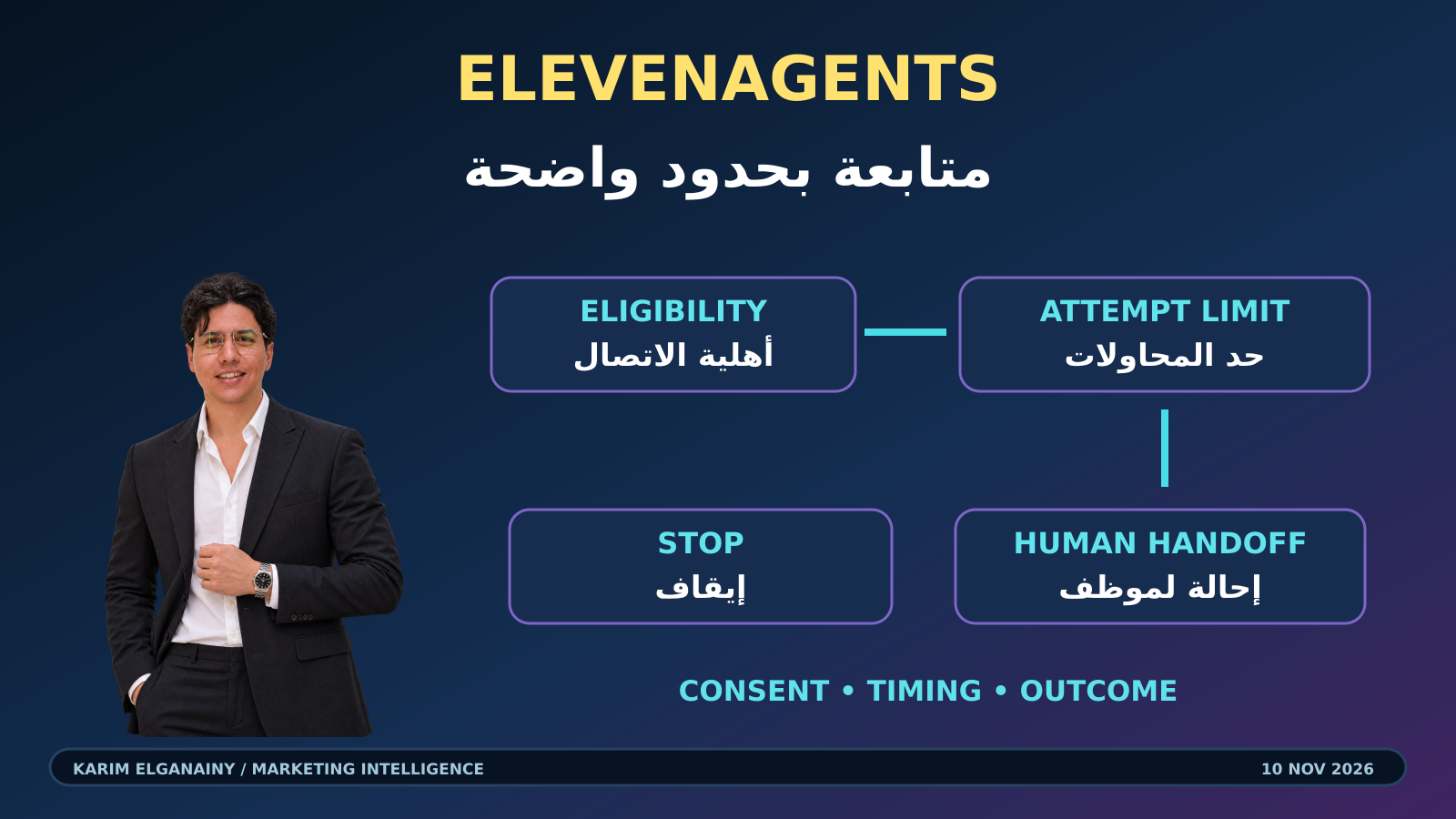
ElevenLabs announced on November 9, 2026 that Campaign Manager is available within ElevenAgents, positioning it as a way to follow up with contacts toward a defined outcome. According to the product announcement, the system retains context between interactions and stops when the goal is achieved or the recipient asks it to stop. For marketing and sales teams, the consequential question is how to translate that promise into a contact policy that people can understand, operators can inspect, and managers can evaluate.
The launch expands the discussion beyond generating a convincing voice. A follow-up system also decides who should be approached, when another attempt is justified, what counts as completion, and when a person should take over. The analysis below proposes an operating framework for those decisions. It is an editorial recommendation, not a description of features that ElevenLabs has independently demonstrated, a legal compliance assessment, or a claim that automating more conversations will produce more sales.
What is available, and what the announcement leaves open
The announced launch channels are phone calls, WhatsApp voice, and WhatsApp messaging. Email and SMS are described as coming soon, so they should not enter a launch plan as currently available capabilities. ElevenLabs lists calling windows, attempt and callback limits, campaign do-not-call lists, disclosures, and contact activity logs among its controls. It also describes outcome funnels, decision timelines, a needs-attention queue, and CSV export. Teams can enroll contacts through CSV or API using existing ElevenAgents agents and phone numbers.
These details establish the product's stated scope, but they do not settle country eligibility, the cost of a particular deployment, or the rules that apply to an individual campaign. The announcement includes an AA Ireland testimonial about lead coverage. That is a customer statement about coverage, not evidence of a conversion-rate improvement or a result every buyer should expect. Before building a business case, separate the supplier's feature descriptions, customer testimony, and your own untested assumptions. Each deserves a different level of confidence and a different verification method.
Define an outcome that can be verified
Begin with one outcome that can be checked in a source system. For an appointment campaign, that could be a booking confirmed by the scheduling service, rather than a recipient saying they might be interested. For a request for information, it could be an explicitly requested follow-up accepted by the responsible team. Write down the evidence required, the system that holds it, and the person accountable when records disagree. A conversation ending pleasantly does not tell an operations team whether its underlying task is complete.
Next, distinguish completion from other legitimate terminal states. A recipient who declines, withdraws permission, or explains that the request is no longer relevant should not remain in an endless pursuit queue. A contact who asks for a human may require a different workflow rather than another automated attempt. Define these states before enrollment and decide how each changes future eligibility. This gives both the campaign and the receiving team a shared vocabulary. It also prevents a dashboard from merging a successful booking, a refusal, and an unresolved case into a vague category such as handled.
Prepare eligibility data before importing contacts
A clean contact list needs more than valid telephone numbers. Review why each person is eligible, where the request or permission came from, which channel is appropriate, whether an existing interaction is still open, and whether another team has already completed the task. Remove duplicates and reconcile suppression records before enrollment. Treat missing evidence as an exception to investigate rather than an invitation to assume permission. Keep the information used for eligibility proportionate to the task, with access and retention governed by the organization's applicable policies and obligations.
CSV and API enrollment are ingestion routes, not a replacement for ownership of these decisions. Assign responsibility for correcting an imported record, propagating a stop request, and resolving conflicts between the campaign and the customer database. A useful internal check asks what happens if a person opts out after a file is prepared but before it is uploaded. Another asks whether two separate campaigns can contact the same person about the same request. These scenarios reveal weaknesses that a successful upload or a low data-error count will not expose.
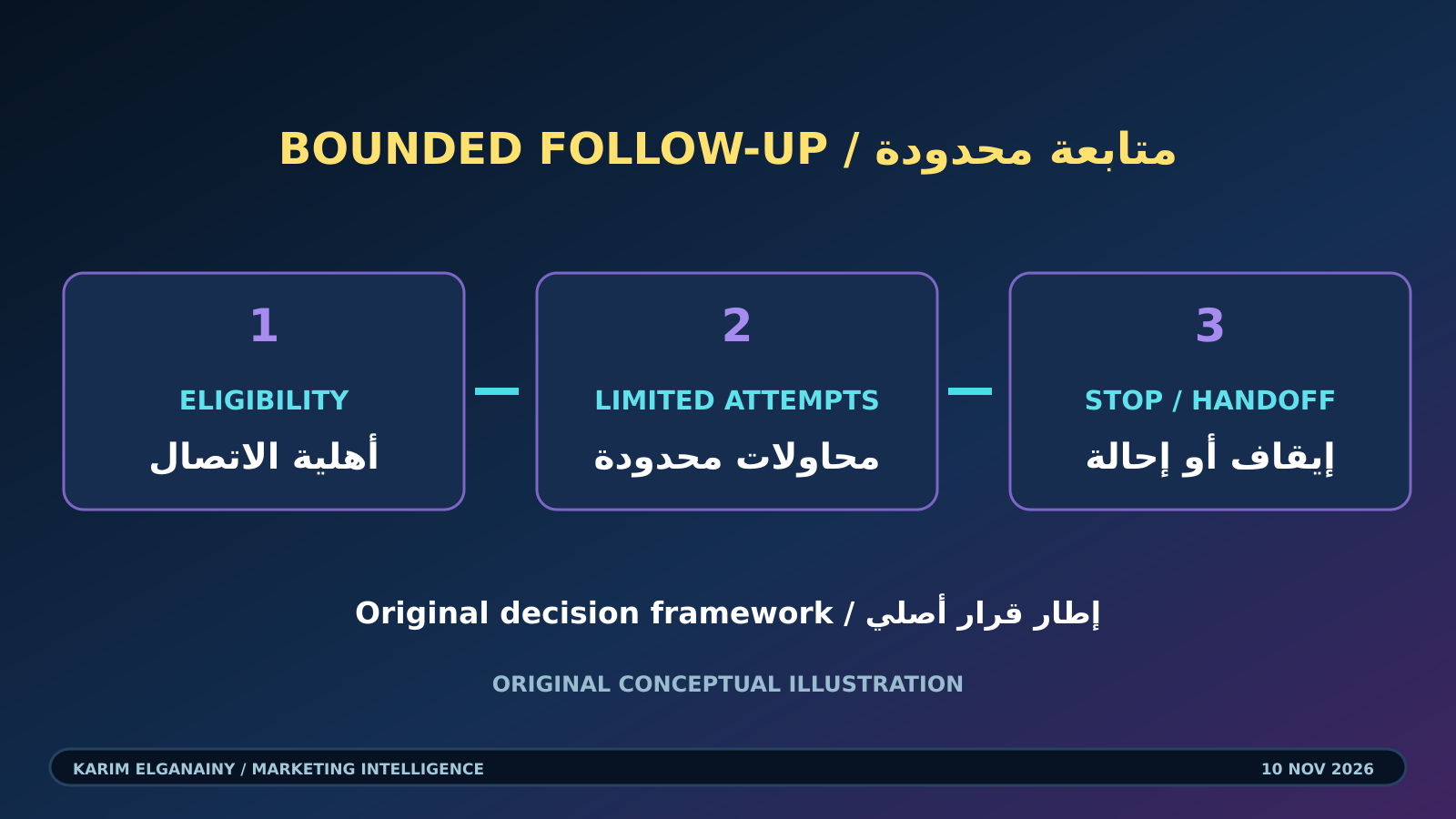
Original conceptual illustration: eligibility leads to limited contact attempts, followed by stopping or human handoff. This is an editorial workflow, not an ElevenLabs interface or an official product diagram. Product context: ElevenLabs announcement.
Set contact limits before scheduling attempts
Write a practical policy that connects the reason for contact with the recipient's context. Define suitable calling windows, the maximum attempts allowed, the treatment of requested callbacks, and the conditions that end the sequence. Decide how the team will check relevant time zones and channel restrictions, rather than relying on an office's default clock. The appropriate policy depends on the service, audience, permission, and jurisdiction. Avoid treating the most permissive setting as a recommendation, and have relevant specialists review legal or regulatory questions before launch.
Also describe how the opening of a conversation should explain its purpose and any required disclosure. Test whether a recipient can easily decline, ask a question, or request a person. A do-not-call list is useful only when the surrounding process keeps it current and respects it across relevant systems. Check what the product can enforce directly and what your integrations or staff must handle. The point is to turn broad intentions into observable behavior, with named owners for failures, rather than to assume that the presence of controls guarantees universal compliance.
Design the human handoff as carefully as the call
Define escalation triggers in language that an operator can audit. Examples include a request to speak to a person, an objection the agent cannot resolve within its approved scope, contradictory account information, or a question that requires specialist judgment. These are proposed operating categories, not a claim about automatic detection in this product. For every category, identify who receives the case, what information they need, and how acceptance is recorded. If no team can take the handoff, a transfer label can conceal an unfinished customer request.
Give the receiving employee a concise account of the purpose, relevant statements, attempts already made, and the unresolved issue. Share only information appropriate to the work and the employee's access. Decide what happens outside staffed hours, when a case is rejected, or when ownership remains unclear. Include a pause or stop path so the automated sequence does not continue while a person is working on the same case. Review the needs-attention queue as a service responsibility, with an owner and capacity plan, rather than a place to store exceptions indefinitely.
Measure useful outcomes and customer friction together
Build a funnel that preserves meaningful distinctions: eligible records, attempted contacts, reached contacts, verified outcomes, declined requests, and cases requiring human work. Use clearly documented denominators so a rate does not improve simply because difficult records were excluded halfway through the test. Calculate cost per verified outcome using the expenses the team actually incurs, including setup, review, integrations, and handling exceptions. Keep reach and lead coverage visible as operational measures, but do not substitute them for business outcomes such as confirmed bookings or appropriately qualified requests.
Alongside that funnel, monitor complaints, stop requests, repeat contact after a stop instruction, and failed handoffs. Define each measure so reviewers know what event counts and where the evidence lives. Inspect samples of decision timelines and activity records, including cases that look successful. A high completion figure can hide incorrect classifications or friction that never enters the main dashboard. These checks are a proposed evaluation method; the announcement does not establish that every desired measure is available automatically. Determine which data can be exported and which must be reconciled elsewhere.
Run a pilot that can support a decision
Choose a limited, well-understood use case with a team able to review the work. Document the existing process before changing it: how contacts enter, how long requests remain open, who follows up, and how outcomes are verified. Where feasible and appropriate, compare similar eligible groups over the same period, keeping differences in lead source, timing, and staff treatment visible. A comparison is less informative when one group receives fresh requests and another receives old or incomplete records. State those limitations instead of presenting a cleaner-looking result than the design supports.
Agree on expansion and pause criteria before looking at results. A campaign might need review if people continue to be contacted after stopping, outcomes cannot be verified, or human queues exceed the team's ability to respond. The thresholds belong to the organization and its risk context; no universal number follows from this launch. Review both aggregate measures and individual cases, then adjust the workflow or stop the pilot if necessary. Broader deployment should depend on evidence that the process works reliably, not merely on a larger volume of conversations or an enthusiastic supplier demonstration.
A hypothetical appointment workflow shows the dependencies
Consider a general service provider following up on requests for an appointment. This is a hypothetical example, not an ElevenLabs customer result. The team first confirms that the request is current and that the proposed channel and follow-up are permitted. It checks that no booking already exists, applies the agreed contact window and attempt limits, and defines a confirmed reservation as completion. If the recipient asks a question outside the approved information, the case moves to a person instead of encouraging the agent to invent an answer.
The same example exposes integration risks. A slot discussed during a call may no longer be available when the scheduling system is updated. A person may book independently while the campaign still shows an open request. The workflow therefore needs a reliable way to check current status and avoid counting an unconfirmed slot as success. For healthcare organizations, even an administrative appointment scenario requires specialist review of data handling and local obligations. This article does not recommend collecting diagnoses, making treatment decisions, or treating a general outreach tool as a clinical system.
Evaluate the operating model before increasing volume
Procurement questions should follow the workflow rather than a feature checklist alone. Ask how the proposed deployment handles duplicate enrollment, status changes, suppression updates, export access, and cases that need a person. Verify the channels and locations relevant to your actual audience, and seek a concrete cost model for the intended use. Clarify who is responsible for configuration, monitoring, and incident response. If an important behavior depends on an integration or a manual step, include that dependency in the plan and budget instead of attributing it to the product automatically.
For marketing leaders, the useful opportunity is more consistent follow-up with a clearer account of what happened to each request. That opportunity must be earned through eligibility checks, appropriate restraint, reliable outcome records, and a handoff process people can use. More available capacity can magnify weak processes as readily as good ones. The sensible next step is a bounded test with explicit responsibilities and reviewable evidence. Expand only when the team can explain both its results and its exceptions, including why a contact was stopped or passed to a human.
Sources and editorial approach
The reported product facts in this article come from the ElevenLabs Campaign Manager announcement, dated November 9, 2026 and reviewed for this November 10 analysis. Channel availability, listed controls, enrollment methods, and campaign views are presented as the company's statements. The launch describes email and SMS as coming soon. Its customer testimonial about lead coverage is not used here as evidence of a conversion lift or a generally achievable commercial result.
The eligibility checks, outcome definitions, measurement framework, pilot design, and appointment scenario are original editorial analysis. They are recommendations and a hypothetical example, not independently tested product performance, an implementation guarantee, or legal advice. Buyers should verify current availability and their specific contractual, technical, and regulatory requirements. The distinction matters because a launch announcement can establish what a supplier says is available, while a dependable operating process still has to be designed, implemented, and evaluated in the organization's own setting.
Comments
No published comments yet.