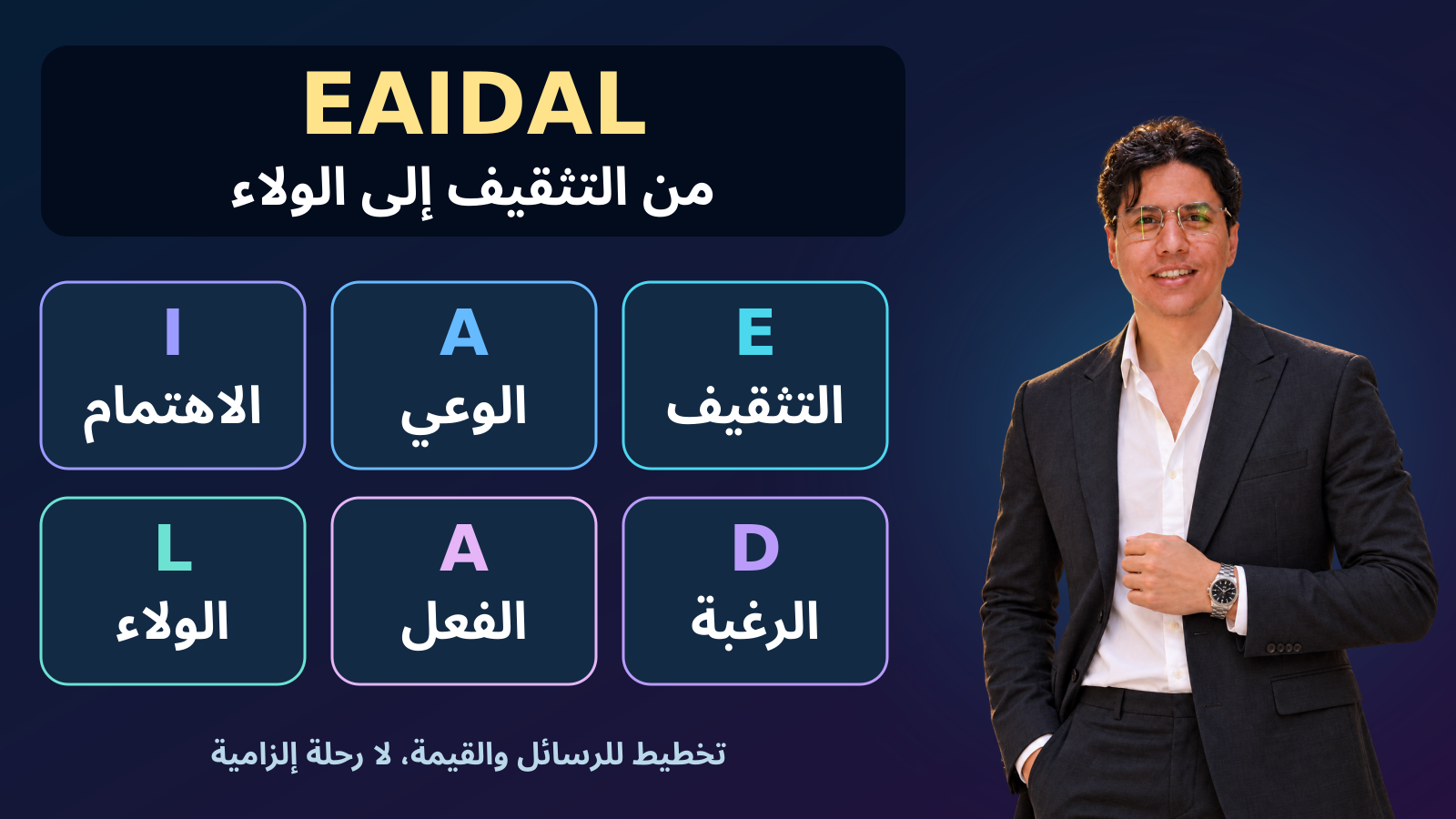
Why does marketing neither begin with advertising nor end with the sale?
Imagine a team launching a new service and designing a good advertisement, only to discover that the audience does not even understand the problem the service solves. Now imagine another team succeeding in selling but failing to prepare usage guidance or support, so customers leave after their first experience. In both cases, a gap exists outside the moment advertising usually focuses on. The first comes before brand awareness; the second comes after conversion. Ignoring them can lead us to spend more on attracting people whose needs we have not understood, or acquire customers whose trust we cannot retain.
The EAIDAL model addresses this space as a framework for organizing messages, execution, and measurement. It adds education at the beginning and loyalty at the end of a familiar path involving awareness, interest, desire, and action. This does not mean that every customer starts from zero or passes through stages of equal duration. The point is for the organization to ask what a person needs before choosing it, and what it must do after that choice to fulfill its promise. This lesson builds on the practical explanation of AIDA, but shifts the focus from message formulation alone to consistency of experience before and after purchase.
Here we distinguish the model's definition from its analytical application. The definition comes from the course's adopted sources; the company examples, figures, and implementation plan are original, hypothetical educational examples, not client results or guaranteed forecasts. In the healthcare example, loyalty does not mean increasing visits or procedures at any cost. It means a trustworthy experience, appropriate care, and freedom of choice, without creating medical need or substituting pressure for clinical assessment.
What is the EAIDAL model, and what are the limits of its attribution?
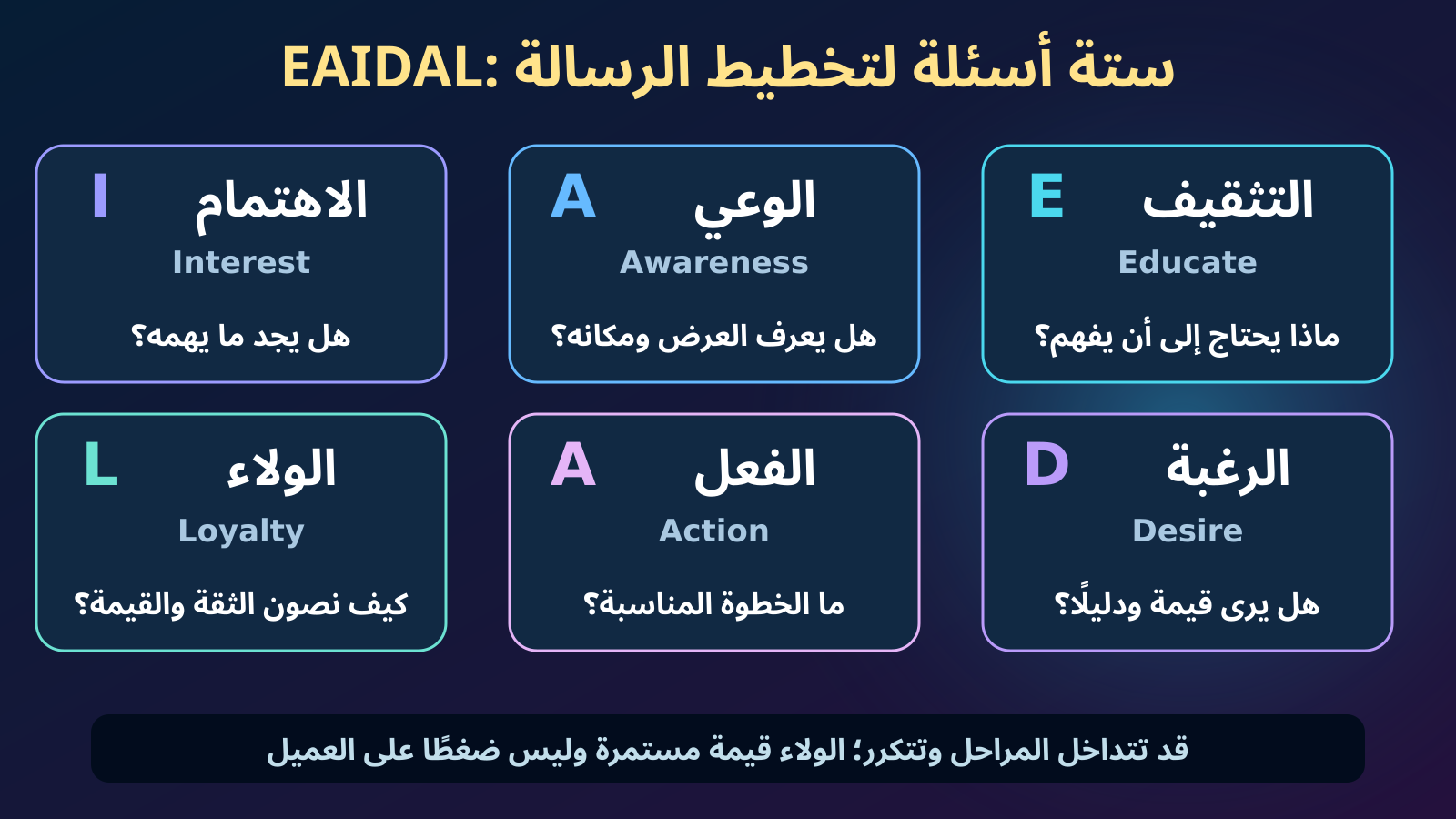
The course materials present EAIDAL as an extension introduced by Jenna Tiffany, with reference to her book published in 2021. Its stages are Educate, Awareness, Interest, Desire, Action, and Loyalty. The first letter after education here means awareness, not simply attracting attention. Tiffany's book can be verified with publisher Kogan Page, and the six stages and their application to measurement appear in London School of Business Administration materials.
In this lesson, we treat it as a practical planning tool, not a scientific law establishing that all people behave identically. Nor do we claim that adding two letters solves every marketing problem or invalidates another framework. Its value is in reminding you of two easily neglected functions: helping the market understand an unfamiliar offering, and delivering an experience worth returning to or recommending after action. Defining the audience, price, operational capacity, and financial viability still requires separate work.
The following applications are practical proposals built on this idea, not recipes copied from the book. You can use them to review a product, service, or campaign, provided you know which decision you are trying to improve. If the problem is a booking malfunction, you do not necessarily need six new campaigns. If people already know the offering well, investing in general education may be a lower priority than clarifying a difference or improving service. The framework helps you pose the question; it does not choose the priority for you.
Start with the audience and the problem before allocating channels
Write a practical definition of the segment you serve: who faces the problem, in what situation, who decides on the purchase, and what constraints affect them? Describing it as “men and women between two ages” is not enough. In business software purchasing, the user may be an employee, the approver a manager, and the payer the finance department. In a healthcare service, someone may seek general information and then consult a specialist before any decision. Different roles change what each party needs to understand and what you may ask of them.
Next, identify what the audience actually knows and what you assume it knows. You can use recurring inquiry questions, short interviews with participants' consent, service-team observations, and lawfully available research findings. Write testable assumptions: “The customer may not understand the difference between an appointment request and a confirmed booking” is better than “The audience needs awareness.” The first sentence leads to a clear change whose impact can be reviewed; the second may justify endless content production.
Set an organizational objective and place a useful outcome for the person alongside it. The organization may want more qualified inquiries, while the person wants to know whether the service suits them and what it is likely to cost. These objectives need not conflict, but ignoring the second can temporarily improve the report and weaken trust later. At every stage, we will review both together: what do we want to happen, and what will make this step useful and clear for the person taking it?
Education: make the idea understandable without inventing a need
Education matters when the solution is new or complex, or when the audience confuses concepts. Do not begin with “We are the best” if the person does not yet know what the product category does. Explain the problem in familiar language, how the idea works, whom it may suit, and when it is not the required option. Good content at this stage gives people understanding they can benefit from even if they do not buy from you. It is not merely a long advertisement that hides its price until the end.
For request-management software, you could explain the difference between saving a message and recording a request's status, owner, and follow-up date. For a professional service, you could explain what an initial assessment includes and excludes. Choose a small, understandable example rather than a list of jargon. If you need a diagram, use it to clarify a relationship or decision, not simply decorate the page. Ask someone from the audience what they understood after reading; view counts alone do not answer that question.
In healthcare especially, education is not remote diagnosis or a way to convince every reader that they are ill. Information should be reviewed by a qualified party, and the content's limitations and the need for individual assessment where appropriate should be clear. Avoid fear-based messages, treatment promises, or suggestions that not buying a particular service means neglecting one's health. Success here may mean understanding the options or knowing where to seek appropriate help, even if that does not result in a booking with the organization that published the material.
Awareness: connect the solution to a clear name and a specific promise
After understanding the idea, people need to know who provides it and what that provider represents. A logo appearing at the end of a long video is not enough if the service type, location, and suitable audience remain unclear. Formulate a specific, deliverable promise and repeat identifying elements consistently across the page, advertisement, and profile. Channels may differ in length and format, but the business should not appear to offer contradictory propositions whenever the message changes location.
Distinguish reach from awareness. An advertisement reaching an account or screen does not prove that its owner remembered the brand or understood the offering. You can track distribution, frequency, and traffic sources, but describe them as such rather than automatically converting them into established knowledge. If your decision requires measuring recall or understanding, look for an appropriate method, such as a carefully designed research question or a small comprehension test, while recognizing that a limited sample does not represent the whole market.
Also review the quality of awareness you are building. If the audience knows you for a promise you cannot fulfill, increased recall is not sufficient success. A brand suggesting instant service when delivery takes days will create friction when people make contact. Operations should therefore participate in reviewing the message, particularly timing, coverage, price, and outcomes. Clear limitations from the outset may reduce inquiry volume but improve fit and prevent avoidable disappointed expectations.
Interest: answer what prevents someone from continuing
When people begin exploring, their questions become more detailed. They want to know how the service works, what they will receive, what effort it requires from them, and what information is missing before they can take a step. Make the page help them compare and understand, rather than asking them to contact you for every basic detail. This section might contain a progressive explanation, a use case, a list of questions, or a short demonstration focused on one problem.
Do not automatically associate interest with a single metric. A long visit may mean useful reading or difficulty finding an answer. Downloading a file may reflect curiosity or academic research rather than purchase intent. Use signals to form hypotheses, then compare them with clearer behavior or outcomes. If most inquiries ask a question already answered on the page, the answer may be buried or written in confusing language, rather than the audience simply not reading enough.
Order content by decision priority. In business software, ease of data migration and access permissions may matter more than the number of interface colors available. For a healthcare service, the specialist's qualifications, what the appointment includes, the location, and how to find out the cost may be essential questions. Do not give every detail equal visual prominence. Help people reach the essentials quickly and keep additional detail available without forcing them to read an entire page before understanding the next step.
Desire: provide value, evidence, and limitations
Desire here is not emotional pressure or an attempt to make everyone buy. It means helping people evaluate whether the offering fits their needs and options. Turn a feature into a clear use: “You can identify who is responsible for a request” is more precise than “A revolutionary system.” Then explain the setup, training, or cooperation that requires. If the benefit depends on regular data entry, do not present it as something that happens automatically upon subscribing.
Choose evidence appropriate to the objection. A practical demonstration may address ease of use; a written scope description may address ambiguity; clear terms may reduce anxiety about commitment. Do not use a customer testimonial without permission or present an exceptional result as typical. If using a hypothetical example, state that explicitly. Evidence is not strong because it is exciting, but because it answers a real question without hiding conditions or limitations that change the promise's meaning.
In healthcare, do not turn this stage into selling a procedure before assessment. You can explain the service pathway, specialist qualifications, communication methods, and the person's rights, but treatment decisions and suitability are not marketing decisions. Nor should a discounted price or countdown pressure someone into a health decision they do not understand. The invitation should match the level of knowledge and risk, leaving room for questions, informed choice, and refusal without an artificial penalty.
Action: define conversion as it actually happens
The action may be requesting a quotation, starting a trial, purchasing a product, or requesting an appointment. Write one clear definition for each outcome, then ensure the wording, button, and system agree. “Request an appointment” is not the same as “Your appointment is confirmed.” “Start a trial” should not conceal a paid subscription that renews without clarity. The greater the commitment, the more important it is to explain what happens after clicking and what the person can review before completing the process.
Test the process on a phone as a new visitor would. Is the price or service scope visible? Are fields understandable? Does the error message appear near the relevant field? Does the person receive clear confirmation? Does the request reach the right owner exactly once? Fixing a small defect may be more useful than producing another campaign. Do not separate the conversion experience from operations: a request arriving in an inbox nobody checks is not a completed outcome, whatever the analytics tool records.
Collect only the minimum data needed at the current step and explain why it will be used. Do not send sensitive field contents to advertising platforms or measurement tools. In healthcare requests, separate the marketing inquiry from the appropriate channels for collecting clinical information when needed. These are operational risk-reduction principles, not a substitute for reviewing the regulatory requirements and platform policies relevant to the organization's activity and location.
Loyalty: test what happens after the promise
This stage begins with delivery, not a message asking for a high rating. Did the person receive what they understood they would receive? Do they know how to start using it? Can they access appropriate support or resolve a problem? A new product may need onboarding and training before its benefits become apparent. If you neglect that and then send repeated renewal offers, you are treating a visible effect while ignoring the reason the customer hesitates to stay.
Separate returning from loyalty. Someone may return because alternatives are limited or changing suppliers is difficult, not because they are satisfied. They may also be satisfied and have no need to buy again soon. Combine behavioral indicators with observations about the experience, complaints, and reasons for leaving. Do not treat repeat visits alone as evidence of a healthy relationship, or attribute every renewal to an email campaign when other factors, such as service quality or an existing contract, explain much of the outcome.
In healthcare, retention should mean trust and continuity of appropriate care when needed, not encouragement of unnecessary services. You can measure clarity of instructions, ease of planned follow-up, complaint handling, and respect for privacy. Do not coerce a patient into becoming an “ambassador” or make service quality conditional on permission to publish their experience. Any testimonial or personal story requires appropriate permission, and you must not reveal health details simply because someone praised the organization in a private conversation.
Hypothetical example: software for organizing business requests
Suppose a company sells monthly subscription software to small service teams. Hypothetical training interviews reveal that the audience confuses a task list with a complete request log. Education begins with an example explaining how a request gets lost when its status and ownership are unclear. Awareness then introduces the software and the types of teams it serves. At the interest stage, it shows a short workflow; at desire, a hands-on trial and data-migration terms; it then invites people to a demonstration session rather than immediately asking for a long subscription.
Once the subscription begins, the company does more than send a welcome message. It defines a first onboarding step, a person responsible for support, and a task that can be completed within an appropriate period. The criterion is not how many people opened the email, but whether the team can use an important function correctly. This is a practical addition at the loyalty stage: a subscription may renew because the product has become useful, not because the customer received a last-minute discount. Cancellation should be as clear as getting started was.
Assume twelve thousand riyals are spent on a test, producing one hundred and twenty unique demonstration requests, of which eighty are suitable, followed by sixty completed sessions and twenty-four new subscriptions. The cost per total request is one hundred riyals; per suitable request, one hundred and fifty; per completed session, two hundred; and per new subscription, five hundred riyals, based on campaign spending alone. This is not comprehensive acquisition cost: it does not include sales or support salaries or all production costs. Nor does it prove profitability without revenue, contribution, cancellation, and collection information.
If twenty of the twenty-four subscribers remain after a defined, equal follow-up period, this cohort's retention is approximately eighty-three percent. Do not compare it with an older cohort observed for longer, or confuse it with the retention rate for all customers. Examine why the four left instead of assuming they need stronger advertising. The problem may have been product fit, onboarding, or an expectation created by the message. The numbers locate the question; the decision then requires qualitative and operational evidence.
Hypothetical example: a healthcare assessment service without commercial pressure
Imagine a center wanting to introduce adults to an assessment service with a specialist, without selling a treatment plan before assessment. Content begins by explaining what happens during the visit and how people can prepare. The awareness message introduces the location, specialty, and service scope. Practical questions appear at the interest stage, while desire content presents verified qualifications and the limits of outcomes. The action is to request a suitable time, with the specialist team confirming the appointment and cost before attendance.
Assume eight thousand riyals in spending produces one hundred valid, unique requests, followed by sixty confirmed appointments and forty-five attendees. The cost per request is eighty riyals; per confirmation, approximately one hundred and thirty-three; and per attendee, approximately one hundred and seventy-eight. Attendance from confirmed appointments is seventy-five percent. All figures are hypothetical, not healthcare industry benchmarks. Attendance must not be equated with successful treatment, nor should an increase in procedures be treated as a marketing outcome to maximize without regard to clinical suitability.
If no-shows recur, examine clarity of location and time, confirmation procedures, and permitted reminders, not just advertising content. If people attend expecting a different service, review the offering's description and the visit's limitations. After the service, the question becomes clarity of instructions and access to appropriate follow-up, not how many visits can be sold. The experience can be improved without collecting unnecessary health details in the marketing report, or turning every contact into an advertising-retargeting opportunity.
A measurement dashboard that keeps the stages distinct
For each stage, define success, an indicator, an interpretive limitation, and an action to take when performance is weak. In education, you may test understanding of a core idea; in awareness, review appropriate reach and knowledge of the offering; in interest, look for unanswered questions; in desire, review objections and evidence; in action, measure correct completion; and in loyalty, track usage, experience, and appropriate retention. These are examples, not a mandatory checklist. Choose what relates to your objective and what you can measure responsibly.
Do not construct a mathematical funnel from incompatible groups. Impressions are not unique people, sessions do not always represent the same users, and requests may be duplicated or arrive through other channels. Dividing a month's requests by a week's visits will not yield a useful rate. Define the period, denominator, duplication, and data source before presenting a percentage. If you cannot connect stages reliably and lawfully, present separate indicators and state the limitation rather than claiming a precise journey for every individual.
Add an outcome that matters to the customer alongside one that matters to the organization. A lower cost per inquiry is good only if it is not accompanied by confusion or poor service. Higher retention calls for reviewing freedom to cancel and experience quality, not celebrating the number alone. Ask at the regular meeting: what did we learn, and which decision will change? A dashboard full of indicators that lead to no action is not an improvement system, but an organized way to gather numbers that may help nobody.
How do we choose a channel for each function without rigid rules?
A common mistake is permanently assigning one platform to each stage: video for education, search for action, and email for loyalty. These choices may work in one situation and fail in another. A video can explain usage to an existing customer, a search result can introduce someone to an unfamiliar solution, and an email can provide information before purchase. Start with the task the person needs and the context in which they use the channel, then choose format and timing, not the other way around.
Ask three questions before choosing a channel: is your intended audience there? Does it allow enough explanation of the task? Can you follow the response in a useful, permitted way? A long explanation may belong on your website, with a short piece in another channel pointing to it. An explanatory conversation may suit a complex decision better than a series of automated messages. Do not treat numerous channels as evidence of maturity. Performance sometimes declines because every channel needs updates and review the team has no time to provide.
Calculate the cost of maintaining the effort, not just launching it. An old page with terms that are no longer accurate can spoil an otherwise coherent cross-channel journey. Assign an owner to update essential information and identify the reference version for price, scope, and frequently asked questions. Then periodically review a sample of actual paths: advertisement to page, page to form, and form to contact. Consistency between the parts matters more than each piece looking excellent on its own.
Team exercise: distinguish the cause from the signal
Bring together someone from marketing and someone from service or sales, and choose a specific problem such as declining qualified inquiries. Ask each person to write two possible explanations and the evidence needed to distinguish between them. Marketing may say the message does not generate interest, while operations sees requests coming from an area the organization does not serve. Do not vote for the most persuasive explanation. Look for information that can be gathered at the lowest cost and risk, then adjust the decision accordingly.
Next, draw the six stages and write beneath each one a promise the person hears and an action the organization takes. If you write “An easy experience” under desire, what process makes onboarding easy under loyalty? If you write “We give you a clear picture” under education, can someone learn the limitations without making a call? This exercise reveals the gap between attractive language and actual capability. It requires no new platform purchase, only willingness to acknowledge what is not working yet.
Finally, formulate one test with a primary outcome and a safeguard outcome. For example, revise the service description to increase the share of suitable inquiries while monitoring confusion, complaints, and whether submissions remain functional. Total forms may decline and the test still be useful, or rise without being useful. Write the interpretation after seeing the results and separate what the data supports from what needs another experiment. This turns EAIDAL from a diagram in a presentation into a shared language that helps the team improve a real experience.
A small implementation plan you can review
Start by inventorying what exists rather than creating six new projects. Against each stage, place a current asset, an owner, and a possible flaw. You may find education content exists but does not connect to a clear page, or that the offering page is good but onboarding is weak. Choose one gap with reasonable impact that can be fixed within available resources. Define what you will change and what you will hold constant, then record the change date so you do not attribute the results of several simultaneous adjustments to one cause.
Before launch, agree on a review criterion, a duration suited to the decision cycle, and stopping conditions such as faulty measurement, an inaccurate promise, or inquiries the team cannot serve. After the experiment, compare results while accounting for changes in audience, budget, and seasonality. Do not declare victory from a handful of conversions or treat every decline as evidence that the model failed. The tool helps organize the work; test and data quality determine what can be inferred.
In short, EAIDAL expands the question from “How do we attract and persuade?” to “How do we understand, introduce, help, deliver, and deserve trust?” Use education when a real understanding gap exists, awareness when the offering needs a clear introduction, and loyalty when you want to fulfill the promise after action. Do not turn the stages into a compulsory journey or six equal budgets. Connect each step to value for the person, an owner within the organization, and evidence that improves the decision, then make the actual experience the final test of what your messages say.
Sources
- London School of Business Administration: Principles of Marketing, measurement materials: the six stages and linking indicators to objectives, tactics, and responses to weak performance.
- Kogan Page: Marketing Strategy, Jenna Tiffany: the publisher's page for the book and its author; the current page is for a newer edition, not a new date of invention for the model.
- O’Reilly: Marketing Strategy, May 2021 edition: the bibliographic reference for the edition cited in the course materials.
Comments
No published comments yet.