
The news and the decision it should inform
DomoAI announced InkoAI Agent on November 13, 2026: a conversational image/video workflow with approval before generation and revisions of earlier outputs. Further advertising Skills are planned, not established as available. Company announcement.
This November 16 analysis does not report an independent product test. The practical question is whether a team can turn a clearer brief into a usable asset with fewer corrections, while preserving truth, identity and approval. The workflow below is an original recommendation, not a description of every product feature. It can guide a controlled evaluation without assuming that a generated clip is suitable for publication merely because it looks polished. Production speed and commercial effectiveness belong in separate parts of the decision.
Start with the decision, not the prompt
Before asking for a video, write what the viewer should understand or do. Choose one audience situation, one credible message and one next step. A short advertisement explaining how to request an appointment has a different job from a product demonstration or a brand introduction. Combining all three usually makes evaluation harder: the team cannot tell whether the result failed because of the story, the offer or the execution.
Add a sentence describing what the video must not imply. A hypothetical clinic introduction, for example, must not suggest guaranteed outcomes or portray a synthetic person as a real patient testimonial. This is a proposed communications safeguard, not a medical claim. Establish the boundary before generation so that reviewers evaluate the same intention rather than negotiating it after an attractive output exists.
Build a reference pack with an owner
Create a small, approved reference pack containing the current logo, product or service description, permitted photographs and spelling of names. Record who owns each asset and what uses are allowed. Public availability is not a license to upload a photograph into another service or use a person's likeness in an advertisement. When permission is unclear, use a placeholder that does not resemble an identifiable person and resolve permission before production.
Keep a dated version of the pack. If a price, package inclusion or visual identity changes, the producer should know which assets are obsolete. Assign one person to approve updates rather than allowing several colleagues to circulate competing folders. This operational discipline is independent of the selected generation tool. It prevents a fast workflow from repeatedly producing accurate-looking material from inaccurate inputs.
Approve the storyboard as a separate artifact
Translate the brief into a simple sequence: opening situation, central explanation, supporting visual and next action. Describe each shot in plain language and identify which statement it supports. A beautiful transition has little value when it distracts from the only information the viewer needs. Decide what can be removed without breaking the message before spending effort on visual detail.
Approve the storyboard independently from the final render. The reviewer should be able to reject a misleading promise without judging lighting or music. Keep the approved version with the project and record any later change. If a revision alters the central claim, return to that approval point rather than treating it as a cosmetic edit. This creates a defensible connection between the intended message and the finished asset.
Use a change log rather than an endless conversation
Conversational production can make successive revisions feel effortless, but a team still needs an identifiable current version. Give each candidate a short identifier and record the requested change, reason and review outcome. Distinguish a deliberate experiment from an accidental deviation. When a later edit improves pacing but changes a product label, the earlier approved wording must remain recoverable.
Prefer one meaningful change per iteration when learning matters. A request to alter color, voice, headline and ending simultaneously may produce a better-looking clip, but it will not show which change helped. For urgent delivery, bundled changes can be reasonable; simply do not present the outcome as a controlled creative experiment. Preserve rejected versions privately only as long as needed for review and operational learning.
Put explicit gates between creation and release
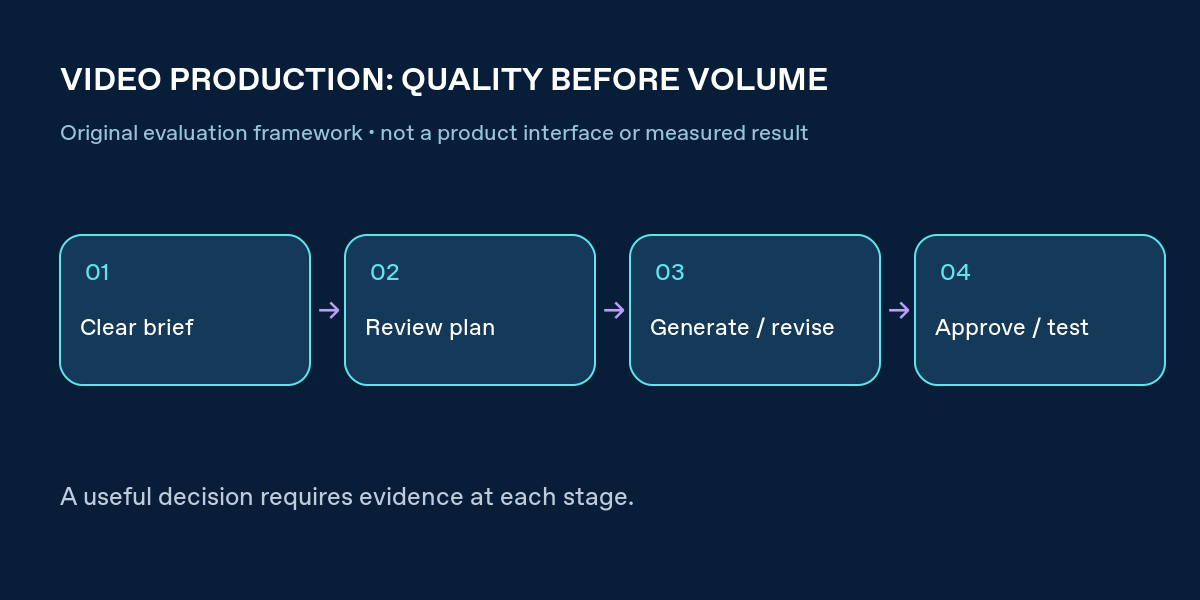
Original explanatory diagram: Clear brief → Review plan → Generate / revise → Approve / test. These are proposed team gates, not a screenshot or guaranteed platform controls. The company announcement supplies news context; the workflow is independent analysis.
Name the person responsible for each gate. A creative producer checks continuity and presentation; a service owner checks factual details; an authorized publisher releases the approved file. One person may hold several roles in a small team, but the checks should remain distinct. Finishing the render must not automatically mean that publishing permission exists.
Set a clear rejection route. If review finds an inaccurate claim, return it to the brief or script owner with the precise sentence or frame. Do not ask a reviewer to approve an entire conversation containing several inconsistent alternatives. Approval should identify the exact exported file and its intended channel, audience and date.
Review the actual export on a phone
Inspect the exported file, not only an editor preview. Read the smallest text at normal phone size, listen through ordinary speakers and check the beginning and ending without pausing. Confirm that subtitles match speech and that the call to action remains visible long enough to understand. For Arabic, check connected letters, punctuation, numbers and the direction of mixed Arabic and English text.
Review every required aspect ratio separately. A centered title in a wide video can become cropped or covered in a vertical placement. Leave room for the channel's interface and test with a realistic preview rather than assuming that a safe area is identical everywhere. Record the dimensions, duration and review device. This is practical quality control, not evidence that the asset will perform well in a campaign.
Define usable output before comparing speed
A team cannot measure productivity honestly if every generated file counts as a completed asset. Define acceptance first: correct facts, authorized imagery, readable text, intelligible sound, appropriate dimensions and a working destination. Add any campaign-specific requirements before starting the trial. An output that fails an essential check remains work in progress even if it took seconds to produce.
Track elapsed delivery time and active human time separately. Waiting for a render differs from rewriting a script or correcting a misleading visual. Include the review and export stages, not just generation. Compare similar briefs with similar complexity and the same acceptance rules. Otherwise a simple experimental clip may appear more efficient than a demanding existing production process merely because the assignments were different.
A hypothetical cost calculation
Consider an invented pilot producing ten candidate clips. Suppose generation charges total 120 monetary units and review takes three hours at an internal planning rate of 80 units per hour. The combined pilot cost is 360 units. If six clips meet the predefined acceptance standard, cost per accepted clip is 60 units, not 12. These figures illustrate accounting only; they are not DomoAI prices, observed results or expected savings.
Now suppose two accepted clips require a further hour of correction before release. Add that labor rather than hiding it outside the trial. The revised total is 440 units and cost per accepted clip is about 73.33. A team may still choose the workflow for flexibility or quality, but the decision should use the full cost and state what was included. Do not confuse accepted assets with successful advertisements.
Connect production measures to marketing outcomes
After an asset passes review, evaluate it against the marketing problem identified at the start. For a hypothetical appointment campaign, a click is not the same as an eligible enquiry, a confirmed booking or attendance. Use definitions that the call-center and marketing teams can reconcile. Keep production metrics beside outcome metrics rather than allowing a larger volume of videos to stand in for better results.
Avoid changing audience, offer, destination and creative at once if the purpose is to understand the creative contribution. Where a controlled comparison is feasible, document its design and limitations. Where it is not, report the result as an observation rather than proof of causation. A strong video may be held back by an unavailable service or a slow response process; production software cannot resolve every downstream constraint.
Apply extra care to healthcare communication
A healthcare team can begin with low-risk service navigation: where to find approved information, how to contact the organization or what administrative steps precede an appointment. Use validated content supplied by the service owner. Do not generate diagnostic advice, patient histories or invented treatment outcomes to make a scene more persuasive. Any clinical content needs the organization's appropriate review before publication.
A synthetic spokesperson should not silently impersonate a real clinician or patient. Obtain the appropriate permission for a real person's image or voice, and make the nature of illustrative scenes clear when needed to avoid misleading viewers. Keep patient information out of a general creative test. These are proposed workflow boundaries; they do not establish that a particular service meets an organization's privacy, security or clinical approval requirements.
Plan a limited pilot with a stopping rule
Choose one recurring asset type and a small set of comparable briefs. Establish the acceptance checklist, review owner and measurement period before production. Keep the existing production route available so that a delayed or rejected output does not force the team to lower its standards. A useful pilot should reduce uncertainty about a defined workflow, not become a permanent experiment with no decision date.
Stop or narrow the test when repeated errors create unacceptable review work, when reference rights are unresolved or when the team cannot identify the approved final version. Expand only after documenting both advantages and failures. The result may justify using the tool for storyboards but not final advertisements, or for visual exploration but not factual text. A narrower role can be a successful operational finding.
Strategic takeaway: optimize the accepted asset
The important unit of work is an accepted, usable asset connected to a clear customer action. A faster first draft is valuable only when subsequent review, corrections and handoff remain manageable. Keep a simple scorecard covering time, full cost, acceptance rate, recurring defects and downstream outcomes. Review it with the people who produce, approve and use the content, not only the person selecting the tool.
My strategic recommendation is to treat conversational video production as a testable process improvement rather than a promise of automatic growth. Preserve human accountability at the point where facts, identity and publication matter. The team should finish the pilot knowing which tasks became easier, which risks remained and what evidence would justify expanding its use. That is a more useful result than a folder of impressive clips without an agreed purpose.
Comments
No published comments yet.