
A new offering, with a limited initial scope
Criteo’s announcement about Adore Beauty brings a familiar retail-media question into focus: when a retailer sells visibility inside its store, what should count as success? Advertising revenue matters to the retailer. Product discovery and profitable customer demand matter too. Those objectives can reinforce one another, but they need to be evaluated separately before a sales dashboard turns into a growth claim.
The company announcement covers Adore Beauty’s retail-media offering in Australia and New Zealand. Its page is dated 9 November 2026, while the Sydney announcement dateline is 10 November. The planned initial inventory is sponsored products on website search and category pages, followed by the app. Product-detail-page advertising and onsite display are described as possibilities for a second phase, rather than formats confirmed as available now.
Criteo identifies Commerce Yield and Commerce Max as supporting integration, demand, campaign activation, reporting and closed-loop measurement. The arrangement extends an existing performance-marketing relationship. These are the verified foundations of the news. The release supplies no advertiser results, incremental-sales estimate or return-on-investment result for the new offering. The evaluation framework below is independent editorial analysis, not a description of performance already achieved.
Start with the placement and the shopping task
A sponsored search result and a sponsored category placement answer different customer needs. Someone searching for a particular item may already have a narrow intention. Someone browsing a category may be comparing benefits, prices and formats. Both can be commercially valuable, but their attribution should not be interpreted as evidence of the same kind of influence.
Before buying, an advertiser should request a placement map that identifies where its products can appear, how sponsorship is labelled and which destinations clicks reach. The map should distinguish exact product searches, broader category searches and browsing contexts where that distinction is measurable. It should also clarify eligibility rules, available controls and how paid positions coexist with organic recommendations. The announcement does not disclose all these operating details; they are questions for a commercial discussion.
Retailers need a corresponding customer test. Can a shopper still find a suitable item quickly? Does the promoted product actually answer the query? Is the result visibly sponsored? Charging for prominence creates an obligation to protect the usefulness of the shelf. A campaign can meet its sales target while making a particular journey less helpful, especially if the reporting aggregates several very different placements.
Make the product ready before paying for discovery
The next practical check belongs to merchandising. A product that cannot be supplied reliably may attract clicks without creating completed purchases. Teams should examine stock by relevant variant, price consistency, delivery information and the accuracy of the product page before increasing exposure. Where applicable, they should also check whether product descriptions explain the differences a customer needs to choose confidently.
For a beauty assortment, suitability information can matter as much as the image. A marketing team should avoid allowing a broad campaign promise to outrun the approved information on the product page. This is a general operating recommendation, not a claim about any deficiency at Adore Beauty. The same discipline applies to any retailer selling products whose variants and intended uses affect the purchase decision.
Availability should be monitored during the pilot, not recorded only at launch. If a promoted variant becomes unavailable halfway through a test, the campaign and comparison periods are no longer commercially equivalent. Log the change, adjust the eligible assortment where permitted, and distinguish lost availability from weak demand. Otherwise a media report may blame creative or bidding for a problem that originated in the shelf itself.
Separate attributed orders from retained contribution
Attribution assigns credit according to a measurement rule. It does not deduct every cost, and it does not automatically identify purchases that would otherwise never have happened. An advertiser therefore needs a commercial view alongside the platform view. Start with attributed sales, then account for cancellations, returns, product cost, variable fulfilment costs and media spend within a clearly stated period.
Consider a deliberately hypothetical example, not Adore Beauty or Criteo performance. A campaign receives credit for A$10,000 in orders. After cancellations and returns, retained revenue is A$9,000. If product and variable fulfilment costs total A$5,400 and advertising costs A$2,000, the simplified remaining contribution is A$1,600: A$9,000 minus A$5,400 minus A$2,000. The attributed revenue-to-ad-spend ratio is 5:1, but that ratio alone does not describe the contribution calculation.
The A$1,600 is also not incremental profit. It excludes any costs omitted from this simplified illustration, and some retained purchases may have occurred without the campaign. An actual business should define its cost treatment with finance and avoid mixing gross orders with net revenue. Retailers should separately assess their own advertising revenue and operating costs; retailer and advertiser economics are related, but they are not interchangeable.
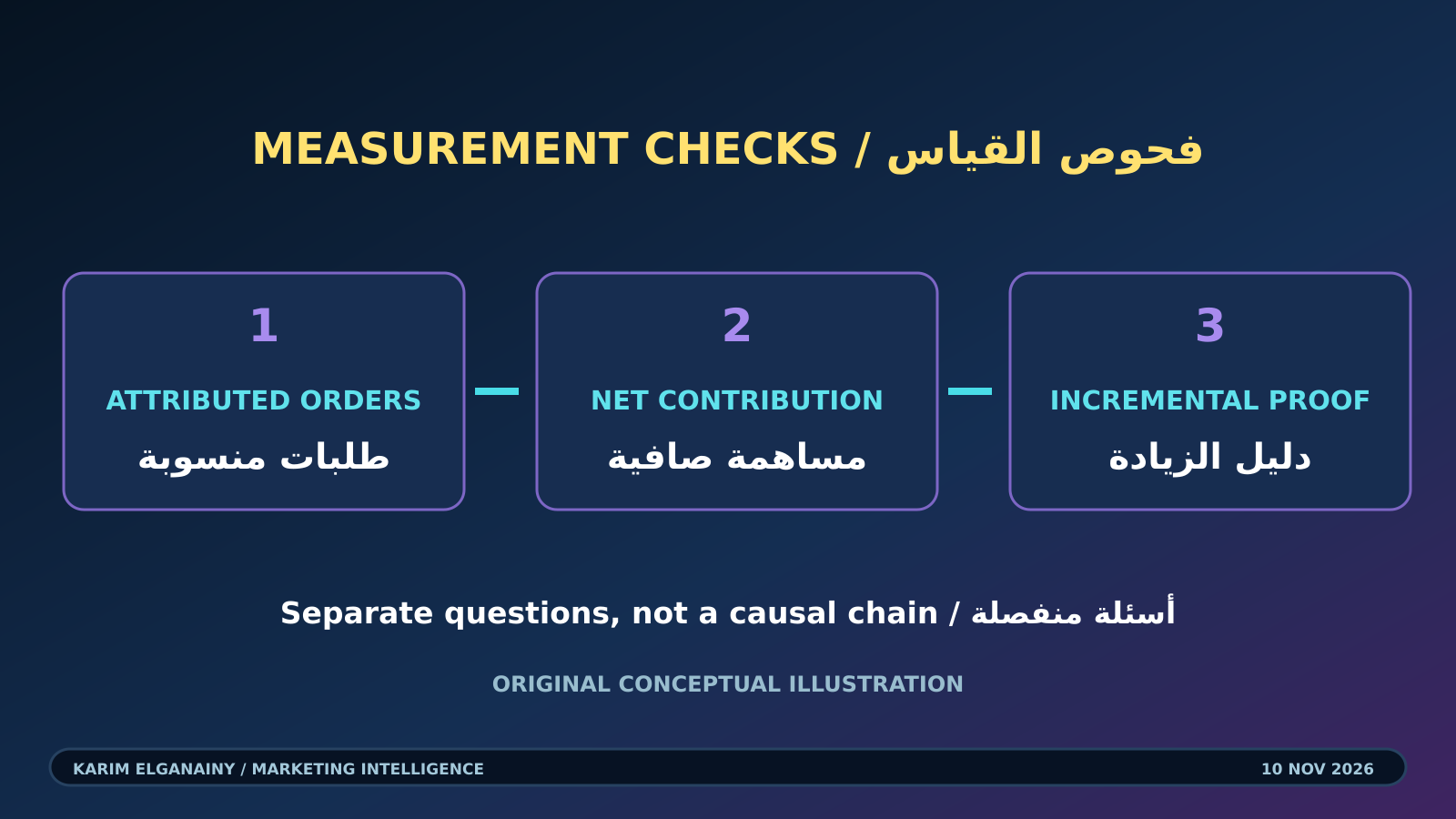
Original explanatory diagram: three analytical checks, not a causal chain or a depiction of vendor software. The announcement establishes the planned offering; the framework is editorial analysis. Source: Criteo.
Ask what moved inside the organic shelf
Sponsored visibility can change which product gets purchased even when the shopper would have bought something anyway. That can still be useful to an advertiser seeking consideration, but it has a different meaning for the retailer. A category-level evaluation should ask whether paid activity adds demand, changes product mix or reallocates sales between items already likely to sell.
For example, a promoted item may gain attributed orders while a close alternative loses organic orders. The advertiser sees a successful campaign, while the retailer sees limited category growth. The reverse is also possible: paid discovery may help a shopper find a suitable option that would otherwise be missed. Neither outcome should be assumed from a platform attribution report alone.
Review organic and sponsored activity together wherever reliable data permits. Track relevant category revenue, order contribution and customer experience rather than declaring displacement from a single product’s decline. Prices, promotions, stock and seasonality can all change the same measures. The aim is to identify plausible explanations and design a stronger comparison, not to label every organic movement as an effect caused by advertising.
Closed-loop measurement needs a separate incrementality test
Closed-loop reporting can connect advertising exposure or interaction with purchases inside a defined measurement system. That connection is useful for campaign management. Its interpretation depends on rules such as the attribution window, treatment of multiple interactions, product matching and how cancellations or returns are reconciled. Buyers should ask for those definitions before comparing numbers across media channels.
Incrementality asks a different question: what would have happened without the advertising? A credible test needs a defensible comparison. Where feasible, randomly assigning eligible shoppers, areas or another suitable unit can help estimate that difference. The design must reflect actual platform capabilities, privacy requirements and business constraints. The announcement does not promise any particular experimental feature or make every possible design available.
When randomisation is unavailable, a carefully chosen comparison may still provide useful evidence, with explicit limitations. Document differences in demand, promotion, assortment and availability, and explain remaining uncertainty. Do not call a before-and-after increase causal merely because it follows launch. A pilot with little volume may be operationally informative while remaining too imprecise to support a confident incrementality claim.
Design a bounded pilot with a decision rule
A practical pilot begins with a specific buying situation, a defined assortment and a budget the business can afford to use for learning. Establish the baseline, the campaign period and the time allowed for returns before inspecting the final result. Record the main commercial outcome and the customer-experience conditions that must remain acceptable. This prevents teams from selecting a flattering metric after seeing the data.
Choose the test duration around purchase patterns, expected volume and the comparison design, rather than prescribing the same number of days for every category. Keep a change log for prices, promotions, stock problems, placement changes and measurement revisions. If several variables change at once, describe that limitation in the result instead of presenting the pilot as a clean test of media alone.
Set a decision rule in advance. Expand when contribution and the strength of additional-demand evidence meet the business’s agreed requirements, while availability and customer experience remain acceptable. Revise when the offer, page or stock position is limiting the test. Stop when the economics are consistently unattractive under the agreed assumptions. No universal return target follows from this announcement, and none should be invented for the pilot.
Apply the framework without inventing market access
For marketing teams in Saudi Arabia, the UAE or elsewhere in the Gulf, this is a useful operating example from Australia and New Zealand. It is not evidence of a Gulf rollout, local buying access or the availability of identical placements through a regional retailer. Those details need to be verified with the relevant commercial partner before budgets or launch dates are discussed as commitments.
The transferable lesson is the sequence of questions. Confirm the inventory and customer task, make the assortment ready, define net commercial contribution, and then ask how additional demand will be estimated. Apply local privacy and advertising requirements to the actual implementation with appropriate advice. A measurement concept can travel across markets even when contracts, permissions and product availability cannot.
Criteo and Adore Beauty have announced a commercial opportunity, not demonstrated its eventual effectiveness. The strongest next step for an interested advertiser is a scoped conversation backed by a product-readiness check and a measurement brief. Sponsored discovery earns a larger role when it produces useful customer choices and defensible business value. The quality of that evidence should determine expansion, rather than the novelty of the inventory or the size of attributed sales alone. Assign named owners for merchandising changes, measurement definitions and the final spending decision. That makes a weak result actionable: the team can distinguish an unsuitable product, an unreliable comparison and an unattractive advertising opportunity, rather than treating all three as the same failure.
Comments
No published comments yet.