A competitor launches a lower-priced package, publishes more frequently, or appears above your business in a search result. Each observation can tempt a marketing team into an immediate response. Yet none explains the whole offer, the audience it serves, or the operating capabilities behind it. Matching the visible move without understanding those details can consume money and attention while leaving the original business problem unresolved.
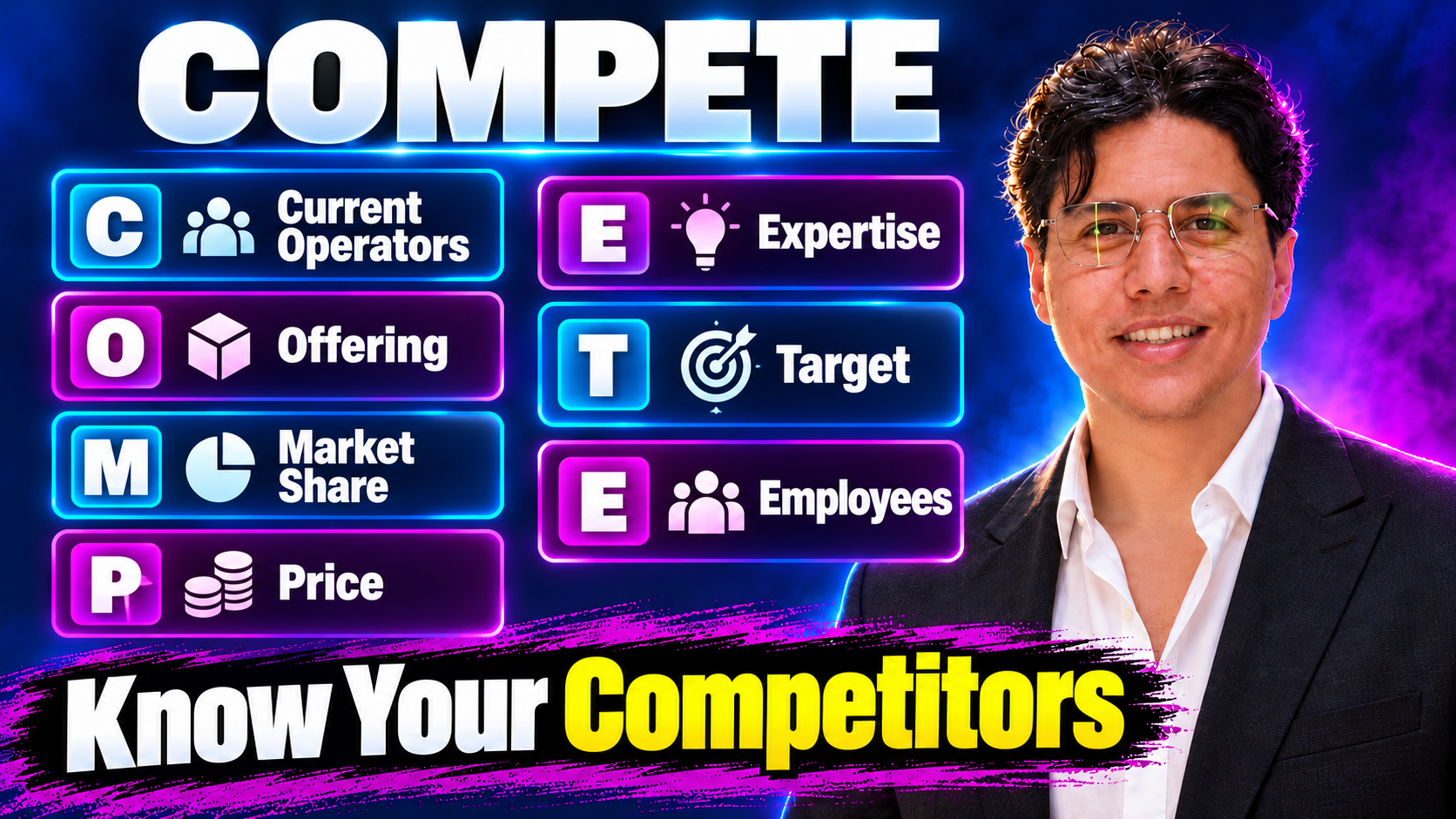
COMPETE gives that investigation a clear structure. In the digital marketing strategy course, the framework is attributed to lecturer Jenna Tiffany and used to examine selected competitors through seven headings: Current Operators, Offering, Market Share, Price, Expertise, Target, and Employees. Treat it as the course's practical competitor-research framework. The source does not establish a universally validated scoring model or a formula that predicts which business will win.
This guide follows the course's physical PDF pages 31–34, then develops an original research workflow and two wholly fictional applications. The aim is to turn a competitor profile into a decision about your own marketing: what to stop, increase, reduce, or test. Throughout, a useful distinction is maintained between a verified observation, an interpretation of it, and an assumption that still needs investigation.
Start with a decision and a defined comparison
The course suggests studying three to five main competitors, or investigating one competitor in greater depth. Choose the scope around a decision your organization actually faces. A team revising an ecommerce bundle needs a different comparison from a service business evaluating booking information. Write down the offer, intended buyer, geography, channel, and review period before collecting screenshots. These boundaries determine which organizations and facts belong in the analysis.
Select competitors because customers could reasonably compare their offers with yours. The loudest brand online may serve a different buyer, sell at a different scale, or solve a different problem. Ask your sales or service team which names arise in genuine comparisons, using only information you are authorized to review. Customer research can help test that shortlist. Avoid treating one employee's memory or one lost inquiry as a complete picture of demand.
Include your own organization in the comparison using the same questions and evidence standard. Otherwise, it is easy to compare a competitor's weaknesses with your own ambitions. If you describe your service as responsive, find evidence for the response you actually deliver. If you admire a competitor's product range, check whether the relevant products are available and appropriate for the target segment. The analysis should expose gaps in your knowledge as readily as gaps in your offer.
Keep the research window visible. A price recorded last month, an annual report covering last year, and a hiring notice published yesterday describe different moments. They may all be useful, but their dates should travel with the observations. A simple record containing the claim, source, date, geographic scope, and confidence is more useful than a polished comparison whose evidence cannot be reconstructed.
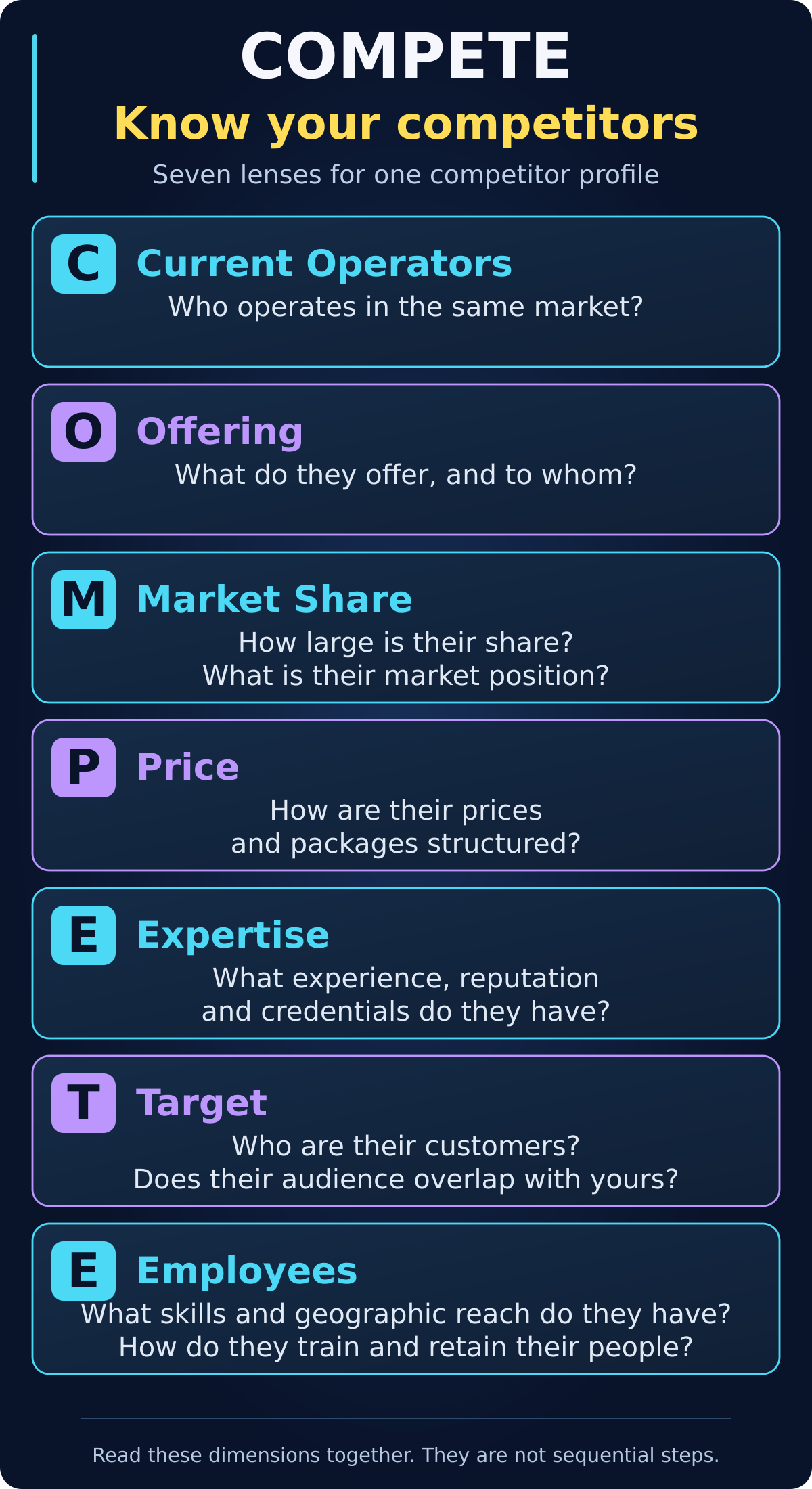
Seven research headings for a competitor profile. They are not sequential stages or a ranking of importance.
C: Current Operators
Current Operators asks who is already active in the market you have defined. Identify the organization behind each offer, the locations it serves, its relevant channels, and the part of the customer need it addresses. Several brands may belong to one company, while one organization may operate several distinct services. Record those relationships when they affect the comparison, rather than counting every brand name as an independent business.
Then examine what enables the operator to compete. A product image is visible; dependable sourcing, distribution, service capacity, and customer relationships may be less visible. The course's fictional Lupini illustration makes this distinction by separating an easily imitated clothing line from a harder-to-replicate supply chain and brand presence. The practical lesson is to investigate the capabilities behind an offer before assuming that copying its appearance produces an equivalent proposition.
Your resulting decision might concern which competitor deserves deeper study, which geographic area needs additional research, or which comparison is misleading. An operator can matter greatly within one segment and little within another. Avoid filling the section with a directory of names. Explain why each selected organization is relevant to the buyer and decision under review, and mark uncertain relationships for verification.
O: Offering
Offering examines what competitors provide, whom it is for, and how it compares with your own proposition. Describe the complete package: core product or service, variations, included support, delivery arrangements, exclusions, and any conditions that change what the buyer receives. Separate a feature shown on a website from evidence that the organization consistently delivers the promised benefit. Marketing copy is evidence of positioning; it does not independently prove performance.
A useful comparison begins with the customer's task. For an online retailer, a product may be purchased together with instructions, replacement parts, and delivery assurance. For a service provider, understandable preparation information and a clear inquiry route may be part of the experience. Compare the elements that matter to the chosen task. A long list of features offers little guidance if customers do not value them or if your organization cannot support them economically.
Convert apparent differences into questions before announcing an advantage. If your offer includes more personal support, ask whether the target buyer wants that support, understands it, and finds it worth the additional price or effort. If a competitor offers a broader range, investigate whether breadth helps the specific segment you serve. The next action could be clearer packaging, a smaller offer, better evidence, or a customer interview rather than immediate product expansion.
M: Market Share
Market Share requires especially careful definitions. A revenue-based share divides a competitor's revenue within the defined market by total revenue in that same market and period. A unit-based share uses units in both places. State the product category, geography, customer group, channel where relevant, time period, and measurement basis. If numerator and denominator describe different markets, the percentage can look precise while answering no useful question.
Consider a completely invented example: a retailer generates £120,000 in net sales of refillable stationery kits to consumers in a defined region during one quarter. Suppose a credible hypothetical market dataset reports £1.2 million in net sales for that identical category, region, customer group, and quarter, with the same treatment of returns and tax. Dividing £120,000 by £1.2 million gives 10% revenue share. The figure is an illustration of the calculation, not an estimate of a real business or market.
Now change the denominator to all stationery sold nationally over a year. The calculation would no longer describe the intended quarterly regional market. Similarly, total company revenue cannot automatically stand in for category revenue when a company sells many product types. Financial accounts may help establish scale, but their reporting boundaries need checking. Two competitors' sales figures alone also leave the rest of the market unmeasured.
Buyer reach is another measure. A survey finding that 10% of respondents bought from a brand says something about the defined survey population and period; it does not by itself establish a 10% share of spending. People may buy from several brands and spend different amounts at each. Record the sample, question, fieldwork date, and coverage when available. Distinguish reported buyer incidence from revenue share, unit share, and awareness.
When a defensible denominator is unavailable, write “market share unknown.” You can still use limited indicators such as estimated website visits, search visibility, store counts, or public review volumes, provided you name them accurately. Visits may include non-buyers and users outside the market; reviews may reflect different collection practices; store counts say little about sales per store. Compare like-for-like indicators and preserve their limitations. Never relabel a visibility proxy as established market leadership.
P: Price
Price covers the structure and terms of the offer as well as its headline amount. Record the version compared, what is included, taxes where shown, delivery costs, quantity requirements, contract length, promotional conditions, and recurring commitments. A low entry price for a restricted package may not be comparable with a fuller service. Where information is missing, identify the missing component rather than quietly assuming that it is free.
Use a consistent comparison scenario. In ecommerce, that could be one defined basket delivered to the same eligible area. In a service example, it could be the same administrative package and support period. Distinguish a public list price from a temporary promotion or individually negotiated quotation. Do not generalize from one observed offer to every customer the competitor serves, and do not imply you know its margins from the selling price alone.
The question for your organization is whether its pricing fits the value and economics of the chosen offer. Lowering a price may attract demand your team cannot fulfil profitably. Keeping a higher price may be reasonable only when the benefit is relevant and supported. Calculate your own delivery costs, returns, support effort, and discounts using authorized internal information. Competitor prices are one input to that decision, rather than a complete pricing strategy.
E: Expertise
Expertise asks about experience, recognition, qualifications, and other evidence that may influence confidence in a provider. The course includes time in the market, awards, and accreditations among its prompts. Check what each signal actually demonstrates. A founding date establishes duration; an award relates to the award's stated criteria; an accreditation has a particular scope and validity period. These details should remain attached to the claim.
Recognizability and competence should also be examined separately. A brand awareness figure, if properly sourced, concerns recognition among the surveyed audience. It does not independently demonstrate product quality, customer outcomes, or staff expertise. Likewise, a specialist team may have substantial experience without broad consumer awareness. Use the section to understand which forms of reassurance are relevant to the buyer, then examine the evidence for each.
A marketing response could be to explain existing, verifiable capabilities more clearly or to commission better documentation of an approved process. It should not involve inventing awards, implying endorsement beyond its scope, or claiming superiority that the evidence cannot support. In healthcare-related communications, keep professional and clinical claims within appropriate review. This framework offers no basis for ranking clinical competence from a website, an award badge, or years in operation.
T: Target
Target examines whom the competitor appears to serve and whether that audience overlaps with yours. Look for explicit audience statements, product design, service areas, buying occasions, language, and channel choices. Distinguish the audience a business says it targets from the customers it actually reaches. Public materials usually reveal the intended positioning more readily than the full composition of the customer base.
Build a working customer description around the buying situation: the problem, desired result, constraints, decision participants, and information needed to choose. Age or occupation alone rarely explains all of these. A purchaser, user, and approver may be different people. For a business-funded service, the buyer's administrative needs and the user's experience both matter, but they should not be collapsed into one imaginary person with contradictory requirements.
Label inferred segments as hypotheses. A formal website does not prove that all buyers are large organizations, and an informal social feed does not prove that everyone purchasing is young. Validate consequential assumptions through authorized customer research and relevant aggregate data. Then decide whether to compete for the same audience, serve an overlooked need within it, or concentrate elsewhere. A segment is attractive only if your organization can serve it credibly and sustainably.
E: Employees
Employees examines the people and workforce capabilities behind the offer. The course asks about geographic reach, skills, retention, and training. Public team pages, company reports, and genuine recruitment announcements may reveal useful information, but each has limits. A vacancy shows a stated hiring intention. It does not prove that someone was hired, that headcount increased, or that a new service is ready.
Prefer organization-level evidence relevant to the business decision. You might investigate whether an operator publicly describes a dedicated support function or a training program. Avoid collecting unnecessary personal information or speculating about individual employees' health, family circumstances, or other private matters. Employee reviews and social profiles can be incomplete, self-selected, or outdated; they should not become unsupported claims about turnover, morale, or skill across an entire workforce.
Bring the analysis back to your own promises. If a proposed position depends on knowledgeable support, who will provide it, at what times, and with what preparation? Marketing cannot create service capacity by describing it. A useful outcome may be an internal training plan, a narrower service commitment, or a revised launch sequence. Treat people as essential contributors to delivery, rather than a score used to declare one organization inherently better than another.
Learn from Lupini without turning a classroom example into market data
The course uses Lupini, an explicitly fictional clothing brand, across pages 32–33. It combines the seven headings into a narrative about product breadth, price, awareness, audience, operations, and recruitment. Read it as a demonstration of the kinds of questions a competitor profile can connect. Its contrast between boutique detail and a broad mid-priced range is a positioning hypothesis that would require customer evidence in an actual business.
The illustration contains historical references and figures associated with 2022 and 2023. They must not be reused as current market facts, and the fictional brand must not be treated as a real competitor with verified performance. In particular, a proportion of shoppers buying from a brand and a comparison between two businesses' revenue are different measures. Neither supplies a complete market-share calculation without the appropriate definitions and denominator.
The same caution applies to the illustration's operating explanations. A manufacturing location alone cannot establish labor cost, shipping reliability, product quality, or working conditions for a particular company. Those questions need specific evidence if they affect a real decision. Preserve the example's research logic while testing its assumptions independently. Copying a completed classroom profile is less useful than learning how to challenge the information within one.
Build an ethical, traceable evidence record
Page 31 identifies competitor websites, financial reports, research papers, press releases, sector reports, and AI tools as possible research resources. Use the underlying material according to the question it can actually answer. An official product page can establish an advertised package on the review date. A press release can establish what the organization announced. Independent confirmation may still be needed before treating either as evidence of operational results.
Research public information and material your organization is authorized to use. Do not seek private customer records, access competitors' accounts, impersonate a customer or employee, or pressure someone to reveal confidential information. Avoid creating fake inquiries or bookings that consume another organization's capacity. If a legitimate research method involves contacting someone or using nonpublic information, obtain the appropriate authorization and explain the purpose honestly.
For every important finding, write a short evidence chain: what was observed, where it came from, what you infer, and what remains unknown. Add the source date and the consequence for your decision. For example, an advertised next-day dispatch policy may suggest a convenience position, while actual dispatch performance remains unverified. You can compare the published promise without claiming to know fulfillment outcomes.
Do not average the seven headings into a seemingly objective winner unless you have a defensible reason for the measures and weights. Different decisions give different factors importance, and a missing critical capability can disappear inside an average. A concise narrative explaining the main differences, evidence gaps, and implications is often more useful. Keep contradictory evidence visible and identify which uncertainty is worth resolving before money is committed.
Fictional application one: clearer administration for an outpatient service
Imagine a wholly fictional outpatient service reviewing its appointment-information and booking administration. The decision is whether to test a clearer inquiry journey for adults who want practical information about the service. This is an administrative marketing example, with no recommendation about tests, treatment, diagnosis, or clinical pathways. No real provider, patient information, market position, regulation, or clinical outcome is described.
Assume the team selects three fictional providers operating within the same imagined service area. Under Current Operators, it checks that their public booking routes concern a comparable service scope. Under Offering, it compares published contact options, explanations of booking steps, and administrative support. Suppose two reviewed pages explain the next step clearly while the fictional team's own page leaves visitors unsure whom to contact. That is an invented observation for this scenario, not a finding about actual providers.
Under Market Share, the team records that reliable share data is unavailable. Search position and review counts cannot establish local patient volumes, and no attempt is made to obtain private records. Under Price, any comparison would require matching service scope and visible payment conditions; missing information remains missing. The team does not infer a clinical or commercial advantage simply because one provider publishes a number and another requires an inquiry.
Expertise research is restricted to verifiable public statements relevant to the offer, with appropriate review before any claim is repeated. Target distinguishes the person seeking administrative information from any separate payer or referring professional. Employees asks whether the fictional service has enough trained administrative staff to handle the proposed inquiry route. None of these observations permits judgments about clinical quality or assumptions about individual patients.
The four-way decision is practical. Stop using an ambiguous “contact us” message without explaining what happens next. Increase the clarity of verified administrative information. Reduce duplicate form questions that are unnecessary for the inquiry, subject to appropriate privacy and operating review. Test a revised page for a defined group of eligible visitors while keeping urgent or clinical questions directed through the service's established appropriate channels.
For measurement, first establish the current rate of administrative inquiries requiring clarification, using approved aggregate records. Then track the same definition during the test, together with inquiry completion, response workload, and errors in information given. A possible success criterion would be fewer clarification exchanges without higher error rates or an unsustainable support burden. The team would choose its actual threshold before the test based on baseline volume and operational judgment. No invented improvement is presented as a result.
Fictional application two: an ecommerce stationery bundle
Consider a wholly fictional online retailer selling refillable stationery kits to consumers in one defined region. It is reviewing a starter bundle over the next quarter. Assume its team can access its own aggregate order, return, cost, and support information. It has no access to competitors' internal sales or customer records. The decision is whether to make the bundle easier to understand while preserving a viable contribution after variable costs.
For Current Operators, the team selects three fictional sellers whose kits customers could plausibly compare. Offering research records the contents, refill compatibility, instructions, and delivery promise shown publicly. Suppose one competitor lists each included item clearly and another emphasizes gift packaging. The retailer's own page shows an attractive photograph but leaves the first refill purchase unclear. These are invented details used to demonstrate how a finding can lead to an actionable question.
Market Share remains unknown unless a reliable matched-market denominator can be obtained. The earlier £120,000 calculation is separate teaching arithmetic and does not supply this retailer's real or fictional research evidence. Price research uses an equivalent basket delivered to the same eligible area, separating temporary promotions from standard terms. Expertise reviews supportable product knowledge and documentation. Target distinguishes first-time buyers from experienced users purchasing refills, rather than assuming they need identical information.
Employees research checks only public organizational signals about competitors, while the retailer verifies its own ability to answer compatibility questions and dispatch the promised bundle. A competitor's job advertisement may identify a topic to watch, but it does not establish fulfillment speed. The retailer might discover that its own small support team repeatedly explains the same missing detail. In this assumed scenario, improving product information is a plausible test before adding more promotional traffic.
The decision could be to stop an unsupported “best value” claim, increase clear explanations of contents and refill compatibility, reduce blanket discounting while the team investigates whether clarity is the main obstacle, and test a revised bundle page. Reducing discounts is a proposed business choice requiring its own commercial review; it is not a prediction that removing promotions will improve results. The team should avoid changing many unrelated elements simultaneously if it wants to learn what contributed to the outcome.
Measure completed purchases among eligible visitors, alongside contribution after the defined variable costs, returns, and compatibility-related support requests per order. Record traffic source and any concurrent promotion that could affect interpretation. If purchase conversion rises while returns and support costs also rise, the result requires closer examination. A useful conclusion might be to retain the information change, revise the bundle contents, restore a promotion, or run a better-controlled test. The framework does not predetermine the answer.
Turn the profile into a manageable action and measurement plan
The exercise on page 34 asks what you discovered, whether the organization can compete successfully, and which marketing activities should change. Structure your conclusion around stop, increase, reduce, and test. Each recommendation should name the evidence behind it and the problem it addresses. There is no requirement to invent an action for every category if the evidence does not justify one.
For each chosen action, assign an owner, a delivery date, the resources required, and a review condition. Separate the person collecting competitor evidence from the person approving a customer-facing promise where those responsibilities differ. Resolve operating dependencies before launch. A support-led proposition, for example, needs agreed staffing and service boundaries as well as copy, design, and a campaign budget.
Choose one primary outcome and a small set of safeguards. The primary outcome should connect to the business decision, such as qualified inquiry completion or contribution per eligible order. Safeguards help detect damage elsewhere, such as more inaccurate information, returns, complaints, or staff workload. Define the numerator, denominator, observation period, and exclusions before reviewing results. A higher count of inquiries can mean something different if the number or quality of visitors also changes.
Establish a baseline and choose a comparison method appropriate to the available volume and practical constraints. A randomized test may help when feasible; a before-and-after comparison needs particular care with seasonality, changing traffic, and concurrent campaigns. In either case, document limitations rather than claim causation from an attractive percentage. At review, decide whether to continue, adjust, investigate further, or stop. Keep monitoring only as long as it serves the defined decision.
Connect COMPETE with the rest of the strategy course
COMPETE works at the level of selected competitors. The course places this inquiry alongside wider analysis, so use the related frameworks to answer different questions. Porter's Five Forces examines industry competition, including buyers, suppliers, entrants, and substitutes. It can help explain pressures that a seven-heading profile of one organization would leave outside the comparison.
PESTLE organizes investigation of wider external conditions. A relevant external change may affect both your organization and its competitors, but the effect still needs evidence. SWOTELL helps connect findings to your own strengths, weaknesses, opportunities, threats, existing activity, limitations, and leverage. The course explicitly encourages connecting COMPETE findings with these broader considerations.
Keep the relationships specific. A public competitor feature may suggest a question about an underserved need. Customer evidence could then support an opportunity, while your staffing capacity determines whether you can act on it. Moving through those steps is more useful than copying the same sentence into several frameworks. The final plan should explain which choice changed because of the research and what would cause the team to reconsider it.
Use AI to improve the questions, then verify the answers
Page 34 permits AI-assisted research while requiring verification and the learner's own judgment. A practical use is to ask an AI tool to organize source excerpts under the seven headings, identify missing definitions, or propose questions for further investigation. Provide the decision boundaries and ask it to distinguish supplied facts from inferences. Do not ask it to manufacture market share simply to complete an empty cell.
Verify every material claim against the underlying source, including dates, entity identity, product scope, and numerical definitions. Check whether a cited page actually supports the sentence, whether a reported figure refers to the intended market, and whether a hypothetical example has been mistaken for evidence. Use only information suitable for the tool and purpose; private records and confidential business material should not be included casually.
The strongest COMPETE analysis finishes with a modest, testable choice grounded in what the organization knows. It may justify improving information, changing an offer, developing a capability, or delaying expansion while a crucial uncertainty is resolved. Keep the seven headings, preserve the evidence trail, and connect the findings to your own delivery conditions. The value is a better decision and a clearer next step, rather than a fully populated competitor worksheet.
Course source and scope
Primary teaching source: “شرح_استراتيجية_التسويق_الرقمي.pdf,” physical PDF pages 31–34. Page 31 supplies the seven COMPETE labels, suggested competitor scope, research resources, and links with SWOTELL and PESTLE. Pages 32–33 contain the fictional Lupini illustration and historical teaching figures. Page 34 supplies the application exercise, stop/increase/reduce/test questions, and requirement to verify AI-assisted work. The course attributes the framework to lecturer Jenna Tiffany.
The evidence workflow, denominator checks, ethical research guidance, measurement plan, and both fictional applications are original explanatory development. They are not reported research results or claims that the course establishes a validated predictive model.
Comments
No published comments yet.