Reviewed November 1, 2026. Canva’s newsroom index dates the campaign announcement October 30.
The announcement and the timing boundary
Canva’s new North American campaign, “What Will You Canva Today?”, was created by Goodby Silverstein & Partners. Its announcement describes three television spots and schedules the first for NBC Sunday Night Football on November 1. At preparation on November 1, 07:30 UTC, that broadcast is still prospective; this article does not confirm it aired. Primary announcement.
The analysis below is an original reading of the campaign’s strategic problem, not a report of its results or a reconstruction of the agency’s private brief. It examines how a broad product can invite a concrete action without becoming a list of features. That question matters to many marketing teams, but the answer is not to copy another brand’s slogan. The useful work is to identify the relationship among the customer’s situation, the action a product enables and the feeling the finished work creates.
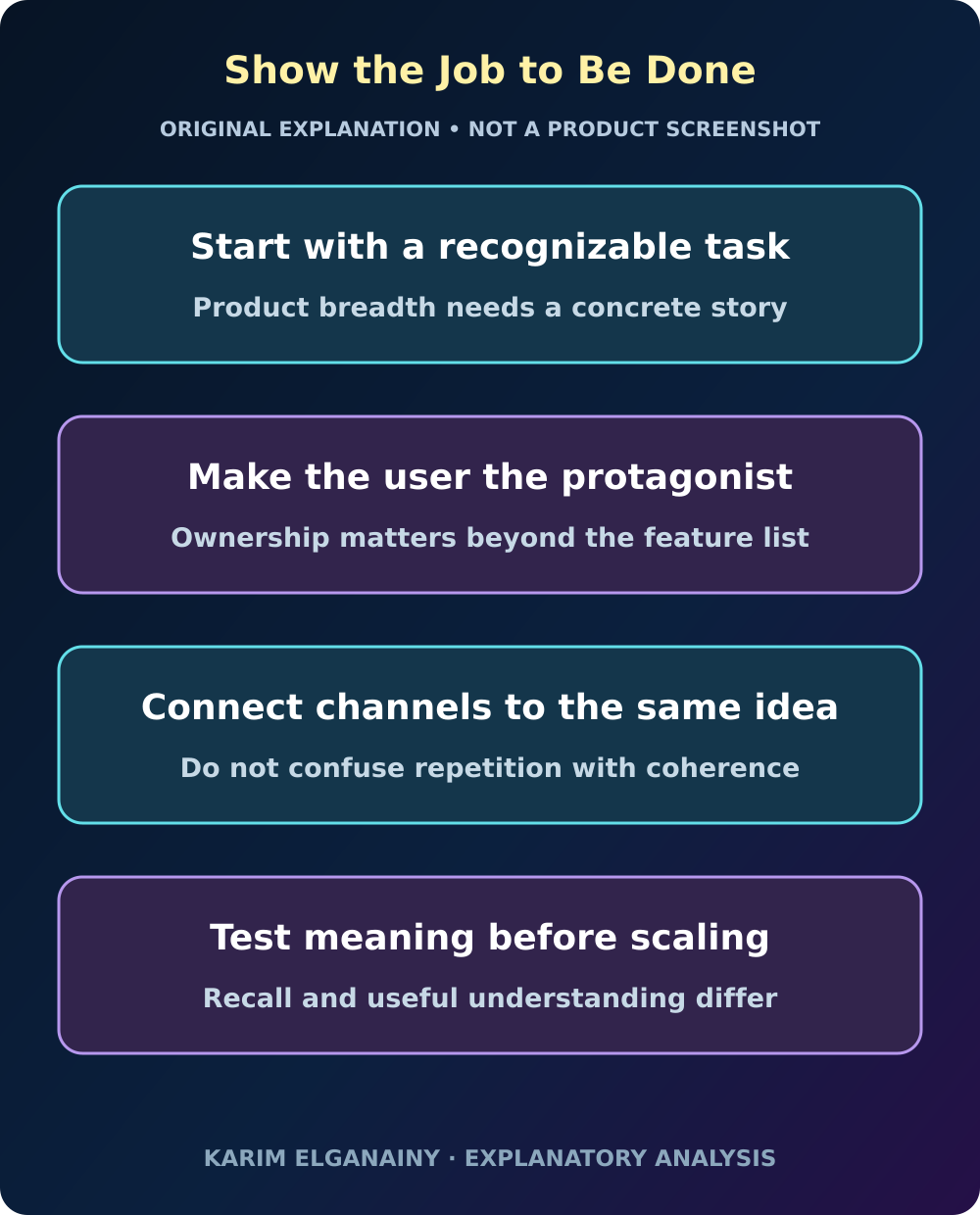
Original editorial framework; not a product screenshot or proof of campaign results.
A brand used as a verb is a creative proposition
Putting a brand name into an action phrase can make a message compact and memorable. It can also ask too much of someone who does not know what the product does. The strategic test is whether the surrounding scene supplies the missing meaning. A familiar name may need little explanation; an unfamiliar one may need a visible task and result. Treat the verbal construction as an invitation the advertisement must earn, not as proof that the public already speaks that way.
For a smaller business, the lesson is not to turn its name into a verb immediately. First ask whether a viewer can explain the action without repeating the slogan. A test participant might remember the line but still be unable to describe the service. That is a useful distinction between verbal recall and practical comprehension. Evaluate both. A line that people enjoy saying can support a campaign, but it cannot substitute for a reason to consider the product in a relevant situation.
Breadth needs a route through it
A platform with many uses faces a selection problem: every capability included in an advertisement displaces time that could make one use understandable. An original planning exercise is to arrange possible stories by customer situation rather than by product menu. Examples might include preparing for a meeting, announcing a local event or making a gift. These hypothetical examples are not additional scenes attributed to Canva. They illustrate how a task can organize a broad offer without reciting every available function.
Choose one clear starting point for each execution and let the wider portfolio emerge across the campaign. The individual advertisement needs coherence; the collection needs range. Those are different jobs. If every asset tries to communicate everything, the audience may learn only that the product is vaguely versatile. Conversely, if every asset repeats one narrow task, the wider positioning may never become visible. A campaign map should show what each execution contributes and where repetition is intentional rather than accidental.
Give the human choice a visible role
A product demonstration can show an operation succeeding while leaving the person using it emotionally absent. A story about choice works differently: the audience understands why the person changes direction, rejects an option or cares about the result. This is our interpretation of a useful creative distinction, not a claim about measured audience response to these advertisements. The marketer’s question is whether the product assists a meaningful decision or merely occupies the screen while something entertaining happens.
When reviewing a storyboard, identify the moment at which the character’s preference becomes visible. If the same story could run unchanged with any tool removed, the product may be incidental. If the story becomes an uninterrupted tutorial, the person may disappear. Look for a productive middle: the task explains the feature, and the person explains why completion matters. That balance can make a familiar operation interesting without adding a benefit the product team cannot substantiate.
Humor should clarify the task, not conceal it
Humor can earn attention but can also consume the time needed to understand an offer. Review the joke and the product explanation separately before judging their combination. Ask what viewers remember immediately, then what they believe the product helped the character do. A memorable punchline with no usable product association may serve entertainment better than the intended marketing task. That does not make humor a mistake; it makes the connection something to evaluate rather than assume.
For a hypothetical local campaign, a joke about endless revisions might be relatable to a design team but confusing to an audience that rarely creates marketing assets. Another joke may rely on a social custom that does not travel well. Choose the audience before selecting the reference. Test whether the humor depends on familiarity with a specific cultural setting, and whether removing that familiarity leaves a clear action. Do not use a broad demographic label as a shortcut for shared experience.
Distinguish emotional ownership from technical ownership
A person can feel proud of a finished creation without that feeling answering every practical question about rights, permissions or originality. A campaign may legitimately explore emotional satisfaction, but its landing experience should not blur that feeling into an unsupported assurance about all possible uses. This is an editorial distinction rather than legal advice. Where rights or permissions matter to a particular use, the organization needs the relevant qualified assessment and accurate product information.
A useful review separates three statements: the person made choices, the result feels personal and the result is cleared for a specified use. The first two do not automatically establish the third. Avoid placing an emotionally expansive headline beside an overly broad promise that the product cannot support. Creative ambition and precise information can coexist. The task is to keep the invitation warm while ensuring that subsequent explanations answer the actual questions people encounter when they begin working.
Plan a recognizable family across channels
A campaign can share an idea without forcing every channel to carry the same miniature television script. A short social asset may need a recognizable action immediately. An outdoor execution may need one legible relationship between image and words. Audio requires the listener to understand the task without seeing an interface. These are general planning considerations, not a description of verified media performance or specific placements beyond the source announcement.
Build a family resemblance from a limited set of elements: the central question, a consistent tone, a recognizable visual relationship or a recurring kind of decision. Then decide what each format can omit. Repeating every element everywhere can create clutter rather than consistency. Review the collection both together and as isolated encounters. Most people will not see the complete presentation used to approve the campaign, so each piece should make sense without relying on a sequence the audience may never experience.
Make the destination honor the invitation
A broad invitation can generate a very specific intent. Someone inspired to make a presentation may not want to explore the entire product catalog before beginning. A useful destination strategy connects the creative task to a relevant starting point while leaving space for discovery. This is a proposed design principle, not a claim about Canva’s actual conversion journey. The marketer should inspect what happens after the message, not assume that a strong campaign line makes navigation self-explanatory.
Map the likely first question for each execution. Does the visitor need a template, an example, a product explanation or a clear account requirement? Provide the information appropriate to that question without promising access that has not been checked. A campaign that celebrates ease can create frustration if the first step is unclear. The solution may be a simpler route rather than more persuasive copy. Measure whether people reach a meaningful starting point, not merely whether they arrive on a page.
Localize the situation before translating the line
The announced geography should not be mistaken for evidence of a Saudi rollout or local audience response. For teams considering an analogous Arabic campaign, start with the social situation and the action, not a literal translation of the English phrase. A grammatical construction that feels playful in one language may sound forced in another. Test whether the line invites an understandable action, and whether the visual example gives it enough context without needing explanatory commentary.
A local adaptation can preserve the strategic idea while changing the scene, rhythm and wording. Use reviewers who understand the intended audience, including how the message sounds aloud. Ask them to explain what they would do next after seeing it. Do not confuse a natural-sounding phrase with a clear proposition, or an unfamiliar phrase with automatic creative distinction. The goal is an invitation that belongs in the audience’s language and situation, not a translation that merely proves loyalty to the original copy.
Separate announcement, delivery and effect
A planned media moment is one kind of evidence. Confirmation that an advertisement appeared is another. A change in audience understanding or behavior is a third. Keep these stages separate in reporting. The scheduled broadcast discussed at the start is not evidence of completed delivery, and completed delivery would not by itself establish success. A careful campaign review distinguishes what the company announced from what an observer verified and what a measurement study could support.
For your own campaign, define the intended effect before the launch moment. If the objective concerns recognition of a broader product range, the evaluation should examine that understanding rather than rely only on immediate clicks. If the objective concerns a specific task, observe progress toward that task. Different goals need different evidence. Avoid selecting whichever available metric looks strongest after launch and treating it as the original purpose. Document uncertainty when overlapping promotions or limited observation make a clear conclusion impossible.
Take the strategic question, not the surface treatment
The most useful takeaway is a briefing question: what real action makes our broad promise understandable? Answer it with a situation, a person’s choice, a credible product contribution and an appropriate next step. Then decide what the audience should remember. The slogan, scene and media format should serve that answer rather than become separate creative competitions. A smaller organization can apply this discipline without reproducing a large campaign’s production scale or assuming that scale is the source of its strategic value.
An effective review can end by rejecting an attractive idea that does not explain the product, or by simplifying an informative execution that leaves no room for a person. Neither decision requires predicting the results of Canva’s campaign. The public announcement offers material for thought; the local business decision still needs its own evidence. As the planned launch proceeds, distinguish observed delivery from hoped-for effects. That keeps the analysis useful before results exist and prevents a confident launch narrative from becoming an unsupported success story.
Comments
No published comments yet.