
A new announcement, not a proven outcome
On November 16, 2026, Circana announced Best Buy's participation in Gateway, combining retailer data with analytics for suppliers. That announcement does not establish incremental sales.
The useful marketing question is what a team should do differently when it can see more of the retail journey. The framework below is our own proposal, not a description of promised software capabilities. It treats information as an input to a commercial decision, rather than treating a dashboard launch as an outcome. A supplier can become better informed and still make an expensive mistake if the business question, responsibility and test design remain vague.
For example, a weekly commercial review can produce a long list of interesting movements without producing a single executable decision. The remedy is not necessarily another analyst or a more elaborate visualization. It is an explicit boundary between observation and intervention. An observation describes a pattern in the available records. An intervention changes a message, an assortment choice or an operational step. The commercial team should be able to explain why that particular intervention addresses the observed problem, and what evidence would show that the explanation was wrong. Keeping those links explicit makes collaboration more productive without assuming that every opportunity requires a campaign.
Define the decision before requesting another report
Start with a narrow question that a person can actually answer through action. For a hypothetical accessories supplier, the question might be whether a clearer compatibility message improves completed purchases for an available product. That is more useful than a general request to understand customers better. Specify the product family, eligible audience, channel, comparison period and proposed change before opening an analysis meeting.
Write down what would make the team reject its preferred explanation. If the apparent weakness is caused by unavailable inventory rather than unclear messaging, advertising is not the first intervention. This discipline prevents a familiar problem: teams collecting more evidence only to justify the campaign they already wanted to run.
A decision brief should also say what will remain unchanged during the proposed test. Otherwise, a team may revise the message, the audience, the price and the placement together, then struggle to learn which change mattered. Consider the smallest useful action rather than the most impressive launch. If the issue concerns one confusing compatibility statement, a focused wording correction may be more informative than a broad promotional package. This is not an argument against ambition. It is a way to earn the evidence needed for a larger commitment while limiting the operational cost of being mistaken about the original problem.
Agree on definitions before comparing performance
Retailer and supplier teams may use similar labels for different measures. A sale could refer to an order, a shipped unit or a transaction remaining after returns. A customer might mean an account, a household or a device identifier. These distinctions change the meaning of a comparison. Create a shared definition sheet and attach it to the decision record, rather than assuming that matching chart labels imply matching data.
Also document missing coverage, refresh delays and access limits. Do not merge customer-level records merely because it is technically possible. Use only the access and purposes that have actually been authorized, and ask the responsible privacy team about any proposed expansion. More detailed information is not automatically more appropriate information.
Definitions need an owner as well as a document. If a source changes its treatment of cancellations or a product identifier is replaced, someone should update the shared record and explain whether past comparisons still hold. Version the definitions used for each review instead of silently rewriting history. When teams disagree about a number, resolve the measurement question before negotiating the action. Otherwise, a discussion about whether to change a campaign can conceal a more basic disagreement about what actually happened. A short reconciliation note often saves more time than another round of presentations using incompatible measures.
Check commercial feasibility before changing media
In the hypothetical compatibility example, confirm that the relevant products are available, that the product page is accurate and that service teams can resolve common questions. Separate problems that marketing can change from problems owned by merchandising or operations. Promoting a product with inconsistent availability can increase demand in the wrong place while giving a misleading impression of weak creative.
A useful working document pairs each observation with a possible explanation and the next verification step. Keep uncertainty visible. An unexplained sales pattern is a question to investigate, not permission to announce a customer insight as established fact.
Include a customer-facing check in this operational review. Ask a colleague unfamiliar with the product to interpret the proposed message using only the information a shopper would see. Record where the wording creates uncertainty, especially around compatibility, included accessories and the distinction between optional and required components. This exercise is a qualitative check, not proof of population-wide behavior. Its value is catching avoidable ambiguity before a larger test. If the message requires an explanation from an expert to make sense, the team should consider revising the presentation before spending money to send more people toward it.
Give the proposed action one accountable owner
A shared information environment still needs a named decision owner. Assign a person who can authorize the pilot, coordinate dependencies and stop it when guardrails are breached. Other teams can supply evidence without making accountability collective and therefore invisible. Record the proposed action, its rationale, the responsible person and the review date in the same place.
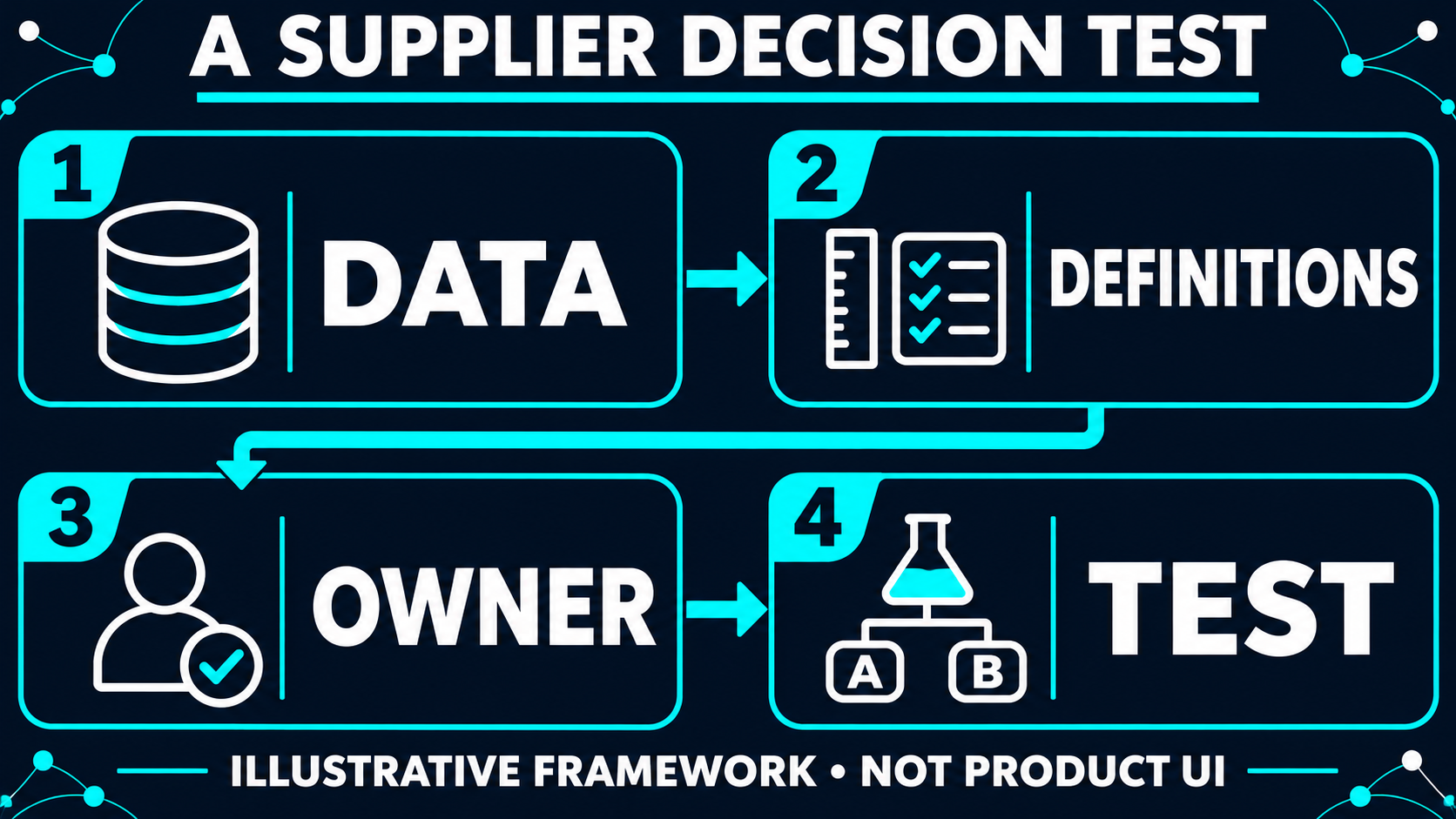
Original suggested workflow, not a screenshot of Gateway or a statement about its features.
The diagram represents a sequence of responsibilities. Data needs definitions; a defined opportunity needs an owner; and an owner's hypothesis needs a test. Skipping any stage makes a persuasive presentation easier than a reliable commercial decision.
The owner should not be expected to manufacture agreement when the evidence conflicts. Instead, the brief should name the unresolved dependency and the person who can resolve it. For example, marketing might be ready to test a message while the product team is still confirming compatibility language. The sensible action is to hold that test until the information is reliable, not to treat the unresolved issue as a minor footnote. Set a review rhythm that matches the decision's operational pace, and make escalation practical. A clear pause decision can protect the quality of learning as much as a quick launch.
Test one change without manufacturing certainty
Where feasible, compare similar eligible groups while changing only the compatibility message. Agree on the evaluation window and success criteria before observing the result. Keep a record of concurrent price changes, stock disruptions and other campaigns that could affect the comparison. If random assignment is unavailable, label the limitations of the alternative design rather than describing it as equivalent evidence.
The primary outcome should reflect the decision being tested. Completed purchases may be useful, but clicks alone cannot establish commercial value. Examine returns, support demand and contribution after relevant costs as guardrails. A message that generates additional orders but more costly misunderstandings may not be a useful improvement.
Before launch, ask the analyst what level of uncertainty the proposed comparison is likely to leave. A short observation period or a narrow product segment may not support a confident conclusion. Do not keep changing the success measure until a favorable pattern appears, and do not stop early simply because the first results look attractive. If the available volume is insufficient, describe the pilot as exploratory and use it to refine the next test. Useful learning can include discovering that the measurement setup itself needs improvement. That is different from claiming that the commercial hypothesis has been validated.
Make the review useful even when the result is negative
At the review, separate what was observed from what the team believes caused it. State which assumption survived, which failed and which remains unresolved. A negative or uncertain result can still prevent a larger ineffective rollout. Preserve the definition sheet, creative version and operational notes so that another team can understand the decision without reconstructing the entire discussion.
Do not turn a successful small pilot into a universal promise. Expansion should check whether product availability, customer needs and service capacity remain comparable. The next decision might be another limited test, not a permanent budget increase.
Include a decision log entry even when the team chooses not to proceed. State the reason in practical terms: insufficient evidence, an unresolved operational dependency, an unfavorable cost tradeoff or an action that would not address the identified problem. This prevents a rejected idea from returning later as if nobody had examined it. It also helps future collaborators understand which assumptions could justify reconsideration. A durable record is not intended to create administrative weight. Its purpose is to preserve the reasoning that would otherwise disappear when people change roles or the next planning cycle begins.
What a supplier should take away
The strategic opportunity is not simply access to another source of information. It is the chance to build a repeatable route from a focused question to an accountable action and a defensible review. The proposed framework applies to supplier collaboration generally; it does not establish local availability, contractual access or measured results for any specific business.
Before the next retail planning meeting, ask for a single decision brief rather than an additional dashboard. Include the question, agreed definitions, operational checks, owner, test and stopping conditions. That compact record gives marketing, merchandising and operations a common object to improve, and makes it easier to distinguish learning from enthusiasm.
A useful final check is whether the brief can be read without the author in the room. A new colleague should understand the problem, the proposed action, the uncertainty and the next decision. If the document depends on unwritten context, simplify the language and add the missing assumption. The same principle applies to an executive summary: report the decision and its evidence limits before showing the most attractive chart. This keeps attention on the commercial choice rather than the sophistication of the analytical environment, and gives stakeholders a concrete way to challenge or improve the recommendation.
Comments
No published comments yet.