Jamjoom Pharma’s latest results raise a useful question for healthcare marketers: when revenue grows, what evidence shows whether the next campaign should generate demand, improve distribution or help an existing buyer reorder? The answer requires more than a corporate growth headline.
The results, with their comparison periods
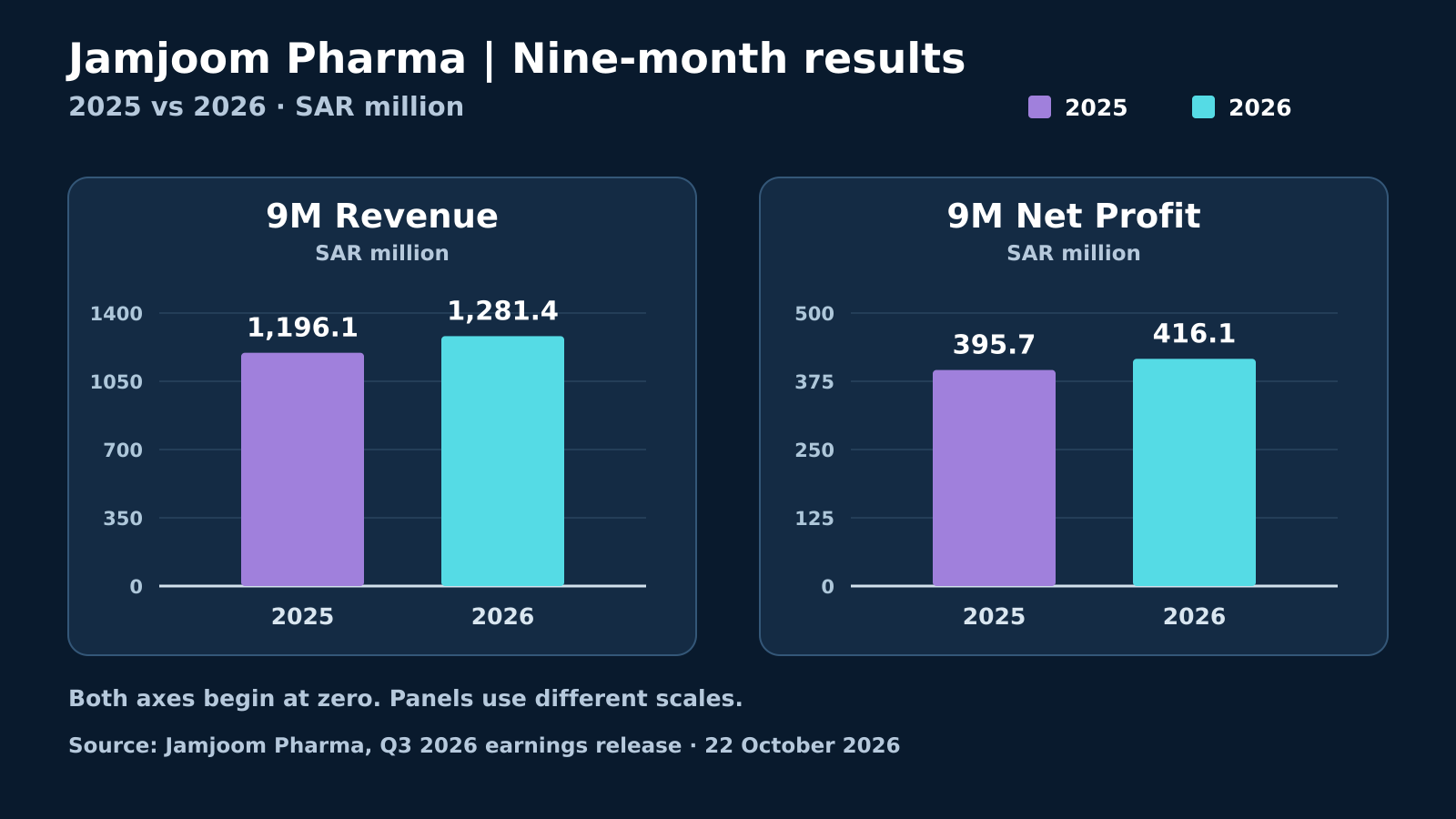
For January–September 2026, revenue was SAR 1,281.4 million versus SAR 1,196.1 million a year earlier, up 7.1%; net profit was SAR 416.1 million versus SAR 395.7 million, up 5.1%. For July–September alone, revenue was SAR 354.7 million versus SAR 342.3 million, up 3.6%; profit was SAR 110.2 million versus SAR 106.7 million, up 3.3%. See Argaam’s results report; figures here follow the company’s one-decimal presentation.
The 22 October company release reports nine-month Saudi revenue of SAR 836.2 million versus SAR 794.5 million, up 5.3%. Production reached 139.4 million units, up 8.7%, expressly based on unaudited management information. FY2026 revenue-growth guidance is 7–9%; the previous 10–12% figure was a FY2026–2027 CAGR, a different basis. The release discusses channel destocking. These are company-specific disclosures, not a measurement of the entire Saudi healthcare sector.
Diagnose the bottleneck before buying more reach
The following workflow is independent marketing analysis, not a description of Jamjoom’s internal practices. Its starting point is simple: orders into a distribution channel and purchases out of it answer different questions. Destocking means a channel is reducing inventory; by itself, that does not establish how end-customer demand changed.
A marketing team could request a weekly view of product availability, distributor orders, inventory and downstream sales where authorized data exist. Keep each dataset’s coverage visible. If pharmacy information covers only selected accounts, label it accordingly rather than presenting it as a national demand measure. Missing data should remain missing, not become zeros.
Then classify the obstacle. Low engagement with approved product information may justify testing clearer content. Strong engagement alongside unavailable stock calls for an availability investigation. Regular reorders interrupted by a commercial or fulfilment issue require that issue to be examined before adding advertising. These are diagnostic possibilities, not conclusions about this company.
Build a shared decision sheet
A practical test could focus on one permitted audience and one clearly defined business objective. Before launching, marketing, sales and operations would agree on:
- The question: for example, whether clearer ordering information reduces incomplete trade enquiries.
- The denominator: eligible enquiries received, not every website visitor.
- The operating conditions: stock availability, response capacity and the reporting window.
- The decision rule: what improvement would justify extending the test, and what failure would pause it.
Keep a comparison group or baseline when feasible. Record price changes, distribution changes and other activity that could affect the result. A before-and-after improvement alone does not isolate a campaign’s contribution. Where account volumes are small, report counts alongside percentages and avoid declaring a winner from a handful of interactions.
Give each audience the information it needs
A distributor may need an accurate ordering route and a clear escalation contact. A professional visitor may need access to appropriately reviewed scientific information. An investor may need definitions and comparable financial periods. Putting all three journeys behind one generic “contact us” button makes it harder to understand what a response actually means.
For an Arabic and English website, localize the task as well as the wording. Check that both versions describe the same availability, route enquiries to the correct owner and use consistent units. An Arabic visitor should not reach a different commercial promise simply because a page was translated later.
Review health-related content through the appropriate medical and compliance process before publication. Financial growth cannot support a claim of superior clinical performance. Initial business forms should request only the information needed to route an enquiry, with no invitation to submit patient records.
Make the next budget decision observable
At the end of the test, review qualified enquiries, response completion and progression to the agreed next step. Add operational exceptions to the same discussion. If interest increased but requests stalled because no owner responded, the first correction is the handoff, not a larger media budget.
Maintain a short evidence register linking each public number to its source, period and approval status. Distinguish actual results, management expectations and the team’s own hypotheses. In particular, avoid describing the two guidance ranges as a like-for-like annual cut when their time bases differ.
The practical opportunity is a more precise growth conversation: identify where customers or partners get stuck, test a bounded improvement, and expand only when the evidence supports it. This is independent healthcare marketing analysis, not investment advice. The cover is conceptual, not a photograph of Jamjoom facilities.
Comments
No published comments yet.