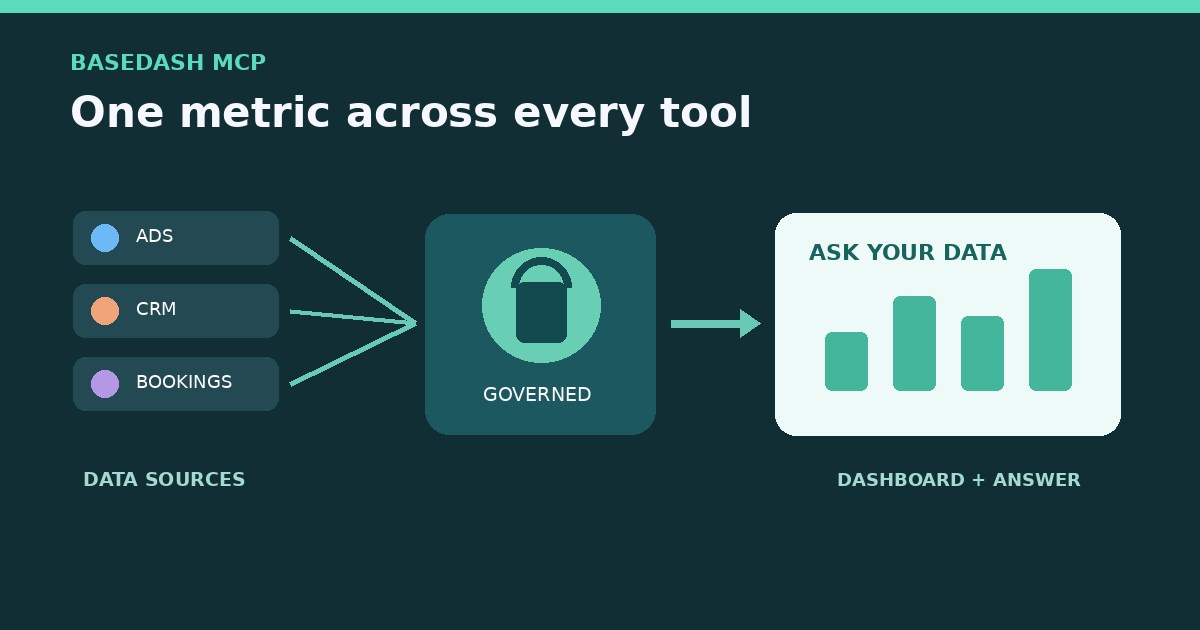
Basedash's newly promoted MCP server is an interesting product discovery because it puts governed business intelligence inside the AI clients a team already uses. The official product page says a user can connect Claude Code, Cursor, ChatGPT, Windsurf, or another compatible remote MCP client to a Basedash workspace through an OAuth flow. The available tools include asking analytical questions, discovering data sources, and creating, editing, listing, or retrieving dashboards and charts. This is not a general-purpose promise that any language model can understand a business's data without preparation. Its value depends on correct metric definitions, current sources, and permissions that match the organization's risk. Basedash's MCP product documentation; public server metadata repository.
What the tool actually does
MCP, the Model Context Protocol, lets an AI client call an external service through a standardized interface. In this case Basedash hosts a remote server at an official endpoint, and the user authorizes an AI client to act with workspace-scoped rights. The Basedash page lists tools such as ask_question and get_data_sources, plus create_dashboard, edit_dashboard, create_chart, edit_chart, list_dashboards, and get_dashboard. A marketer could ask for weekly qualified leads by channel, then request a chart based on the answer without exporting a CSV into a separate chat. The server's documentation says created charts and dashboards return durable Basedash links. Basedash MCP documentation.
The product also offers a semantic layer: reusable definitions of measures, dimensions, and segments. This is essential. If finance defines revenue net of refunds while marketing calls gross checkout value revenue, a fluent AI response may still be wrong. A governed model makes the definition explicit and available across questions. Basedash says the same models and permissions support its chat, dashboards, insights, and MCP interface. It also describes source information and SQL behind answers. These are product claims to verify with a real dataset, especially when a query combines systems with different update schedules. Basedash official platform overview.
Basedash says it can ingest more than 750 data sources and offers a managed DuckDB-based warehouse, while allowing existing warehouses such as BigQuery or Snowflake. That is a vendor description of connector coverage, not proof that a particular healthcare CRM or regional payment system has a supported, policy-compliant connection. Connector availability, historical backfill, currency conversion, and row-level access need hands-on validation. A small first pilot should connect only a few non-sensitive sources rather than giving an assistant broad access to every operational table. Basedash platform overview.
Why this matters for marketing operations
Marketing teams often move numbers between ad dashboards, web analytics, CRM, booking systems, and a spreadsheet before they can answer a basic question: which channel produced attended appointments? Each transfer creates delay and a chance to change the definition. A governed analytical assistant could reduce the time from question to a traceable answer. The useful shift is not that a dashboard can be created by conversation; it is that the same qualified-customer definition can drive the answer, chart, and weekly briefing.
Consider a clinic running Meta, Google, and referral activity. A naive view compares platform leads. A better view joins campaign cost, accepted inquiries, booked consultations, attendance, and completed revenue under a common patient or opportunity key, while protecting health data. An assistant could then reveal that one source generates more cheap forms but fewer visits, and create a recurring dashboard for that funnel. The model must expose missing data rather than quietly assuming all forms are equal. An analyst still needs to validate joins, duplicate handling, cancellation rules, and attribution.
For a content business, the same system might compare article topic, search visibility, qualified newsletter signups, and consulting conversations. A rise in page views can hide falling engagement from the target audience. An AI client that sees a trusted semantic model can ask follow-up questions more naturally, but the organization must decide which questions are permissible and who can see the underlying customers.
Governance is the product's central test
The MCP page says requests run with the same workspace access as the user and that OAuth scopes include dashboard reading and writing. It states that a client cannot access sources, dashboards, or charts its user cannot access in Basedash. This is the right design principle, but a buyer should verify it with a test account. Create a limited user with access to one reporting model, connect that identity to an AI client, and try to enumerate restricted data. Check that read tools respect row restrictions and that write tools cannot alter shared executive dashboards without the intended authorization. Basedash MCP documentation.
The company's security page and platform overview describe audit logs, role-based access, row-level controls, optional self-hosting, and approval for AI-initiated write queries. These capabilities may depend on plan or deployment configuration. Request exact contractual terms, logging retention, data residency, subprocessors, and incident procedures before connecting patient or financial information. An OAuth flow is safer than copying a long-lived API key into a configuration file, but it is not sufficient if the account itself has excessive privileges or if a prompt can induce an authorized user to ask for an inappropriate export. Basedash security information; Basedash product page.
A useful control is an analysis-only role for the first trial. Do not enable production write operations, broad table access, or automatic outbound messages. Maintain an approved list of questions and compare every answer to a known dashboard or SQL result. Record the exact sources, model version, query, output, and reviewer decision. When the AI cannot answer because a field is missing or a join is ambiguous, that is valuable information about data readiness.
A pilot with explicit success criteria
Begin with one decision that repeatedly consumes analyst time, such as weekly cost per attended consultation by acquisition channel. Write the metric in plain language and SQL terms: which appointment statuses count, how cancellations are excluded, whether revenue is gross or net, and which date anchors the cohort. Identify the two or three data sources needed and their refresh cadence. Remove direct identifiers wherever possible. The baseline should include how long the current manual report takes, how many corrections it requires, and whether stakeholders trust it.
Connect a restricted workspace to the source tables or warehouse. Build and validate the semantic model with an analyst and the operational owner. Create test cases that include missing campaign tags, duplicate records, late-arriving bookings, refunds, and branches using different time zones. Then authorize a limited MCP client account. Ask the same questions through the Basedash interface and the external AI client, and compare the numbers and cited source tables. If the interfaces disagree, stop and investigate before sharing charts.
Next, test the creation workflow. Ask for a dashboard of weekly cost, accepted leads, bookings, and attendance by channel. Inspect chart labels, denominators, filters, and time zone. Try a follow-up question about a surprising week and require the assistant to distinguish a genuine demand change from a data-ingestion delay. A useful pilot succeeds when stakeholders receive consistent answers faster and can trace them back to data; it fails when plausible prose masks a wrong metric. Set thresholds based on the team's existing reporting process, not marketing claims from the vendor.
Finally, evaluate cost and operations. Basedash's public pricing page currently lists a Startup plan at $1,000 per month plus AI usage for up to 25 users and a 14-day trial; enterprise terms are custom. These are the company's published terms as viewed in October 2026 and can change. Include implementation time, source integration, security review, and usage in the total cost comparison. A tool is economical only if the decisions or labor it improves justify the ongoing cost. Basedash pricing page.
Limits and Karim's strategic opportunity
The Basedash website demonstrates capabilities, but it does not provide independent accuracy results for a GCC healthcare deployment. Examples on the site are illustrations, not evidence that its model will correctly resolve every patient's pathway. Data quality, model design, permissions, and AI usage cost remain live constraints. A remote MCP connection may also be unavailable under some organizational security policies. Self-hosting is described for enterprise users, but the exact architecture and residency must be confirmed contractually.
Karim can run a small, defensible proof of value for one clinic group or marketing client: connect campaign spend to accepted leads and attendance in a restricted environment, define the business metric once, and compare AI answers with a trusted manual report. If it works, the deliverable is a reusable decision system rather than a decorative dashboard. If it fails, the pilot identifies which data definitions or permissions need repair before any AI analytics purchase.
Procurement questions beyond the demo
Ask which data leaves the organization's environment, which model providers process prompts, whether query logs include personal data, and how quickly access can be revoked. Confirm whether a workspace role can create a shared dashboard but cannot change an approved executive metric. Require a sample audit record and a method for exporting definitions if the contract ends. In healthcare, check the legal basis and local rules for processing patient-related fields before ingestion. Review Arabic labels and right-to-left presentation in the actual reporting workflow; a product that answers English questions well may still confuse a bilingual team if its source categories remain inconsistent. None of these questions is solved by a polished demo chart. They determine whether a useful proof of concept can become a reliable operational system.
Comments
No published comments yet.