
The announcement and its date On November 4, 2026, Attain announced direct activation of purchase-based audiences in Amazon Ads DVA+. It describes segmentation by retailer, category and shopping channel, with daily signal refreshes. Its data source is US-based; the announcement does not establish equivalent Saudi coverage or guaranteed sales improvement. [Attain announcement](https://www.attainoutcomes.com/news/attain-enhances-the-power-of-purchase-data-across-amazon-ads-dva-with-direct-audience-integration)
Define the commercial question first The following is independent practical analysis, not a repetition of vendor performance claims. A purchase signal may be more relevant to a decision than a broad interest, but it remains only part of the picture. First decide whether the campaign seeks new category buyers, customers whose activity has declined, or an appropriate audience for a complementary product. Each question requires a different audience, measurement approach and evaluation period. Choosing an attractive segment before defining the problem lets the available tool dictate the strategy.
Previous buyers are not automatically ready to purchase again. Relevance depends on replacement cycles, transaction recency, price and the relationship between the previous product and the new offer. A durable appliance differs from a frequently replenished household item. Planning should therefore describe the behavior the campaign intends to influence, then establish whether the segment actually represents it. A convenient audience label should not be treated as a complete explanation of individual needs or current buying readiness.
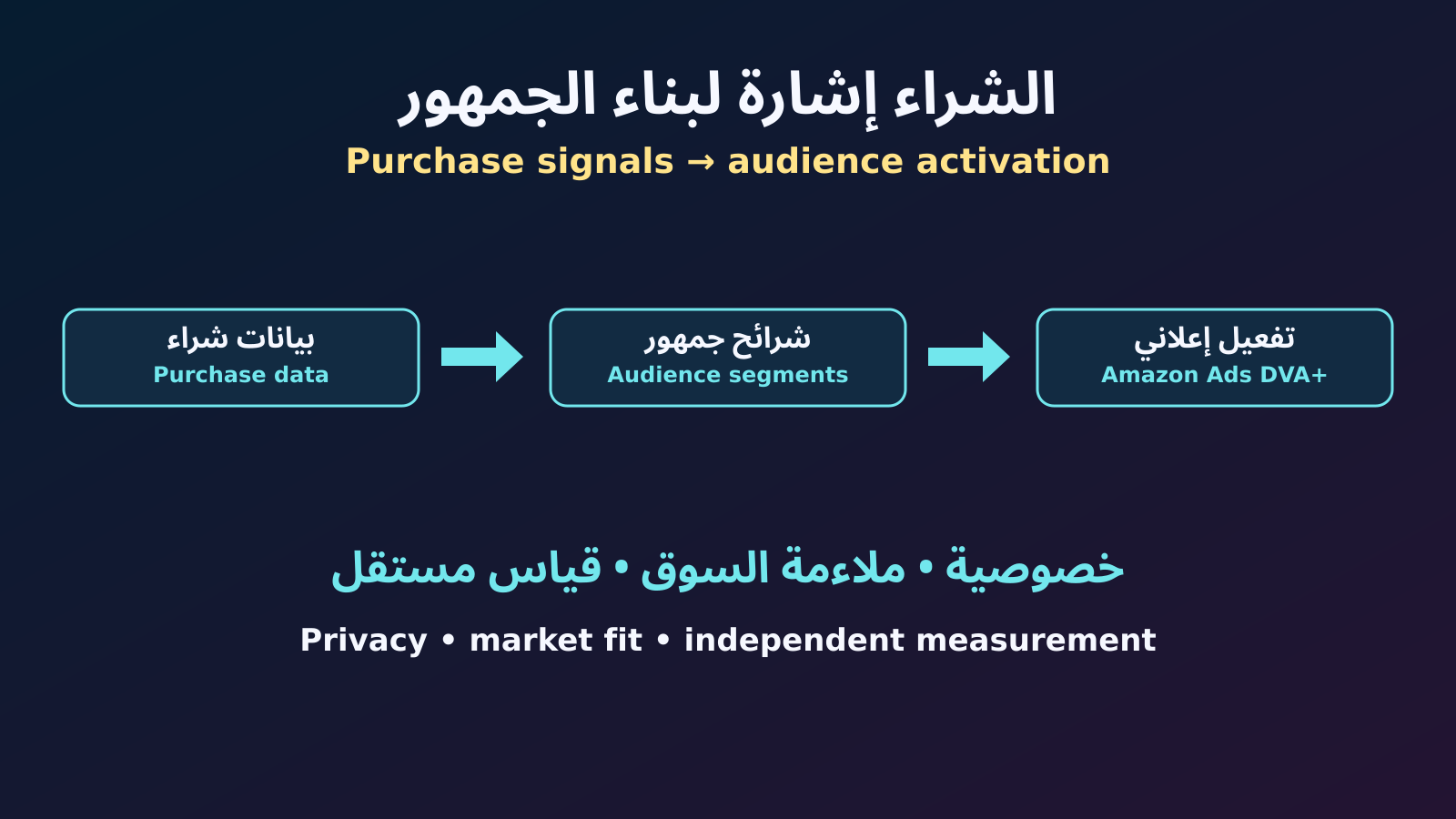
Original editorial illustration, not a product screenshot or evidence of campaign outcomes. Based on the source.
Distinguish activation from measurement There are two separate questions: can the advertiser reach an appropriate audience, and can it establish that advertising made a difference? Better audience fit may coexist with weak measurement. An apparently strong return may reflect people who would have bought anyway. Set the measurement plan before activation, including the primary outcome, its source, the observation window and treatment of cancellations, returns and repeat purchases. Those choices should not change simply because early reporting looks encouraging.
Platform reporting can be compared with permitted sales data and overall business trends, while acknowledging differences in attribution windows and customer definitions. If two platforms claim the same purchase, adding their reported returns can overstate the business outcome. The objective is a consistent account of events, not the most optimistic number. Where matching is unreliable, describe the limitation and treat the result as preliminary evidence rather than claiming that the campaign caused every recorded transaction.
An illustrative household-products test Imagine a household-products brand entering another city in a market actually covered by the data. This is a hypothetical example, not a case study from the announcement. The team could compare category-purchase targeting with a broader audience in the same city while keeping the offer and creative as consistent as possible. The comparison becomes difficult to interpret if one group receives a better discount, faster landing page or different trading period. Record meaningful external changes during the test.
Track reach cost, visit quality, completed orders, order value and contribution after fulfillment costs. A specialized audience might generate more orders but be more expensive to reach or more dependent on discounts. A broader audience might initially convert less often while bringing genuinely new customers. The correct judgment depends on the market-entry objective rather than one isolated metric. If the measurement system cannot distinguish new customers reliably, state that limitation instead of inferring customer status from browsing behavior.
Do not transfer evidence between markets automatically For a Saudi marketing team, the first question is whether the data covers the intended audience. US purchase information should not be treated as an automatic map of Saudi consumer behavior. Retailers, payment methods, seasons, languages, delivery costs and product availability differ. Even similar product categories may involve different motivations and alternatives. Request documented geographical coverage and methodology before incorporating the audience into a local media plan or using it to support financial projections.
The underlying idea can still be strategically useful when the specific tool is not directly suitable. A local brand might improve its consented customer information, standardize category definitions or strengthen offline sales measurement. These are independent improvements that do not require assuming access to an external audience. Purchasing or activating data, however, requires evaluation of its origin, permitted uses and contractual and regulatory fit. A platform's reputation or success in another country cannot replace that evaluation.
Ask what the segment actually contains Request a written explanation of segment entry and exit rules, transaction lookback periods, treatment of refunds and minimum audience sizes. Establish whether a category is inferred from the retailer or identified from product-level detail. Those are different forms of evidence. A purchase from a department store does not necessarily reveal the product bought. Campaign planning should not assume more precision than the segment definition and underlying methodology can support, however intuitive the label appears.
Ask about sample representation, matching rates and coverage lost between the data provider and activation platform. A large overall dataset does not guarantee a suitable audience for a particular service area. Evaluate the reachable segment after geography and other restrictions, rather than relying on the provider's total database size. Where answers are incomplete, keep the trial exploratory and bounded. Unresolved questions should remain visible in the investment decision rather than disappearing inside a polished planning presentation.
Protect the budget with a narrow experiment Start with one objective, one hypothesis and an appropriate comparison. For example, the team might test whether a category-purchase audience improves completed-order cost relative to existing targeting when shown the same offer. Specify the observation period, expansion criteria and stop conditions before launch. Do not move the full budget after a few strong days. Natural variation and delayed sales recording can change the interpretation once the measurement window is complete.
Monitor spending, frequency and distribution during the test without redesigning it every day. Constant intervention makes the final result difficult to explain. A major change in stock, price or delivery should be recorded and may justify repeating the experiment. Preserve a meaningful comparison group: a new campaign versus an old campaign from another season cannot isolate the effect of audience data. A clear experiment is more useful than a complicated dashboard built around incompatible comparisons.
Read profitability alongside revenue Higher sales are insufficient if acquiring them becomes more expensive or margins deteriorate. Decide whether the evaluation concerns revenue, contribution or customer value over a longer period, and keep those measures distinct. An audience may be useful for clearing inventory but unsuitable for building a profitable customer base. Reaching repeat buyers may make sense for complementary products, yet that proposition still needs evidence. The role of measurement is to challenge the hypothesis rather than decorate it.
A simple commercial view can include media, data and production costs against contribution after fulfillment and returns. This is a suggested analytical approach, not a forecast for the integration. When the business cannot connect sales to campaigns precisely, begin with a closer business proxy and explain its limits. There is no need to manufacture precision to justify a trial. The first phase may be valuable because it reveals what the measurement system needs before larger investment becomes defensible.
Privacy belongs in the design A description of permissioned data does not remove the advertiser's responsibility to assess the intended use. Review contracts, purposes, jurisdictions, platform rules and restrictions on combining or reusing information. Qualified privacy and legal teams should assess these questions rather than relying on a marketing statement. Establish whether activation involves sharing additional business data, what minimum information is necessary and how applicable withdrawal or deletion obligations are handled across the contractual relationship.
Healthcare requires particular caution. A purchase should not be treated as proof of a person's medical condition or used casually to infer sensitive characteristics. The item may have been purchased for somebody else. A healthcare organization can focus on general educational content, service experience and aggregate performance while subjecting more personalized uses to appropriate review. These are precautionary principles for planning, not legal advice or a claim that all transaction categories can be used in the same way.
Audience quality cannot repair a weak offer An appropriate audience still needs a clear proposition and a landing page that answers practical questions. Customers should understand who the product serves, what the offer includes, when delivery occurs and how to resolve a problem. Targeting precision cannot repair unclear pricing, low trust or a broken checkout. Review the whole journey before blaming the audience or increasing spending, and ensure that the advertising promise matches the organization's actual delivery capability.
The message should also avoid suggesting that the brand is personally monitoring a consumer's transactions. Useful category-level advertising can explain a general need, benefit and conditions without implying private knowledge. In multilingual markets, test meaning, clarity and trust rather than literal translation alone. Post-purchase service belongs in the evaluation as well. Reaching the right person efficiently creates little lasting value if fulfillment is unreliable or customer support cannot resolve an ordinary issue.
A practical decision sequence The strategic opportunity is to connect an audience hypothesis to behavior that can be defined and evaluated while retaining professional skepticism. Check market coverage, define the segment and commercial objective, review data permissions, then run a limited test with a clear outcome. Decide afterward whether to expand, improve measurement or stop. This sequence applies to comparable suppliers without assuming that a technology's name or novelty determines its relevance to the business.
The final decision memo should state both what was learned and what remains unproven. Was the audience reachable? Did the outcome improve after costs? Was the effect consistent? What circumstances could prevent repetition? An honest assessment is more useful than a premature success story. A weak result can still support a valuable decision to stop spending. The longer-term objective is a disciplined learning process that improves future choices, rather than defending a purchase because its announcement attracted attention.
Comments
No published comments yet.