What the collaboration actually establishes
ApexFlow announced its collaboration with Catch NYC on 2 November 2026. The issuer release connects brand work with mobile technology, more than 100 owned-and-operated apps and publisher relationships. It describes shorter supply paths as an objective, without disclosing fees, viewability, incremental lift or quantified client results.
For a buyer, the practical question is what can be verified between the approved budget and the impression inside an app. The following procurement framework is original analysis, not a report of the partners' undisclosed contractual or technical arrangements. A shorter route may simplify an investigation, but its value still depends on the evidence available along it.
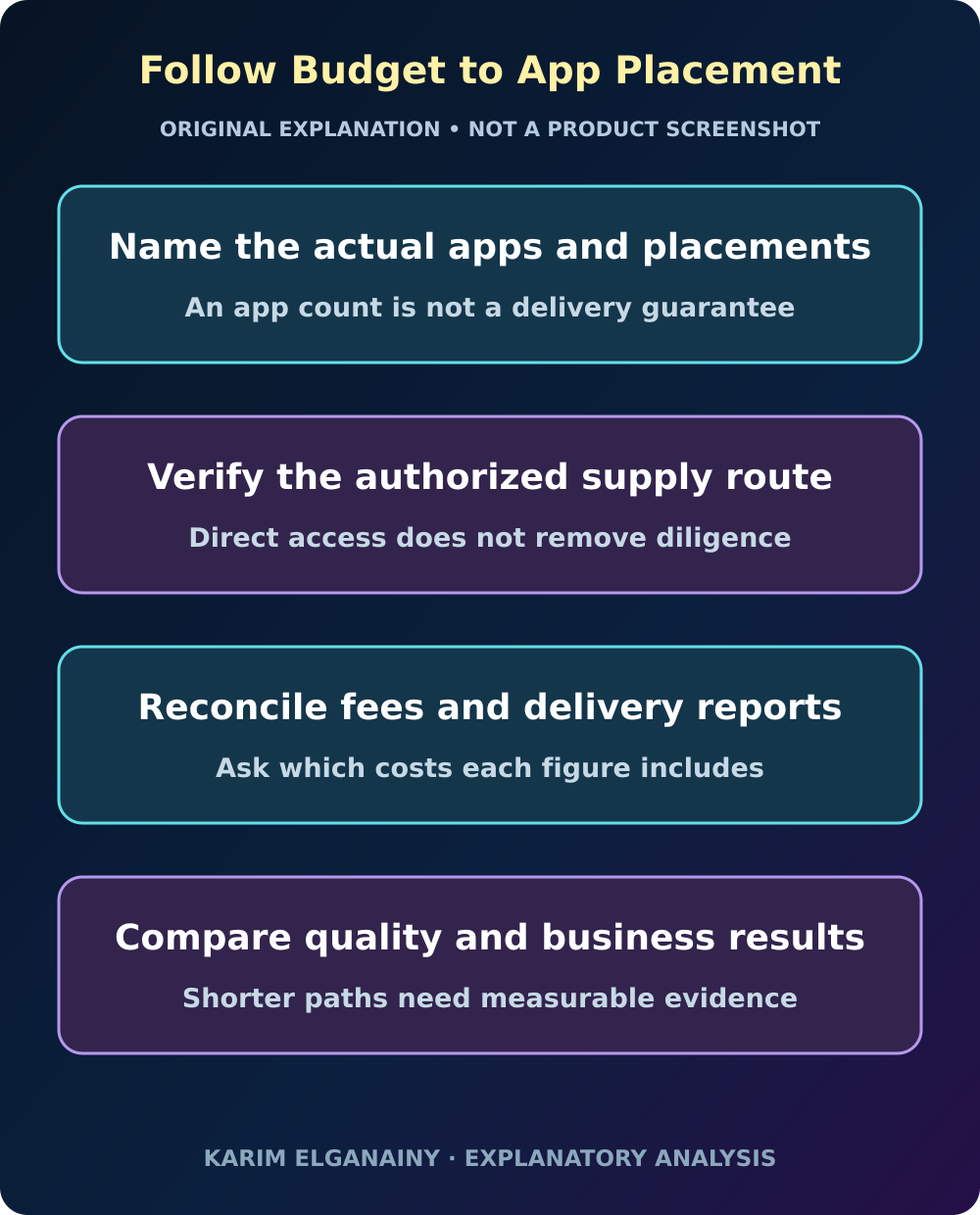
Original editorial framework; not a product screenshot or proof of campaign results.
Draw the route before comparing the price
Ask the proposed seller to describe how the campaign reaches the app placement. Identify the party buying, the party selling, any service between them and the publisher responsible for the environment. Use consistent names across the proposal, reporting and invoice. A route described only through marketing labels is difficult to reconcile after delivery.
Distinguish inventory the supplier operates from inventory available through another publisher relationship. Neither category automatically establishes quality. The distinction helps explain who controls placement, who can investigate an incident and who can change the commercial arrangement. Ask the supplier to identify where control ends rather than allowing the word direct to cover several different relationships.
Make the route specific to the inventory in the proposed campaign. A company-wide network diagram may contain many options that the actual buy will never use. Request a dated scope with known exceptions and a process for disclosing substitutions. The buyer needs to know what is being purchased, not merely what the supplier could theoretically access.
Treat app count as a catalog question
A large portfolio invites questions about its composition. Ask which apps are eligible for this campaign, the markets they serve, their content and the placement types offered. Consider whether the proposed environments support the brand's purpose and the audience's likely task. An app total alone does not answer any of those questions.
Request examples of the actual placement experience. A format's name may not reveal when it appears, what surrounds it, how it closes or whether the user initiated the interaction. Review representative screens or a controlled demonstration where permitted. This is inspection of the advertising environment, not permission to copy third-party creative or collect user information.
Define exclusions and replacement rules before launch. If an app becomes unsuitable or unavailable, specify whether the buyer must approve a substitute. A narrow campaign can be easier to evaluate than a broad one whose composition changes continuously. Preserve enough flexibility to operate, but make changes visible so the final report describes the campaign that actually ran.
Separate identity, delivery and quality evidence
The first question is whether the reported placement belongs to the stated app and seller relationship. The second is whether the advertisement was delivered as contracted. The third is whether the resulting opportunity was suitable for the campaign. A single attractive dashboard should not collapse these into a general assurance that everything performed well.
Ask what each metric means, how it is collected and where coverage is missing. If a quality check applies only to part of the buy, report its scope. Do not describe unmeasured inventory as verified by implication. Missing evidence can justify a smaller test or a different reporting requirement without requiring an unsupported accusation against the supplier.
Agree how discrepancies will be investigated. Name the report used for billing and preserve definitions, time boundaries and adjustment rules. Different counts may reflect timing, filtering or measurement scope. Reconciliation should establish the reason before assigning blame. A documented unresolved difference is more useful than a confidently averaged number that hides incompatible inputs.
Reconcile the money without inventing a benchmark
Ask which costs are included in the quoted price and which are separate. Relevant categories could include media, buying services, technology, verification, production or other contracted work. The exact categories depend on the proposal. Make them comparable across options so that a low headline price does not conceal a materially different service boundary.
Use a clearly hypothetical example: a buyer spends 1,000 units, the available records show 600 reaching the publisher and 300 assigned to disclosed services. The remaining 100 is a reconciliation question. It is not automatically waste, fraud or margin. It could reflect an omitted category or a timing difference, which must be established from the records.
Publisher receipts can be commercially confidential or unavailable to the buyer. Record that limitation honestly and decide whether the remaining evidence is sufficient for the purchase. Do not manufacture a net-media estimate from an industry assumption. Transparency is strongest when the parties agree what can be disclosed, what cannot and how uncertainty affects the decision.
Ask what the publisher gives up
Evaluate publisher economics alongside buyer economics. A placement may generate revenue while creating maintenance work, interrupting users or competing with another monetization choice. These are considerations for an individual publisher to measure, not outcomes established by this announcement. The buyer should understand whether a proposed format depends on conditions that are sustainable for the app.
Ask who handles creative defects, loading problems and user complaints. Set an escalation route that can reach someone responsible for the app environment, rather than stopping at the agency account team. A commercially efficient path that cannot resolve a broken placement is operationally weak, regardless of how few organizations appear in the initial diagram.
For a publisher considering participation, compare net receipts with the work and constraints accepted under the arrangement. Include settlement terms, reporting effort and the ability to remove unsuitable campaigns. These are questions for commercial review, not conclusions about an undisclosed contract. Both parties benefit from discovering a mismatch before a campaign creates dependencies.
Define audience claims without demanding personal data
Ask what a proposed audience label means and what evidence supports it. Separate contextual suitability from an observed individual characteristic and from a modeled inference. The procurement team should understand the distinction in ordinary language. It should not request raw personal information simply to make an audience explanation appear more concrete.
For any planned overlap or reach analysis, identify the method, lawful operating boundaries and limits with the appropriate specialists. If deduplication is not available or not reliable across the relevant inventory, state that clearly. Adding reported reach from several sources may not represent distinct people, and the buyer should not present it as such without support.
Review the campaign's data requirements through the organization's approved privacy and security process. Specify retention, access and permitted uses where relevant to the arrangement. Avoid treating a direct commercial relationship as an exemption from that review. The purpose is to obtain decision-useful evidence without creating unnecessary exposure or promising a level of precision the data cannot support.
Choose the outcome before the reporting template
A branding campaign, a qualified enquiry campaign and an app engagement campaign can require different evidence. Define the decision the buyer expects to make after the pilot. Then choose measures that inform it, along with the operational checks necessary to establish delivery. Start with the decision rather than selecting whichever available metric looks most favorable.
Distinguish a counted event from an incremental effect. Visits or enquiries observed during a campaign can be useful, but the observation alone does not establish what would have happened without advertising. Where feasible, design a suitable comparison before launch and involve someone able to assess its limitations. Where a credible comparison is unavailable, report the result as descriptive.
Do not let a narrow downstream metric erase the campaign's actual purpose. A brand initiative may require a different observation plan than immediate conversion activity. Equally, a compelling brand narrative cannot substitute for confirming where the advertising ran. Outcome evaluation and delivery diligence serve different questions and should remain connected without becoming interchangeable.
Run a pilot that can answer a question
Choose a bounded set of eligible apps, placements, markets, creative and commercial terms. Record these before delivery and identify the changes that require approval. Set the budget and observation period according to the decision, expected volume and organization’s authority. This article proposes no spending level or universal minimum sample for an unspecified campaign.
Specify the acceptance conditions for reporting, placement suitability and reconciliation, as well as the evidence needed to continue. Set thresholds using the buyer's baseline and tolerance for uncertainty. Include a legitimate option to stop or redesign the test. A pilot with no defined decision at its end can become a continuing purchase that nobody actually evaluated.
Review results with both buying and publisher perspectives present. Inspect exceptions, not only averages. One problematic placement can disappear inside an otherwise acceptable aggregate. Conversely, a small isolated incident need not characterize the entire portfolio. The purpose of the review is to establish what happened and what should change, with the scope of each conclusion explicit.
Adapt the diligence to Gulf campaigns
For a Gulf campaign, verify the actual country and language scope of the proposed inventory rather than inferring it from global scale. An Arabic creative file does not establish that the destination, service or offer fits the audience reached. Review the complete path, including practical information required to decide whether the next step is appropriate.
Use a reviewer who can assess Arabic meaning in the specific context and verify that the placement preserves readability. Define how mixed-language environments and bilingual landing pages will be handled. These choices should follow the campaign audience, not an assumption that one language or register works uniformly across the region or every app category.
For a hypothetical clinic campaign, separate procurement review from clinical approval of claims. Use appropriate local review for the service and content, and avoid importing patient information into a media test without the required authority and safeguards. The example is a workflow adaptation, not a statement that the collaboration offers healthcare inventory or regulatory approval.
Keep an evidence register that survives renewal
Store the approved app scope, route description, metric definitions, commercial categories, exclusions and unresolved limitations together. Name the owner of each open question and retain the version used for the buying decision. A concise register is more useful than a folder of presentations that leaves future reviewers unsure which proposal actually governed delivery.
At renewal, compare the new arrangement with the one evaluated. A familiar supplier name does not mean the inventory, services or reporting remain unchanged. Revisit material differences while retaining evidence that still applies. This protects both parties from repeating unnecessary diligence and from relying on a previous approval for a substantially different campaign.
Karim's strategic takeaway
Treat a shorter mobile supply path as a claim to examine through app-level visibility, commercial reconciliation, quality evidence and a meaningful outcome plan. The opportunity is a better-understood purchase, but that opportunity must be demonstrated in the actual campaign. Portfolio size and a collaboration announcement cannot answer the buyer's questions on their own.
The most useful next step is a small, well-specified evidence request followed by a bounded pilot if the answers justify it. A buyer should be able to explain where the budget went, where the ad appeared, what was measured and what remains uncertain. That explanation creates a stronger basis for renewal than a simple count of intermediaries.
Comments
No published comments yet.