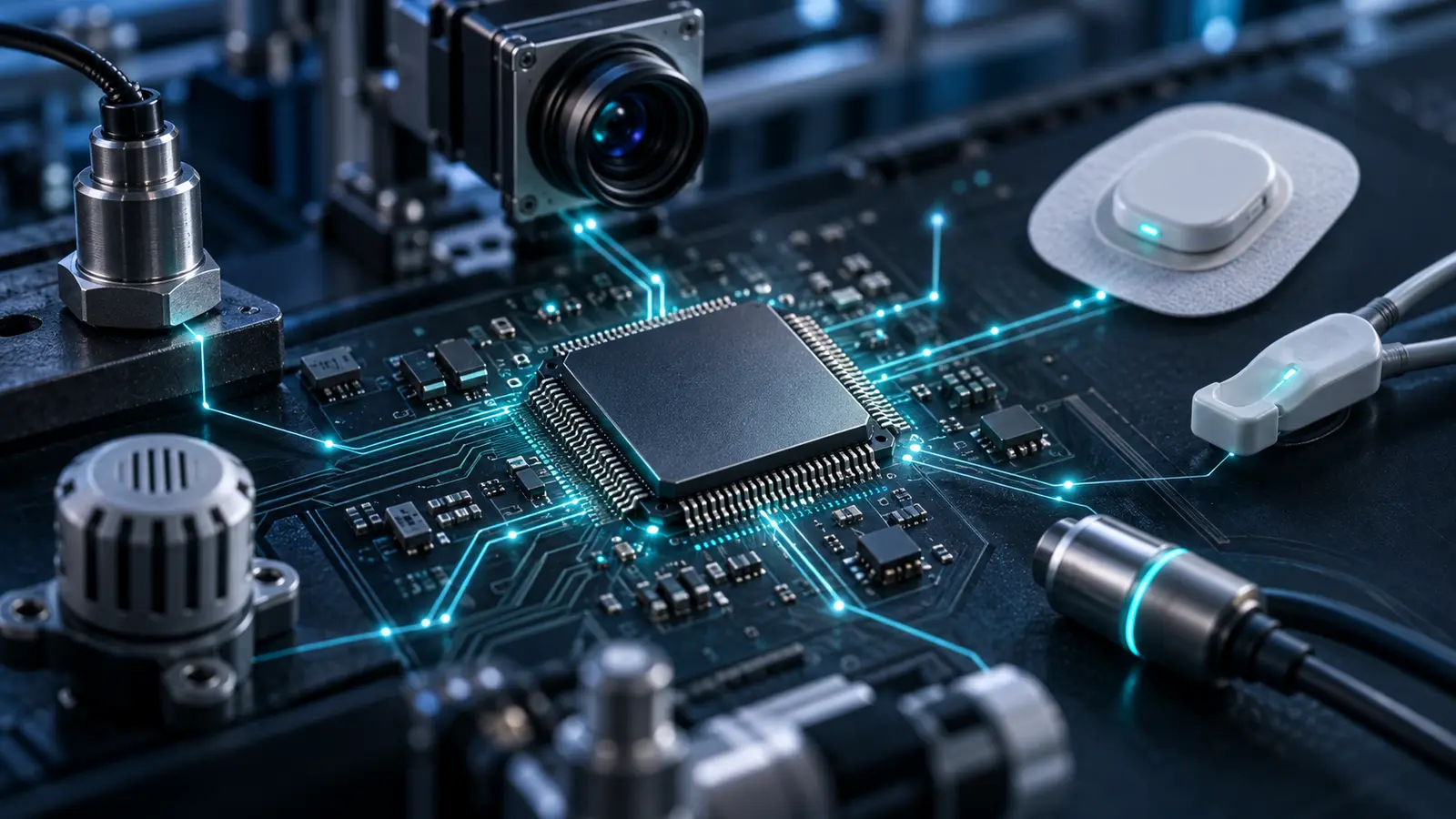
Analog Devices has agreed to acquire Alif Semiconductor for $1.35 billion in cash, with up to $200 million in additional contingent payments. The transaction brings together Analog Devices' strengths in sensing, signal processing and power management with processors designed to run artificial intelligence efficiently inside devices.
This is part of a broader shift from AI as a cloud service to AI embedded in machines, instruments and products. For GCC industries, that can change speed, connectivity requirements, privacy and operating cost.
What the acquisition adds
Analog Devices' official announcement says Alif adds secure, connected and low-power AI processing that can analyse sensor data and support real-time decisions. Reuters reported the $1.35 billion cash value on 9 September 2026.
Traditional sensors capture a signal and send it elsewhere for interpretation. Edge AI can classify, filter or react locally. The cloud still matters for coordination and training, but every decision does not need a round trip to a remote data centre.
Why local processing changes product economics
Lower latency matters in factory safety, robotics and medical devices. Reduced connectivity can help remote energy assets and logistics equipment. Processing sensitive information locally can also limit how much raw data leaves a device, although privacy and security still depend on the complete system design.
Power efficiency is another commercial variable. A small device that performs useful inference for longer without charging or cooling can support different products and deployment models.
GCC use cases to watch
Saudi industrial sites can apply edge intelligence to predictive maintenance, quality inspection and worker safety. Hospitals can use it in monitoring equipment where rapid response and data control matter. Retailers and smart-city operators can process environmental or movement signals with less dependence on continuous connectivity.
Buyers should test accuracy under local heat, dust, language and network conditions. They should also ask how models are updated, how devices are patched and whether data can move between vendors.
Karim's strategic takeaway
The next AI advantage may be hidden inside an ordinary product. GCC organisations should stop separating AI strategy from equipment procurement. The winning specification will combine useful intelligence, low power, security and maintainability—and will measure fewer failures, faster decisions or better outcomes rather than merely advertising an AI feature.
Comments
No published comments yet.