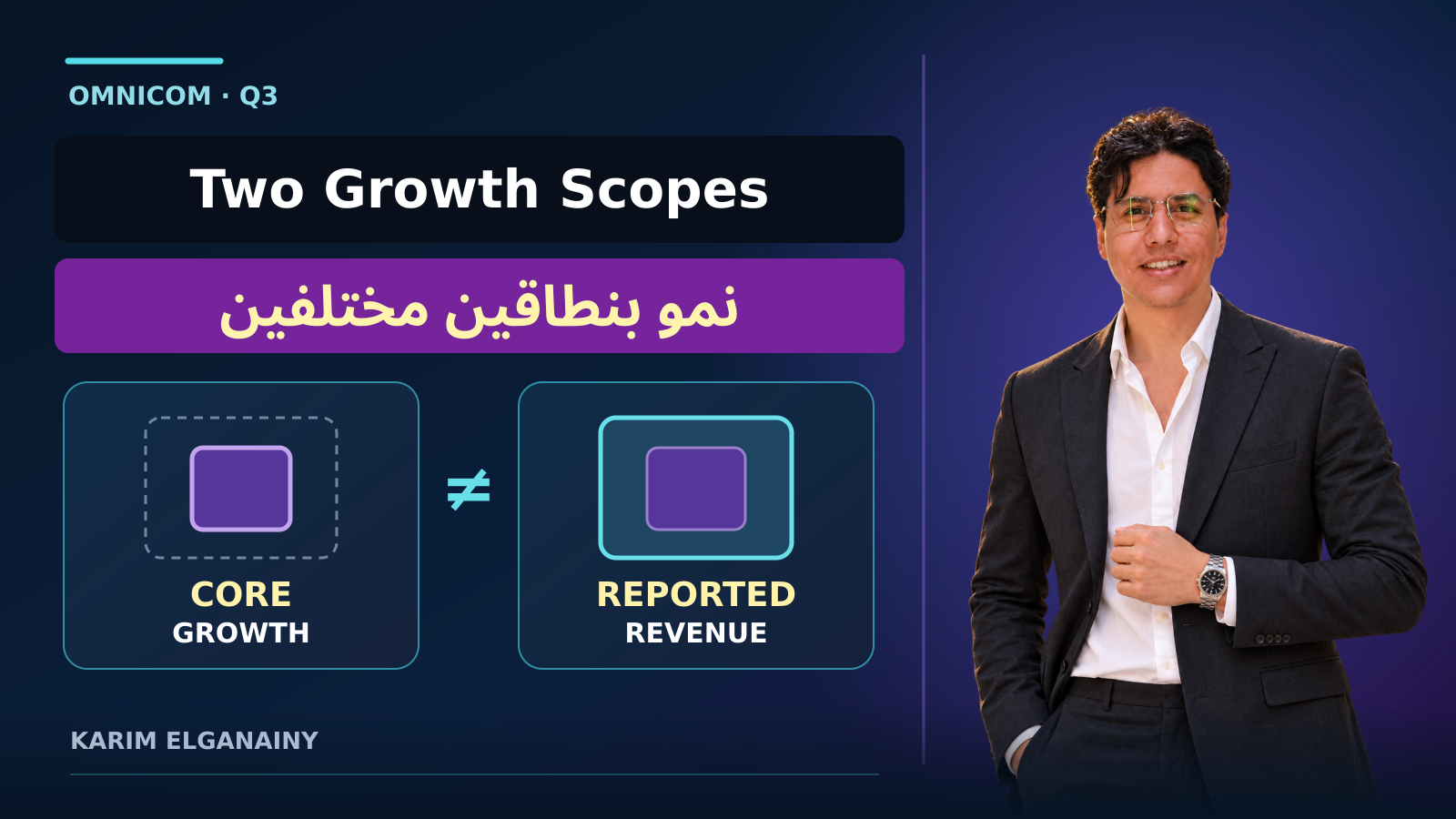
The reported news, with its boundaries intact
Omnicom’s October 22, 2026 release for the quarter ended September 30 reports core revenue of $6.0 billion, 7.2% organic growth and non-GAAP adjusted EBITA of $1.1 billion, an 18.2% margin. Reported revenue was $6.4 billion, operating income $991.7 million and adjusted EBITA margin 17.6%. Company release.
All monetary amounts above are US dollars. Organic growth compares core operations with Q3 2025 on the company’s combined Omnicom–IPG basis; core operations exclude disposed businesses and businesses held for sale. It is not the change in reported consolidated revenue. Earnings tables and definitions.
The distinction matters more than the headline. Different scopes and accounting measures answer different questions. The following is independent marketing-management analysis, not an explanation supplied by the company, a forecast of its performance or investment advice. It uses the announcement as a prompt to examine how an agency buyer or marketing leader should define growth before celebrating it.
Give every number a complete identity
A number without a definition can move through a presentation faster than the qualification attached to it. Before discussing any performance release, build a small glossary recording the period, business perimeter, currency, measure and comparison basis. Keep that glossary beside the executive summary rather than burying it in an appendix. Someone should be able to explain what a figure includes before using it to support a procurement decision.
For a marketing organization, the equivalent mistake is comparing total leads in one period with qualified leads in another. Both can be accurate numbers while their comparison remains invalid. Acquisitions, service changes, reporting revisions and different client mixes can also alter a denominator. A disciplined team asks whether it is comparing like with like before asking whether a line is moving in the desired direction.
Do not combine a numerator from one business perimeter with a denominator from another. Likewise, do not relabel an adjusted earnings measure as operating profit. These are basic controls, but basic controls are precisely what an attractive slide can tempt a team to skip. The purpose is intelligibility, not accounting theatre.
Separate growth quality from growth quantity
A larger revenue total does not tell a buyer whether an agency has become better at solving their particular problem. The relevant question is how growth connects to delivery capacity, specialist availability, creative judgment and continuity of service. Those issues require account-level evidence. A corporate announcement is a reason to ask informed questions, not a substitute for asking them.
Consider a hypothetical regional retailer evaluating two partners. One presents an impressive corporate growth story, while the other offers a clearer staffing plan for the actual assignment. Neither point alone settles the decision. The retailer should compare named responsibilities, relevant work samples, onboarding assumptions, reporting access and escalation procedures. Growth can coexist with excellent execution, but it cannot certify execution in advance.
Ask potential partners to distinguish work already supported by existing capability from work dependent on new hires, subcontractors or future tooling. That distinction does not penalize ambition. It makes the delivery risk visible while there is still time to design around it. The strongest commercial conversation turns abstract capability into verifiable commitments.
Use margin as a question, not a verdict
Agency margin and client value can move together, move apart or reflect unrelated changes. More standardized delivery could remove avoidable rework, but indiscriminate reductions in experienced supervision could make a superficially efficient process fragile. A buyer cannot infer which explanation applies merely from a margin percentage. The correct response is a focused operational inquiry rather than automatic praise or suspicion.
Ask how the proposed operating model protects quality. Who reviews strategic assumptions? Who can stop misleading creative? Which tasks require senior approval? How are revisions priced? What happens when an automated output is wrong? These questions connect commercial efficiency to the experience the client will actually receive. They also reveal whether savings depend on a realistic process or on invisible unpaid work.
On the client side, examine your own contribution to waste. Repeatedly changing objectives, supplying incomplete assets and maintaining contradictory approval chains can make any agency engagement expensive. A fair efficiency review measures friction on both sides. It should not treat every delay as a vendor failure or every saving as proof of better work.
Build a value bridge for the account
A practical account review can connect four layers: business need, marketing intervention, delivery evidence and commercial result. Start with the constraint the business wants to change. Then state the proposed intervention and the evidence that would show competent execution. Only after that should the team specify the commercial result and the uncertainty surrounding it.
For example, a hypothetical business may need more qualified consultations rather than more inquiries. The intervention might combine clearer service information with faster response handling. Delivery evidence could include approved content, functioning forms and measured response times. Commercial evidence would examine qualified appointments and subsequent outcomes, with appropriate time windows. This bridge prevents an agency from presenting asset volume as if it were automatically business value.
Give each layer an owner and a review cadence. Creative quality may need weekly discussion during launch, while commercial outcomes may take longer to mature. If every layer is judged on the same short deadline, the organization will favor fast visible activity over slower useful learning. A value bridge makes that trade-off explicit.
Design procurement around a testable assignment
A request for proposals should describe the decision problem, not simply ask for a full-service growth engine. Specify the audience, operational constraints, accessible data, internal responsibilities and the first measurable question. Leave room for a partner to challenge weak assumptions. A good procurement process tests judgment as well as presentation skill.
One useful exercise is a paid, bounded diagnostic with clearly agreed ownership of outputs. The assignment might identify where qualified demand is lost between inquiry and a sales conversation. Evaluation can then compare the clarity of the diagnosis, the realism of the proposed changes and the usefulness of the measurement plan. This is a proposed procurement method, not a description of any company’s offering.
Avoid requesting elaborate unpaid campaigns and then selecting on visual polish. Such exercises can reward speculative production rather than collaboration. Equally, do not allow a pilot to become an indefinite engagement without decision criteria. Set the duration, deliverables, information access and the conditions for continuing before the work begins.
Make technology claims operationally specific
When a partner proposes automation or artificial intelligence, ask what changes in the workflow. Does the tool reduce repetitive formatting, improve retrieval of approved information or help explore creative alternatives? Which inputs does it use? Where does human review remain necessary? A claim becomes useful only when it identifies a task, a control and a measurable consequence.
A hypothetical reporting workflow illustrates the distinction. Automation may assemble channel data and flag anomalies, while a human analyst checks definitions, investigates causes and approves recommendations. Measure preparation time, correction frequency and decision usefulness separately. A faster report that repeatedly mislabels revenue or hides missing data is not an improvement simply because it arrived sooner.
The commercial agreement should also address portability. Clients need usable access to their approved assets, definitions and historical reports if an engagement ends. Ask which materials can be exported and in what format. Operational dependency is a real procurement consideration even when the initial demonstration is persuasive and the promised efficiency appears attractive.
Keep geography and service fit separate
A multinational performance story does not automatically establish suitability for a particular country, language or regulated category. A Saudi or UAE buyer should verify the actual team, local review process and relevant experience for the work being purchased. These checks should be proportionate to the assignment rather than based on assumptions about a global brand.
For bilingual work, ask how the meaning is developed in both languages and how discrepancies are resolved. Translation alone may not preserve the intended proposition or tone. A useful test compares whether Arabic and English readers receive the same essential promise, limitations and next step. It should not demand that every sentence follow an identical structure.
For healthcare marketing, keep the review of clinical claims and patient information distinct from ordinary campaign approval. The agency may support communications, but appropriately qualified reviewers should govern medical accuracy and sensitive workflows. No corporate growth metric establishes that those safeguards exist for a particular account. They need to be specified and verified directly.
Create a scorecard that resists easy gaming
Use a small set of measures with clear denominators. Possible dimensions include delivery reliability, accepted creative quality, qualified demand, response handling and retained customer value. Choose the dimensions that fit the assignment rather than copying a generic dashboard. Each measure should have a written definition, an owner and an explanation of what decision it informs.
Pair attractive indicators with guardrails. Lower acquisition cost can be accompanied by weaker qualification; more rapid production can produce more corrections; higher utilization can reduce capacity for unexpected work. Guardrails do not make success impossible. They prevent a team from optimizing a visible number while transferring the resulting cost elsewhere in the organization.
Review disagreements explicitly. If the agency and client use different definitions of a qualified opportunity, reconcile the definitions before debating performance. Maintain a change log when definitions evolve, and avoid silently rewriting earlier periods. A trustworthy scorecard should remain interpretable to someone who was not present at the meeting where it was created.
Turn the next review into a decision
The next partner review can begin with three documents: a metric glossary, a responsibility map and a short value bridge. Together they clarify what is being measured, who controls the work and why the work should matter. None requires a new platform. Their value comes from disciplined use and willingness to expose uncertainty.
End the meeting with a specific decision: continue the current plan, change a defined part of the operating model or run a bounded test. Record the evidence supporting that decision and the information that would cause it to change. This turns reporting from a retrospective performance ritual into a practical management tool.
The broader lesson is not that scale is good or bad, nor that one margin proves superior service. It is that precise definitions and observable delivery make commercial claims useful. Read the headline, preserve its boundaries, and then ask what evidence would justify your own next commitment. That is a stronger foundation for a marketing partnership than either enthusiasm or skepticism alone.
Source and editorial scope
Primary company announcement, October 22, 2026. Published October 24, 2026. The opening summarizes the announcement; the frameworks, examples and recommendations are independent editorial analysis. They do not claim access to undisclosed operations or results.
Comments
No published comments yet.