A new buying route is not the same as a new business case. When a platform becomes easier to purchase through a local partner, a marketing team gains an opportunity to evaluate it, not a reason to move its budget immediately. The useful question is whether contracting, implementation, measurement and service delivery can form a complete working chain. That question matters more than the excitement of adding another platform logo to a media plan.
This article separates a short, verified announcement from an original planning framework. The proposed checks, hypothetical calculations and operating choices below are editorial recommendations, not documented product capabilities, customer results or claims that a campaign has been run. They are intended to help a team prepare a disciplined conversation before it makes a commercial commitment.
The announcement, and its limits
Aleph's corrected announcement, dated November 12, 2026, describes an exclusive ChatGPT Ads reseller arrangement covering 44 markets, including Saudi Arabia, the UAE, Egypt, Kuwait and Qatar, with local contracting, billing and support. The correction specifies Hong Kong as “outbound.” This is Aleph's announcement, not an independently tested service assessment.
Advertiser access must not be confused with delivery to users in every listed market. Nor should a team infer automatic account eligibility, a guaranteed credit facility, specific targeting capabilities or a minimum commercial return. These are matters to verify for the actual advertiser and proposed campaign. The analysis that follows does not fill those gaps with assumptions.
Separate procurement from audience reach
Build two separate checklists. The first asks who can purchase: which legal entity signs, which entity receives the invoice, which currency is used and who resolves an account issue. The second asks what can be delivered: which audiences, locations, languages, placements and campaign objectives are actually available. Approval of the first list does not establish the second. This separation prevents a procurement milestone from being reported internally as a media milestone.
Ask for a written answer to each unresolved item, tied to a date and the proposed account. A general presentation may describe a wider portfolio than the configuration offered to one advertiser. If a capability remains unconfirmed, mark it as unconfirmed in the media plan. Do not make creative, staffing or revenue forecasts depend on it. A smaller plan based on verified functionality is more useful than an ambitious plan built around a sales conversation that nobody has documented.
Define the business question before the channel
Write a test question that names the audience problem and the measurable next step. For example, a hypothetical service business might ask whether an additional discovery channel generates qualified enquiries that its team can handle profitably. That is different from asking whether a new channel can generate clicks. A click may be necessary for a particular journey, but it is not sufficient evidence that the commercial problem has been solved.
Also specify what would count as a useful negative result. The test may show that available reach is too limited, the proposition is unclear or operational follow-up is too slow. Learning this before expansion is valuable. If every possible outcome will be described as success, the test has no decision function. Agree in advance whether the next decision is to stop, redesign, repeat with a better sample or expand cautiously.
Map responsibilities across the buying chain
Create a responsibility sheet covering the advertiser, its agency, the reseller and the platform. For each task, record the accountable owner, the person performing it and the escalation route. Include account creation, creative review, billing questions, tracking problems, reporting access and campaign pausing. Do not assume the same party owns all of these tasks simply because it is the commercial contact.
Test the handoff process with an ordinary operational scenario before launch. Who receives a rejected creative, and how does the advertiser learn what needs changing? Who can stop spend if the landing page breaks outside office hours? Who can export the information needed to reconcile the invoice? These are questions, not assertions about this reseller's processes. Documented answers reduce the risk that an otherwise fixable issue spends days moving between teams.
Compare total cost, not the invoice headline
Request a complete cost schedule and distinguish media spend from any service, setup, creative, tracking or currency-related costs that may apply. Do not presume that any of these charges exist; ask which ones are included, excluded or conditional. Clarify tax treatment, payment timing, cancellation conditions and the treatment of unused balances with the appropriate commercial and finance teams. The goal is a comparable budget, not a speculative fee list.
Then identify internal costs. Someone must prepare the landing experience, answer enquiries and reconcile results. A local invoice can simplify administration without making those tasks disappear. Compare the proposed route with the organisation's real alternative, including the cost of doing nothing for now. A financially sound decision may be to prepare assets and measurement first, then buy media when the team can evaluate the outcome properly.
Establish a measurement contract
Choose one primary business outcome and a small set of diagnostic measures. A useful sequence for a hypothetical lead-generation service is enquiry, valid contact, qualified enquiry, booked appointment and attended appointment. Define each stage, its timestamp and its owner. State whether repeat enquiries from the same person are counted once or several times. Otherwise two teams can report different results while both believe they are using the same definition.
Keep platform-reported events, CRM outcomes and finance results distinguishable. They may have different windows, identifiers and reporting delays. Do not promise that a particular integration exists until it has been checked. Where a reliable connection is unavailable, design an appropriately limited reconciliation process and state its uncertainty. A visible gap is safer than a neat dashboard that silently treats an incomplete match as complete attribution.
Design the landing experience around the promise
The landing page should answer the question implied by the advertisement without requiring visitors to reconstruct the offer. Make eligibility, service scope, location and the next step clear. Use language that the intended audience understands, and test the mobile journey with the actual form and confirmation message. A concise page can still explain material limitations. Removing necessary detail to improve a superficial conversion rate can create more unsuitable enquiries downstream.
For healthcare-related marketing, keep educational or administrative information separate from individual medical advice. Do not suggest that an advertisement or automated response can determine a diagnosis or guarantee a treatment result. Confirm the provider's actual services, prices and availability before presenting an offer. Use only the data needed for the intended contact process, and arrange the relevant privacy and compliance review rather than treating a new channel as an exception to existing responsibilities.
A diagram for the decision, not a platform screenshot
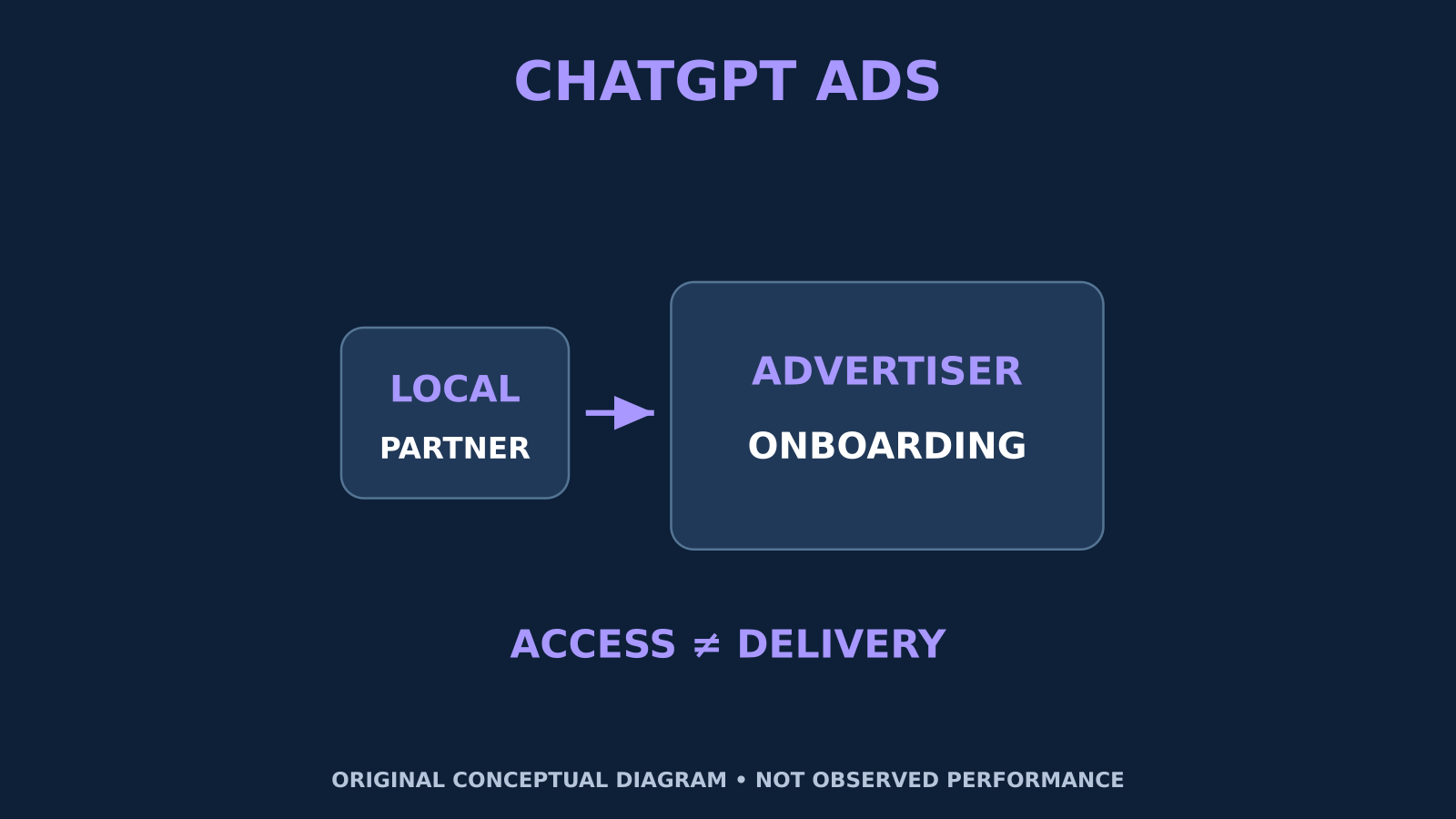
Original explanatory illustration by Karim Elganainy: the local-partner and advertiser-onboarding flow concerns access. “ACCESS ≠ DELIVERY” means buying access is not proof of ad delivery; delivery eligibility and measured value need separate checks. It is not a screenshot or a representation of a live campaign. News context: Aleph's corrected release.
Use the diagram as a meeting agenda. At the first checkpoint, establish whether the organisation can buy through the proposed arrangement. At the second, verify whether the actual campaign can reach its intended audience under the available conditions. At the third, decide how commercial value will be assessed. A positive answer at one checkpoint should trigger the next investigation, not erase it. This simple discipline keeps a launch announcement from turning into an unsupported forecast.
A hypothetical budget test
Suppose a service business sets aside SAR 12,000 for media and SAR 3,000 for additional implementation and measurement work. Its total test cost is SAR 15,000. If it records 120 qualified enquiries, the fully loaded cost per qualified enquiry is SAR 125. If 30 of those become attended appointments, the cost per attended appointment is SAR 500. These invented values illustrate arithmetic only; they are not benchmarks, product forecasts or results from any client.
Now suppose the contribution before acquisition costs is SAR 600 per attended appointment. Thirty appointments produce SAR 18,000 in that contribution, leaving SAR 3,000 after the stated test cost, before any other omitted costs. This is still not proof of incremental profit: some appointments might have occurred without the campaign. The example shows why a cheap enquiry can coexist with a weak commercial result, and why contribution and incrementality should be discussed separately.
Decide how much causal confidence is possible
Where practical, compare a genuinely comparable unexposed group or period using a design agreed before launch. Record other changes that could affect demand, including offers, availability, staffing and activity in other channels. A comparison is only useful if its limitations are understood. Do not describe a simple before-and-after difference as proof that the new channel caused the entire change.
If a strong experimental design is not feasible, use a narrower conclusion. The team may be able to establish that the process works and produces enquiries of a defined quality, without proving how many are incremental. That can justify a further test rather than immediate expansion. Report uncertainty in the decision itself: a preliminary operational finding should lead to a preliminary commitment, not a permanent budget transfer presented as settled evidence.
Write stop rules before results arrive
Define operational stop conditions such as a broken destination, unavailable service, unresolved billing discrepancy or a material mismatch between the promise and the delivered experience. Define who can act and how the pause is communicated. Financial limits should be set by the authorised budget owner. Nothing in this planning framework authorises spending, signing an agreement or changing a live campaign.
Performance rules need a different treatment. Avoid stopping merely because an early day looks disappointing, or continuing indefinitely because a promising story can be told. Agree on the observation period, the quality checks and the evidence required for each decision. If the data is too sparse, label it inconclusive. If the process fails, repair it before judging the channel. This prevents measurement problems from being misdiagnosed as audience indifference.
Prepare the next conversation
Take a one-page brief into the commercial discussion: advertiser identity, intended market, audience problem, proposed outcome, available landing assets, measurement readiness and unanswered questions. Ask the partner to distinguish confirmed capabilities from conditions requiring further review. Obtain the relevant commercial documents through the organisation's normal approval process. Do not assume that a press announcement substitutes for account-specific terms.
My strategic takeaway is to treat local access as a reduction in one kind of friction, not proof of channel effectiveness. The strongest first move is a well-defined, reversible test with clear ownership and honest measurement. If the buying route, audience eligibility and operational journey all fit, the team can make a bounded commitment. If they do not, waiting is a disciplined decision, not evidence that the organisation has missed the future of advertising.
Comments
No published comments yet.