
A campaign can generate enquiries and still leave people struggling to book. Someone repeats the same question to several teams, receives conflicting information, or gets a follow-up after already making an appointment. Improving the advertisement addresses only part of that experience. The next operational decision deserves equal attention.
This article reads McKinsey's customer-experience report through a practical healthcare-marketing lens, then develops an independent operating proposal: choose one useful administrative action, establish who can authorise it, and check whether it helped. Clinical decisions remain with qualified professionals.
What the source establishes
McKinsey's July 14, 2026 report describes context-aware decisions across customer experiences. It reports that 41% of customer-facing AI deployments had fully scaled, 3.5 times the likelihood in other domains. One US automotive case recorded 24% better first-contact resolution and 30% higher employee productivity. These findings are specific to the research and case described. They are neither healthcare benchmarks nor guaranteed returns, and the improvements are not percentage-point claims.
Editorial boundary: The following analysis and implementation proposal are independently developed by Karim Elganainy. They are not a McKinsey-endorsed framework, medical advice, or a claim about a deployed client system.
Start with a useful next step
A narrow question is a better starting point than a large technology purchase: what prevents a person with a straightforward administrative enquiry from receiving a useful answer? The obstacle might be outdated opening hours, inconsistent information across a service page and telephone team, or a booking link that is difficult to use on mobile.
Before selecting an Agentic AI tool, review a suitable sample of friction points with unnecessary personal information removed. Separate information gaps, capacity constraints, handover failures, and questions requiring a professional. Faster messaging cannot create appointment capacity where none exists.
This connects directly with healthcare marketing strategy in Saudi Arabia: demand quality and the organisation's ability to serve it belong in the marketing decision. The useful next step may be explaining availability or stopping an unsuitable follow-up, rather than sending another message.
An original operating proposal
The illustration below is a proposed administrative workflow, not a ready-made technical architecture. It does not select treatment or establish clinical suitability. The process begins with a clear request, uses only the information needed for that purpose, and chooses between an authorised action and an orderly handover.
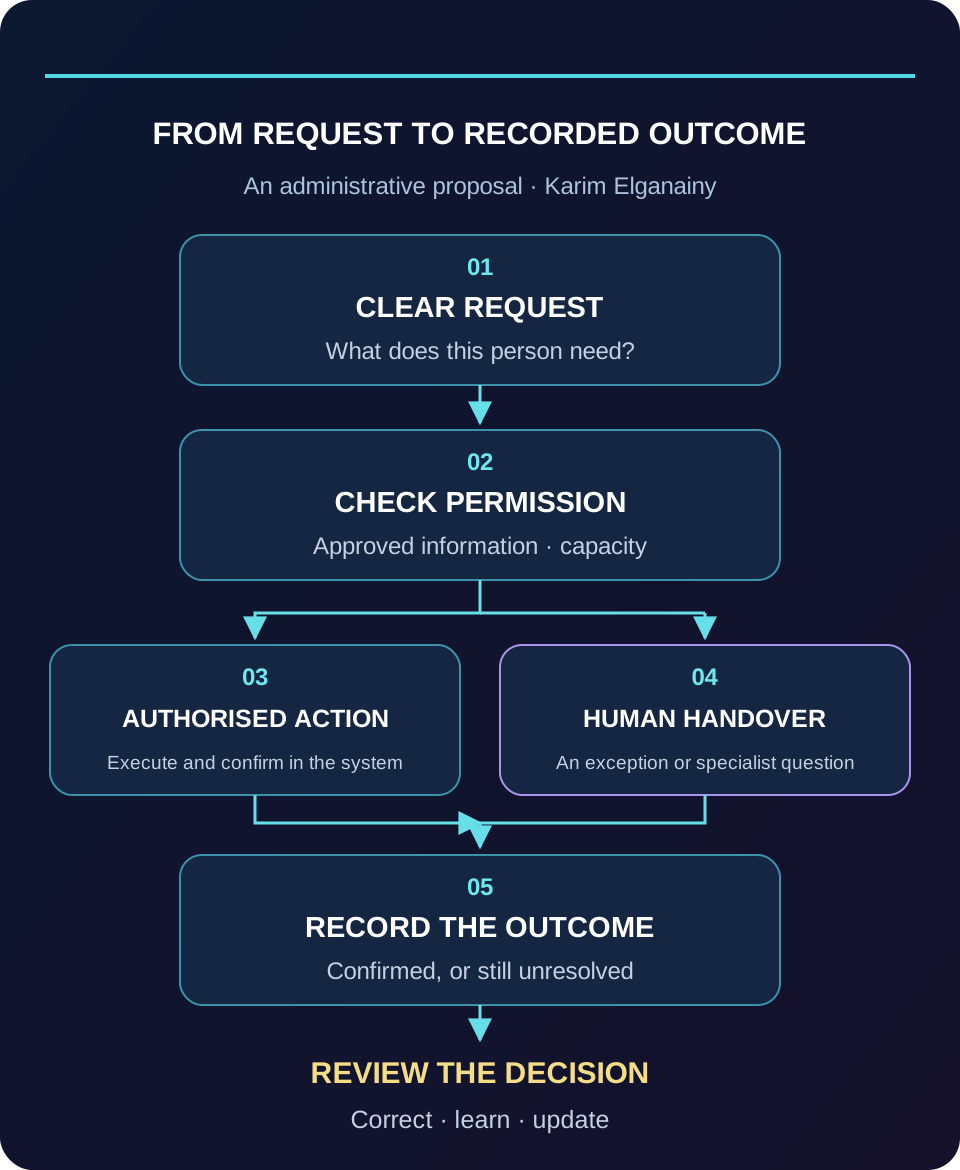
Original illustration by Karim Elganainy. A proposed operating example, not a McKinsey figure or a deployed system.
Consider a fictional appointment enquiry. The person asks about an available time. The assistant uses approved service information and a reliable availability source, then offers options the booking system can actually confirm. A requested appointment is not a confirmed booking until the booking system returns confirmation. A question about symptoms or treatment comparisons goes to the appropriate human route.
A handover should not automatically forward an entire conversation. The receiving employee needs a concise administrative summary: what was requested, what was checked, and what remains unanswered. The organisation should decide what may be transferred and what must be withheld under its policies. A smaller, more relevant handover is easier to review.
Define permission before writing the assistant's instructions
Start with a short document an operations owner can understand. For each action, identify the information source, accountable role, and stopping condition. “Authorised” means that the organisation has approved the action, method, and circumstances. This article grants no system permission to handle patient information.
| Situation | Proposed action | Stop condition |
|---|---|---|
| Opening-hours question | Answer from an approved published source | Missing or conflicting information |
| Appointment request | Offer verified availability and request confirmation | No confirmation from the booking system |
| Cancellation or change | Follow the approved procedure and required checks | Uncertain identity or authority |
| Medical question or sensitive complaint | Route to an appropriate professional | No diagnosis or outcome promise |
| Marketing follow-up | Apply approved consent and contact preferences | Opt-out or unauthorised purpose |
Do not force an assistant to guess a price or invent an exception. Provide an obvious route to a person. If the booking integration fails, the request should remain visibly unconfirmed with a human owner for follow-up. Sending a message is not proof that the appointment was made.
My related article on AI in Middle East healthcare marketing discusses administrative and marketing applications. The practical distinction here is between helping someone access a service and making a clinical judgement that belongs with a professional.
A scorecard beyond cost per lead
Begin with stable definitions. An enquiry is not a booking, a booking is not attendance, and attendance alone proves neither profitability nor clinical quality. Follow one enquiry cohort until the relevant appointment outcomes have matured, rather than dividing convenient totals drawn from different groups or reporting periods.
- Booking conversion: confirmed bookings divided by unique enquiries within the same cohort.
- Attendance: attended appointments divided by bookings whose appointment dates have passed, under a stated cancellation and rescheduling definition.
- Cost per attendance: costs included in the measurement scope divided by attended appointments attributed to that cohort.
- Operational quality: ownerless requests, incorrect information, failed handovers, and process-related complaints.
- Experience: whether people understood the next step and could reach support; satisfaction does not replace safety.
Entirely hypothetical calculation: Assume one cohort produces 200 unique enquiries, 80 confirmed bookings whose dates have passed, and 60 attendances. Booking conversion is 40% and attendance is 75%. If included costs total SAR 12,000, cost per attendance is SAR 200. These are teaching assumptions, not client results or recommended performance targets.
Even if performance improves after launch, do not immediately attribute the entire change to the assistant. Channels, prices, capacity, or demand mix may also have changed. Compare suitable groups, record concurrent changes, and use a controlled evaluation when appropriate under the organisation's supervision. Count human review and error-handling costs alongside messaging and technology costs.
Run a bounded test with an exit decision
A staged test does not need a universal timetable. Choose one administrative process, an accountable team, and a defined information source. Begin with synthetic cases containing no real patient data: missing information, unavailable appointments, an opt-out request, and a technical failure should all appear in the test set.
Next, review proposed actions before executing them within a limited scope. Do not expand permissions automatically because simple responses work well. Require evidence that exceptions reach the right person and that errors are visible and can be addressed.
- Define the current problem, accountable owner, and one primary outcome measure.
- Review information quality, capacity, channels, and permissions.
- Test ordinary and exceptional cases using synthetic data.
- Run a limited scope with human review proportionate to risk.
- Document the decision: expand cautiously, revise, or stop.
SWOTELL analysis can help examine operational readiness and constraints before buying tools. Once a test is selected, the marketing strategy framework can turn it into responsibilities, resources, and an explicit review date.
Keep the promise smaller than the operating system
In this proposal, Agentic AI earns its place through a small, observable outcome. Did the person receive correct information? Was the next step clear? Did the authorised action actually happen? Could the team detect and address a failure?
Start with those questions and then decide how much technology is needed. A clearer process and measurable result make expansion defensible. Placing an AI layer over conflicting definitions and ambiguous authority may simply make mistakes happen faster.
Source and reading boundaries
Primary source: Rewiring Customer Experience for the Agentic Era, McKinsey, July 14, 2026, by Alex Rodriguez, Nicolas Maechler, Ema Karavdic, and Khalid Quidwai. Its findings are summarised only in the source section above. The operating proposal, illustration, calculation, and testing steps are independent analysis. No McKinsey endorsement or partnership is claimed.
Comments
No published comments yet.