A marketing campaign can look busy while leaving the organisation’s real problem untouched. More impressions will not fix an unavailable appointment. A polished landing page will not help if callers receive contradictory information. A low enquiry cost can conceal appointments that never happen. Good planning connects the audience, the promise, the delivery system, and the evidence used to decide what happens next.
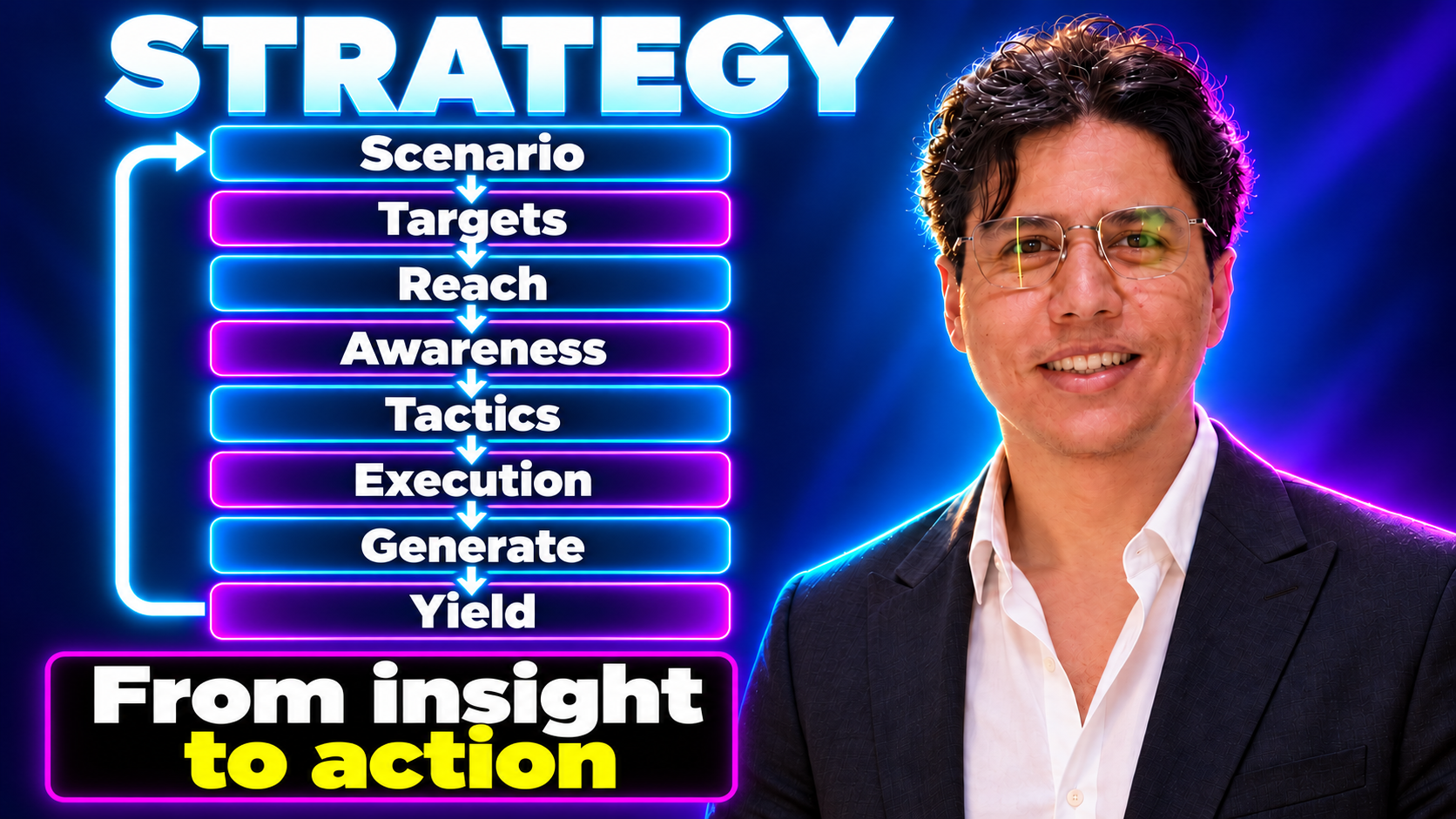
Jenna Tiffany’s STRATEGY framework provides an eight-part structure for making those connections. This course article follows the formulation in the supplied course and her May 2021 introduction: Scenario, Target or Targets, Reach, Awareness, Tactics, Execute or Execution, Generate, and Yield. In this formulation, Reach develops understanding of the audience, and Awareness considers how to attract its attention. Jenna Tiffany’s original introduction to STRATEGY.
The explanation, working documents, decision gates, and examples below are original practical applications of that structure. They are not quotations from Tiffany’s book or claims that the framework guarantees results. By the end, you should be able to turn a broad campaign request into a capacity-aware plan, distinguish strategic choices from channel activity, and use measurement to make defensible decisions.
Every organisation, budget, rate, and result in the examples is fictional. The healthcare case concerns appointment information and administrative access only. It offers no medical advice and makes no claim about treatment quality or clinical outcomes. All example reporting uses synthetic aggregate counts without patient identifiers.
Read the framework as a connected decision cycle
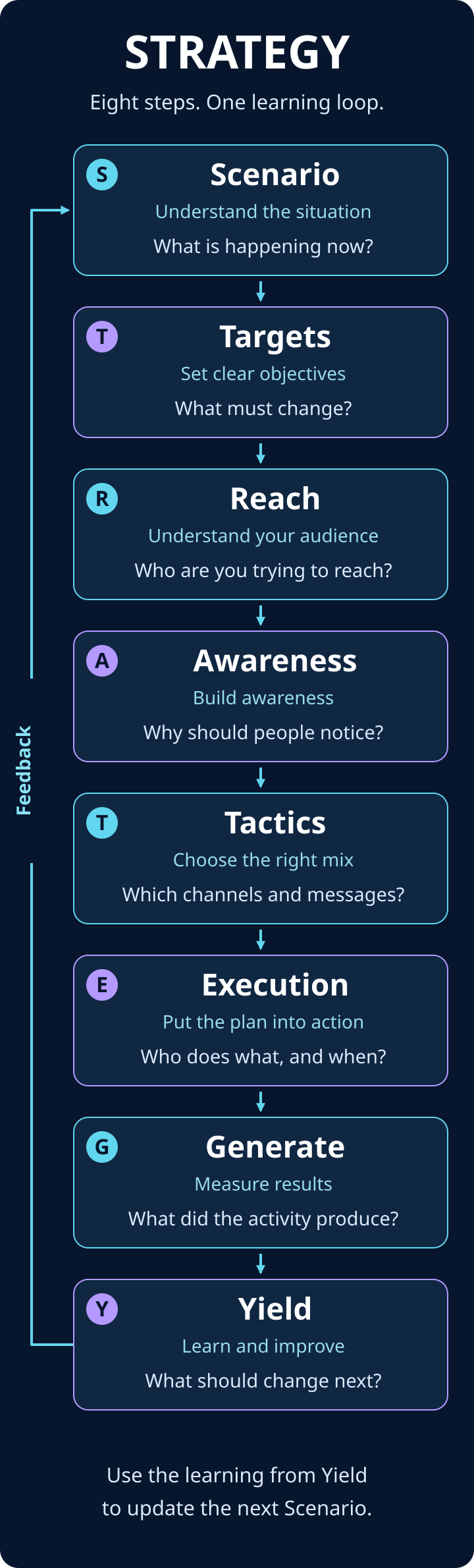
The forward arrows in the diagram show the main planning logic. Evidence about the situation informs the target; understanding the audience shapes attention and communication; tactics become deliverable work; measurement supplies material for learning. The feedback arrow means that learning changes the next plan. It also permits earlier correction: if execution exposes a capacity problem, revisit the target immediately rather than waiting for the campaign to finish.
The steps overlap in practice. Measurement definitions belong in planning, even though Generate appears late in the sequence. Research continues after the initial audience work. Execution requires judgement throughout. Use the sequence to check connections, rather than treating it as a rule that one department must finish its document before anyone else can contribute.
The supplied course makes a useful distinction between strategy and tactics. Strategy establishes the route from the current situation toward an intended organisational result; tactics are the specific means selected along that route. A short strategy might prioritise clearer access for existing local demand before expanding acquisition. Search advertising, a rewritten appointment page, and a booking response guide are possible tactics. Each should have an identifiable reason to exist.
The working case: an outpatient access campaign
Consider Meridian Outpatient Centre, a fictional organisation planning an eight-week campaign. Operations has approved 480 additional bookable appointment slots across that service window, averaging 60 each week. These slots form the campaign’s planning allocation; they do not represent the centre’s entire schedule. Availability still needs to be checked by day and service, because a spare Tuesday slot cannot automatically satisfy someone seeking Thursday evening.
The fictional team suspects that unclear administrative information prevents some interested people from completing a booking. Prospective visitors repeatedly ask about opening times, location, fees, contact options, and what happens after an enquiry. The centre wants to improve this journey while testing a measured increase in demand. Clinical questions and decisions remain with the appropriate professional team.
The proposed planning funnel is 20,000 landing-page visits across paid and owned channels, 1,000 unique administrative enquiries, 400 confirmed bookings, and 320 attended appointments. These imply a 5% visit-to-enquiry rate, a 40% enquiry-to-booking rate, and an 80% booking-to-attendance rate. They are assumptions to test, not existing results or sector benchmarks. A visit is a session, not necessarily a different person; enquiry counts must therefore use a separate definition.
The total hypothetical campaign budget is EGP 60,000: EGP 42,000 for media, EGP 12,000 for landing-page and content work, and EGP 6,000 for measurement and team preparation. An assumed EGP 300 contribution per attended appointment represents revenue less the relevant variable delivery costs, before campaign costs. It is a teaching assumption requiring financial validation in a real organisation, and it does not represent net profit.
S: Scenario, diagnose the constraint before choosing activity
Begin with a question precise enough to investigate: what currently prevents appropriate demand from becoming a completed appointment, and what can the organisation actually support? Gather evidence from the appointment journey, staff capability, current communications, competitor offerings, and wider conditions. The purpose is to identify the decisions that matter, rather than assembling every available chart.
Build an evidence register with four fields: finding, source and period, confidence, and implication. For Meridian, a verified operational schedule could establish available slots. A sample of administrative enquiries could reveal repeated questions. A mobile usability review could expose a hidden contact button. Each source answers a different question. Staff recollections may identify a useful hypothesis, but they should not be presented as a quantified pattern without checking.
SWOT can summarise relevant strengths, weaknesses, opportunities, and threats; PESTLE can organise wider influences. Both become more useful when each entry ends with a consequence. “Limited evening availability” should lead to a decision about which times to promote. “Increasing local competition” needs a more specific explanation of what competitors offer and why that changes the audience’s choice. Unsupported labels make the plan longer without making it stronger.
For this fictional case, the scenario conclusion is conditional: unclear access information may be suppressing bookings, and the available schedule could support a controlled test. Before approving that conclusion, distinguish lack of demand from unanswered demand, unsuitable timing, and demand outside the service’s scope. Those problems require different responses.
The output is a one-page diagnosis with a baseline, constraints, and unresolved assumptions. The decision gate is whether the proposed marketing intervention addresses an observable barrier and whether delivery capacity exists. If the booking team cannot handle current enquiries, expanding media should wait while that constraint is resolved. If the real barrier is appointment timing, a new creative concept alone is unlikely to be sufficient.
T: Target, translate ambition into a bounded result
Targets should connect the organisational purpose to a measurable change within a defined window. For Meridian, the main planning target is 320 attended appointments arising from 400 confirmed bookings within the eight-week service allocation. This means an average of 50 bookings and 40 attendances a week, but averages must never override daily availability. The team should compare the proposed pacing with the actual release of slots.
Separate outcomes from the assumptions that might produce them. Attendance is an operational outcome. Enquiries and bookings are intermediate stages. Visits and media delivery are earlier signals. Publishing a page is a completed task. This hierarchy helps the team understand why completing all planned activities does not establish that the campaign worked.
Define the counts before launch. A confirmed booking has an accepted appointment in the approved scheduling system. Rescheduling the same appointment does not create a second acquisition. An attended appointment is recorded only after attendance is established. Repeated contacts about the same booking should not inflate enquiry totals. Record cancellations and non-attendance separately so that the team can understand where the planned journey diverges.
The 400-booking target uses 83.3% of the 480-slot allocation. The 320-attendance target represents 66.7% of that allocation. These figures describe different things: booked capacity and attended capacity. Neither is the centre’s total utilisation. The remaining capacity is not permission to overbook, and an unfilled slot may no longer be recoverable once its time has passed.
Set balancing conditions alongside volume: accurate availability, manageable enquiry workload, consistent administrative information, and an accessible contact route. Agree what evidence triggers an operational review. The output is a target sheet with definitions, owners, deadlines, and constraints. The gate is whether the funnel arithmetic, budget, and capacity can coexist. When one assumption changes, recalculate the chain instead of leaving an attractive headline target unchanged.
R: Reach, understand the people and their decisions
In this version of STRATEGY, Reach starts with audience understanding. A platform’s reach number is not enough. Ask who needs the service information, what decision they are making, what they already understand, and what prevents a confident next step. This keeps the research connected to an actual communication problem.
For Meridian, useful distinctions might include people comparing practical access options, people who already know the centre but need clearer booking instructions, and professional referrers seeking an accurate administrative contact route. These groups may need different information without requiring elaborate fictional biographies. Age, occupation, and lifestyle details should enter a persona only when there is credible evidence that they affect the decision being planned for.
Research can combine aggregated enquiry themes, voluntary interviews about the booking experience, search intent, and observation of navigation difficulties. Use questions such as “Which information did you need before contacting us?” or “At which step were you unsure what would happen?” Avoid turning an administrative research exercise into unnecessary collection of personal health information. The marketing team needs an understanding of friction, not a copy of clinical records.
Create a compact persona or audience card containing the decision, information needs, barriers, preferred contact routes, and evidence supporting each item. Mark assumptions explicitly. For example, “prefers telephone because online booking feels unclear” is a testable hypothesis; “middle-aged people dislike digital booking” is an unsupported generalisation. A useful card changes page design, messaging, or service delivery.
Prioritise one or two audience needs for the pilot. Meridian might focus on people already seeking local appointment information who need a clear route to availability. The output is an evidence-backed audience choice and a list of unanswered research questions. The gate is whether the selected segment can actually use the available service and whether its main barrier is one the campaign can address. If those conditions fail, revisit the target or scenario.
A: Awareness, earn attention with a relevant promise
Awareness turns audience insight into a reason to pay attention and continue. Ask where people encounter the organisation, what question they bring to that moment, and what message can be supported by the service. Attention has value when it helps the right person understand a useful next step.
Map a simple journey for Meridian: encounter a message, inspect practical information, contact the centre, receive a response, book an available appointment, and attend. At each stage, write the person’s likely question and the organisation’s responsibility. Someone comparing locations needs clear access information. Someone who has already booked needs dependable administrative communication. Repeating an acquisition message at every stage ignores these different needs.
A plausible awareness message might invite people to check opening times, location, and current appointment options. Its credibility depends on the destination providing those details accurately. Avoid promising immediate availability if the schedule cannot support it. Avoid implying a clinical benefit merely to increase response. A clear administrative promise can still be compelling when it resolves a genuine obstacle.
Develop two message hypotheses rather than a collection of unrelated slogans. One might emphasise straightforward booking information; another might emphasise accessible contact options. Keep the audience and destination reasonably comparable so that the team can interpret the response. A higher click-through rate is an early signal, not proof that the message produces suitable bookings or attended appointments.
The output is a message brief and a journey map showing the next step, evidence behind the promise, and possible friction. The gate is consistency: can the website, receptionist, and actual schedule deliver what the message suggests? If not, revise the promise or fix the service before increasing exposure. The feedback from this step may reveal that the supposed awareness problem was really an information or execution problem.
T: Tactics, choose channels by their job in the journey
Tactics turn the chosen audience and promise into a practical mix of activities. Give each channel a specific job. Search can respond to expressed intent; an owned information page can explain access; a trained booking team can resolve administrative uncertainty. Whether any particular channel belongs in the plan depends on observed audience behaviour, available skills, cost, and measurement limitations.
Meridian’s hypothetical mix includes a mobile-friendly appointment information page, a search campaign for relevant general service and location queries, clear information on existing owned channels, and a consistent administrative response guide. The page answers practical questions and distinguishes sending an enquiry from receiving a confirmed appointment. Where a telephone route is offered, its opening hours and expected response process should be clear.
Attach a hypothesis and a measure to each tactic. Improving page clarity may increase qualified administrative enquiries per visit. A better response guide may improve enquiry-to-booking progression while reducing repeated questions. These effects should remain hypotheses until the test provides evidence. Do not give every tactic credit for the same final appointment and then add those claims together.
Use the EGP 42,000 media allowance as a bounded test envelope, rather than a promise to spend the full amount regardless of results. The EGP 12,000 content and page allocation supports the destination and message, while EGP 6,000 supports measurement and preparation. This separation makes it harder to mislabel the whole budget as advertising spend or to forget the operational work required for conversion.
The output is a short activity plan stating audience, job, hypothesis, owner, cost, and dependency. The gate is traceability: every activity must support a target and respond to evidence from the earlier steps. Remove a channel if the only argument for it is that another organisation uses it. If the team cannot explain what a tactic contributes, it is not ready for a budget allocation.
E: Execute, make delivery and pause authority explicit
Execution includes the people, resources, timing, and coordination needed to deliver the plan. A campaign should have a named role accountable for its overall result, with clear owners for operations, content approval, media, and measurement. “Marketing and reception” is too broad when a problem requires a decision within the next hour.
For Meridian, operations confirms the release of bookable slots. The booking supervisor owns administrative response readiness. The content owner verifies that practical information is consistent. The media owner controls pacing within the approved envelope. The reporting owner checks that the numbers use agreed definitions. Appropriate professional reviewers remain responsible for content within their remit; marketing sign-off alone does not resolve every specialist concern.
Rehearse the journey with synthetic test enquiries before launch. Test the form on a mobile device, the telephone route during advertised hours, an unavailable requested time, a rescheduling request, and a question requiring clinical routing. Confirm that forms, confirmations, and staff scripts describe the same next step. Check that a successful button click actually produces an enquiry in the intended system.
Start with a limited pilot that can be supported by the current schedule. Agree who can reduce spend or pause an affected message if capacity disappears, information becomes inaccurate, or enquiries accumulate beyond the team’s ability to respond. A pause should have a documented reason, owner, and condition for resuming. It is a control mechanism, not an admission that planning has failed.
The output is a launch checklist, responsibility map, and paced schedule. The gate requires working contact routes, approved information, verified availability, and functioning measurement. Protect the ability to change the plan: a launch date should not force the team to advertise a service promise it cannot currently deliver. Record changes as they happen so that later analysis can explain differences between the intended campaign and the campaign people actually experienced.
G: Generate, produce evidence that supports a decision
Generate focuses attention on collecting and interpreting performance evidence. Establish a small reporting set that follows the journey from visits to enquiries, confirmed bookings, and attended appointments. Keep definitions and time windows visible. Track operational balancing measures alongside volume so that a positive acquisition number does not hide a deteriorating experience.
At the fictional target levels, EGP 60,000 divided by 1,000 enquiries gives EGP 60 per enquiry. Dividing by 400 bookings gives EGP 150 per booking, and dividing by 320 attendances gives EGP 187.50 per attended appointment. These are blended campaign-cost measures. EGP 60,000 divided by 20,000 visits is EGP 3 per visit, but it is not an advertising cost per click because both the numerator and traffic sources include more than paid media.
Keep the appointment cohort aligned. A report issued mid-campaign will contain bookings whose appointment dates have not yet occurred. Show them as pending rather than treating them as non-attendance. Final reporting should cover the agreed eight-week service window after attendance records are reconciled. Do not divide unrelated weekly totals and describe the result as a person-level conversion rate.
Use the approved booking system for any necessary operational reconciliation and share appropriately aggregated reporting outside it. A campaign dashboard should not contain patient names, contact details, clinical notes, or identifiers embedded in URLs. Any tracking design needs review for its actual context, including what information leaves the organisation. This article’s example requires no real personal data and proposes no upload of patient lists to advertising platforms.
The output is a decision dashboard with source, calculation, reporting lag, owner, and known limitations for every measure. The gate is data quality: verify missing events, duplicate counts, changing definitions, and incomplete cohorts before reallocating money. If enquiries rise while bookings fall, inspect relevance, response handling, and availability. More traffic is only one possible intervention, and may worsen a bottleneck the report has just exposed.
Y: Yield, turn results into a better next decision
Yield asks what the organisation learned and what it should change. Begin by separating observed performance from causal claims. A campaign-linked appointment may have happened without the campaign. Existing demand can move between channels, and changes in availability or staffing can affect results at the same time as marketing activity.
Suppose the fictional campaign reaches its planning target of 320 attended appointments. Multiplying 320 by the assumed EGP 300 contribution gives EGP 96,000 before campaign costs. Subtracting EGP 60,000 gives EGP 36,000 only if all 320 attendances are incremental and the contribution assumption holds. This is a conditional scenario, not a measured financial return or net profit figure.
The break-even point is 200 incremental attended appointments: EGP 60,000 divided by EGP 300. If only 60% of the 320 observed attendances are incremental, there are 192 incremental attendances, generating EGP 57,600 contribution and leaving EGP 2,400 below campaign break-even. At the target volume, at least 62.5% of attendances would need to be incremental under these assumptions. That sensitivity makes the attribution question economically important.
A comparison period, a carefully designed staggered rollout, or another suitable evaluation approach may improve interpretation, but each has limitations. Document changes in opening hours, available capacity, referral activity, and seasonal demand. Do not label a simple before-and-after comparison causal merely because the dashboard is precise. Where incrementality cannot be established, report observed performance and a range of plausible financial interpretations.
The output is a learning memo: what happened, what remains uncertain, what explains the result, and what decision follows. Continue elements supported by evidence; revise weak assumptions; stop activity whose cost or operational burden lacks justification. Assign an owner and a test to each important learning. The final gate is whether the next budget decision reflects those findings. A retrospective that changes nothing has not completed the cycle.
A practical preparation and review plan
Use a short preparation period before the eight-week service campaign. In the first preparation week, the marketing and operations leads agree the diagnosis, check the available schedule, define the funnel, and identify the highest-risk assumptions. The deliverable is a shared planning brief that distinguishes verified facts from proposed targets. Any unresolved capacity issue remains visible as a launch dependency.
In the second preparation week, the team builds the page and response guide, reviews the message, configures the approved measurement, and rehearses the journey. The deliverable is an operationally tested campaign with a clear decision owner. Release media only after the launch gate is satisfied. If an essential dependency fails, revise the schedule rather than hiding the problem in a status report.
During the pilot, check contact-route failures and capacity changes promptly. Hold a regular operating review to examine enquiries, response handling, booking progression, and workload. Review attendance only with an explicit view of which bookings have matured. A broader weekly decision meeting can adjust pacing and test priorities, while recording what changed and why. The exact cadence should fit the service’s response speed and reporting delay.
After the service window, reconcile the final cohort and complete the Yield review. Give the next planning meeting three concrete inputs: the strongest supported finding, the most consequential uncertainty, and the next test worth funding. This discipline prevents the same unsupported assumption from being copied into a new campaign simply because it appeared in the previous plan.
A shorter B2B example: software demonstrations
The same logic can support a fictional scheduling-software company selling to small service businesses. Its Scenario shows many demonstration requests but poor attendance and limited sales capacity. Its Target is 24 attended demonstrations from 30 confirmed bookings during a six-week pilot. Sales can support no more than six demonstrations a week, so the plan must respect that weekly ceiling as well as the total.
Reach identifies operations managers comparing administrative workflows, with research focused on their decision criteria and purchasing process. Awareness uses a message explaining what the demonstration will cover and who it is useful for. Tactics include a focused landing page, a short workflow example, and an appropriate confirmation process. Execute assigns ownership of scheduling, demonstration preparation, and handoff to sales.
Generate reports booked and attended demonstrations, relevant opportunity creation, sales workload, and reasons for non-attendance. Yield asks whether attendance and opportunity quality justify continuing the pilot. Twenty-four demonstrations do not equal 24 sales, and pipeline value is not realised revenue. The company should wait for the relevant sales outcomes before making a final acquisition-cost claim.
The comparison highlights the transferable principle: choose measures close enough to the business result to matter, while respecting the time needed to observe that result. The software company and outpatient centre share a planning structure, but they need different audience research, information boundaries, service promises, and evaluation windows.
Common errors, limits, and the connection to SOSTAC
One common error is starting at Tactics and filling in the earlier headings afterward. That produces a justification for a preferred channel rather than a genuine choice. Another is describing Reach entirely as an advertising metric, which loses the audience research role used in this course. A third is selecting an impressive attention measure while leaving booking quality, attendance, and capacity outside the plan.
Financial errors are equally important. Do not combine total campaign cost with a paid-media denominator and call the result a platform efficiency metric. Do not count contribution as revenue or net profit. Do not assume every attributed booking is incremental. Keep the arithmetic inspectable so that a colleague can reproduce it and challenge the assumptions without reverse-engineering a presentation.
STRATEGY also has limits. The framework does not validate weak research, choose an ethical objective, resolve operational disagreements, or supply specialist judgement. Eight completed headings can still contain a poor plan. A small team may use one page and a simple review log; a larger organisation may need supporting research and detailed controls. The amount of documentation should follow the complexity and consequences of the decision.
If you already use SOSTAC, treat the frameworks as related planning aids. Scenario overlaps with Situation Analysis, Target with Objectives, Tactics with Tactics, and Execute with Actions. Generate and Yield cover monitoring, evaluation, and learning that connect closely with Control. Reach and Awareness make audience understanding and attention particularly visible. This is a practical comparison, not an exact equivalence or a claim that one framework replaces the other. The existing SOSTAC marketing planning guide develops the six-stage approach in detail.
The strongest final test is to trace the plan both ways. From the scenario, can you explain why the audience, promise, activities, and measures fit? From any activity, can you identify the target and evidence that justify it? Then ask what would make you change your mind. A plan becomes useful when its owners can answer those questions, deliver the work within real constraints, and revise their decisions when the evidence changes.
Sources and teaching notes
- Supplied digital marketing strategy course, physical PDF pages 4 and 8–10: course structure, strategy and tactics, planning questions, and the eight STRATEGY components. Page references use the physical PDF sequence.
- Jenna Tiffany, Introducing the STRATEGY framework, 27 May 2021: original public attribution and the 2021 eight-part formulation.
- SOSTAC Marketing Planning: From Situation Analysis to Action and Control: related course reading on the six-stage planning approach.
- Meridian Outpatient Centre, the software company, all numerical assumptions, financial sensitivities, decision gates, and implementation examples are original fictional teaching applications. They are not reports of real campaigns or evidence of clinical outcomes.
Comments
No published comments yet.