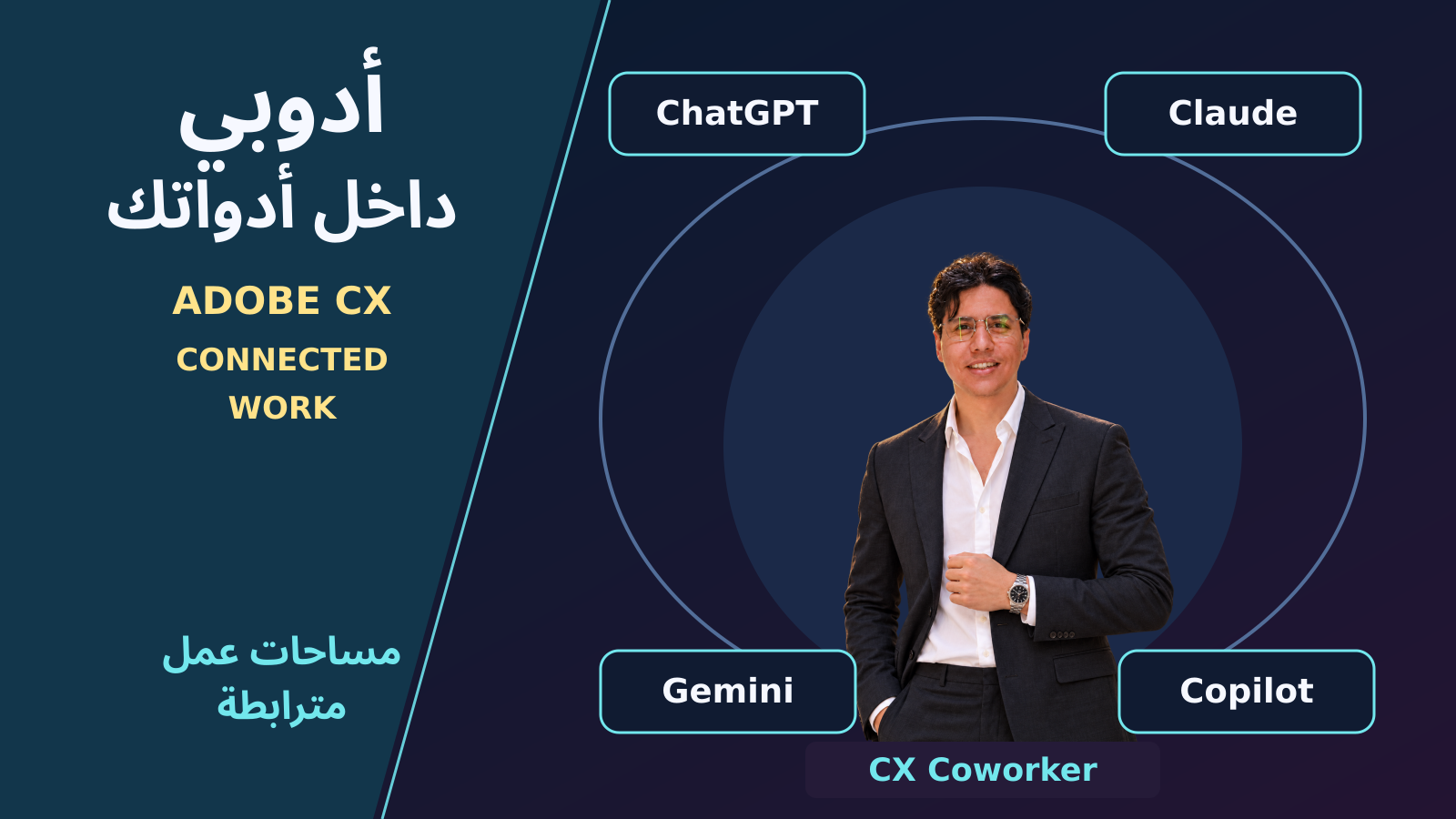
The announcement and its date On November 4, 2026, Adobe announced CX Enterprise Coworker availability through ChatGPT, Claude, Databricks Genie, Gemini for business and Microsoft Copilot, with additional platforms to follow. It also announced partner MCP connectors. This is Adobe's product announcement, not independent evidence of business returns. [Adobe announcement](https://news.adobe.com/news/2026/11/adobe-integrates-agentic-cx-enterprise-coworker-into-ai-platforms)
Start with a delayed decision The following is an original evaluation framework, not a report of a product trial. A marketing leader should first identify a decision that is delayed because its evidence sits across different systems. That might be whether to reduce a campaign's spend, adjust a message for a customer segment, or fix a confusing step before purchase. A tightly defined decision provides a useful test of the technology. A broad request to make marketing more intelligent usually produces a demonstration that is much harder to evaluate.
Working inside a familiar assistant may reduce switching between applications, but switching is not always the largest cost. Finance may define a customer differently from sales. Campaign names may conceal the actual product being promoted. Operations may not have updated service availability. Those are information problems, and connecting more applications can expose rather than resolve them. The practical starting point is a map showing each input, its owner, its last update and the decisions it can legitimately support.
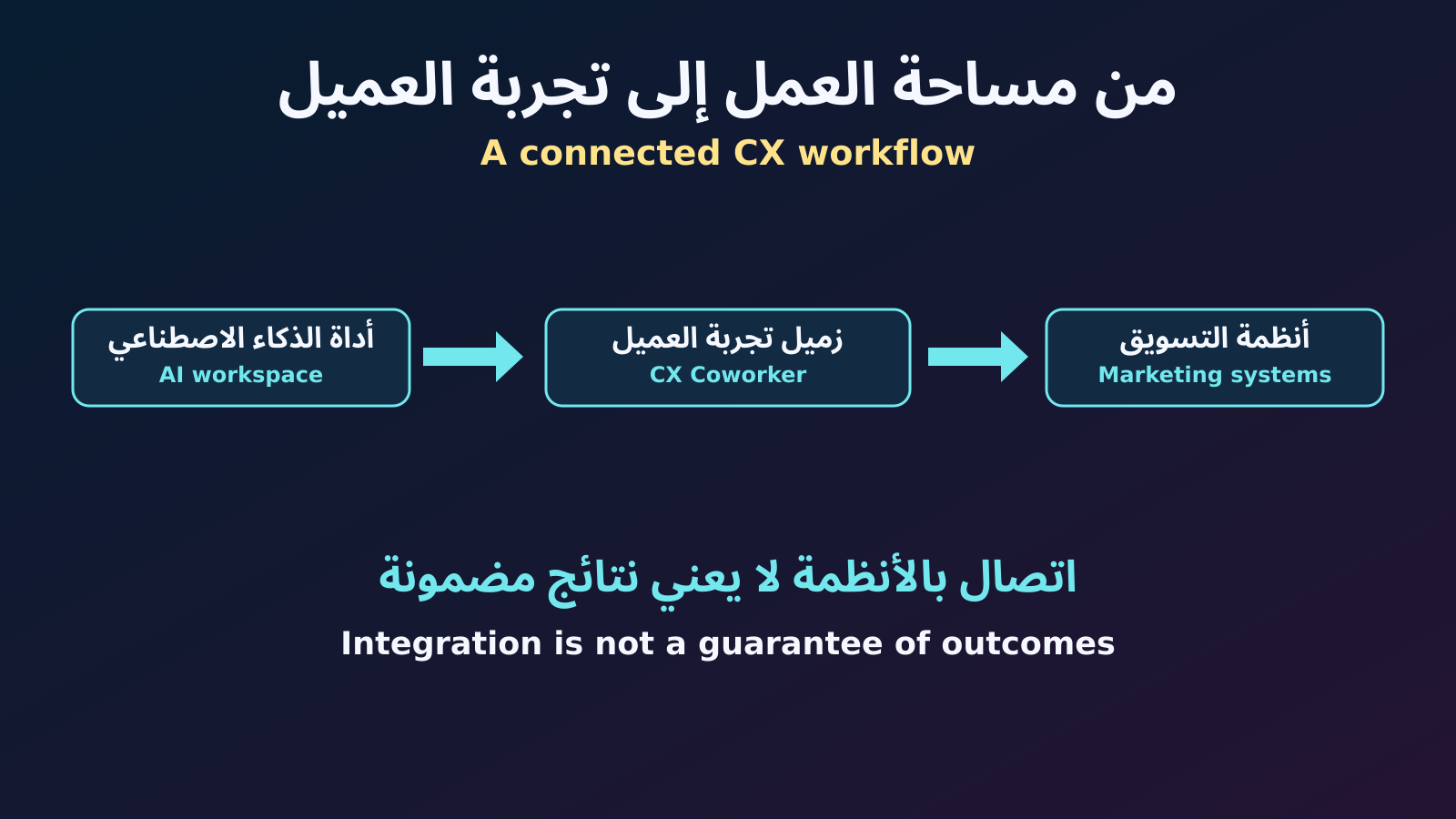
Original editorial illustration, not a product screenshot or evidence of campaign outcomes. Based on the source.
Design one workflow before connecting everything Consider a narrow first workflow: review one campaign for one service in one city, then prepare a recommendation without changing anything. The assistant receives approved information, explains a possible problem, identifies missing evidence and proposes a reviewable next step. The initial test concerns diagnosis and decision preparation, not the number of connections. If the team cannot explain the recommendation to another person, giving the system execution permissions will not resolve that weakness.
Map the handoffs between marketing, sales and operations. Who confirms that an inquiry is qualified? Who checks available capacity? Who knows whether the service has an acceptable margin? Document the input, owner, refresh frequency and dependent decision. Avoid moving every available field into the workflow simply because a connector makes it possible. A smaller, purpose-specific dataset is easier to validate and govern, especially where customer information or healthcare activity is involved.
An illustrative healthcare scenario Imagine a rehabilitation center with rising inquiry costs. This is a hypothetical example, not an Adobe case study or a claim about the author's experience. A review could combine aggregate campaign expenditure, accepted inquiries, appointment capacity and attendance. The underlying issue might be delayed responses on particular days or a shortage of suitable appointments. Changing the advertising message alone could increase pressure on an already constrained operation without improving completed appointments.
The marketing manager should request alternative explanations and evidence that would contradict each one. Poor message fit should appear in inquiry rejection reasons. An operational bottleneck should appear in response times or appointment availability. The team can examine aggregate evidence without exposing patient records or diagnoses. It might then test faster inquiry handling, clearer eligibility information or a different spending schedule. Advertising, privacy and clinical review remain separate responsibilities held by qualified people.
Separate reading from changing Not every useful task requires permission to edit campaigns. An organization can distinguish reading information, proposing an action, preparing a draft, approving a change and executing it. These are recommended governance levels, not an assertion that every platform implements identical controls. Verify the settings available in the actual account and the contracts governing information use. A read-only phase can provide meaningful learning without exposing a live budget to avoidable errors.
Combined changes deserve special caution. If a team changes targeting, creative and budget simultaneously, it becomes difficult to determine which intervention caused a later difference. Start with a single reversible adjustment, preserve the previous state and assign a rollback owner. Maintain an explicit list of actions that cannot be automated, such as publishing a new medical claim, expanding customer-data sharing or changing a binding commercial offer. A plausible recommendation should never substitute for the relevant authority.
Business context needs an owner Uploading a brand guide is only a beginning. Translate broad principles into checkable instructions: prohibited language, currently available services, offer expiry dates, approval requirements and the difference between confirmed information and assumptions. Explain that a cheaper lead is not desirable when it is unsuitable for the service. The workflow needs both a commercial objective and boundaries. Without those, a technically accurate optimization may move the business toward an outcome it does not actually want.
Metric definitions require similar discipline. Conversion can mean a submitted form, qualified call, booking, attendance or completed sale. Mixing those stages can produce misleading recommendations even when the arithmetic is correct. Define each stage, its reporting delay and its deduplication method. Do not ask the model to infer a relationship between datasets when that relationship has not been documented and approved. An uncertain mapping should be visible in the output rather than hidden behind a confident narrative.
Evaluate recommendations before live execution Begin with historical decisions that have already been resolved. Ask the workflow to analyze only the information available before each decision. Compare its reasoning with the team's reasoning, not just with the eventual outcome, which may reflect seasonality, competition or operating changes. Include examples with missing information to establish whether the system acknowledges uncertainty. This can reveal misunderstandings of accounts, dates and campaign goals before those mistakes reach a live environment.
Next, run a limited recommendation-only trial. Agree on a monitoring period, acceptance criteria and stop conditions before starting. Reviewers should record why they accepted or rejected each proposal and whether substantial correction was necessary. This creates evidence beyond the pleasantness of the conversation. Repeated errors, such as ignoring conversion lag or comparing unequal periods, become an actionable improvement list rather than a vague complaint about the quality of artificial intelligence.
Measure the review burden as well as speed Useful operational measures include preparation time, recommendations accepted without major correction, errors intercepted before execution and human review effort. Where the experiment supports it, add a specific business outcome. These are proposed evaluation measures, not reported product results. Saving an analyst an hour is valuable, but saving that hour while creating several hours of correction work is not. A high volume of recommendations is also unhelpful when none addresses the current commercial constraint.
A financial assessment should include licensing, integration, data cleaning, training, maintenance and human oversight. Separate initial setup costs from recurring costs and compare the complete workflow with the existing alternative. Avoid attributing every subsequent improvement to the assistant: the offer, demand or spending level may have changed. Where a commercial effect cannot yet be established, a narrower claim about operational efficiency is more defensible than an expansive return-on-investment narrative.
Questions for procurement and technology teams Before purchase, establish account eligibility, prerequisite products, data destinations, permission management, action logs and rollback options. Request a demonstration that resembles the actual workflow using test information, rather than a frictionless ideal case. Ask what happens when a connector fails or a source becomes stale. A visible error is generally easier to manage than an apparently complete report that quietly omits important information and encourages an unsupported decision.
Also clarify ownership and export of instructions, integration definitions and decision logs when the agreement ends. Ask how unintended actions are investigated and who can revoke access. These are due-diligence questions, not claims about Adobe's contractual terms. Marketing should involve technology, legal and data owners early in a bounded trial. Discovering governance requirements after the organization depends on an integration creates avoidable disruption and may leave important responsibilities undefined.
Relevance for Gulf marketing teams Arabic needs to be tested within real tasks, such as classifying inquiry objections or reviewing local advertising language. Fluency alone does not establish understanding of branch names, service differences or operating days. Prepare equivalent Arabic and English test cases and compare the decisions as well as the wording. In a multi-market operation, label countries, currencies and time zones explicitly. A unified report should not quietly transfer assumptions from one market into another.
For healthcare organizations, aggregate performance and internal workflow data are a sensible starting point. Response rates, attendance and available capacity can reveal considerable operational value without exposing medical details. More granular use should involve the organization's privacy and compliance specialists under applicable rules and contracts. Global technical availability does not automatically establish suitability for every local purpose. The team must evaluate the actual data, recipient, permissions and intended decision rather than relying on a general product description.
A practical first-month sequence In the first week, select one decision and document its sources, definitions and boundaries. In the second, validate connections and test historical cases, including missing-data scenarios. In the third, run a limited live recommendation workflow with full human review. In the fourth, compare time, errors and decision quality, then choose whether to continue, repair or stop. This is an illustrative sequence, not a promised implementation schedule. Necessary approvals may require a longer period.
The strategic priority is a measurable improvement to a specific decision. If the decision becomes clearer and faster while accountability, records and controls remain visible, there is a reasonable basis for expansion. If the underlying evidence remains contradictory, fixing it should take priority over adding another interface. A successful integration helps people explain what they are doing, identify why it matters and correct a mistake before its operational or financial consequences grow.
Comments
No published comments yet.