Editorial review: November 3, 2026. The announcement discussed below was issued on November 2.
What Adly reported
On November 2, 2026, Adly Technologies reported that 43% of Gulf businesses in its platform dataset had Latin-letter names, while 92% of those businesses' ads were Arabic. The February–October snapshot uses a self-selected, Arabic-first platform sample. Neither sample size nor campaign outcomes is disclosed. It cannot establish Gulf-wide preferences or superior performance. Adly issuer release.
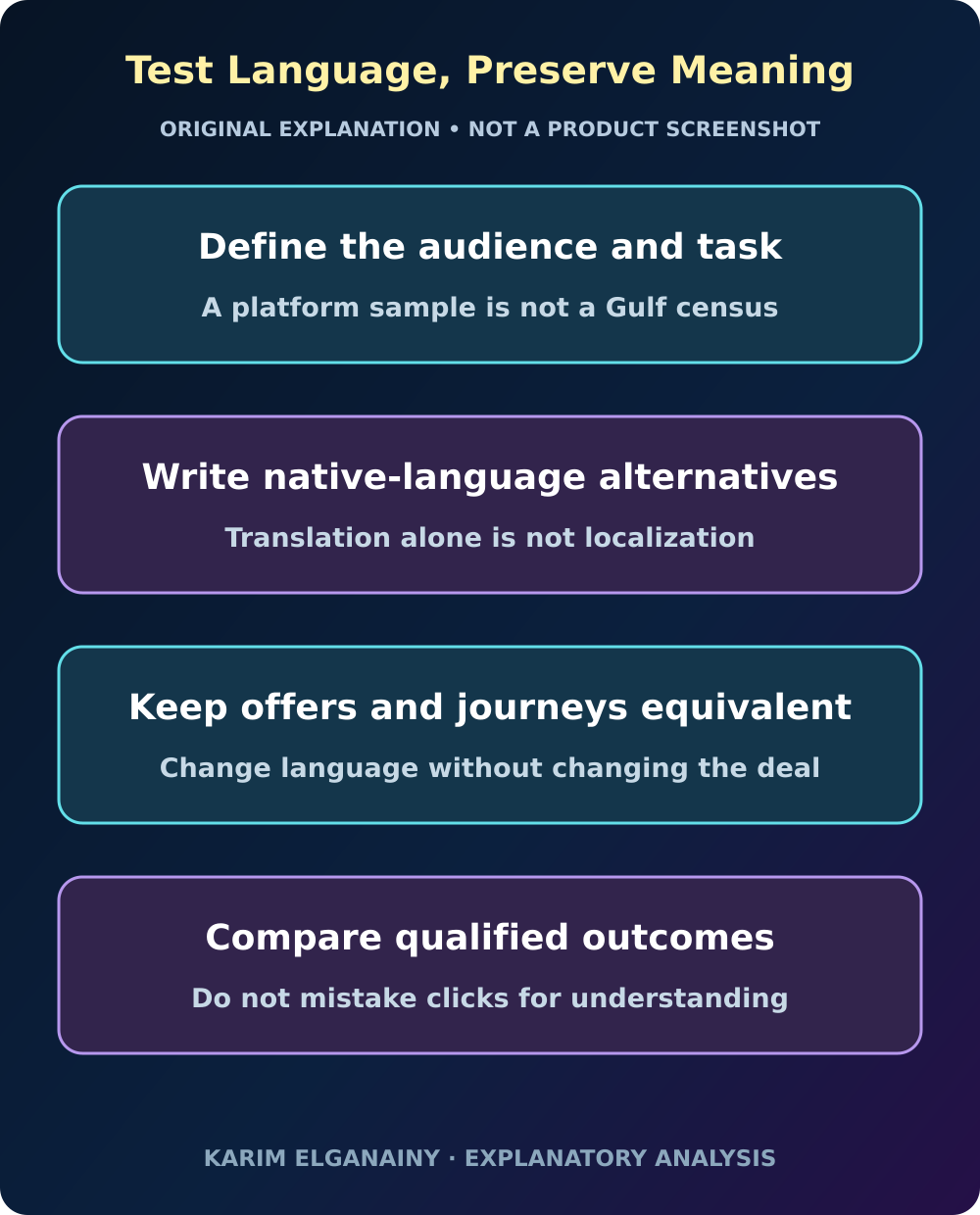
Original editorial framework; not a product screenshot or proof of campaign results.
Original analysis: turn the language question into a decision
The following is an original campaign-testing framework, not a description of Adly's product capabilities or a reported customer result. Its purpose is to help a marketing team decide how to test language without confusing a brand's name, an audience's needs and the performance of an entire customer journey. All examples are hypothetical. No recommended allocation follows automatically from the figures above.
A useful starting point is to write the decision in operational terms. Should a particular campaign offer a different language experience to a defined eligible audience? That question can produce a testable plan. Asking which language the Gulf prefers invites a sweeping answer that one campaign cannot establish. Even a well-run experiment would apply first to the offer, audience, channel and period actually studied.
Separate the name, the language and the register
A brand identifier can remain consistent while the message around it changes. Keep the approved name recognizable, then decide how to explain the service and next step. A Latin-letter name need not force an English sentence, and an Arabic sentence need not require inventing an Arabic brand name. Treat changes to the identifier as a separate brand decision, with the appropriate owner, rather than an incidental choice made during ad production.
Language and register also deserve separate decisions. Formal, conversational, technical and promotional wording are creative options within a language. Comparing restrained English with heavily embellished Arabic would test multiple differences at once. If the team wants to understand the language experience, agree on a comparable degree of specificity and persuasion before writing either version. Later experiments can explore register once the team understands what it is changing.
For a multilingual market, record who can reasonably use each journey. Do not infer an individual's language ability from a name or nationality. Use information the business already holds appropriately, explicit language choices where available, and the limits of the chosen research design.
Write a shared meaning brief before separate copy
Create one short brief that both writers can use. It should identify the actual offer, intended audience, substantiated claim, material conditions, required next step and destination. Separate facts that must remain equivalent from expression that can adapt. The writers should have freedom over sentence structure without freedom to improve the promise. Otherwise a stronger offer can slip into one version and later be mistaken for a language effect.
For example, a fictional appointment campaign might invite people to request available times. Both variants must preserve the difference between a request and a confirmed booking. Neither should imply immediate availability merely to make the headline shorter. The same principle applies to a retail discount, a software trial or a delivery estimate: keep the commercial meaning aligned before judging the wording.
Ask a competent reviewer in each language to explain the message back in plain terms. Compare those explanations against the brief, not against a word-for-word translation. Record disagreements about eligibility, certainty, timing or price. These are substantive changes that deserve resolution before a test launches.
Decide whether the experiment covers the ad or the journey
An Arabic ad leading to an English-only page introduces a second experience after the click. Comparing it with an English ad and English page may reveal the effect of that particular combination, but it will not cleanly answer what a coherent Arabic journey would achieve. Define the treatment before selecting the campaign objective. Otherwise different colleagues may believe they are testing different things with the same budget.
For an initial operational experiment, consider two complete journeys: Arabic creative with equivalent Arabic destination content, and English creative with equivalent English destination content. Keep the offer, functional steps, visual assets and available service the same where feasible. This tests a localized journey as a package. Do not later describe the result as the isolated effect of translating the headline.
A narrower ad-copy experiment would need an appropriate common destination and a population able to use both variants. A language selector might be suitable, but it creates its own interaction to measure. Preserve the visitor's ability to choose. Experimental neatness should not make essential information harder to understand or force someone into a journey they cannot use.
Build the comparison around comparable opportunities
Where a platform supports a suitable randomized experiment, use its documented assignment method and inspect the unit being assigned. A person, device, impression and campaign are different units. For the hypothetical bilingual-audience test, the question is how equivalent eligible opportunities are allocated to the two journeys, and whether repeat exposure can cross between them. Have the analyst document the practical limits rather than assuming a split-budget setup creates randomization.
If the campaigns target separate language groups, the result combines audience composition with the creative and destination experience. That comparison can still help an operational budget decision, but it cannot isolate language as the cause. Label it accordingly. Avoid assigning a stronger interpretation because one dashboard line looks decisively better than another.
Keep bid strategy, schedule, geography, objective and placement eligibility comparable where the system permits. Log unavoidable differences. If automatic delivery optimization allocates traffic differently, the experiment may estimate the performance of two operating policies rather than a pure message-language effect. That distinction should appear in the decision report, not only in an analyst's private notes.
Choose qualified outcomes before reading the dashboard
Select one primary outcome that reflects the job of the campaign. A completed purchase, an appropriate service inquiry or a qualified demo request can be useful if the business can define and observe it consistently. A click is easier to obtain, but a change in click rate alone does not establish better commercial results. Decide what qualifies before knowing which language produced the interaction.
Use a denominator that matches the question. If assignment-level data is available, compare qualified outcomes across assigned opportunities or users as the design allows. A conversion rate calculated only among clickers describes a selected group: the ad itself influenced who entered that group. Keep click-to-conversion rates as diagnostic evidence rather than presenting them as the whole experimental result. Also show spend, delivery and cost per qualified outcome so the business can see the operating trade-off.
Measure downstream quality consistently. Do not allow different sales representatives to apply different definitions without review. Deduplicate repeat requests under the business's existing authorized process. Report unresolved records separately instead of classifying them in whichever way makes the favored variant look better. Use only data necessary for the decision; a language experiment does not justify collecting additional sensitive information.
Set the evidence threshold and stopping rule in advance
Before launch, ask the analyst what information is needed to distinguish an economically meaningful difference from ordinary variation. That depends on the baseline outcome rate, the decision's stakes, expected delivery and the comparison design. There is no universal number of days or conversions that makes every language test reliable. A low-volume business may need a simpler question, a longer observation window or a decision explicitly made under uncertainty.
Write down when results will be evaluated and how delayed outcomes will mature. Avoid stopping the test simply because an early result is attractive. Separate statistical uncertainty from the practical importance of the difference. A tiny change can be precisely measured and still fail to justify the additional production and support costs of a new journey.
Keep operational and safety stops distinct from performance stopping. Broken forms, misleading copy, unavailable services or failed tracking may require intervention immediately. Record what changed and whether the comparison remains interpretable. A clean explanation of a disrupted test is more useful than a tidy winner label built on inconsistent conditions.
Inspect execution before interpreting a language result
Review both experiences on an actual narrow mobile layout. Check reading order, mixed-script brand names, numerals, punctuation, truncation, form labels and error messages. A linguistically accurate sentence can still become unusable when a call-to-action covers it or a form reverses the relationship between labels and values. These checks protect the comparison from avoidable implementation defects.
Test the complete path with ordinary sample entries and no real sensitive information. Confirm that both versions expose equivalent choices, communicate the same conditions and reach the correct confirmation state. Check that language switching preserves the task wherever practical. If one version loses entered information or returns the visitor to the homepage, the team is testing that disruption alongside the content.
Assign an owner for each layer: language quality, commercial accuracy, interface behavior, tracking and service readiness. The media buyer should not be the only person deciding whether both variants represent the same offer. Keep a short issue log so a later performance difference can be checked against known execution changes.
A hypothetical healthcare adaptation
Consider a fictional clinic evaluating two language journeys for a general appointment inquiry. The campaign team first confirms what the service description can accurately say and what the inquiry process actually does. A clinical reviewer checks relevant health-related wording; an operations owner checks booking instructions and availability statements. This is a suggested workflow, not legal advice or a claim that one approval process satisfies every market's requirements.
Both journeys explain the same service boundaries and invite the same administrative next step. Neither promises a clinical outcome, uses unsupported superiority language or asks the visitor to disclose more health information simply to measure the advertisement. The team uses appropriate, already-authorized aggregate operational measures rather than inventing a patient-profiling exercise for the test.
The contact team must be able to handle the language expectation created by the page, or clearly explain the available service languages before the person proceeds. A well-written advertisement followed by an unsupported conversation is a service-design problem. If the Arabic journey attracts useful inquiries but those inquiries wait longer for a response, record that bottleneck. Do not blame the language for an operational difference the experiment exposed.
Read mixed results without manufacturing a winner
Suppose, hypothetically, one journey earns more clicks while the other produces fewer but more qualified requests. Start with the prespecified outcome, then inspect the intermediate steps to understand the difference. Do not switch the primary measure after seeing the results. Click volume may help diagnose attention, but it does not override the business question agreed at the start.
If the outcome estimates remain uncertain, say what range of decisions the evidence can support. The business may continue both versions, run a better-powered comparison or improve a visibly weak part of the experience before retesting. An inconclusive test is useful when it prevents a confident but unsupported regional rule.
Check whether the result depends on one placement, an unusual delivery period or a small audience segment. Treat unplanned subgroup patterns as follow-up questions rather than established findings. A language policy should not oscillate every time a small slice changes direction. Keep the interpretation proportional to the actual design and information available.
Turn the result into an operating decision
Finish with a decision record that a colleague can understand without the dashboard. State the population studied, the journey variants, the primary outcome, material implementation differences, uncertainty, extra operating costs and the proposed next action. Attach the approved copy and the meaning brief so future teams know what was actually tested. The record should survive a campaign rename or a change of personnel.
If the business adopts a language journey, assign maintenance responsibility. Prices, eligibility, offers and service arrangements can change. A translated page that stops receiving updates can gradually diverge from the approved promise. Give both versions the same change-notification process, and define who checks that the customer can still complete the intended task.
Karim's strategic takeaway
Choose a language strategy through a clear audience question and a fair customer-journey test. Keep the brand recognizable, preserve the offer's meaning and judge qualified outcomes with the limitations visible. The valuable result is a defensible decision for a specific business context, including a decision to keep learning. That is a stronger foundation for local-language marketing than turning a platform snapshot into a rule for an entire region.
Comments
No published comments yet.