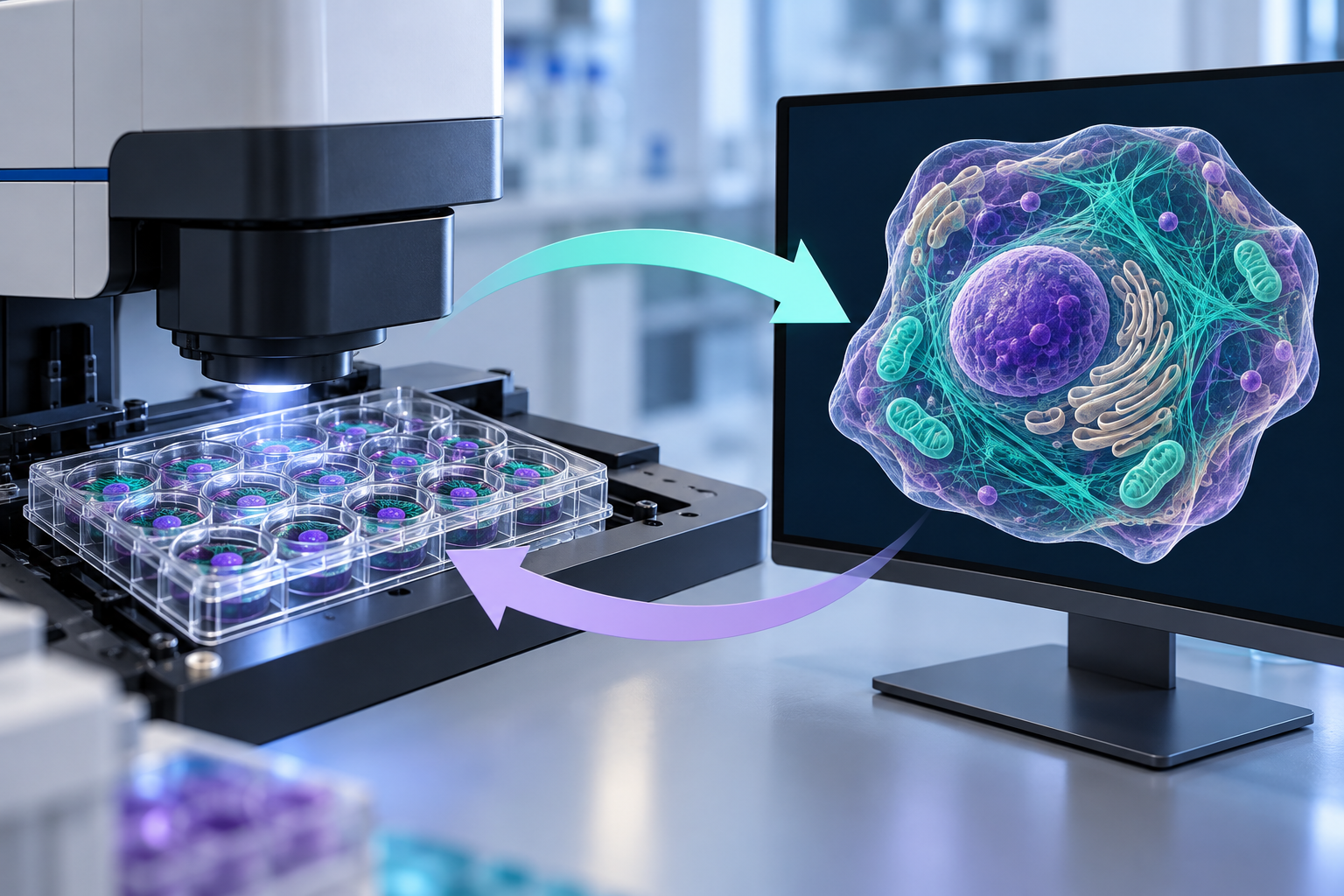
Original editorial illustration; this is not a real product screenshot, laboratory photograph or clinical result.
Biohub's 7 October 2026 expansion of the Virtual Biology Initiative directs attention to an important AI bottleneck: useful experimental data. The announcement describes a coordinated commitment of $1.8 billion spanning funding, data, computing, and measurement technology. It is not accurate to describe the whole figure as fresh cash or as the price of an already working medical product. The initiative aims to build resources for predictive biological research, with potential benefits that still require scientific validation. Biohub's expansion announcement, 7 October 2026.
For healthcare businesses and technology suppliers, the immediate significance is a shift toward better measurement, interoperability, and research infrastructure. The opportunity is not to sell a virtual cell as a replacement for clinical judgment. It is to understand which capabilities researchers need to connect experiments with models, and which services can help them produce, organize, validate, or use trustworthy data.
Read the financial commitment accurately
The 7 October release says the U.S. Department of Energy will contribute more than $500 million over five years. NIH's contribution includes resources developed through more than $500 million of prior federal investment. Google DeepMind, Isomorphic Labs, and Meta collectively commit $300 million. These amounts have different forms and timelines; adding them into a single headline should not erase those distinctions. Exact breakdown in the October release.
The expansion builds on Biohub's previously announced $500 million anchor commitment. Its 29 April 2026 launch allocated $400 million to internal data-generation and technology work and $100 million to external research. Those are initiative allocations, not a public market-size estimate or evidence of realized return. Original launch and allocation, 29 April 2026. A supplier assessing opportunity should therefore examine actual programs, eligibility, and procurement rather than assuming the total is immediately available spending.
What a virtual biology workflow means
In a simplified workflow, researchers measure a biological system, record conditions and interventions, train or evaluate a model, and compare its predictions with additional experiments. A useful model should help answer a defined question, such as how a cell response changes under a particular intervention. It does not gain scientific value merely because a visualization resembles a cell.
The loop is important. Predictions guide experiments, while experiments reveal where predictions fail. Keeping the two connected helps prevent a model from becoming a persuasive simulation with little relationship to observed behavior. For a commercial team, the implication is that value can lie in the interfaces between steps: experimental capture, metadata, quality control, computational access, and reproducible evaluation. Those tasks may be less visible than the model itself but essential to whether anyone can use it reliably.
More data must mean more usable evidence
A dataset is useful when a researcher can understand what was measured, how it was obtained, which conditions apply, and which limitations matter. Volume alone does not solve missing metadata, inconsistent labels, or experimental bias. Two large collections can remain difficult to combine if they use incompatible identifiers or omit information about the protocol.
Before promising an AI-ready data service, define readiness in operational terms. Can users trace an observation to its source? Are units and labels consistent? Are missing values and exclusions recorded? Can a separate team reproduce the preparation? These questions turn a vague product label into a reviewable deliverable. A smaller, well-documented dataset may be more appropriate for a defined task than a larger collection whose provenance and measurement conditions are unclear.
Understand the difference between description and prediction
A biological atlas can describe observed cell types or states. A predictive model attempts to infer what will happen under conditions that may not have been directly observed. Moving from description to prediction requires evaluation designed around that additional claim. Success at organizing existing measurements does not establish success at forecasting an unfamiliar response.
A business evaluating a research tool should ask exactly which task has been tested. Was the model reconstructing known data, predicting held-out experiments, transferring to another laboratory, or assessing a new intervention? Each task supports a different conclusion. Keep the evidence attached to the claim. A marketing statement that combines them into general medical intelligence may obscure what researchers can responsibly rely on and what still needs further investigation.
Map the commercial value chain
Potential beneficiaries include measurement and imaging suppliers, research software teams, data engineering providers, compute operators, and organizations with relevant scientific expertise. The initiative's direction suggests attention to these capabilities, but it does not establish a contract pipeline for any particular company. Each supplier should identify a specific problem it can solve and a customer able to evaluate the solution.
For example, a data service could focus on converting a laboratory's exports into a documented, searchable collection with quality checks. A visualization team could help researchers inspect conditions and compare predictions with observations. A software provider could improve reproducibility across repeated analyses. The strongest offer explains who uses it, what work it replaces or improves, how results are verified, and which scientific assumptions remain outside the provider's responsibility.
Start with an existing public resource
Teams can learn the practical demands of biological data using established public resources rather than waiting for every new initiative dataset. Biohub references infrastructure such as CELLxGENE and the CryoET Data Portal in its broader work. CELLxGENE Discover is a useful starting point for exploring how biological data is organized and presented; verify the applicable dataset terms before reuse.
Choose one narrow question and one resource. Document the dataset version, access date, license, and relevant metadata. Avoid downloading a large collection merely because it is available. A successful first exercise should show that the team can explain the data and produce a reproducible observation. That practical understanding is more valuable for a commercial proposal than a demonstration that displays impressive-looking cells without a clear question or traceable evidence.
Design an evaluation before selecting a model
Write the research question and the appropriate baseline first. Agree with a scientific reviewer which errors matter and what would count as a useful improvement. Decide how to separate development data from evaluation data. Where appropriate, use independent laboratory or condition-level separation rather than allowing closely related records to leak across the boundary.
Keep the evaluation aligned with the intended use. A tool that helps prioritize experiments may tolerate different uncertainty from a tool presented as decision support. Do not invent a universal accuracy threshold. Instead, document the metric, the sample, the comparison, the uncertainty, and the scientific rationale. A prototype is ready for a limited research workflow only when its evidence matches that workflow; a polished interface cannot compensate for a mismatched test.
A concrete exploratory project
A suggested pilot has four deliverables: a data inventory, a reproducible preparation process, a baseline comparison, and an explanation of failure cases. These are proposed deliverables, not requirements published by Biohub. Assign a scientific owner alongside the engineering owner, and keep the task small enough to inspect the underlying observations.
Track preparation time, completeness of provenance, reproducibility, computational cost, and the quality of the answer to the chosen question. Record where the system fails rather than presenting only favorable examples. The final review should answer whether the tool saves useful work or improves a defined research decision. If the evidence is not strong enough, the pilot can still reveal which data or expertise is missing before the organization makes a larger commitment.
Calculate economics without forecasting a cure
A research infrastructure project can be evaluated through concrete operating costs before it has a clinical outcome. Estimate staff time, storage, compute, review, integration, and maintenance. Distinguish a one-time demonstration from a service that must remain reliable as datasets and dependencies change. Include the cost of correction when quality checks reveal a problem.
As a hypothetical example, reducing repeated preparation from ten staff-hours to six saves four hours for that task, not forty percent of the entire discovery process. The percentage applies only to the specified activity and sample. No such saving is claimed by the Biohub announcement. This careful denominator prevents an operational improvement from being exaggerated into a drug-development breakthrough or an unsupported forecast of faster patient treatment.
GCC institutions should examine transferability
A Gulf research institution can potentially benefit from global open resources, but applicability depends on the question, population, experimental conditions, and permissions. A model trained on one set of biological observations may not generalize to another environment. Local research capability and validation matter even when the resource is internationally prestigious.
The sensible first opportunity is research collaboration, data engineering, or staff capability building around a defined scientific task. Do not position the initiative as a ready-made clinical product for a local hospital. If a project touches patient-derived material or identifiable information, involve the institution's appropriate research and data governance processes. Public availability of one resource does not authorize combining it with every private dataset or sharing all resulting information with a model provider.
Communicate uncertainty to nontechnical buyers
Commercial communication should distinguish a funding announcement, a resource under development, a validated research model, and an authorized clinical application. These are different stages. A business reader needs to know which stage a proposal addresses, what evidence exists, and what the team still has to establish.
Use specific language about the task and the model's limits. An original cover illustration showing laboratory measurements feeding a simulation can explain the mechanism, but it should not imply that the simulation has already cured disease. Likewise, a demonstration should label simulated output and avoid presenting it as an actual clinical result. Clear communication helps serious buyers assess value and makes scientific partnerships more credible than broad promises of an imminent transformation.
Karim's strategic angle
Karim can use the development to identify healthcare technology opportunities grounded in workflow rather than hype. A useful engagement could map how a research organization generates data, where preparation or documentation breaks down, and which capabilities it needs to run a reproducible pilot. The commercial story should be about a specific bottleneck with a measurable solution.
For marketing, explain the initiative's financial structure accurately and connect its ambitions to practical buyer questions. For business development, prioritize partners who combine scientific competence with usable software and transparent evaluation. The expansion is a material signal that AI biology depends on measurement and data infrastructure. It is not evidence that a treatment is ready. Acting on that distinction allows Karim to build informed positioning, credible partnerships, and useful services while the underlying science continues to develop.
Comments
No published comments yet.