A business can have an attractive website, capable employees, useful software, and enthusiastic customers while still struggling to explain why buyers should choose it. Listing strengths is easy. Deciding which strengths deserve investment requires a more demanding test.
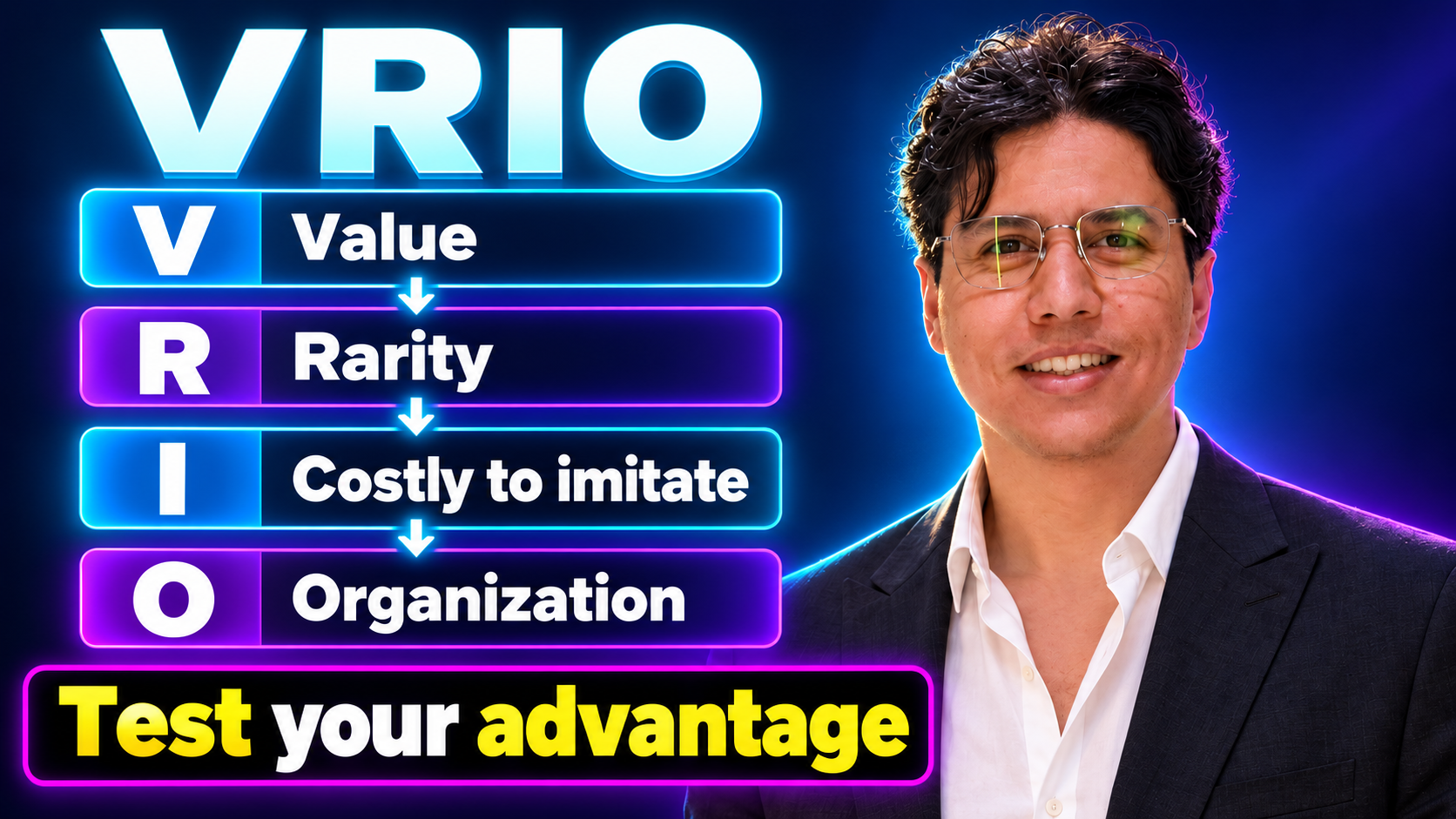
VRIO provides that test. It asks whether a resource or capability creates value, is rare in the relevant market, is costly to imitate or replace with an equivalent alternative, and is supported by an organization able to use it. Together, these questions help connect an internal capability with a credible competitive position.
For marketers, the practical benefit is better judgment about promises, budgets, and growth. A campaign can draw attention to an advantage, but its claims need support from the business behind it. Faster delivery, specialist advice, or a smoother service experience must remain believable after the customer buys.
This article explains the course framework, then develops an original method for applying it. Every business example and numerical illustration is fictional or hypothetical. They are teaching tools, not reports of actual companies or client results.
Where VRIO Fits in the Course
In the supplied digital marketing strategy course, VRIO appears immediately after COMPETE on physical pages 35–36, corresponding to lecture-one slides 33–34. The course introduces four questions: Value, Rarity, Imitability, and Organization. Its sequence connects the answers with competitive disadvantage, competitive parity, temporary competitive advantage, unused competitive advantage, and sustained competitive advantage. Later, physical pages 157–158 return to VRIO when assessing resource feasibility.
This placement offers a useful bridge between recognizing a market opportunity and asking whether the business can serve it convincingly. A promising opportunity still needs suitable resources. Equally, an impressive internal capability needs a market where its benefits matter.
The research background deserves a precise distinction. Barney’s 1991 resource-based paper discusses value, rareness, imitability, and substitutability, commonly associated with VRIN. His 1995 article, “Looking Inside for Competitive Advantage,” is a later reference for examining internal strengths and weaknesses. The fully named VRIO framework should not simply be attributed to the 1991 paper. Barney, 1991; Barney, 1995.
The practical audit, workshop, measurement approach, and examples below are original applications of the course framework rather than additional claims about what its slides contain.
Begin With a Specific Resource and a Specific Market
VRIO works best when the object of analysis is clear. “Our team,” “our brand,” and “our technology” are usually too broad. Each label hides several capabilities, some ordinary and some potentially distinctive.
Replace a broad claim with an observable activity. A fictional agency might assess its ability to turn recurring customer questions into tested landing-page improvements. A fictional online retailer might assess its ability to recommend compatible product combinations accurately. A fictional repair company might assess its ability to complete selected repairs during the first visit.
Next, define the customer group, buying situation, geography where relevant, and comparison set. A capability can be unusual among local providers and common among national specialists. A customer may also compare buying from the business with doing the work internally, using a simpler product, or postponing the purchase.
Write a scope statement before scoring: “We are assessing this capability for these customers, against these alternatives, over this planning period.” This prevents the team from moving between different markets whenever one comparison produces a more flattering answer.
Value: Does the Capability Improve an Outcome That Matters?
Value starts with a useful outcome for the customer or the business. The course’s question asks whether a resource helps the firm take advantage of an opportunity or deal with a threat. In a practical marketing audit, translate that into an outcome that can be examined.
A capability may reduce customer effort, improve reliability, shorten waiting time, lower delivery costs, or support a product that buyers prefer. The explanation needs a causal path: what the business does, what changes for the customer, and how the business benefits economically.
Consider a fictional retailer with unusually detailed product measurements. The proposed value is more confident product selection and fewer unsuitable purchases. Evidence could include customer research, return reasons, support requests, and a controlled comparison of product pages. A large number of measurements alone proves little.
Include the cost of maintaining the capability. Extra advice might increase conversion while adding so much staff time that the orders become unattractive. Equally, a process improvement that customers never notice may still be valuable if it reduces avoidable work without lowering service quality.
Separate evidence from enthusiasm. “Customers love our service” is a starting hypothesis. “Customers repeatedly identify clear arrival windows as a reason for choosing us” is more specific, although the size and representativeness of the sample still matter.
Also ask when the capability stops creating value. A delivery service that matters to urgent buyers may have little appeal to customers willing to wait for a lower price. Record the conditions under which the value claim holds. These conditions become important when the business considers a different segment or offer.
Rarity: How Many Relevant Alternatives Can Match It?
Rarity is relative to the competitive situation. The useful question is how widely a comparable capability is available among the alternatives customers could realistically choose.
A professional website, a basic customer database, or competent paid-search management may be valuable requirements for participation. If suitable competitors already have them, those resources can support parity. They still deserve maintenance, but they provide a weak foundation for claims of meaningful difference.
Research the promised outcome as well as visible features. Competitors might use different systems to produce similar reliability. Conversely, several providers might advertise the same promise while differing considerably in their ability to deliver it. Advertising copy alone cannot settle the assessment.
For a fictional local repair business, the relevant comparison could be providers that cover the same neighborhoods and appliance categories during the required booking window. Comparing it with every repair business in a country would make the assessment less useful.
Keep a dated evidence record: competitor service descriptions, available booking windows, verified customer research, and internal win-loss observations. Use publicly accessible information and authorized research. Mark unavailable information as unknown.
Avoid creating a universal rarity percentage. A capability’s competitive significance depends on the number and strength of credible alternatives, demand, capacity, and the buying situation. Two rival providers could be enough to remove an advantage in a small market. A team should explain its judgment in ordinary language before compressing it into a yes or no.
Imitability: Could a Rival Copy or Replace the Benefit?
For clarity, interpret a positive answer to the I question as “costly to imitate,” consistent with the course’s decision sequence. Asking merely whether something is imitable can accidentally reverse the scoring.
Examine how a capable rival could reproduce the benefit. Could it buy the same software, hire a specialist, copy a public process, partner with a supplier, or adopt a different delivery model? Consider the likely time, cost, access, coordination, and uncertainty involved.
A purchased tool rarely tells the whole story. A fictional agency may combine an ordinary analytics platform with accumulated sector knowledge and a disciplined testing routine. The software is accessible. The coordination among research, interpretation, creative work, and client decision-making may take longer to reproduce. The team must demonstrate that difference rather than assume experience automatically creates protection.
Substitution deserves its own discussion. A competitor does not need to copy the exact resource if another approach delivers a sufficiently similar customer outcome. A fictional company’s expensive same-day delivery system could face a substitute from nearby pickup locations. Customers interested primarily in speed may accept either solution.
Run a practical rival exercise: describe the cheapest credible route to a comparable benefit. Then describe a route using a different business model. This makes the discussion less dependent on the company’s preferred story about itself.
Difficulty of imitation is a judgment under assumptions. It can weaken when technology becomes easier to buy, employees move, supplier access changes, or customers become satisfied with a simpler alternative. Record these possibilities as review triggers.
Organization: Can the Business Deliver and Capture the Value?
Organization concerns the operating ability to use a promising resource. The course includes systems, processes, structure, and culture. A resource can be valuable, rare, and difficult to reproduce while remaining underused because the business cannot deploy it reliably.
Look for an accountable owner, clear decision rights, sufficient capacity, training, quality controls, incentives, and usable information. Then follow the customer journey. Can sales describe the offer accurately? Can delivery teams meet the promise? Can support resolve exceptions? Can management see whether the economics remain acceptable?
Promotion is one part of this picture. Better advertising cannot solve a dispatch process that consistently loses bookings or an approval system that prevents employees from helping customers. Increasing demand before resolving those problems may make the weakness more expensive.
A fictional specialist agency might have excellent research capability concentrated in one founder. If nobody else can access the research, interpret it, or apply it within deadlines, the organization test remains weak. A usable knowledge system, peer review, realistic workloads, and training could improve its readiness.
Capturing value also requires attention to pricing and cost. Customers might receive a strong benefit while the business absorbs uncompensated work. Review whether contracts, service boundaries, and internal incentives support an economically workable offer.
Test organization through ordinary and difficult cases. A process that works only when the owner intervenes has a different risk profile from one that works during staff absence or demand peaks. Evidence should include actual handoffs and exceptions, rather than only a process diagram or an optimistic meeting.
Read the Outcomes as a Sequence
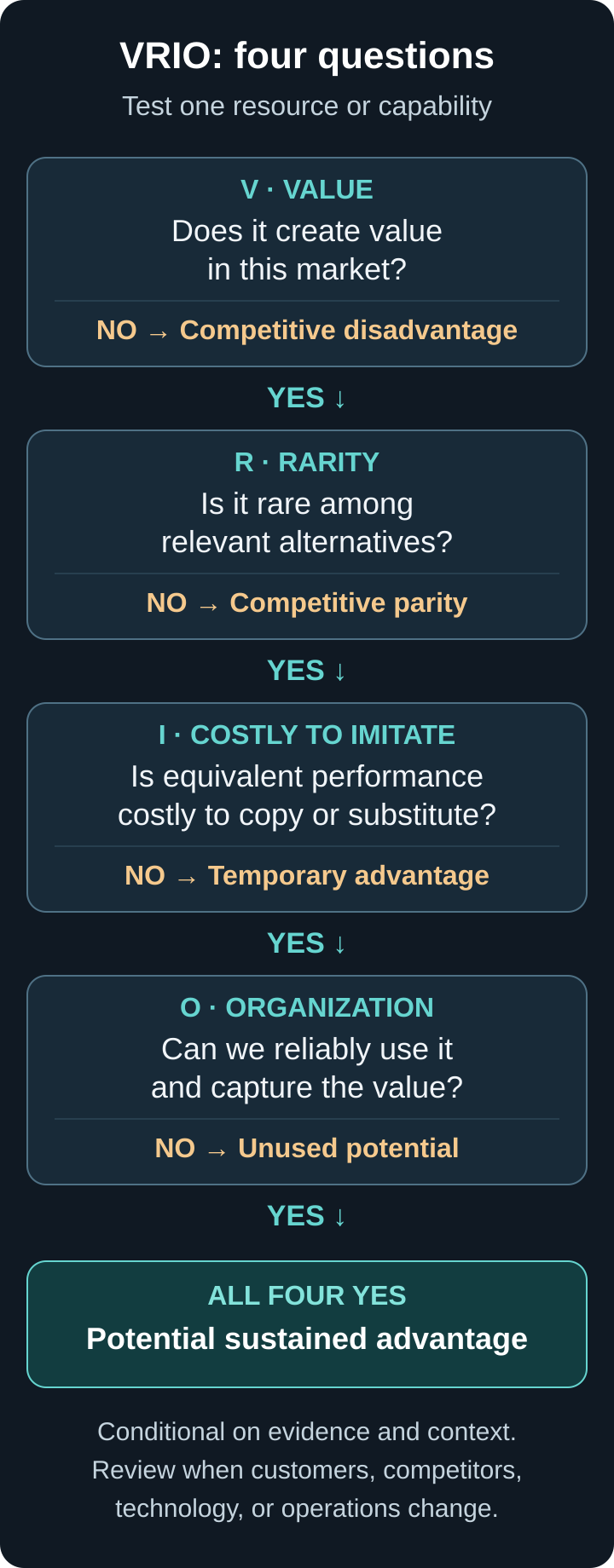
The course’s sequence helps locate the first important constraint. If the resource is not valuable in the defined context, it can contribute to competitive disadvantage. If it is valuable but widely available, it supports competitive parity. If it is valuable and rare but relatively easy to reproduce, the advantage may be temporary.
When value, rarity, and costly imitation are present but organizational support is missing, the course describes unused competitive advantage. The practical priority is to make the capability usable. If all four conditions hold, the framework identifies the potential for sustained competitive advantage.
That final result is conditional. It does not guarantee permanent superiority, unlimited growth, or continuing profit. The assessment depends on the market definition, quality of evidence, customer preferences, competitive responses, and the organization maintaining its capabilities.
Do not average the letters into a flattering overall score. Strong evidence of rarity cannot compensate for a benefit customers do not value. Record uncertain answers explicitly, identify the missing evidence, and choose an action appropriate to that uncertainty.
Build an Evidence Record Before Making Investment Decisions
Create a short record for each candidate capability. Include its scope, proposed benefit, supporting evidence, contradictory evidence, confidence level, owner, and next review date. Keep the four judgments visible beside the evidence used to make them.
For value, combine customer behavior with economics. For rarity, examine relevant alternatives. For imitation, investigate credible replication and substitution routes. For organization, inspect the processes that connect the capability to consistent delivery.
The strongest available evidence will vary. A small business may have limited transaction history. It can still document customer interviews, run a modest pilot, and compare what happened with a clearly stated expectation. Label such evidence as preliminary.
Actively collect disconfirming observations. Lost sales, refund explanations, delivery exceptions, and customers choosing simpler alternatives may reveal weaknesses hidden by favorable averages. Ask someone who did not propose the investment to challenge the interpretation.
Keep claims proportional to the evidence. A successful trial with a narrow customer group can support a larger test. It cannot establish that every segment will respond similarly or that competitors cannot adapt.
Analyze Resource Bundles Without Hiding Weak Links
Some capabilities depend on a combination of ordinary resources. A fictional retailer’s accurate recommendations might require product data, customer questions, staff judgment, interface design, and a feedback process. Assessing each component separately could miss how they work together.
Start with the customer-facing capability, then map its essential components. Identify which components create value, which restrict imitation, and which enable reliable operation. This makes the investment discussion more precise.
Be careful with the word “unique.” A bundle can contain many parts while remaining easy to assemble. Complexity is meaningful only when it creates a relevant benefit and makes comparable performance genuinely costly to reproduce.
Identify the weakest dependency. A trusted supplier relationship may be important, but the business also needs a plan for interruptions. A knowledgeable employee may contribute distinctive insight, but the firm needs enough shared understanding to keep serving customers responsibly.
Check whether the business can continue accessing each essential component. A resource does not have to be owned outright to be useful, but borrowed access, a supplier arrangement, or a platform dependency may change the risk. Record who controls availability and what would happen if access became more expensive or less reliable.
For customer information, assess whether the team can use the relevant data appropriately for the stated purpose. A large database is not automatically a strategic asset. Its usefulness depends on relevance, accuracy, access, and the ability to turn information into a better experience. Avoid collecting extra personal information simply to make the resource inventory look more substantial.
Avoid double-counting. If the same specialist knowledge supports three offers, those offers may share one underlying dependency. Treating each as an independent advantage would understate the concentration risk and overstate how diversified the business really is.
Worked Example: A Fictional Local Repair Company
Consider a wholly fictional appliance-repair company assessing first-visit resolution for selected repairs within a limited service area. Its capability combines fault descriptions collected before booking, relevant parts availability, technician preparation, and disciplined scheduling. All observations and numbers in this example are hypothetical.
For value, imagine that a pilot increases first-visit resolution from 60 percent to 75 percent across 100 comparable jobs. This suggests a potentially useful improvement, but the team must check repair complexity, repeat visits, customer experience, and costs. Changes in the mix of jobs could explain part of the difference.
Suppose the pilot also requires additional inventory and preparation time. The team should calculate whether fewer return visits and stronger customer outcomes justify those costs. It should examine unused stock and scheduling flexibility before assuming that operational improvement translates directly into higher contribution.
For rarity, suppose a review of local alternatives finds that several competitors make similar first-visit promises. Their delivery performance is unknown. The company should mark rarity as uncertain. It could gather better customer research and examine why buyers choose one provider over another.
For imitation, the booking form and scheduling software appear easy to acquire. Technician learning, local parts coordination, and reliable execution may be harder to reproduce as a bundle. However, a larger competitor might achieve a similar result through broader inventory. That substitute limits the strength of the protection claim.
For organization, suppose two experienced technicians use the preparation routine consistently while newer colleagues receive incomplete information. The immediate action is clearer handoffs, training, and an accountable process owner. Increasing advertising before fixing that gap would expose more customers to inconsistent service.
The resulting decision is specific: improve operating consistency, extend the pilot, and investigate competing offers before presenting first-visit resolution as a defensible advantage. The business can still communicate an accurate, carefully scoped service benefit while its strategic assessment remains provisional.
Worked Example: A Fictional Home-Products Retailer
Imagine a fictional shop called Simple Home that sells household products within one city. Its team is proud of its product photography, delivery within an agreed time window, and knowledge of the reasons customers hesitate before buying. The workshop separates these claims into specific capabilities. Its hypothetical objective is to increase completed orders without increasing complaints or reducing margin.
Good photography helps customers understand a product’s size and use, so there is a reasonable value argument. A review of relevant alternatives, however, finds comparable photography widely available. The provisional outcome is competitive parity. The decision is to maintain useful quality at an appropriate production cost, rather than double the budget simply because photography appeared on a strengths list.
Delivery within an agreed time window appears more distinctive, but the team discovers an organizational weakness. One employee coordinates exceptions by telephone, and the ordering system cannot confirm available capacity before accepting an order. A larger campaign promising precise arrival times would increase demand before the business could reliably support the promise.
The retailer first tests a simple capacity-booking process, clear responsibility for confirmations, and cover for staff absence. An illustrative pilot target might be to increase the share of orders delivered within the agreed window from 80 percent to 92 percent over eight weeks. These are invented teaching figures, not a market benchmark or an achieved result. Rarity and imitation still need evidence: a better internal process alone does not establish that alternatives cannot match the service.
Knowledge of customer objections might become a stronger capability if it is collected consistently and used to improve descriptions, packaging, and service. A folder of observations by itself cannot establish an advantage. The team checks whether using those observations repeatedly improves customer decisions and whether a competitor could acquire equivalent knowledge quickly. The resulting decision may be to develop and test this capability before investing in a prominent claim of superiority.
Run a Practical VRIO Workshop
A useful workshop begins before the meeting. Ask participants to bring a small number of candidate capabilities and the best available evidence. Include marketing, delivery, customer-facing staff, and someone able to examine costs. In a very small business, one person may cover several roles.
Begin by agreeing on the decision. The team might be choosing a segment, reviewing a service promise, or deciding which capability to develop. An explicit decision keeps the discussion from becoming a general celebration of company strengths.
Next, define each capability and its market boundary. Remove vague labels. Participants should be able to explain what happens differently when the capability works and which customers benefit.
Have people assess the four questions independently before discussion. Differences are useful: marketing may see demand that delivery cannot support, while operations may have a capability that customers rarely hear about. Ask participants to explain evidence rather than defend their department.
Discuss the earliest failed or uncertain condition first. If value remains unproven, debating the exact degree of rarity is unlikely to change the immediate action. If organization is the constraint, name the operating changes needed before growth.
Finish with a short decision record for each priority capability: the current judgment, the key uncertainty, the next test or improvement, the responsible person, the resources required, and the event or date that will trigger review. A completed matrix becomes useful when somebody knows what to do next.
Choose Metrics That Test the Argument
Metrics should follow the capability’s proposed mechanism. If the claimed benefit is fewer avoidable service visits, track that outcome alongside preparation costs, customer effort, and service quality. If the benefit is more accurate product selection, examine unsuitable returns and support needs alongside conversion.
Distinguish leading indicators from outcomes. Training completion can indicate readiness, but it does not establish that customers receive a better service. A completed data-cleaning project is useful only if the improved information influences decisions and delivery.
Use balanced measures. A team rewarded solely for speed might close cases before resolving them. A campaign optimized only for lead volume might attract customers the business cannot serve economically. Pair the desired improvement with a measure that reveals an important failure mode.
For a hypothetical pilot, the team might compare qualified conversion, contribution after relevant delivery costs, repeat problems, and customer-reported effort. There is no universal target supplied by VRIO. Set targets using the business’s baseline, capacity, and decision requirements.
Where practical, compare similar customer groups or periods and document other changes. A promotion, seasonal demand shift, or different product mix can distort interpretation. When evidence is noisy, describe the result as directional and choose a proportionate next step.
Turn the Assessment Into a Marketing Decision
A capability that supports parity may still need investment because customers expect it. Fund it to an appropriate standard and avoid building the entire positioning around a feature competitors routinely provide.
A temporary advantage can still be commercially useful. A fictional retailer might use a short-lived service innovation to learn about demand, attract suitable customers, and improve its operating routines. Investment should reflect the likely response window and avoid assuming indefinite exclusivity.
An unused advantage points toward operational work. Marketing can help explain the benefit and understand demand, while the business fixes ownership, capacity, incentives, or information flow. Growth spending should match actual delivery readiness.
A capability that passes all four tests may justify focused investment, stronger supporting proof, and protection of important dependencies. The marketing message should express the customer benefit in language buyers understand. Internal labels such as “rare capability” are less useful than a precise, supportable promise.
For every option, compare the cost of strengthening the resource with alternative uses of the same time and money. Passing VRIO does not by itself establish that an investment is affordable, appropriately timed, or the best available choice.
Keep the Assessment Current
VRIO is an internal analysis tool with important boundaries. It does not establish market size, forecast demand, calculate investment returns, or resolve every competitive question. Use it alongside customer research, external market analysis, operating plans, and financial evaluation.
The exercise also contains judgment. Teams may overrate familiar strengths, underestimate substitutes, or interpret success as proof of a preferred explanation. Independent scoring, contrary evidence, and written assumptions help make these weaknesses visible.
Review capabilities when their assumptions change. Relevant triggers include a competitor introducing a comparable offer, a key supplier changing terms, repeated service failures, an important employee leaving, or customers accepting a simpler alternative. Use a scheduled review appropriate to the business as well.
Keep previous assessments so the team can see what changed and whether earlier predictions were reasonable. Over time, this creates a better record of strategic learning than repeatedly replacing yesterday’s confident answers with new confident answers.
The central habit is straightforward: define the capability, explain its customer and economic value, test the competitive comparison, inspect delivery readiness, and choose the next action. VRIO earns its place in a marketing strategy when that process improves what the business promises and what it can consistently deliver.
Related Models
Use COMPETE competitor analysis to organize the external comparison, and Porter’s Five Forces to examine industry pressures alongside your internal capabilities.
Sources and Attribution
- Supplied course: شرح_استراتيجية_التسويق_الرقمي.pdf, physical pages 35–36, lecture-one slides 33–34 of 42; physical pages 157–158 for resource feasibility. The course provides the framework definitions and sequential outcomes summarized here.
- Barney, J. (1991). “Firm Resources and Sustained Competitive Advantage.” Journal of Management, 17(1), 99–120. Publisher DOI.
- Barney, J. B. (1995). “Looking Inside for Competitive Advantage.” Academy of Management Executive, 9(4), 49–61. Publisher DOI.
- The practical procedures, workshop design, examples, and suggested measurement approach are original teaching applications. All example businesses, scenarios, and numerical illustrations are fictional or hypothetical.
Comments
No published comments yet.